


 Download Free Sample
 Buy Now
Market Size
The oilfield scale inhibitor market is projected to reach USD 3.32 billion in 2026 and USD 5.35 billion by 2040, representing a compounded annual growth rate (CAGR) of 3.47% during the forecast period 2026 to 2040.

See What’s in the Full Report - Request Your Complimentary Insights!
Market Overview
The global oilfield scale inhibitor market encompasses specialty chemical solutions engineered to prevent mineral scale buildup (such as calcium carbonate and barium sulphate) within critical oilfield infrastructure. These formulations are essential for maintaining flow assurance and protecting pipelines or wells from debilitating structural damage. The scope covers squeeze treatments and continuous injection methods primarily supporting upstream drilling, completions, and enhanced oil recovery operations where high water cut environments challenge production efficiency.
The global oilfield scale inhibitor industry trends and growth opportunities are increasingly shaped by the rising need for advanced chemical management solutions capable of addressing the complex water chemistries associated with hydraulic fracturing and flowback operations. Elevated crude oil prices are further encouraging investment in asset maintenance and secondary recovery projects. Reflecting this momentum, several service providers have introduced new biodegradable scale inhibitor formulations for offshore operations, designed to meet increasingly stringent environmental discharge regulations.
The industry’s technological trajectory emphasizes eco-friendly, non-toxic chemistries designed to align with evolving global environmental regulations. Extending treatment lifecycles through polymer-encapsulated inhibitors and smart chemical delivery systems which significantly reduce operational downtime. This positive outlook is underpinned by a strategic shift toward real-time monitoring and asset integrity, ensuring long-term production optimization amidst a complex and high-cost energy landscape.
Innovation is focused on enhancing device stability and enabling large-scale manufacturing to overcome perovskite durability challenges. The industry is moving from lab-scale success to commercial readiness with partnerships between established silicon manufacturers and perovskite innovators accelerating adoption.
Market Report: Key Takeaways
- Leading Players Competitive Footprint: Key players in the oilfield scale inhibitor industry like APTIM, Baker Hughes, BASF, ChampionX, CLARIANT, Ecolab, Gradiant, Green Stratos, Halliburton, Innospec, Italmatch Chemicals, Kemira, Nouryon, Permian Resources, Prochem, SLB, SNF, Solenis, and Solvay hold strong market positions with extensive geographic presence in various regions.
- Startup Ecosystem and Innovation Hotspots: Early-stage companies are emphasizing scaling from lab prototypes to commercial manufacturing supported by a robust venture funding ecosystem. Companies are making advancements such as nanocarrier-based inhibitors for precision dosing and biodegradable formulations to enhance stability, reduce costs, and meet environmental regulations positioning them to compete with traditional chemical providers.
- Regional Penetration and Adoption Trend: North America and the Middle East continue to dominate, driven by deepwater exploration and mature field revitalization. Meanwhile, the Asia-Pacific region is emerging as the fastest-growing market, fueled by rapid industrialization and a surge in geothermal scaling projects. This shift reflects a global transition toward high-performance, eco-friendly chemical adoption across diverse and demanding geographies.
- Synthetic Scale Inhibitors Hold Highest Market Segment: As global production shifts toward extreme environments, synthetic scale inhibitors have solidified their lead and are anticipated to capture a commanding 79.05% market share in 2026. This dominance is fueled by the technical necessity of phosphonates and advanced polymers in HTHP reservoirs, where thermal stability above 200°C is essential for operational integrity. In mature assets across the Permian Basin and Middle East, synthetic chemistries remain the gold standard, offering a critical combination of proven reliability, established economies of scale, and highly competitive unit cost curves.
- Opportunities in Oilfield Scale Inhibitor Market: The industry is shifting toward intelligent, high-performance solutions. By integrating real-time digital monitoring with predictive dosing and pioneering green chemistry for hypersaturated brines, operators can drastically improve reliability. Strategic partnerships now offer a decisive edge, mitigating risks in harsh environments and ensuring sustainable, long-term operational excellence.
- Funding and Investment Momentum: The oilfield scale inhibitor market continues to attract diverse funding streams with capital flowing from government backed research initiatives, venture capital, private equity, and strategic corporate partnerships that foster innovation, sustainability, and digital transformation.
Recent Industry Developments
- January 2026: SLB completed its acquisition of RESMAN Energy Technology, bringing RESMAN’s wireless reservoir surveillance and tracer solutions into SLB’s advanced production and recovery portfolio. The deal strengthens SLB’s ability to deliver faster, more precise reservoir insights and production optimization capabilities to operators worldwide.
- November 2025: SLB & ANDOC announced the launch of a new chemical injection optimization platform that uses real-time sensor data and machine learning algorithms to adjust scale inhibitor dosage based on changes in fluid composition, and operational costs in deepwater environments.
- October 2025: Baker Hughes and Woodside Energy entered a strategic partnership to advance the decarbonization of the natural gas supply chain by utilizing net power platform.
- May 2025: BASF announced a significant investment in expanding production capacity for specialty surfactants and polymers used in enhanced oil recovery and scale inhibition applications.
Pay Only for What You Need – The Best Way to Optimize
Market Dynamics
Key Market Drivers
- Structural Maturation of Global Brownfield Assets: As conventional oilfields enter late-cycle production they experience escalating water cut ratios which elevate mineral saturation levels and the risk of scale deposition. This trend necessitates intensive chemical intervention to uphold wellbore integrity making scale inhibitors indispensable for protecting production rates and extending the economic viability of aging reservoirs.
- Strategic Prioritization of Asset Integrity and Flow Assurance: E&P operators and regulatory agencies are ramping up efforts on asset integrity management to prevent catastrophic failures and environmental incidents. Mineral scale buildup threatens tubing integrity and sparks corrosion making proactive inhibitor use essential for compliance, cost savings, and avoiding unplanned downtime.
- Emerging Utilization in Carbon Capture and Storage (CCS) Infrastructure: The rapid expansion of carbon capture and storage projects requires the injection of CO2 into depleted subsurface reservoirs, a process that can trigger carbonate precipitation and other scale-related bottlenecks.
Market Restraints
- Cyclicality and Price Volatility in Upstream Capital Markets: Inherent fluctuations in global crude oil prices directly influence the operational budgeting of E&P companies. During market downturns, firms often implement aggressive cost-reduction strategies that target chemical injection programs leading to intermittent demand and high price sensitivity as operators trade long-term asset health for immediate savings.
- Tightening Environmental Mandates for Offshore Chemical Discharge: Stringent environmental regulations particularly in mature offshore regions like the North Sea and the Gulf of Mexico are increasing restrictions on the toxicity and biodegradability of produced water. This regulatory shift complicates the use of traditional phosphonate-based chemistries and requires significant R&D investment to develop eco-compliant alternatives that maintain performance parity.
- Prioritization of Short-Cycle Production Over Long-Term Asset Health: The operational philosophy emphasizes rapid drilling cycles and accelerated initial production rates over lifecycle asset management. This focus on front-end volume can lead to suboptimal chemical dosing or inconsistent application of inhibitors as operators prioritize low-cost, high-speed execution over the robust treatment protocols typical of conventional long-life assets.
Market Share Insights
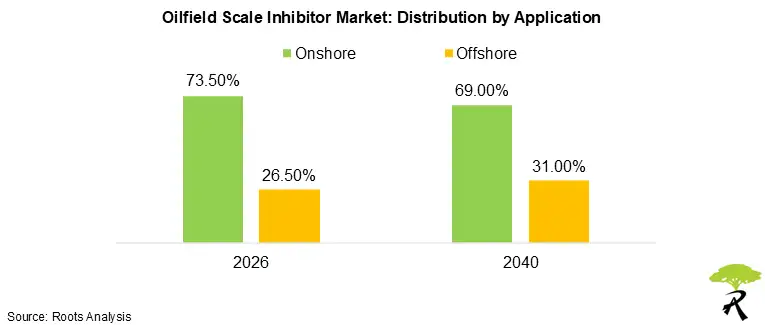
Market Share by Application: Onshore Holds the Largest Global Oilfield Scale Inhibitor Industry Share
- The structural reallocation of market share from onshore to offshore applications is fundamentally dictated by the shifting geography of global capital expenditure, where high-margin deepwater and ultra-deepwater projects are increasingly prioritized over mature, price-sensitive terrestrial basins. While onshore operations remain the volume anchor (likely to capture 73.5% by 2036), they face headwinds from maturing fields and a pivot toward lower-cost, generic chemical formulations, leading to an implied CAGR of 3.0% that trails the global average.
- Conversely, the offshore sub-segment is projected to capture 31.0% of the market by 2040 with a robust 4.6% growth trajectory (CAGR). This is propelled by the technical necessity of specialized, high-performance inhibitors capable of operating under extreme high-pressure/high-temperature (HPHT) conditions and stringent environmental mandates such as OSPAR.
- This shift is validated by the changing collaboration dynamics within the oilfield scale inhibitors industry; for instance, in January 2025 Petrobras announced the accelerated deployment of advanced subsea chemical injection architectures for the Buzios-11 FPSO, which emphasizes the increasing "chemistry intensity" per barrel produced in offshore environments. Further, the March 2025 final investment decision (FID) on the Whiptail development in Guyana illustrates a long-term commitment to offshore infrastructure that necessitates sophisticated scale management to prevent catastrophic subsea flowline blockages.
Market Share by Geographical Regions: North America to Dominate the Industry While Asia-Pacific to Grow Rapidly Through 2040
The regional analysis suggests that North America is expected to hold the largest oilfield scale inhibitor market share of 27.50% while Middle East and Africa (MEA) region is expected to witness the fastest CAGR 4.00%. This dominant position is increasingly defined by capital discipline and maximizing recovery from unconventional assets, prioritizing high-efficiency chemical OpEx and digital monitoring to sustain production margins amidst a plateau in drilling intensity.
The MEA region emerges as the primary growth engine and is anticipated to grow at a relatively faster pace (4.1% CAGR) through 2040. This trajectory is anchored by the Jafurah gas expansion and a surge in capital allocation toward high-salinity carbonate reservoirs. These environments necessitate advanced scaling management systems to mitigate aggressive kinetics in high-pressure, high-temperature (HPHT) operations.
Global adoption trends reflect a divergence in infrastructure milestones and tightening regulatory frameworks:
- Asia-Pacific: Momentum is fueled by deepwater gas exploration and the technical necessity for water-cut optimization across maturing brownfields in the South China Sea and Indonesia.
- Europe: A projected share loss is dictated by OSPAR Commission regulatory tightening, forcing a transition from high-volume synthetics toward specialized, low-volume biodegradable alternatives.
- Latin America: Growth is underpinned by intensive subsea chemical injection requirements for pre-salt FPSO deployments, specifically aligned with Petrobras’s 2025–2029 strategic spend cycles.
Want Information on Specific Region / Segment?
Market Ecosystem Insights
Leading Players Competitive Footprint
Competitive landscape analysis of oilfield scale inhibitor market domain include giants such as APTIM, Baker Hughes, BASF, ChampionX, CLARIANT, Ecolab, Gradiant, Green Stratos, Halliburton, Innospec, Italmatch Chemicals, Kemira, Nouryon, Permian Resources, Prochem, SLB, SNF, Solenis, and Solvay which hold strong market positions through their extensive product portfolios and global reach.
Collaborations and expansions remain key growth strategies, with players accelerating innovation, market penetration, and scalability. For instance, ChampionX announced a strategic agreement with Equinor to provide chemical solutions including scale inhibitors to enhance production and optimize operations at multiple Norwegian offshore assets.
Similarly, Clariant announced a partnership with H+S to provide comprehensive chemical services, including scale inhibitors, for production operations in the North Sea region, focusing on optimized chemical supply chain management and technical support.

Startup Activity and Innovation Hotspots
Oilfield scale inhibitor market competitive strategy analysis report suggests reflects rapid technological evolution, with early-stage companies playing a critical role in advancing high performance and sustainable inhibitor chemistries. These innovators focus on eco-friendly phosphonate-free formulations, slow-release nanocarriers, and application-specific solutions for harsh brines. Their developments complement onshore shale, offshore deepwater, and geothermal applications strengthening competitive dynamics and accelerating the transition from laboratory innovation to commercial deployment.
Recent launches include investments focused on commercialization, production scaling, and R&D for higher efficiency. For instance, Green Stratos is developing bio-based alternatives for oilfield chemicals, launching pilot projects for its non-toxic scale inhibitor formulations to meet operator demand for eco-friendly solutions in sensitive ecosystems.
Additionally, there are other startups, which enable technological advancements, expansions, and innovations, such as Prochem’s new non-phosphorus scale inhibitor formulations, specifically developed for produced water applications where phosphorus-based inhibitors create regulatory challenges during disposal or re-use.
Funding and Investment Momentum
The oilfield scale inhibitor industry revenue forecast is evident in the strong funding and investment momentum across the market. Funding inflows target manufacturing scale-up for phosphonate-free inhibitors, nanocarrier integration for slow-release delivery, and stability enhancements for harsh brines in shale and deepwater operations.
These funds support the accelerated development and deployment by providing critical capital for pilot lines, interface engineering to minimize losses, and compatibility upgrades with existing silicon infrastructure, aligning with Asia Pacific dominance and utility-scale deployments. Key investors include companies, such as Gradiant a water treatment solutions provider for industrial applications including oil and gas, secured USD 125 million in growth equity funding from various investors including private equity funds, targeting expansion of its water treatment and chemical management solutions globally.
For instance, Solenis completed the acquisition of Diversey Holdings creating a larger specialty chemical company with expanded capabilities in industrial water treatment and chemical solutions, including those applicable to the upstream oil and gas sector. Similarly, SLB announced to acquire ChampionX that aims to combine ChampionX's production chemicals and digital solutions with SLB's existing oilfield services portfolio to create an integrated production services offering.
Your Business is Unique – Why Shouldn’t Your Report Be?
Oilfield Scale Inhibitor Market: Scope of the Report
| Key Report Attributes | Details | |
| Historical Trend | Since 2022 | |
| Forecast Period | Till 2040 | |
| Market Size 2026 | $ 3.32 Billion | |
| Market Size 2040 | $ 5.35 Billion | |
| CAGR (Till 2040) | 3.47% | |
| Segments Covered |
|
|
Market Segmentation
Based on research, we have segmented the oilfield scale inhibitor market into chemical type, composition, application, geographical regions, and key players.
Market Share by Chemical Type
- Carboxylates
- Phosphonates
- Sulfonates
Market Share by Composition
- Natural
- Synthetic
Market Share by Application
- Offshore
- Onshore
Market Share by Geographical Regions
- North America
- US
- Canada
- Mexico
- Rest of North America
- Europe
- Austria
- Belgium
- Denmark
- France
- Germany
- Ireland
- Italy
- Netherlands
- Norway
- Russia
- Spain
- Sweden
- Switzerland
- UK
- Rest of Europe
- Asia-Pacific
- Australia
- China
- India
- Japan
- New-Zealand
- Singapore
- South Korea
- Rest of Asia-Pacific
- Latin America
- Brazil
- Chile
- Colombia
- Venezuela
- Rest of Latin America
- Middle East and Africa (MEA)
- Egypt
- Iran
- Iraq
- Israel
- Kuwait
- Saudi Arabia
- UAE
- Rest of MEA


