


 Download Free Sample
 Buy Now
Market Size
The optical brighteners market is projected to grow from USD 2.19 billion in 2026 to reach USD 4.03 billion by 2040, representing a compounded annual growth rate (CAGR) of 4.45% during the forecast period 2026 to 2040.
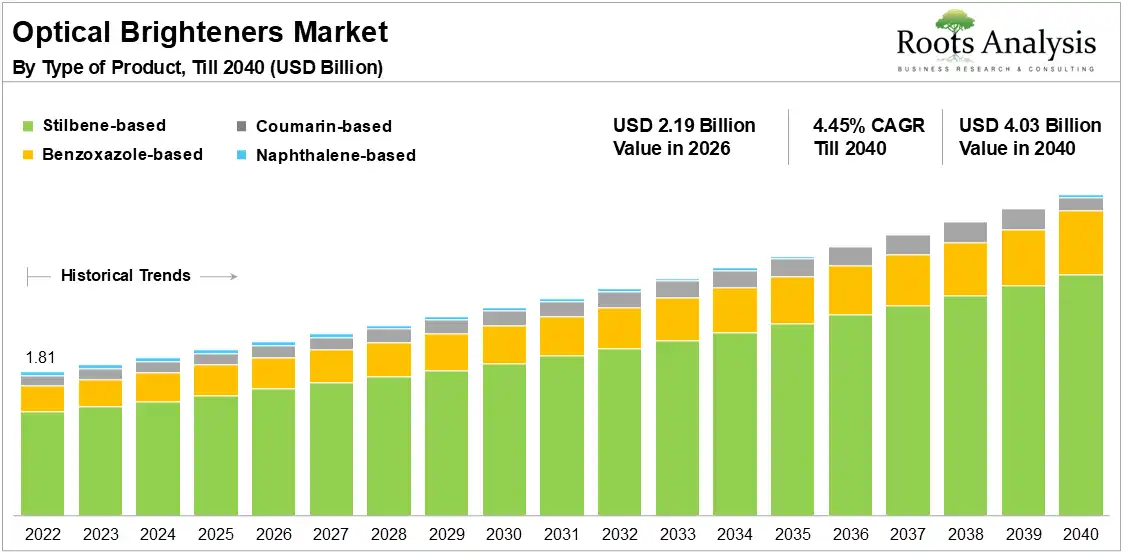
See What’s in the Full Report - Request Your Complimentary Insights!
Market Overview
The optical brighteners (OB) market centers on the production of fluorescent whitening agents (FWAs) designed to elevate the visual quality of various substrates. These specialized compounds function by absorbing invisible ultraviolet radiation and re-emitting it as visible blue light. This mechanism effectively masks natural yellowing, significantly enhancing the perceived brightness and whiteness of industrial materials.
Robust growth is fueled by escalating demand for brighter packaging, print materials, and premium textiles, particularly across fast-growing global economies. As brands prioritize shelf appeal, they are increasingly adopting advanced whitening technologies. Concurrently, stringent environmental mandates from organizations like the European Chemicals Agency are driving a critical shift toward eco-friendly and compliant innovations.
Future market strategies focus on harmonizing high-performance brightness with environmental stewardship. Industry leaders are rapidly developing biodegradable architectures and bio-based agents via precision fermentation to minimize petrochemical dependence. This transition supports a positive long-term outlook, enabling the sector to adapt to shifting consumer preferences, regulatory pressures, and the demand for sustainable manufacturing.
Market Report: Key Takeaways
- Leading Players Competitive Footprint: The optical brighteners competitive landscape features key players such as 3V Sigma, AkzoNobel, Archroma (a portfolio company of SK Capital), BASF, Clariant, DIC, Eastman, Grolman, Huntsman, Kemira, Kolorjet Chemicals, Mayzo, Milliken, RPM, RUDOLF, Meghmani Organics, Sanyo Chemical, SK Capital, and Teh Fong Min International. These key companies hold strong market positions and extensive geographic presence across multiple regions.
- Startup Ecosystem and Innovation Hotspots: Early-stage companies are focusing on addressing rising demand through innovative, eco-friendly formulations, scalable production technologies, and pilot projects focused on sustainable raw materials and high-performance whitening solutions for textiles and paper. Companies are making advancements in areas, such as BASF launching new Basonyl brand fluorescent whitening agents for paper manufacturing, designed to be non-toxic and biodegradable to meet stringent eco-label standards.
- Regional Penetration and Adoption Trend: Rising infrastructure investments, expanding desalination projects, and rapid industrialization drive optical brighteners adoption in Asia-Pacific. Strong growth in detergent and consumer goods production further supports regional consumption. Meanwhile, European countries such as Germany, Netherlands, and France are seeing steady demand due to sustainability-focused regulations and innovation in eco-friendly whitening technologies.
- Detergents & Soaps Dominate the OB Industry: Based on distribution by application, detergents & soaps currently dominate the global market, capturing 36.40% market share. This growth is a logical consequence of non-discretionary hygiene demand and rapid urbanization across the Asia-Pacific and African regions.
- Opportunities in the Optical Brighteners Market: Bio-based biodegradable innovations, expansion in emerging economies, growth in high-value specialty chemical applications, and performance improvements through advanced molecular engineering for greater efficiency and sustainability provide untapped avenues for companies active in the optical brighteners industry.
Recent Industry Developments
- December 2025: BASF announced a definitive agreement to divest its global optical brightening agent (OBA) business to Catexel, a care chemicals platform of the international chemical investors group (ICIG). This move aligns with BASF's portfolio prioritization under its "Winning Ways" strategy, while Catexel aims to expand its detergent ingredients offerings.
- May 2025: Huntsman commissioned a new E-GRADE purification unit in Texas, boosting capacity for high-purity chemistries linked to advanced brightener systems.
- March 2024: Novonesis launched Luminous, a biodegradable enzyme that replaced petroleum-based technologies, enhancing fabric whiteness and brightness while reducing environmental impact and supporting sustainable laundry practices aligned with UN sustainable development goals.
Pay Only for What You Need – The Best Way to Optimize
Market Dynamics
Optical Brighteners Market Growth Drivers
- Product Premiumization in Detergent and FMCG Portfolios: Rising consumer demand for “ultra-white” laundry results make OBs essential in FMCG detergents. Further, growing disposable incomes in emerging markets are accelerating the shift toward premium formulations, prompting manufacturers to adopt advanced brightener technologies for superior whiteness and competitive product differentiation; consequently, propelling the OB market.
- Strategic Expansion of Premium and Recycled Packaging Solutions: The rapid growth of e-commerce has elevated packaging from a protective necessity to a critical branding tool, driving demand for high-whiteness board and coated papers that require OBs. Further, as the "circular economy" gains momentum, manufacturers are increasingly dependent on higher loadings of optical brighteners to mask impurities and restore a "virgin-like" bright appearance across recycled paper fibers and plastics.
- Accelerating Integration within Polymer and Plastic Processing: The plastics industry is increasingly leveraging optical brighteners to mitigate the intrinsic yellowing caused by thermal degradation during high-temperature processing. Optical brighteners enhance plastic aesthetics, making visual quality a durability and brand value signal in high-end polymer applications.
- Rising Consumer Benchmarks for Product Aesthetics and Vibrancy: Optical brighteners market trends reflect rising consumer expectations for visual brilliance across home textiles, personal care, and cosmetics. Manufacturers deploy optical brighteners to enhance product appeal and reinforce premium positioning, as optical performance increasingly influences purchase decisions and perceived overall product quality.
Market Restraints
- Regulatory Constraints and Environmental Scrutiny on Fluorescent Whitening Agents: Europe and Asia-Pacific highlight how the persistence and low biodegradability of traditional FWAs have intensified regulatory pressure, particularly under the EU’s REACH framework. These restrictions on chemical discharge are pushing manufacturers toward costly reformulations and more sustainable innovation pathways.
- Input Cost Volatility Linked to Petrochemical Feedstocks: The production of essential intermediates, such as diaminostilbenedisulfonic acid (DAS), relies heavily on the petrochemical value chain. Fluctuating crude oil prices and feedstock shortages directly compress optical brighteners manufacturer margins. This volatility complicates long-term pricing strategies, introducing financial uncertainty and operational challenges for stakeholders across the industrial chemicals sector.
- Emergence of Alternative Whitening and Cleaning Solutions: Advances in bio-based surfactants and enzyme technologies threaten traditional chemical brightening in detergents. Meanwhile, some industries are shifting toward alternative pigments and natural whitening solutions to meet sustainability goals. These “green” innovations may slow volume growth for conventional optical brightener chemistries in mature markets.
Market Share Insights
Market Share by Form: Powder Optical Brighteners Hold the Largest Market Share
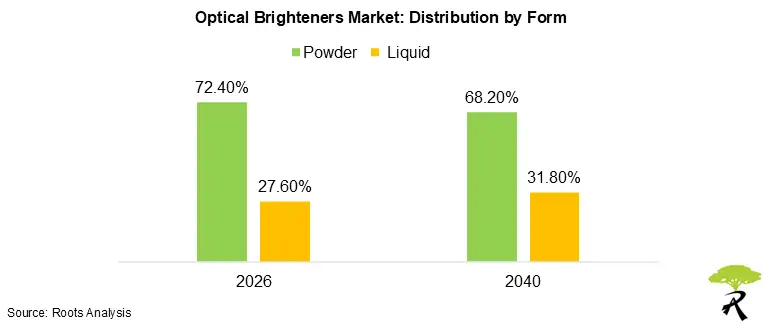
- According to our optical brighteners market segmentation, powder sub-segment holds the largest market share of 78% in 2026. This dominant position is primarily a result of its long-standing role as the high-volume anchor for legacy paper and detergent manufacturing, where it is valued for its high concentration, superior storage stability, and lower transportation costs.
- Growth is further driven by increasing industrial demand for powder-form OBs in order to meet the stringent regulatory standards, expanding detergent and textile manufacturing capacity, and proven cost-efficiency in bulk handling and formulation stability.
- Liquid form of optical brighteners is projected to grow at a faster CAGR of 5.5% through 2040. This is due to their rising adoption in textile and packaging applications, where liquid formulations enable better dispersion, precise dosing, and rapid dissolution, essential for low-temperature processing and water-efficient concentrated systems.
Market Share by Geographical Regions: Asia-Pacific to Drive Industry Growth Through 2040
- The regional analysis suggests that Asia-Pacific region is expected to dominate the optical brighteners market, capturing a share of 42.10%. Further, this trend is unlikely to change during the forecast period, given the relatively higher CAGR (5.5%) of Asia-Pacific.
- This leadership is sustained by the Asia-Pacific region's massive paper and detergent production bases, where significant economies of scale and low labor costs create a competitive cost-curve advantage that Western producers struggle to match.
- On the other hand, the MEA holds a smaller 5.6% market share, though it matches Asia-Pacific’s 5.5% CAGR as the fastest-growing emerging node, catalyzed by strategic diversification into specialty chemicals, such as the January 2026 expansion of chemical clusters in Saudi Arabia.
Want Information on Specific Region / Segment?
Market Ecosystem Insights
Leading Players Competitive Footprint
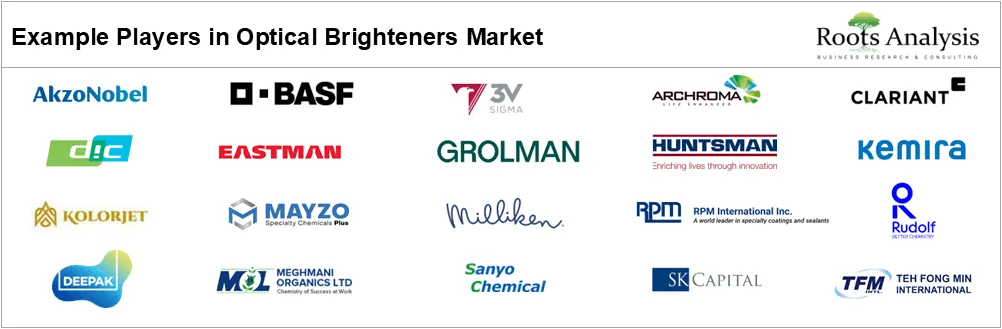
Optical Brighteners market key players include 3V Sigma, AkzoNobel, Archroma (a portfolio company of SK Capital), BASF, Clariant, DIC, Eastman, Grolman, Huntsman, Kemira, Kolorjet Chemicals, Mayzo, Milliken, RPM, RUDOLF, Meghmani Organics, Sanyo Chemical, SK Capital, Teh Fong Min International which hold strong market positions through their extensive product portfolios and global reach.
Collaborations, product launch and expansions remain key growth strategies, with players accelerating innovation, market penetration, and scalability. For instance, Archroma (a portfolio company of SK Capital) introduced several new products and initiatives for sustainable paper and packaging production, with a significant focus on high-performance, eco-labeled optical brightening agents (OBAs) and functional chemicals. These solutions are designed to reduce environmental impact, minimize carbon footprints, and comply with safety standards such as FDA and BfR for food contact.
Startup Activity and Innovation Hotspots
Startup activity in the optical brighteners industry is advancing through sustainable, high-efficiency formulations tailored for detergents, textiles, and coatings. Emerging players focus on bio-based chemistries, improved dispersion technologies, and eco-friendly synthesis methods, enhancing brightness performance while meeting regulatory standards and challenging established manufacturers with innovative, value-added functional solutions.
Recent developments in the optical brighteners market competitive landscape show companies prioritizing market ready OB formulations backed by strategic partnerships, standardized production processes, and pilot-scale validations demonstrating performance advantages in real-world applications. For instance, Grolman signed new distribution partnerships for eco-friendly additives, including specialty optical brighteners and pigments, to expand its offering for sustainable paint and coatings applications in Europe.
Additionally, there are other startups such as Sanyo Kasei that introduced high-efficiency optical brighteners for use in high-performance textile fibers, specifically targeting improved whiteness retention in synthetic materials subject to repeated washing.
Funding and Investment Momentum
The optical brighteners market has evolved from a specialized performance chemical niche into a strategic growth segment, driven by validated commercial demand and accelerating capital inflows. Funding and expansion initiatives now prioritize sustainable OB chemistries, capacity additions, and technological upgrades as manufacturers align with stricter regulatory pressures and rising end-use performance standards.
Recent strategic moves underscore this momentum. Notably, Archroma (a portfolio company of SK Capital) completed the acquisition of Huntsman Textile Effects, creating a global powerhouse in sustainable textile and paper solutions. Simultaneously, major players like BASF have invested in significant capacity expansions, such as the upgrade of their Monthey, Switzerland facility, to meet the growing global demand for high-performance optical brightening agents in consumer care and industrial applications.
Your Business is Unique – Why Shouldn’t Your Report Be?
Optical Brighteners Market: Scope of the Report
| Key Report Attributes | Details | |
| Historical Trend | Since 2022 | |
| Forecast Period | Till 2040 | |
| Market Size 2026 | $ 2.19 Billion | |
| Market Size 2040 | $ 4.03 Billion | |
| CAGR (Till 2040) | 4.45% | |
| Segments Covered |
|
|
Market Segmentation
Based on research, we have segmented the optical brighteners market into type of product, form, application, geographical regions, and key players.
Market Share by Type of Product
- Benzoxazole-based
- Coumarin-based
- Naphthalene-based
- Stilbene-based
Market Share by Form
- Liquid
- Powder
Market Share by Application
- Coatings & Inks
- Detergents & Soaps
- Paper & Pulp
- Personal Care
- Plastics
- Textiles
Market Share by Geographical Regions
- North America
- US
- Canada
- Mexico
- Rest of North America
- Europe
- Austria
- Belgium
- Denmark
- France
- Germany
- Ireland
- Italy
- Netherlands
- Norway
- Russia
- Spain
- Sweden
- Switzerland
- UK
- Rest of Europe
- Asia-Pacific
- Australia
- China
- India
- Japan
- New-Zealand
- Singapore
- South Korea
- Rest of Asia-Pacific
- Latin America
- Brazil
- Chile
- Colombia
- Venezuela
- Rest of Latin America
- Middle East and Africa (MEA)
- Egypt
- Iran
- Iraq
- Israel
- Kuwait
- Saudi Arabia
- UAE
- Rest of MEA


