
Lowest Price Guaranteed
Slides
172
Last Updated
February 2025
View Count
11407
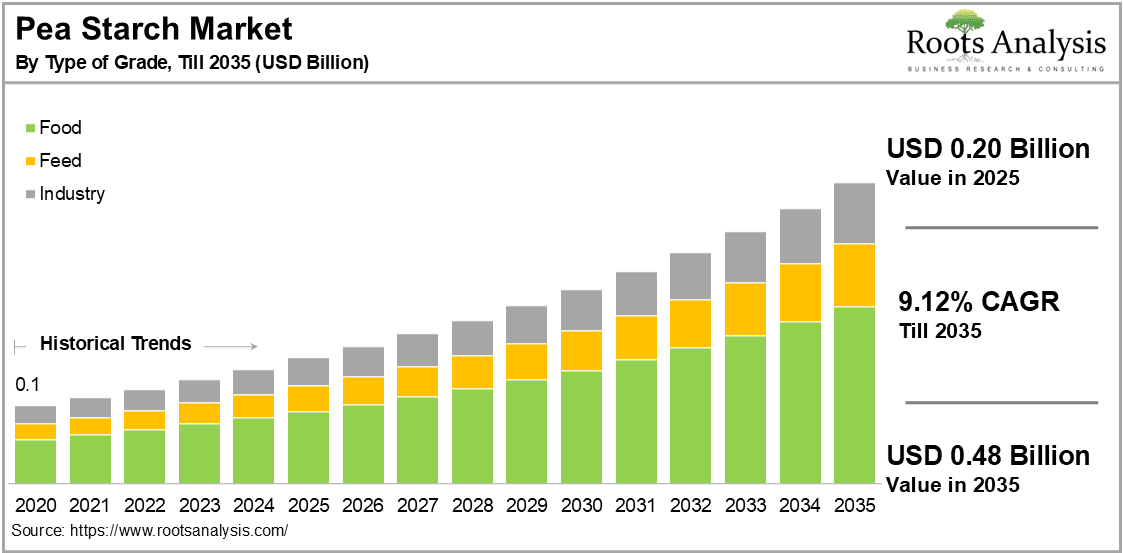
The pea starch market size is projected to grow from USD 0.20 billion in 2025 to USD 0.48 billion by 2035, representing a CAGR of 9.12%, during the forecast period till 2035.
 |
To learn more about this report, request a free sample copy
The new research study consists of pea starch industry analysis, detailed pea starch market analysis, mega trends, patent analysis, porter five forces, SWOT analysis, value chain analysis and other strategic frameworks.
Pea starch is a polysaccharide which functions as a carbohydrate store and is widely used in various industries, such as food and beverages, feed industry, pharmaceuticals, cosmetics, textile and others. Dried peas are also used for pea protein and starch extraction. Starch extracted from the dried peas have various functional properties which can be applied in various applications. Pea starch can be distinguished from other native starches by the high amylose concentration of pea starch granules. As a result, pea starch has a high gelling ability that helps in the creation of gel in water at a considerably lower dose than other starches, making it a good gelling native starch.
A significant market propeller is the evolving dietary patterns, including the rise of vegetarian and vegan diets driven by health concerns, ethical considerations, and the demand for sustainable food additives. With a growing number of consumers transitioning to alternative proteins and plant-based products, there is a need for ingredients like pea starch that align with these trends and offer distinctive functional properties for food manufacturing. Furthermore, its gelling, thickening, and texturizing properties make it ideal for use in pharmaceuticals and / or nutraceuticals for film forming and coating tablets and capsules. Along with this, the extracts obtained from peas are used as an ingredient in personal care and cosmetic products, further propelling the market growth.
The market research report presents an in-depth analysis of the various companies that are involved in offering pea starch solutions, across different segments, as defined in the table below:
| Key Report Attributes | Details | |
| Historical Trend | Since 2020-2024 | |
| Forecast Period | 2025-2035 | |
| Market Size Value in 2025 | $ 0.20 Billion | |
| Market Size Value by 2035 | $ 0.48 Billion | |
| CAGR (Till 2035) | 9.12% | |
| Type of Source |
|
|
| Type of Grade |
|
|
| Areas of Application |
|
|
| Type of Function |
|
|
| Type of Modification Methods |
|
|
| Type of Form |
|
|
| Company Size |
|
|
| Geographical Regions |
|
|
| Leading Market Players |
|
|
| PowerPoint Presentation (Complimentary) |
Available | |
| Customization Scope | 15% Free Customization | |
| Excel Data Packs (Complimentary) |
|
|
Based on the type of source, the market is split into inorganic and organic. Among these categories, the organic pea starch market size is expected to be 75.88% by 2035, dominating the market. This growth is attributed to the increasing consumer preference for natural and chemical-free products. This trend is being driven by growing awareness of health and environmental issues associated with synthetic chemicals, leading to a higher demand for organic goods across various industries, including food and beverages, cosmetics and personal care.
On the other hand, the inorganic segment is expected to witness rapid growth at a significant CAGR of 10.23% during the forecasted period. This growth is attributed to the advancements in technology and the development of new, efficient inorganic compounds that offer superior performance and cost-effectiveness. Industries such as agriculture, pharmaceuticals, and construction are increasingly adopting inorganic products to enhance productivity and meet stringent regulatory standards, hence propelling the market growth.
The global pea starch market is segmented into various types of grades, such as feed, food and industrial. According to our pea starch industry analysis, the food segment will augment the segment's growth with the largest market share of over 74.56% by the next decade. The market growth is driven by increasing pea starch applications in food products such as baked goods, sauces, soups, dairy items, and snacks. Additionally, the rising health consciousness among consumers has led to an increased demand for natural and functional ingredients. Pea starch is perceived as a healthier alternative to synthetic additives and gluten-containing ingredients, making it more beneficial and appealing for consumers with dietary restrictions.
The market is segmented into various areas of application such as animal feed and pet food, food and beverage, personal care and cosmetics. According to our global pea starch market analysis, the food and beverage segment will augment the segment's growth with the largest market share of over 68.6% as well as the fastest CAGR of around 10.78% by the next decade. The market growth can be attributed to its extensive use of pea starch as a natural thickening agent, stabilizer, and emulsifier in a wide range of products such as sauces, soups, dairy alternatives, and gluten-free baked goods. Further, the rising demand and popularity of plant-based diets, the increasing prevalence of food allergies and the growing preference for natural ingredients in food formulations, is propelling the market growth.
The market is segmented into various types of functions, such as binding and thickening, film forming, gelling and texturizing. According to our pea starch statistics, the binding and thickening segment will augment the market's growth with a market share of 65.8% during the forecasted period. The dominance is driven by the widespread application of binding and thickening agents across various industries, including food and beverages. These agents are essential for improving the texture, consistency, and stability of products, making them highly valuable in the formulation of a wide range of consumer goods.
On the other hand, the gelling segment is expected to witness the fastest CAGR of around 11.6% during the forecasted period. This growth is fueled by the increasing demand for innovative food products with unique textures and sensory experiences, particularly in the confectionary and dairy industries. Additionally, the use of gelling agents in the pharmaceutical sector for controlled-release drug formulations and in the cosmetics industry for novel skincare products is contributing to the propelled growth of this segment.
The market is segmented into various types of modification methods, such as chemical modification and physical modification. According to our pea starch analysis, the chemical modification segment will augment the market's growth with a market share of 87.65% during the forecasted period. This growth can be owed to the enhanced functional properties that chemically modified pea starch can provide, such as improved stability, texture, and performance in various applications. Chemical modifications allow for a broader range of functionalities, making it suitable for diverse uses in food products, pharmaceuticals, and industrial applications.
Furthermore, the physical modification segment is expected to witness the fastest CAGR of around 11.8% during the forecasted period. This growth can be attributed to the increasing demand for clean-label products and the rising consumer preference for minimally processed ingredients. Physical modifications, which include processes such as heat treatment and mechanical processing, retain the natural qualities of pea starch while enhancing its functional attributes. As consumers continue to seek healthier and more natural options in their food and personal care products, the appeal of physically modified pea starch is expected to grow significantly, leading to its rapid expansion in the market.
The market is segmented into various types of forms, such as liquid and powder. According to our pea starch analysis, the powder segment will augment the market's growth with a market share of 87.65% during the forecasted period. This growth can be owed to its versatility and ease of use in various applications. Powdered pea starch is widely utilized in the food and beverage industry as a thickening, stabilizing, and gelling agent in products such as soups, sauces, baked goods, and snacks. Its favorable handling and storage properties make it a preferred choice for food manufacturers looking for functional ingredients that can enhance texture and mouthfeel.
Furthermore, the liquid segment is expected to witness the fastest CAGR of around 12.84% during the forecasted period. This growth can be attributed to its applications in industries, such as textiles, adhesives, and paper manufacturing, where a viscous and adhesive solution is required. Additionally, innovations in liquid formulations that optimize viscosity, and rheological properties are enhancing its appeal to industrial users.
The market is fragmented into multiple types of enterprise namely large and small and medium enterprise. Currently, the large enterprise segment is anticipated to dominate the segment with 72.48% of the market share. However, small and medium enterprise segments are expected to witness a relatively higher (10.88%) growth rate until 2035. This is ascribable to their agility, innovation, focus on niche markets, and ability to adapt to changing customer preferences and market conditions.
This segment highlights the distribution of pea starch market share by region, such as North America, Europe, Asia, Latin America, Middle East and North Africa, and the rest of the world. According to our regional analysis, North America currently exhibits dominance with 37.69% of overall market share. The North America growth is driven by the major shift toward healthier eating patterns and the growing awareness of the benefits of a diet comprising more plant-based and gluten-free pea starch products. The strength of the North American food and beverage industry is focusing on innovative varieties of plant-based foodstuffs which is further helping in deriving pea starch as a major ingredient a variety of food products, propelling the market growth in the region.
The “Pea Starch Market, Till-2035: Industry Trends and Global Forecasts” report features an extensive study of the current market landscape, market size and future opportunity within the pea starch market forecast period. The market report highlights the efforts of several stakeholders involved in this rapidly emerging segment of the service providers industry. Key takeaways of the pea starch market report are briefly discussed below.
The global pea starch market growth is expected to be driven by growing demand for clean-label products and plant-based ingredients among consumers. The increasing consumer preference for clean-label products, driven by health consciousness and ingredient transparency, has propelled the demand for clean-label foods. Pea starch, sourced naturally from peas and devoid of GMOs and allergens, meets the demands of being a clean labeled food. This has positioned it as a favored ingredient in the clean label ingredients market. Similarly, the rise of plant-based diets, including vegetarian and vegan options, is fueled by health, ethics, and sustainability concerns. As a result, consumers are increasingly opting for plant-based alternatives which is further increasing the demand for ingredients such as pea starch, propelling the market growth.
With the presence of several small and large companies, the market is experiencing intense competition and changing market dynamics. From large multinational companies to local players, companies are striving to enhance their competitive edge. In terms of market share, large enterprises and multinational companies are dominating the market. The key players are using strategies such as partnerships, acquisitions, ventures, innovations, novel product launches, R&D and geographical expansions in an attempt to solidify their position in the industry. Additionally, the increasing emphasis on sustainability is driving companies to invest in biodegradable materials and technologies, further intensifying the competitive landscape.
For instance, in June 2022, Roquette launched a new NUTRALYS organic range of texturized pea and fava proteins. In reference to this, Jeremy Burks, Senior Vice President of Plant Proteins at Roquette stated that, this new organic range is allowing them to propose new alternatives, going a step beyond a conventional offer. They are not only offering organic versions of textured proteins, but also proposing a complete range to boost the creativity of Chefs and food lovers while contributing to a better food system.
Despite the strong market growth projection, there are several challenges in the pea starch market. The most common challenge is the increasing costs due to international trade barriers. International trade barriers, including tariffs and regulations, pose significant challenges for the pea starch market by disrupting global supply chains. These barriers increase cost, create uncertainty, and hinder market expansion opportunities, limiting access to international markets and impacting the competitiveness of pea starch manufacturers on a global scale.
On the other hand, competition from other starch sources, such as corn, potato, and tapioca starch, is also hindering the market growth. These sources have established brands with lower production costs which dominate the entrenched market positions. This competition is impeding the market growth of pea starch, limiting its adoption and market share within the starch industry.
With respect to regional industry insights, North America is likely to dominate the market for the forecasted period. The dominance of this region is majorly influenced by the research and development by companies that focus more on functional benefits of pea starch in food formulations, such as improving the texture, emulsification, or shelf-life stability. Furthermore, the presence of major pea producers, primarily in Canada, with the availability of raw materials, is contributing significantly to the solid position of the North American market among the leaders in the global pea starch market.
Examples of leading companies in pea starch market (which have also been captured in this market report, arranged in alphabetical order) include Agridient.nl, AGT Food and Ingredients, American Key Food Products, Axiom Foods, Cargill, Cosucra Groupe, Dakota Dry Bean, Emsland, EMFOOD TRADING, Healy, Ingredion, Inner Mongolia Qiaqia Food, Meelunie, NISCO, Nutri-Pea, Parrheim Foods, Prairie Fava, Puris, Qingdao CBH, Roquette Frères, Royal Ingredients, Sanstar Bio-Polymers, Scoular, Shandong Jianyuan, Tereos, Vestkorn Milling, Yantai Oriental Protein, Yantai Shuangta Food.
The market report presents an in-depth analysis, highlighting the capabilities of various companies engaged in this domain, across different segments. Amongst other elements, the market report includes:
At Roots Analysis, we genuinely care about your success and understand that your business requirements are unique. While our pea starch market research reports provide valuable insights, we recognize that they might not cover every aspect you need to make well-informed strategic decisions. To account for that, we offer 15% free report customization tailored to your specific needs. Whether you require additional quantitative analysis, qualitative insights, or any other information related to the pea starch market, reach out us today at: support@rootsanalysis.com