


 Download Free Sample
 Buy Now
Market Size
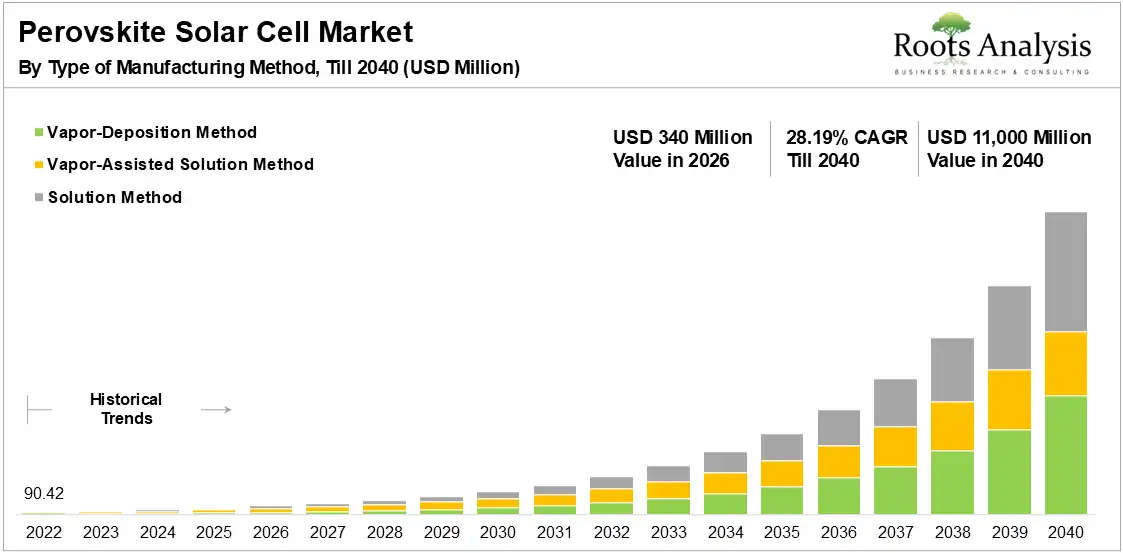
The global perovskite solar cell market is projected to reach USD 340 million in 2026 and USD 11,000 million by 2040, representing a CAGR of 28.19% during the forecast period 2026 to 2040.
See What’s in the Full Report – Request Your Complimentary Insights!
Market Overview
The photovoltaic industry is shifting from crystalline silicon to perovskite solar cells (PSCs) as silicon nears its theoretical efficiency limit of ~33% known as the Shockley-Queisser limit. Perovskites offer a viable leap forward through high-efficiency tandem configurations, low-cost processing, and flexibility. Value creation is primarily focused on applications requiring next-generation performance characteristics, such as tandem cell architectures, where perovskites boost silicon cell efficiency, and lightweight, flexible panels for building-integrated photovoltaics (BIPV).
The global perovskite solar cell market growth is also driven by the demand for higher power conversion efficiency beyond the physical limitations of conventional silicon cells. In addition, the end use industries are seeking new solutions to meet rising energy demands and enhance the performance of existing solar infrastructure.
Major applications include high-efficiency tandem cells and flexible electronics for specialized sectors like aerospace and smart devices. This momentum is evidenced by recent commercial activities, as leading developers like Oxford PV have announced significant progress in scaling up pilot production of silicon-perovskite tandem cells, validating the industry's focus on this specific architecture.
Innovation trends are centered on enhancing long-term stability, competitive costs, and durability, which remain critical barriers to widespread commercialization, particularly regarding moisture sensitivity and lead content. The key forward-looking perovskite solar cell market trends and opportunities includes strategic partnerships between perovskite developers and established energy companies aimed at rapidly progressing from pilot projects to full-scale commercial production in the next 12-24 months.
Market Report: Key Takeaways
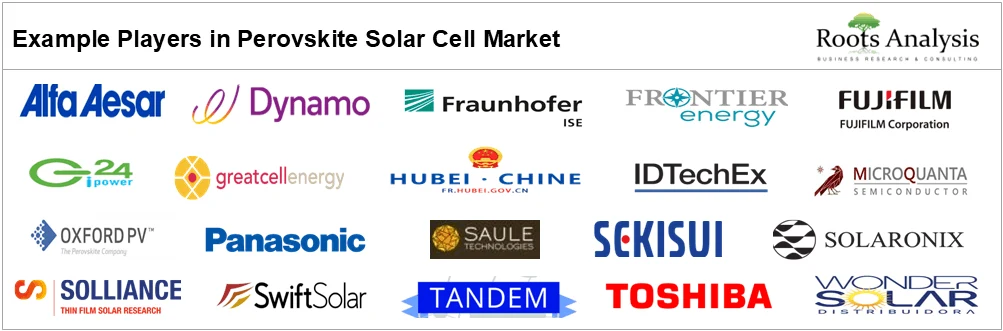
- Leading Industry Players: Market giants like Oxford PV, FUJIFILM, and Saule Tech are broadly focused on expanding perovskite applications across consumer electronics, IoT devices, lead-free formulations, and commercial manufacturing of perovskite-silicon tandem modules. In order to leverage competitive edge, partnerships, technological innovations and collaborations will remain center of attraction in this industry.
- Startup Ecosystem: Based on the global perovskite solar cell market report, the startup ecosystem in 2026 and beyond is characterized by "pure-play" innovators who are specializing in high-growth niches. These companies are moving beyond the "lab-to-fab" phase and are now securing funds required for industrial scale-up. Recently, Tandem PV secured USD 50 million in a Series A funding round for the development of commercial-scale manufacturing facility to develop solar panels in the US. This round is particularly notable because it includes a major utility as a strategic partner, signaling that the end-users of solar power are now directly investing in the technology's success.
- Robust Venture Capital Support: Investment is also flowing into the "Enabler" segment. For instance, in January 2026, GraphEnergyTech announced that it is raising a GBP 3 million seed round to scale its graphene-enhanced carbon electrode technology, which aims to replace the expensive gold and silver currently used in perovskite cell contacts. This focus on cost-reduction at the material level is a sign of a maturing industry where the focus has shifted from "Will it work?" to "How cheap can manufacturers make it for widespread adoption?"
- Geographical Regions Trends: Regional clusters are becoming increasingly distinct. The Asia-Pacific region (particularly China and Japan) is the world's "manufacturing workshop" for perovskites, focusing on high-speed, high-volume production of both rigid and flexible cells. Based on the perovskite solar cell market drivers and restraints analysis, North America is emerging as the "innovation and re-shoring hub," where companies are leveraging government grants and a strong VC ecosystem to build domestic manufacturing that targets the high-performance utility market. On the other hand, Europe maintains a strong lead in "R&D and pilot deployments," with a focus on outdoor durability testing and BIPV pilots in regions like Germany and the UK.
- Companies Leveraging the BIPV Vertical: The integration of solar into the trillions of dollars of global real estate development is the single largest untapped opportunity for perovskites. Startups focusing on "active glass" and transparent solar facades are likely to capture high-margin niches.
- End Use Industry Analysis: Utility sector accounts for the largest share of end user demand, representing 40.0% of the market in 2026. This highest share is driven by grid-scale energy generation priorities and early adoption of emerging photovoltaic technologies within large energy portfolios.
Recent Industry Developments
- January 2026: Homerum Energy announced that the companies has achieved a durability breakthrough in large-area perovskite modules, maintaining over 95% efficiency after 5,000 hours of testing.
- January 2026: Halocell Energy and Lava Blue signed a memorandum of understanding to develop a domestic supply chain for high-purity perovskite. By refining high-purity materials from mine waste, the partnership aims to produce Australian-made specialty chemicals for perovskite printing, reducing the market's dependence on Chinese imports, which currently account for three-quarters of global precursor supply.
- January 2026: Hainan Drinda New Energy Technologies announced its plan to invest 30 million yuan (USD 4.3 million) in Shanghai Starwing Core Energy Technology. This partnership will help Drinda tap opportunities in space computing industry and low-Earth-orbit satellite constellations, leveraging complementary strengths in photovoltaic industrialization and perovskite technology.
Get an Instant Quote in 10 Minutes. Lowest Price Guaranteed
Market Dynamics
Key Market Drivers
- Rapid Advancements in Conversion Efficiency: Perovskite solar cells have achieved unprecedented gains in power conversion efficiency within a short development cycle, with laboratory results approaching the performance levels of commercially deployed silicon technologies. This pace of improvement has strengthened confidence in perovskites as a credible high-efficiency photovoltaic platform, drawing sustained research investment and reinforcing their relevance in next-generation solar system design.
- Potential for Low-Cost Manufacturing Processes: Perovskite fabrication avoids many of the energy-intensive, high-temperature steps required in conventional silicon processing. The ability to use solution-based and scalable coating techniques supports lower capital intensity and manufacturing flexibility, creating a pathway toward structurally lower energy generation costs as production volumes increase.
- Synergies with Silicon Tandem Cells: The optical properties of perovskite materials make them well suited for tandem architectures when paired with silicon bottom cells. This configuration enables efficiency gains beyond the inherent limits of single-junction silicon, offering established manufacturers a performance upgrade route that leverages existing production assets rather than requiring wholesale technology replacement, accelerating the perovskite tandem solar cells market growth.
- Suitability for Flexible and Lightweight Applications: Perovskite materials can be deposited on thin, flexible substrates, enabling solar modules that are lighter and more adaptable than rigid silicon panels. This expands addressable demand into applications such as building-integrated systems, portable power electronic solutions, and aerospace use cases where weight, form factor, and surface conformity are critical constraints.
Market Restraints
- Long-Term Durability and Stability Concerns: Perovskite solar cells remain vulnerable to performance degradation when exposed to moisture, elevated temperatures, and prolonged ultraviolet radiation. Compared with the long operational lifetimes expected of conventional photovoltaic modules, these durability limitations undermine confidence in long-term output reliability and restrict adoption in bankability-sensitive projects.
- Material Toxicity and Regulatory Uncertainty: High-efficiency perovskite formulations frequently rely on lead-based compounds, introducing environmental and health considerations related to leakage, handling, and end-of-life disposal. Unclear regulatory treatment of lead-containing modules creates compliance uncertainty and poses adoption barriers in markets with strict environmental oversight.
- Lack of Commercial Scale Manufacturing Standards: Scaling perovskite production from laboratory-scale cells to large-area modules introduces challenges in maintaining uniformity, yield, and reproducibility. The absence of widely accepted testing, qualification, and certification standards increases technical and commercial risk for developers, investors, and downstream project owners.
- Underdeveloped Supply Chain for Precursor Materials: Key raw materials used in perovskite production lack the mature, high-volume supply networks that support the silicon photovoltaic industry. Limited supplier scale and cost optimization elevate material expenses and introduce procurement risk during early commercialization phases.
Market Share Insights
Regional Analysis: Perovskite Solar Cell Market Growth Opportunities Asia Pacific Region
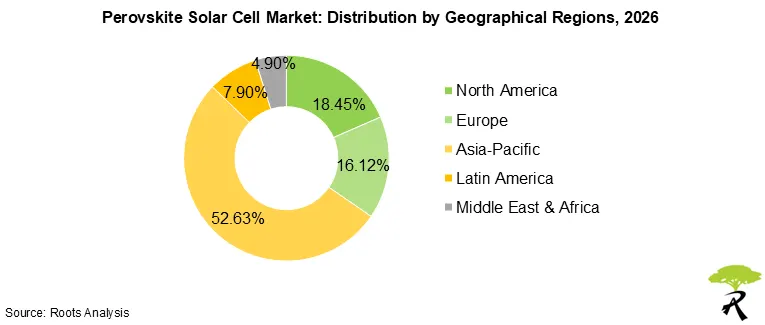
- Asia-Pacific is both the largest and fastest-growing regional market, holding a 52.63% market share in 2026 and expanding at the fastest CAGR through 2040. The region’s leadership is reinforced by its concentration of solar manufacturing hubs, strong government policy support, and accelerating urbanization across major economies.
- The high-volume production capabilities and aggressive renewable energy targets position Asia-Pacific as the central engine of global perovskite solar cell adoption. While other regions continue to invest in research and pilot deployments, Asia-Pacific’s scale advantages and integrated value chains translate directly into sustained market share leadership and growth momentum.
Perovskite Solar Cell Market Segmentation by Application
- Based on the perovskite solar cell market segmentation analysis, power generation holds the largest share of the market in 2026, accounting for 45.0% market share. This growth reflects its early commercialization focus and direct alignment with utility-scale and distributed energy deployment models. In addition, the dominance is also driven by the technology’s improving efficiency-to-cost profile and its suitability for large-area energy generation.
- In contrast, building integrated photovoltaics (BIPV) is the fastest-growing application segment. Rapid growth is supported by rising urban density, demand for multifunctional building materials, and the aesthetic and form-factor advantages of perovskite cells, particularly in smart facades and architecturally integrated surfaces. Moreover, the building integrated photovoltaics (BIPV) market trends clearly indicate a shift from pure energy output optimization toward integrated, design-driven solar solutions in urban environments.
Want Information on Specific Region / Segment?
Market Ecosystem Insights
Perovskite Solar Cell Competitive Landscape Analysis
The transition in the solar industry is a high-stakes pivot point where perovskite technology is rapidly moving from "lab-to-fab" commercial readiness. The current market is consolidating into a distinct two-tier ecosystem defined by how established giants and agile innovators integrate this next-generation material to achieve unprecedented energy yields.
The Legacy Integrators: Scaling Through Synergy
Established silicon leaders such as Qcells, LONGi, and Trina Solar are leveraging their massive manufacturing footprints to adopt a "Silicon-Perovskite Tandem" approach. Rather than abandoning the industry-standard silicon substrate, these companies are "bolting on" perovskite layers to bypass the theoretical efficiency limits of pure crystalline silicon.
A primary innovation in this tier is the investment in Asymmetric Self-Assembled Monolayers (SAMs), which act as ultra-thin selective layers to ensure a seamless electrical interface between the silicon and perovskite. For example, LONGi has utilized this strategy to achieve a world-record certified efficiency of 34.6%, maintaining their market dominance by building a "Tandem Ecosystem" that integrates directly into existing silicon production lines.
The Pure-Play Innovators: Setting the New Standard
On the other end of the spectrum, specialized firms and startups like Oxford PV, Swift Solar, and UtmoLight are serving as the vanguard of the industry. These pure-play innovators are defining the new technical standards for stability and scalable coating processes without being unencumbered by legacy silicon manufacturing constraints. Oxford PV, for instance, has recently achieved the milestone of shipping the first commercial tandem modules, reaching 24.5% efficiency for utility-scale applications.
Meanwhile, firms like UtmoLight are focusing on "factory-of-the-future" models, such as gigawatt-scale lines that use roll-to-roll or large-area deposition to produce both all-perovskite thin films and high-efficiency tandems. These strategic initiatives, bolstered by incentives like the US Inflation Reduction Act (IRA), are expected to significantly accelerate market revenue and volume as the "silicon-only" era comes to a close.
Perovskite Solar Cell R&D: Investment and Strategic Funding
Driven by rapid technological innovation, the potential for significantly lower production costs, and global policy alignment, both market players and government organizations are accelerating R&D investments in next-generation perovskite solar cells. These capital infusions are designed to bridge the gap between laboratory records and high-volume commercial manufacturing.
Government-Led Initiatives: The Case of Japan
Japan has emerged as a frontrunner in national-level support, committing approximately USD 1.5 billion through its Green Innovation Fund to commercialize ultra-thin, flexible perovskite solar panels. This investment is a cornerstone of Japan's broader energy strategy, which aims to generate electricity equivalent to 20 nuclear power plants using perovskite technology by 2040. Because these panels are lightweight and pliable, they are uniquely suited for Japan's mountainous terrain and dense urban environments, wherein traditional, heavy silicon panels cannot be easily installed. This initiative is vital to the country's goal of achieving a 50% renewable energy share by 2040.
Private Capital and Industrial Scaling
In the private sector, strategic funding is shifting from isolated cell R&D toward building comprehensive "Tandem Ecosystems." In November 2025, GCL Technology secured USD 700 million from Infini Global Master Fund to accelerate commercialization. By vertically integrating the production of silane gas and granular polysilicon, GCL is creating a high-purity supply chain essential for stabilizing perovskite-silicon tandem cells at scale. This capital influx facilitates the transition to gigawatt-scale production, offering industrial players a path to redefine solar economics by potentially reducing factory capital expenditure by 50% compared to traditional silicon facilities.
Your Business is Unique – Why Shouldn’t Your Report Be?
Future of Perovskite Solar Cells Market Outlook
- Expansion into Portable Electronics and IoT Devices: Perovskites demonstrate strong performance under diffuse and low-light conditions, making them ideal for small-scale power generation in Internet of Things (IoT) sensors, wearables, and consumer electronics. This high-growth niche market offers a faster path to commercialization than utility-scale projects.
- Strategic Partnerships with Incumbent Silicon Manufacturers: Tandem cell technology offers a clear opportunity for collaboration between perovskite developers and established silicon manufacturers. Perovskite companies can license their technology to silicon leaders, enabling rapid market penetration and access to optimized manufacturing infrastructure without incurring high capital expenditure.
- Development of Lead-Free Formulations: Significant R&D efforts are focused on creating stable, lead-free perovskite alternatives using materials like tin or double perovskites. Success in this area would remove the primary regulatory and environmental barrier, unlock mass market adoption and reduce long-term disposal costs.
- Off-Grid and Emerging Market Solutions: The low-cost potential of solution processing and flexibility in manufacturing allows perovskites to be implemented as decentralized power solutions in regions lacking established electrical grids. This provides an opportunity to provide affordable energy access in emerging economies through small-scale, localized systems.
Perovskite Solar Cell Market: Scope of the Report
| Key Report Attributes | Details | |
| Historical Trend | Since 2022 | |
| Forecast Period | Till 2040 | |
| Market Size 2026 | $ 340 Million | |
| Market Size 2040 | $ 11,000 Million | |
| CAGR (Till 2040) | 28.19% | |
| Segments Covered |
|
|
Market Segmentation
Based on the research, we have segmented the perovskite solar cell market into type of product, type of structure, type of manufacturing method, type of cell, application, end use industry, geographical regions, and key players.
Market Share by Type of Product
- Rigid Perovskite Solar Cells
- Flexible Perovskite Solar Cells
- Tandem Perovskite Solar Cells
- Single-Junction Perovskite Solar Cells
Market Share by Type of Structure
- Planar Perovskite Solar Cell
- Mesoporous Perovskite Solar Cell
Market Share by Type of Manufacturing Method
- Solution Method
- Vapor-Assisted Solution Method
- Vapor-Deposition Method
Market Share by Type of Cell
- Single-Junction Perovskite Cells
- Multi-Junction (Tandem) Solar Cells
Market Share by Application
- Smart Glass
- Power Generation
- Building Integrated Photovoltaics (BIPV)
- Transportation and Mobility
- Others
Market Share by End Use Industry
- Aerospace
- Consumer Electronics
- Energy
- Manufacturing
- Industrial Automation
- Utility
- Other End User
Market Share by Geographical Regions
- North America
- US
- Canada
- Mexico
- Rest of North America
- Europe
- Austria
- Belgium
- Denmark
- France
- Germany
- Ireland
- Italy
- Netherlands
- Norway
- Russia
- Spain
- Sweden
- Switzerland
- UK
- Rest of Europe
- Asia-Pacific
- Australia
- China
- India
- Japan
- New Zealand
- Singapore
- South Korea
- Rest of Asia-Pacific
- Latin America
- Brazil
- Chile
- Colombia
- Venezuela
- Rest of Latin America
- Middle East and Africa (MEA)
- Egypt
- Iran
- Iraq
- Israel
- Kuwait
- Saudi Arabia
- UAE
- Rest of MEA


