Photovoltaics (PV) Market
Photovoltaics (PV) Market Till 2035: Distribution by Type of Component (Modules, Inverters, and Balance of Systems (BOS)), Type of Material (Compound and Silicon), Type of Installation (Building-integrated photovoltaic, Floating PV, and Ground-mounted), Type of Application (Commercial, Industrial, Residential, and Utilities), and Geographical Regions (North America, Europe, Asia, Latin America, and Middle East and North Africa and Rest of the World): Industry Trends and Global Forecast
-
Lowest Price Guaranteed
-
Slides
211 -
Last Updated
May 2025 -
View Count
13886 -
Photovoltaics (PV) Market Overview
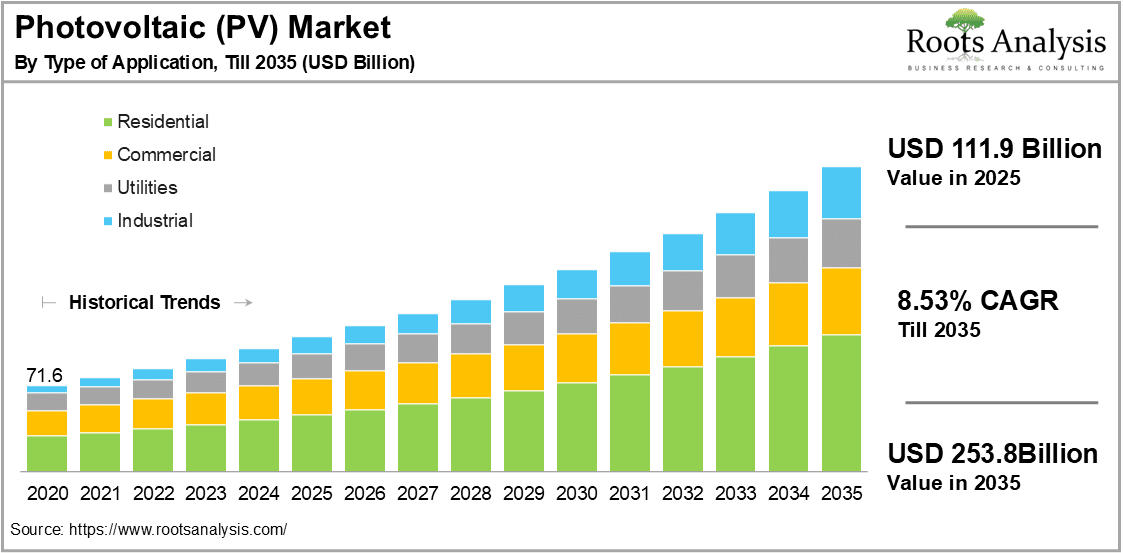
The photovoltaics market size is projected to grow from USD 111.9 billion in 2025 to USD 253.8 billion by 2035, representing a CAGR of 8.53% during the forecast period till 2035.
 |
The new research study consists of photovoltaics market and trends analysis, detailed market forecast analysis, and provides actionable strategic recommendations.
In the quest for sustainable energy solutions, photovoltaic technology has emerged as the most powerful technique for environmentally friendly alternatives. Photovoltaic (PV) also known as solar panel is a technology that is used to convert solar energy directly into electricity through the use of solar cells. These cells are typically made from semiconductor materials similar to silicon that absorb sunlight release electrons and generate electric current. Solar PV systems range from small rooftop solar panels to large-scale solar farms where building integrated leads systems in terms of installation.
In the past few decades, the growing market demand for solar panels due to a surge in renewable energy adoption has scaled the photovoltaic (PV) market up and advanced it to new heights. The renewability, low environmental impact, and ability to generate clean energy without producing harmful emissions are the substantial benefits of photovoltaic technology which continue to spur the market demand. As an effect, governments around the world are subsidizing and promoting solar adoption. It is interesting to note that Asia is leading the trajectory for the exponential growth of the industry with the highest investment and technology development. For instance, in September 2024, TotalEnergies and Adani Green Energy formed a joint venture to develop an 1150 MWac solar project in Gujrat, India. Similarly, in December 2024, the Chinese government allocated $30 billion to renewable energy projects including solar power installation.
As a consequence, the market for photovoltaics is expected to experience ever-growing growth during this forecast period. Nevertheless, the lack of infrastructure and high costs of installation are considerable challenges that need to be addressed to maintain the steady growth of the market.
Photovoltaics (PV) Market Share Insights
The photovoltaics market report presents an in-depth analysis of the various companies that are involved in offering photovoltaics, across different segments, as defined in the table below:
Photovoltaics (PV) Market: Report Attributes / Market Segmentations
| Key Report Attributes | Details | |
| Historical Trend | Since 2020 | |
| Forecast Period | Till 2035 | |
| Current Market Size | $ 111.9 Billion | |
| Market Size Value by 2035 | $ 253.8 Billion | |
| CAGR (Till 2035) | 8.53% | |
| Type of Component |
|
|
| Type of Material |
|
|
| Type of Installation |
|
|
| Type of Application |
|
|
| Geographical Regions |
|
|
| Leading Market Players | ||
| PowerPoint Presentation (Complimentary) |
Available | |
| Customization Scope | 15% Free Customization | |
| Excel Data Packs (Complimentary) |
|
|
Photovoltaics (PV) Market Segmentation
Market Share by Type of Component
This segmentation of the photovoltaic market underscores a variety of components including modules, inverters, and balance of systems. Among these components, the modules component has been dominating the segment by holding (~49%) of the current market share. Modules are responsible for converting sunlight into electricity. Thus, being a core component, the segment will continue to lift the growth of the market in the future as well. Furthermore, the inverter segment shows promising growth and is expected to grow at (9.82%) CAGR till the forecast period. Inverters are essential and play a key role in converting the DC electricity generated by solar panels into AC electricity which is further used for grid distribution and household consumption.
Market Share by Type of Material
On the basis of the type of material, the market is fragmented into compounds and silicon. As per photovoltaic industry insights for the material segment, silicon is a leading material wherein crystalline silicon is expected to capture the largest (~44%) of the market share by 2035. Silicon material drives the market due to its higher efficiency, longer lifespan, and better performance in low-light conditions. Additionally, the material is used for flexible and lightweight solar panels which offer low-cost production and high efficiency. Hence, the silicon segment is anticipated to expand at a faster CAGR of (10.76%) during this projection period.
Market Share by Type of Installation
The distribution of the market based on installation is categorized into building-integrated photovoltaic, floating PV, and ground-mounted. According to this photovoltaic growth forecast report, the ground-mounted PV is projected to escalate the segment growth with (~46%) of the market share by 2035. Ground-mounted PV is installed in large-scale solar farms to maximize sunlight exposure and accommodate high-capacity installation. Also, government and private investors favor large-scale solar farms to meet energy demand and decarbonization goals which support the segment growth. Furthermore, the building-integrated photovoltaic segment is gaining traction in the industry and is poised to witness a noteworthy (10.15%) CAGR during this projection timeframe. The key factor of this growth is accredited to the growth in urban areas due to its dual function as a building material and energy generator.
Market Share by Type of Application
Based on the type of application, the residential application shows dominance in the industry and is likely to hold substantial (~49%) of the market share till 2035. This is mainly due to the increasing adoption of rooftop solar PV systems around the world driven by the decay in the cost of solar panels, rising energy costs, and government incentives. While the commercial application continues to foster the market with extensive installation in large commercial buildings and businesses. Companies are increasingly investing in solar energy to meet environmental, social, and governance goals. Therefore, the commercial sector is likely to experience a faster (11.5%) growth rate in the upcoming decade.
Market Share by Geographical Regions
This segment highlights the distribution of the photovoltaics market across various geographical regions, such as North America, Europe, Asia, Latin America, the Middle East and North Africa, and the rest of the world. In the context of revenue generation, Asia is leading the industry and is estimated to hold nearly (~48%) of the market share by 2035. This can be ascribed to the high solar irradiation, lower component production costs as well as advancement in silicon wafers and bifacial modules which improve performance and adoption rates. Therefore, Asia is expected to grow at a faster CAGR of (11.62%) over this forecaster period.
In terms of the integration of photovoltaics in building design (BIPV), Europe rising at a steady pace. According to a report, the EU installed 66 GW of solar in 2024 which slightly surpasses the 63 GW installed in 2023, however, there has been a slowdown in the overall growth of the EU solar energy market in the previous year. Moreover, the market for photovoltaics is expanding swiftly in North America due to the heightening embrace of advanced photovoltaic technologies especially, in the US and Canada.
Photovoltaics (PV) Market Key Insights
The “Photovoltaics (PV) Market, Till-2035: Industry Trends and Global Forecasts” report features an extensive study of the current market landscape, market size and future opportunities within the photovoltaics market, during the given forecast period. The market report highlights the efforts of several stakeholders involved in this rapidly emerging segment of the service providers industry. Key takeaways of the photovoltaics market report are briefly discussed below.
Key Drivers of the Photovoltaics (PV) Market
The market has been evolving speedily due to numerous key drivers such as cost reduction in solar PV systems and government policies & incentives to encourage solar adoption. The significant impact of government incentives on photovoltaics has boosted the adoption of the technology through subsidies, tax credits, and feed-in-tariffs which make solar energy more affordable and accelerate the transition to clean energy. Additionally, the environmental benefits of solar energy are also attributed to the spike in the adoption of solar energy solutions. Solar energy produces zero greenhouse gas emissions during operations and does not create air or water pollution which makes it a sustainable energy technique. Moreover, ongoing innovations in solar cell technology including perovskite solar cells, bifacial solar cells, and tandem solar cells provide cost-effectiveness and versatile solar solutions, which help enhance energy production rate. Notably, These key drivers are expected to continue to lift the photovoltaic market growth throughout this forecast period.
Photovoltaics Market Competitive Landscape
Currently, the market for photovoltaics is facing intense competition with the presence of several global and regional industry players including LONGi, JinkoSolar, Trina Solar, First Solar, and many more. These key players in the photovoltaics market dominate the industry through their technological advancements, and cost-reduction strategies to fulfill the increasing global demand for renewable energy. Additionally, the market share of leading solar manufacturers continues to grow as they lead global PV module production, EPC, and energy storage sectors. These companies are racing to enhance efficiency, lower costs, and integrate storage solutions for greater market dominance.
Market Challenges in Photovoltaics Market
Despite the declining cost of solar technology, the upfront investment required for photovoltaic projects remains a significant issue particularly, for large-scale solar farms. This is due to the fact that the initial costs of solar projects including solar panels, inverters, mounting structures, and energy storage systems need rigorous capital for installation. In addition, weak or outdated grids struggle to handle fluctuating solar power inputs and lack of infrastructures are also substantial challenges in photovoltaic technology adoption which can curb the market progress.
Regional Analysis: Asia is Expected to Dominate the Market with the Largest Photovoltaics (PV) Market Share
With respect to regional analysis of solar market growth, Asia reflects dominance in the photovoltaic industry and is poised to capture the highest (~48%) of the market share till the forecast period. Strong manufacturing hubs in China, Taiwan, and South Korea essentially contribute to the region’s leading position. According to data research, China alone produces over 70% of the world’s solar panels which remarkably advances the growth of the photovoltaic market. Also, the growing government support and initiatives of solar deployment to meet carbon neutrality goals as well as significant investment & trade agreements in the region magnify the market growth. For Instance, in December 2024, POWERCHINA and Meralco signed an EPC (engineering, procurement, and construction) contract for the 1050 MW Terra Solar Project in Manila Philippines. This marked the first phase of Southeast Asia’s largest photovoltaic project.
Leading Photovoltaic Manufacturers
Examples of key players involved in the market for photovoltaic (which have also been captured in this market report, arranged in alphabetical order) include ABB (Switzerland), Array Technologies (US), Canadian Solar (Canada), Chint Solar (China), First Solar (US), GCL System Integration Technology (China), Huawei (China), JA Solar (China), JinkoSolar (China), LG Electronics (South Korea), LONGi (China), Mitsubishi Electric (Japan), Risen Energy (China), Sharp (Japan), Tongwei Solar (China), Trina Solar (China), and Waaree Energies (India). This market report includes an easily searchable excel database of all the companies who have adopted the photovoltaics market.
Recent Developments in Photovoltaics (PV) Market
- In December 2024, Vertiv collaborated with PV Lumens India to expand its reach in India’s safety, security, and business productivity sectors. Through this partnership, Vertiv aims to get access to new customer segments while PLV offers a broader range of power cooling and IT solutions to its partners.
- In November 2024, Onyx Solar introduced walkable PV floor titles that are suitable for use on decks, sidewalks, or patios. The product has a nominal capacity of 75 W.
- In April 2024, LONGi, a leading company in solar technology unveiled its TaiRay silicon wafer products. The R&D tests and secured system patents company has been completed which was preparing for full-scale production.
Photovoltaics (PV) Market Report Coverage
The market t report presents an in-depth analysis, highlighting the capabilities of various companies engaged in this domain, across different segments. Amongst other elements, the market report includes:
- A preface providing an introduction to the full report photovoltaics market, 2020-2024 (Historical Trends) and till-2035 (Forecasted Estimates).
- An outline of the systematic research methodology adopted to conduct the study on the photovoltaics market providing insights on the various assumptions, methodologies, and quality control measures employed to ensure the accuracy and reliability of our findings.
- An overview of economic factors that impact the overall photovoltaics market including historical trends, currency fluctuation, foreign exchange impact, recession, and inflation measurement.
- An executive summary of the insights captured during our research. It offers a high-level view on the current state of the photovoltaics market their likely evolution in the mid-long term.
- A detailed assessment of the photovoltaics market landscape, based on several relevant parameters, including year of experience, company size, location of headquarters, and ownership structure.
- Elaborate profiles of prominent players engaged in the photovoltaics market, featuring information on their year of establishment, location of headquarters, company size, company mission, company footprint, management team, contact details, financial information, operating business segments, photovoltaics market portfolio, moat analysis, recent developments, and an informed future outlook.
- A qualitative assessment of the various megatrends ongoing in the photovoltaics industry, including growing innovation in materials and technological advancements in solar cells.
- An analysis highlighting the key unmet needs across the photovoltaics market, featuring insights generated from real-time data on unmet needs as identified from social media posts, recent publications, industry blogs and the views of key opinion leaders expressed on online platforms.
- An in-depth analysis of various patents that have been filed / granted related to photovoltaics market and its components, based on various parameters, such as type of patent, patent publication year, patent age and leading players.
- A detailed analysis of recent developments in the photovoltaics market domain, based on relevant parameters such as year of initiative, type of initiative (partnerships and collaborations, expansions, funding and product launches), geographical distribution and most active players (in terms of number of recent developments).
- Key winning strategies framework that helps in analyzing the level of competition within an industry, by tracing the key market activities including partnership, funding, expansion of leading players
- A qualitative analysis, highlighting the five competitive forces prevalent in photovoltaics market, including threats for new entrants, bargaining power of suppliers, bargaining power of customers, threats of substitution and rivalry among existing competitors.
- A discussion on affiliated global photovoltaics market trends, key drivers and challenges, under a SWOT framework, which are likely to impact the industry’s evolution, along with a Harvey ball analysis, highlighting the relative effect of each SWOT parameter on the overall photovoltaics market.
- A value chain analysis featuring a discussion on various stakeholders involved in the development of the photovoltaics market, from suppliers to end-users.
- A detailed estimate of the current market size and the future growth potential of the photovoltaics market over the next decade. Based on multiple parameters we have provided an informed estimate on the market evolution during the forecast period 2025-2035. The report also features the likely distribution of the current and forecasted opportunity within the photovoltaics market. Further, in order to account for future uncertainties and to add robustness to our model, we have provided three forecast scenarios, namely conservative, base, and optimistic scenarios, representing different tracks of the industry’s growth.
- Detailed projections of the current and future market across various types of components such as modules, inverters, and balance of systems (BOS).
- Detailed projections of the current and future market across various types of material such as compound and silicon.
- Detailed projections of the current and future market across various types of installation such as building-integrated photovoltaic, floating PV, and ground-mounted.
- Detailed projections of the current and future market across various types of verticals such as commercial, industrial, residential, and utilities.
- Detailed projections of the current and future photovoltaics market across various geographical regions, such as North America (US, Canada, Mexico and other North American countries), Europe (Austria, Belgium, Denmark, France, Germany, Ireland, Italy, Netherlands, Norway, Russia, Spain, Sweden, Switzerland, UK and other European countries), Asia (China, India, Japan, Singapore, South Korea and other Asian countries), Middle East and North Africa (Egypt, Iran, Iraq, Israel, Kuwait, Saudi Arabia, UAE and other MENA countries), Latin America (Brazil, Chile, Colombia, Venezuela and other Latin American countries) and rest of the world (Australia, New Zealand and other countries).
Author: Ronit Sharma and Neha Kashyap
Customization Opportunities
At Roots Analysis, we genuinely care about your success and understand that your business requirements are unique. While our market research reports provide valuable insights, we recognize that they might not cover every aspect you need to make well-informed strategic decisions. To account for that, we offer 15% free report customization tailored to your specific needs. Whether you require additional quantitative analysis, qualitative insights, or any other information related to the photovoltaics market, reach out us today at: support@rootsanalysis.com