
Lowest Price Guaranteed
Slides
175
Last Updated
August 2026
View Count
13114
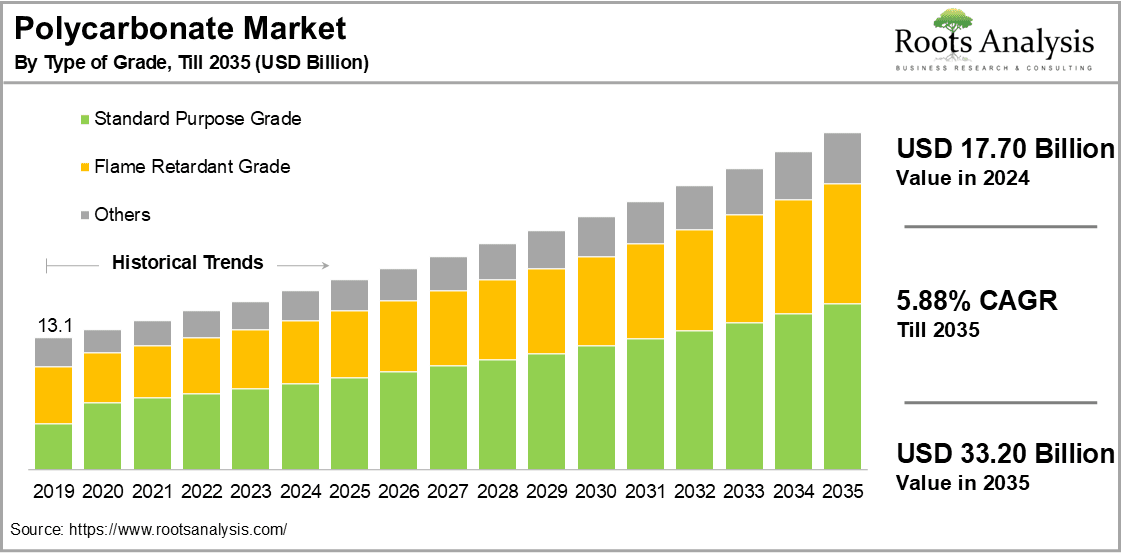
The polycarbonate market size is projected to grow from USD 17.70 billion in 2024 to USD 33.20 billion by 2035, representing a CAGR of 5.88%, during the forecast period till 2035.
 |
To learn more about this report, request a free sample copy
The new research study consists of polycarbonate market and trends analysis, detailed market forecast analysis, and provide actionable strategic recommendations.
Polycarbonate refers to a thermoplastic polymer that is highly used in several applications due to its lightweight, durability, transparency, and impact resistance features. Historically, in 1953, polycarbonate was first patented by Herman Schnell. It was produced via chemical reactions between bisphenol A and phosgene. This is the same polycarbonate manufacturing process that is still used to make polycarbonate either through extrusion or injection molding. Its molecular structure and unique properties allow it to withstand high levels of physical stress without breaking or deforming. Driven by this, the demand for polycarbonate is ascending rapidly across various industries. This is due to the fact that polycarbonate properties and benefits in heat resistance, exceptional thermal insulation, and malleability make it versatile and convenient to operate in manufacturing processes.
Furthermore, the availability of different types of polycarbonate grades, such as standard purpose grade, medical grade, and flame-retardant grade has magnified the scope of the polycarbonate market. Based on the polycarbonate production capacity analysis, Asia represents a huge potential for material production. According to a report, polycarbonate capacity in Asia is going to expand and is anticipated to be 2.05 million tonnes annually by 2028 driven by the inflating demand from the packaging, automotive, and construction industry.
Apart from key drivers, the emerging market trends are accelerating market development. For instance, a rise in the demand for sustainable and recycled material as well as advanced-grade polycarbonate for specific applications is creating lucrative opportunities for the stakeholders. Therefore, industry players are increasingly investing in the market to expand their manufacturing capacity of sustainable polycarbonate materials. Overall, these factors are collectively expected to move forward the market dynamically during the forecast 2024-2035.
The polycarbonate market report presents an in-depth analysis of the various companies that are involved in offering polycarbonate, across different segments, as defined in the table below:
| Key Report Attributes | Details | |
| Historical Trend | Since 2019 | |
| Forecast Period | Till 2035 | |
| Current Market Size | $ 17.70 Billion | |
| Market Size Value by 2035 | $ 33.20 Billion | |
| CAGR (Till 2035) | 5.88 % | |
| Type of Grade |
|
|
| Type of Application |
|
|
| Geographical Regions |
|
|
| Leading Market Players | ||
| PowerPoint Presentation (Complimentary) |
Available | |
| Customization Scope | 15% Free Customization | |
| Excel Data Packs (Complimentary) |
|
|
Based on the type of grade, the market is categorized into flame retardant grade, food grade, medical grade, standard purpose grade, and others. As per our polycarbonate market research, the standard grade segment is anticipated to propel the market with a maximum of (~48%) of the market share by 2035. The segment will likely retain this leading position due to its versatility and diverse range of applications. Also, the material is considered the best alternative to glass, metal, and wood which is highly used in countless end-use applications.
However, flame retardant is expected to experience a faster (6.53%) CAGR and augment the market expansion throughout this forecast period. The demand for flame retardant material across several applications, from air conditioners and refrigerators to other home appliances, notably fosters the segment growth. Additionally, medical-grade polycarbonate is also remarkably lifting the market growth with its increasing use in the manufacturing of medical devices and equipment.
This polycarbonate market segmentation describes various types of applications including automotive, construction, electrical, medical equipment, packaging, and others. The electrical application is projected to capture the largest (~47%) of the market share by 2035. The segment will continue to foster market growth owing to extensive demand for consumer electronics. Polycarbonate is widely used in electronic devices such as smartphones, laptops, and others due to its transparency, heat resistance, and durability. Whereas the construction application is expected to grow at a substantial CAGR of (7.01%) during this forecast period.
Owing to the need for safety and longevity in construction projects, polymer materials are commonly used in the production of polycarbonate sheet applications including glass alternatives, skylights, wall panels, and others. Furthermore, the wide range of polycarbonate applications in the automotive sector is contributing to reinforcing the market development. This can be ascribed to the increasing production of automobiles particularly; electronic vehicles which highly need lightweight durable materials. Apart from this, the packaging and medical sectors are some other important polycarbonate end-use industries, driving the market demand.
This segment highlights the distribution of the Polycarbonate Market across various geographical regions, such as North America, Europe, Asia, Latin America, the Middle East and North Africa, and the rest of the world. With regard to polycarbonate market share by region, Asia is poised to obtain the highest (~ 45%) of the market share and will retain its dominance till 2035. Furthermore, North America is likely to register a notable (6.78%) CAGR during this forecast period. This trend is unlikely to change due to extensive demand for flame retardant grade material particularly, in the electronics and construction industry in the region. Besides, Europe is also escalating the market growth driven by the expanding automotive sector where polycarbonate is primarily used in the automobiles’ interior and exterior components.
The “Polycarbonate Market, Till-2035: Industry Trends and Global Forecasts“ report features an extensive study of the current market landscape, market size and future opportunities within the polycarbonate market, during the given forecast period. The market report highlights the efforts of several stakeholders involved in this rapidly emerging segment of the service providers industry. Key takeaways of the polycarbonate market report are briefly discussed below.
The market is expanding at a rapid pace driven by various key drivers. One of the main key drivers is the mounting demand for durable and lightweight materials across several key application industries from automotive to construction. Polycarbonate is popular for its lightweight nature and high-resistance properties, thus, gaining the extensive demand from applications that need safety and efficiency. Another key driver is its quality of UV resistance, transparency, and high impact strength which is advancing the future of polycarbonate in construction industry. In modern construction, the material is highly used in roofing panes, skylights, and windows. As a result, the soaring urbanization and high construction activities around the world are expected to inflate market demand. Additionally, the great polycarbonate demand in electronics and rising use in the manufacturing of medical devices is also boosting market progress. Moreover, ongoing technological advancements and demand for recyclable materials are other considerable polycarbonate industry growth factors that will likely enhance the market outlook in the future as well.
Currently, a rising number of small and medium sized companies along with established industry players are shaping the polycarbonate market competitive landscape. However, successful companies like SABIC, LG Chem, Trinseo, and others dominate the market with their advanced production facilities and vast global network. It is interesting to note that the top eight companies occupy the maximum share of the market. This is due to polycarbonate market trends of mergers, acquisitions, and collaborations. Thus, companies are following these trends, securing substantial market share and increasing their product portfolios. For instance, In April 2024, Neste partnered with Lotte Chemical to develop more sustainable chemicals and plastics. In this agreement, both companies intend to replace fossil resources with renewable raw materials in chemical and plastic manufacturing. Meanwhile, regional manufacturers and niche players are also changing polycarbonate supply chain dynamics by offering specialized products and materials.
Despite the positive market growth, some restraints such as fluctuating raw material prices and harmful environmental impact may hamper market progress. Polycarbonate relies on petrochemicals which is a by-product of crude oil. Thus, the volatility of crude oil prices directly impacts the polycarbonate production costs which may also lead to supply chain disruptions. Additionally, due to the adverse effects of petrochemicals on the environment, several countries are imposing stringent regulations on the production and use of plastic. Consequently, these confining factors may cause challenges for the polycarbonate suppliers and manufacturers to meet these requirements, and slow down the market growth.
With regard to polycarbonate market growth forecast, Asia is expanding speedily in the global market for polycarbonate and is likely to dominate due to its vast plastic manufacturing industry particularly, in China. This expansion is accredited to the lower labor cost, strong supply chain, and availability of raw materials that attract global companies to set up their production plant in the region. Additionally, application industries, such as automotive and electronics significantly raise the demand for polycarbonate resin due to its lightweight properties and transparency. Rapid urbanization and infrastructure development are also increasing the market growth with growing construction activities and the growth of the packaging industry that essentially requires plastic materials. As a result, manufacturing companies are constantly investing and collaborating with the application industry to leverage the growing demand for polycarbonate in the region.
Examples of key polycarbonate manufacturers involved in the polycarbonate market (which have also been captured in this market report, arranged in alphabetical order) include Ashi Kasai Chemical (Japan), Bayer Material (Germany), CHIME (Taiwan), Centroplast Engineering Plastics (Turkey), Covestro (Germany), Entec Polymers (USA), Formosa Chemical & Fiber (Taiwan), Idemitsu Kosan (JapanLG Chem (South Korea), Lone Star Chemical (Houston, USA), LOTTE (South Korea), Mitsubishi Japan), Royal DSM (Netherlands), RTP ( USA), SABIC (Arabia), TENJIN (Japan), and Trinseo (USA). This market report includes an easily searchable excel database of all the companies who have adopted the polycarbonate market.
The market report presents an in-depth analysis, highlighting the capabilities of various companies engaged in this domain, across different segments. Amongst other elements, the market report includes:
At Roots Analysis, we genuinely care about your success and understand that your business requirements are unique. While our market research reports provide valuable insights, we recognize that they might not cover every aspect you need to make well-informed strategic decisions. To account for that, we offer 15% free report customization tailored to your specific needs. Whether you require additional quantitative analysis, qualitative insights, or any other information related to the polycarbonate market, reach out us today at: support@rootsanalysis.com