
Lowest Price Guaranteed
Slides
213
Last Updated
April 2025
View Count
9494
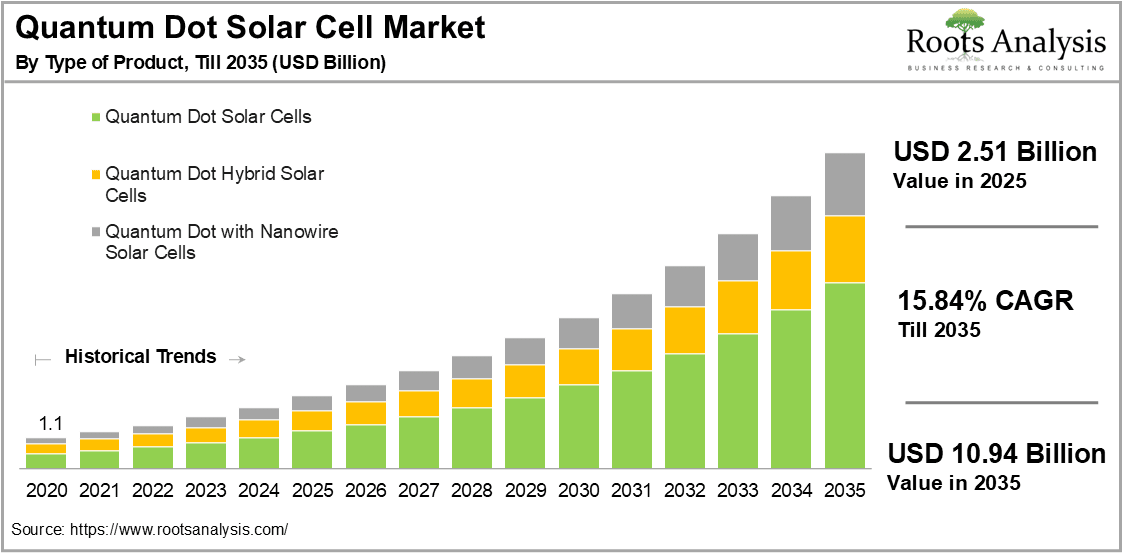
The quantum dot solar cell market size is projected to grow from USD 2.51 billion in 2025 to USD 10.94 billion by 2035, representing a CAGR of 15.84% during the forecast period till 2035.
 |
The new research study consists of quantum dot solar cell market and trends analysis, detailed market forecast analysis, and provide actionable strategic recommendations.
Quantum dot solar cell refers to a third-generation solar cell that uses quantum dots which are tiny semiconductor particles, a few nanometers in size, absorb sunlight, and generate electricity. This technology has transformed the solar industry by pushing the efficiency of present solar panel technology. Thus, the quantum dot solar cell market is evolving speedily driven by the ongoing innovation in technology. These solar cells offer higher efficiency, tunable absorption properties, and cost-effective production compared to conventional silicon-based solar cells. Also, the advancements in quantum dot synthesis, surface passivation, and hybrid architecture are boosting the performance of solar cell materials. The thin-film solar cells are promising alternatives to traditional semiconductor-based panels and offer flexible and cost-effective manufacturing of quantum dot solar cells.
Driven by the benefits of the technology, the quantum dot solar cell applications are expanding across various industries from the commercial sector and portable consumer electronics to residential building integrated photovoltaics. In addition, space & defense are increasingly adopting the technology for lightweight and high-efficiency cells for satellites. As a consequence, stakeholders and industry players are investing heavily in research and development to improve the performance and scalability of quantum dot solar cells. Recently, in February 2024, professor Sung-Yeon Jang’s team at UNIST developed a novel ligand exchange technique for perovskite quantum dots (PQDs) to enhance their stability and efficiency in solar cells. By sharing the news, profession Jang stated that their technology has achieved 18.1% efficiency in quantum dot solar cells, the highest recorded by the National Renewable Energy Laboratory (NREL).
In spite of these advancements, toxicity concerns and high cost of production remain significant challenges that are required to address in order to continue expanding the market growth.
The quantum dot solar cell market report presents an in-depth analysis of the various companies that are involved in offering quantum dot solar cell, across different segments, as defined in the table below:
| Key Report Attributes | Details | |
| Historical Trend | Since 2020 | |
| Forecast Period | Till 2035 | |
| Current Market Size | $ 2.51 Billion | |
| Market Size Value by 2035 | $ 10.94 Billion | |
| CAGR (Till 2035) | 15.84 % | |
| Type of Product |
|
|
| Type of Material |
|
|
| Type of Application |
|
|
| Type of End User |
|
|
| Geographical Regions |
|
|
| Leading Market Players |
|
|
| PowerPoint Presentation (Complimentary) |
Available | |
| Customization Scope | 15% Free Customization | |
| Excel Data Packs (Complimentary) |
|
|
The global quantum dot solar cell market is distributed into different types of products wherein the quantum dot solar cell sub-segment is anticipated to continue to dominate the segment with over (~48%) of the current market share till 2035. These products are the most established and widely researched products in the industry. They leverage the unique properties of quantum dots to enhance solar energy conversion.
Furthermore, the quantum dot hybrid solar cells segment is estimated to experience a faster (17.64%) CAGR during this forecast period. Majorly, the key factor behind the segment’s growth is the notable advantages such as the potential for higher efficiency due to synergistic effects improved charge transport, and reduced recombination losses. Additionally, quantum dots with nanowire solar cell products are gaining noteworthy demand and supplementing the growth of the market driven by the rising integration of quantum dots with semiconductor nanowires to enhance light absorption and charge collection.
This segmentation of the market describes a variety of materials available in the market such as cadmium selenide, cadmium sulfide, cadmium telluride, indium, silicon, zinc sulfide, and others. According to cadmium-free quantum dot solar cell market research, currently, cadmium selenide is leading the segment growth with the largest (~46%) of the current market share. The extensive use of cadmium-based materials due to their excellent optoelectronic properties such as high absorption, coefficients, tunable bandgaps, and relatively mature synthesis techniques, fortifies the market growth.
Apart from this, being a promising alternative to cadmium-based quantum dots, the indium-based quantum dots solar cells are gaining traction in the market. The non-toxic nature and good optoelectronic properties are the leading aspects to drive the segment’s growth. As a result, the indium material is expected to expand at a substantial CAGR of (18.5%) during this projection timeframe.
This segmentation of the market for quantum dot solar cells is segmented into a myriad of applications wherein multi-junction cells have been leading the segment with occupying around (~45%) of the current market share. The key factor of this growth is attributed to the higher efficiency compared to single junction cells, rising use in satellites and aerospace applications because of their superior power output, and expanding commercial uses. Furthermore, single junction solar cells are anticipated to rise at a higher CAGR of (16.32%) over this projection period. This growth can be attributed to the increasing demand for rooftops, and other building-integrated photovoltaics such as roof tiles, and walls.
Based on the type of end user, the commercial segment is emerging as the leading sector and is projected to hold the highest (~64%) of the market share by 2035. This trend is expected to continue owing to soaring corporate sustainability goals, building integrated photovoltaics, and increasing use of quantum dot solar cell technology in portable electronics and wearable devices in the healthcare industry. Besides this, the residential sector is fueling substantial demand for the technology for rooftop solar panel installation and demand for energy independence. Hence, the residential sector is poised to rise at a faster (17.08%) CAGR in the upcoming decade.
This segment highlights the distribution of the quantum dot solar cell market across various geographical regions, such as North America, Europe, Asia, Latin America, the Middle East and North Africa, and the rest of the world. With regard to QD solar cell market insights, North America is expected to capture (~46%) of the market share by 2035.
Moreover, Asia reflects a promising growth and is likely to grow at (19.04%) CAGR during this forecast period. Asia is witnessing rapid industrialization and urbanization which is leading to a spike in energy demand. Due to this, quantum dot solar cells with their potential for high efficiency and versatility are seen as a promising solution, thereby raising the market development in Asia. Apart from this, increasing investment in R&D and prevailing renewable energy demand are broadening the prospects of the quantum dot hybrid solar cell market in the region.
The “Quantum Dot Solar Cell Market, Till-2035: Industry Trends and Global Forecasts” report features an extensive study of the current market landscape, market size and future opportunities within the quantum dot solar cell market, during the given forecast period. The market report highlights the efforts of several stakeholders involved in this rapidly emerging segment of the service providers industry. Key takeaways of the quantum dot solar cell market report are briefly discussed below.
Essentially, the technological advancements in the quantum dot solar cell are a major key driver in elevating the market demand as they offer tunable bandgaps which enable them to absorb a broader range of the solar spectrum and lead to higher power conversion efficiencies, flexibility, and innovative material designs. Additionally, the inflating demand for renewable energy is also attributed to this significant quantum dot solar cell market growth. The growing inclination towards clean and sustainable energy sources is substantially fostering market progress with promising features of the technology that can provide alternative energy resources. Furthermore, these cells are widely used in solar windows, agrivoltaics, and portable and wearable electronics. Consequently, expanding quantum dot solar cell applications and versatility are anticipated to widen the market scope in the forthcoming years.
The competitive landscape of the market is fragmented into several established companies, innovative startups, and research institutions which are driving innovation in technology, boosting the competitive landscape. Leading quantum dot solar cell manufacturing companies such as Quantum Materials Corps, UbiQD, NN-Labs, Avantama, and others are influencing the market development with their R&D initiatives, commercialization efforts to advance quantum dot solar cell technologies and strong portfolios. Meanwhile, emerging startups are focusing on developing non-toxic quantum dots for solar energy and other applications to gain a competitive edge in the market.
Despite the promising aspects of the market for advancing solar power technologies, the industry faces various challenges such as high production costs and environmental concerns which impact the growth of the market. Firstly, the synthesis of high-quality quantum dots is generally, expansive and complex as it entails precise control over size, shape, and composition. Thus, scaling up production while maintaining cost-effectiveness remains a key challenge. Secondly, several quantum dots are made from heavy metals similar to cadmium and lead which pose environmental and health risks. As a result, regulatory restrictions and the effects of toxic materials may obstruct the adoption of quantum dots.
North America is predicted to be the dominating region in the global market for quantum dot solar cells by capturing (~46%) share till the forecast period. This dominance is ascribed to advanced research and development in the US with prominent universities, national laboratories, and private companies that are actively working on quantum dot technologies. Governments in the US and Canada substantially support these research programs by providing funding and incentives for renewable energy. Moreover, the presence of key industry players and growing technological advancements and patents related to quantum dot solar cells solidify the region’s leading position.
Examples of key players involved in the market for quantum dot solar cell (which have also been captured in this market report, arranged in alphabetical order) include Avantama (Switzerland), Canadian Solar (Canada), DuPont (US), Fraunhofer IAP (Germany), Nanosys (US), Natcore Technologies (US), Navillum Nanotechnologies (US), NN-Labs (US), Ocean NanoTech (US), Qdsolar (Canada), Quantum Material (US), QUANTUM SOLUTION (UK), Ricoh (Japan), Solterra Renewable Technologies (US), TFQD (Netherlands), Trina Solar (China), and UbiQD (US). This market report includes an easily searchable excel database of all the companies who have adopted the quantum dot solar cell market.
The market report presents an in-depth analysis, highlighting the capabilities of various companies engaged in this domain, across different segments. Amongst other elements, the market report includes:
At Roots Analysis, we genuinely care about your success and understand that your business requirements are unique. While our market research reports provide valuable insights, we recognize that they might not cover every aspect you need to make well-informed strategic decisions. To account for that, we offer 15% free report customization tailored to your specific needs. Whether you require additional quantitative analysis, qualitative insights, or any other information related to the quantum dot solar cell market, reach out us today at: support@rootsanalysis.com