


 Download Free Sample
 Buy Now
Radiation Hardened Electronics Market Size
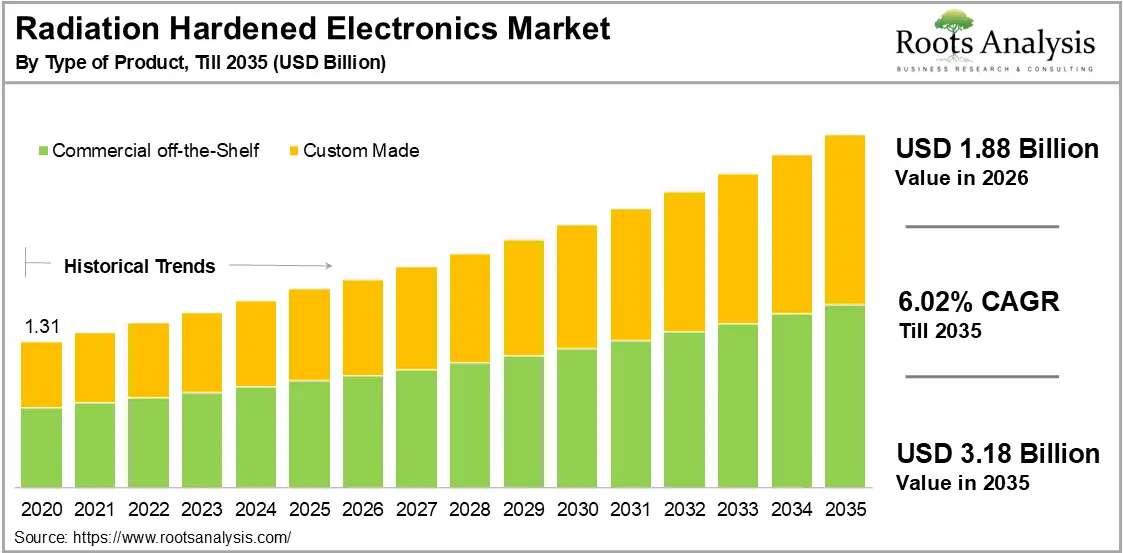
The global radiation hardened electronics market, valued at USD 1.88 billion in 2026, is projected to reach USD 2.51 billion in 2030 and USD 3.18 billion by 2035, representing a CAGR of 6.02% during the forecast period.
See What’s in the Full Report – Request Your Complimentary Insights!
Radiation Hardened Electronics Market Overview
According to Novaspace, about 8 satellites are launched each day. This high number of launches are possible due to the development of reliable space exploration electronics. Radiation hardened electronics have made a significant place in the vast development.
What’s driving the growth of the radiation hardened electronics market is the demand for nuclear reactor monitoring systems. These systems offer safe and enhanced operation of nuclear power plants. By benefitting with triple modular redundancy, these offer critical control systems.
It is worth highlighting that the demand for electronic system shielding for securing electric components against electromagnetic interference and radio frequency interference is accelerating the domain.
In reference to this, innovations in fault-tolerant computing architectures that maintain system functionality after component fail are accelerating adoption.
Consequently, the rising focus on space research programs in China, India and Japan are continuously aided by rad-hard electronics in Asia-Pacific space industry growth.
Radiation Hardened Electronics Market Recent Industry Developments
- In December 2025, QuickLogic’s contract for the development of strategic radiation hardened (SRH), high reliability field programmable gate array (FPGA) technology has been increased by the US government to support identified and future department of defense strategic and space system requirements.
- In November 2025, GlobalFoundaries announced that BAE Systems with utilized its FinFET semiconductor technology to develop advanced radiation-hardened semiconductors for new space application. Moreover, BAE Systems is also launching its RH12™ Storefront, a turnkey solution leveraging GF’s 12LP FinFET technology to rapidly develop custom radiation-hardened chips for space missions.
- In September 2025, Texas Instruments announced that it will power NASA’s NISAR satellite with radiation-hardened semiconductors for all weather earth observations.
Get an Instant Quote in 10 Minutes. Lowest Price Guaranteed
Radiation Hardened Electronics Market Share Insights
Which Type of Component Will Dominate the Radiation Hardened Electronics Market?
When it comes to the global radiation hardened electronics market, the power management segment is set to take the lead, holding a significant market share of over 36.47% of the market. This market growth is largely a result of their high efficiency in mitigating the risks of component failure due to radiation. In addition, these systems are highly reliable in satellite and defense system applications. The major reason for that is high accuracy and reliability in extreme environments.
Which Type of Manufacturing Technique Will Witness the Fastest Growth Rate?
When it comes to the radiation hardened electronics industry analysis, the radiation hardening by process (RHBP) segment is expected to grow the fastest with a projected CAGR of 6.77% during the forecast period. Here’s why: this manufacturing focuses on enhancing material quality to withstand high radiation unlike RHBD that solely focuses on designing and structure.
Such technique offers longer product life, that neglects the need for frequent replacements forwardly saving costs, boosts space electronics market.
Which Product is Most Popular in Radiation Hardened Electronics?
When we look at the products of the radiation hardened electronics market, the commercial off-the-shelf segment really stands out as the dominant application area. In fact, it’s expected to grow with a radiation hardened electronics market growth rate of 6.94% during the forecast period.
Here’s how; these products do not require dedicated infrastructure and machines, as they can be manufactured through existing technologies, they are ideal for budget conscious organizations. In addition, they also take less manufacturing time and widens profit margin.
Why is North America Leading the Radiation Hardened Electronics Industry?
According to our radiation hardened electronics market by region analysis, the North America radiation hardened electronics market currently exhibits dominance with 43.12% of the overall market share.
This is mainly because of the high focus on space research by NASA and SpaceX in the region. These spacecraft require components that are highly radiant resistance. For these crafts to work effectively commercial off the shelf (COTS) components are used.
The introduction of artificial intelligence in space systems for enhanced image processing, data analysis and autonomous decision-making is also leading the regional satellite electronics market.
Another major factor of this growth is that North America has the highest share in global defense spending that allows the region to invest in the latest deployed technologies for improved security.
Have Questions? Let’s Get Them Answered.
Radiation Hardened Electronics Market Trends and Insights
Key Market Drivers
The swift growing space exploration programs such as rising satellite launch trends are actively playing as a major key driver. As these satellites require radiation resistance components, radiation hardened electronics are ideal for such applications.
Various countries around the world are mandating radiation hardened electronics due to defense modernization programs. Particularly, India and China are highly focusing on improved defensive systems forwardly boosting military electronics market.
Furthermore, the development of silicon-on-insulator (SOI) technology for faster speed, improved resistance and lower power consumption are revolutionizing the radiation hardened semiconductors industry.
What Strategies are Companies Using to Gain Radiation Hardened Electronics Market Share?
Radiation hardened electronics suppliers are using smart strategies to stay ahead. Big players are focusing on partnerships, acquisitions, joint ventures, and innovations to strengthen their position while also investing in R&D to bring innovative and novel products to the market. Launching new technologies and expanding into regions where industry automation is growing are key moves helping them capture more market share.
What are the Challenges in Radiation Hardened Electronics?
The major challenges in radiation hardened components are a longer development cycle and high manufacturing costs. Despite the development of advanced manufacturing techniques, the process is still a long procedure.
The other major challenge is this requires specialized workers and materials that also limit the manufacturing speed. While low demand makes it impossible to bulk manufacture.
Another major challenge is performance degradation over a period of time. High-energy particles can disrupt radiation hardened memory, causing erroneous data storage or processing and even permanent failure.
Who are the Key Players in the Radiation Hardened Electronics Market?
Examples of leading radiation hardened electronics manufacturers (which have also been captured in this market report, arranged in alphabetical order) include Analog Devices, BAE Systems, GSI Technology, Honeywell, Infineon Technologies, Microchip Technology, Northrop Grumman, Renesas Electronics, STMicroelectronics and Texas Instruments.
What is the Difference Between Rhbp and Rhbd?
They both are main approaches of making radiation hardened electronics. While Rhbd focuses on designing the structure to withstand the radiation, Rhbp focuses on design as well as material enhancements for effective radiation hardened electronics.
How Nuclear Power Plant Expansions Influence Radiation Hardened Electronics Adoption?
Various countries are rapidly developing new nuclear power plants or upgrading the existing ones. To prevent the hazardous radiation contaminating the environment effective nuclear power electronics are required. Radiation hardened electronics are reliable as well as durable in withstanding radiation exposure in high-radiation environments.
What is Ionizing Radiation Protection?
Ionizing radiation protection uses three key principles: time, distance and shielding, to minimize exposure to radiation.
Pay Only for What You Need – The Best Way to Optimize
Radiation Hardened Electronics Market: Scope of the Report
| Key Report Attributes | Details | |
| Historical Trend | Since 2020 | |
| Forecast Period | Till 2035 | |
| Market Size 2026 | $ 1.88 Billion | |
| Market Size 2035 | $ 3.18 Billion | |
| CAGR till 2035 | 6.02% | |
| Type of Component |
|
|
| Type of Manufacturing Technique |
|
|
| Type of Product |
|
|
| Area of Application |
|
|
| Type of Enterprise |
|
|
| Geographical Regions |
|
|
| Key Players Profiled |
|
|
| PowerPoint Presentation (Complimentary) |
Available | |
| Customization Scope | 15% Free Customization | |
| Excel Data Packs (Complimentary) |
|
|


