


 Download Free Sample
 Buy Now
Market Size
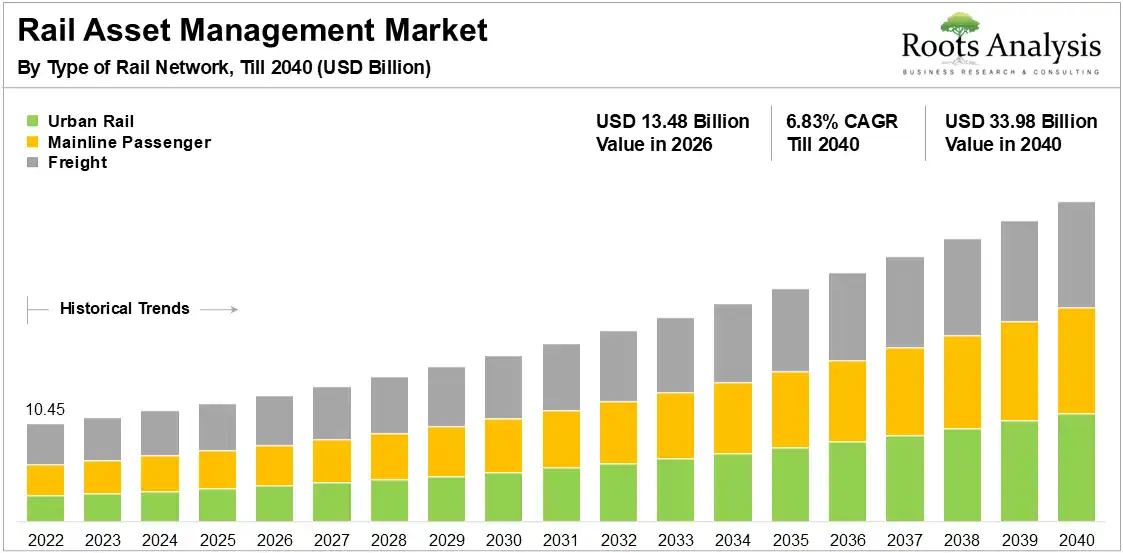
The rail asset management market size is projected to grow from USD 13.48 billion in 2026 to USD 33.98 billion by 2040, representing a CAGR of 6.83% during the forecast period 2026 to 2040.
See What’s in the Full Report – Request Your Complimentary Insights!
Market Report: Key Takeaways
- In terms of offerings, solutions hold an 86.5% share in 2026 for initial deployments, while services present a 14.1% CAGR through 2040 driven by recurring lifecycle analytics.
- By type of asset managed, rolling stock controls dominant share in 2026 securing active fleets, whereas railway infrastructure records an 8.2% CAGR till 2040 tracking digitization mandates.
- Across types of rail networks, freight dominates with a 39.5% share in 2026 for heavy-haul logistics, while urban rail projects a 7.2% CAGR through 2040 fueled by smart-city expansions.
- Within technologies, IoT captures a 35.2% share in 2026 establishing sensor backbones, yet AI / ML exhibits a 9.8% CAGR till 2040 by enabling predictive algorithmic maintenance.
- Based on deployment, on-premises currently dominate the market ensuring localized cybersecurity, while cloud platforms are projected to grow at a rapid CAGR of 8.1% through 2040 facilitating decentralized data aggregation.
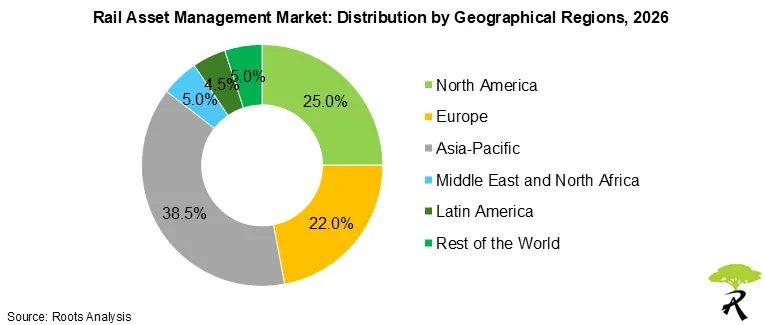
- Geographically, Asia-Pacific commands a 38.5% share in 2026 via sovereign investments, whereas North America and Europe capture substantial market shares.
- Among end users, railway operators hold a 40% share in 2026, while maintenance contractors project a 7.8% CAGR through 2040, propelled entirely by global decarbonization mega-trends.
Rail Asset Management Market Overview
Rail asset management is moving decisively away from reactive maintenance toward data-centric, proactive operational models. Industry dynamics are shifting as operators retire legacy, siloed systems in favor of integrated cloud-native platforms, a transition driven by intensifying demand for network availability and sophisticated lifecycle management. Leveraging IoT, rail authorities are embedding condition-based monitoring into core operations, fundamentally restructuring how capital-intensive assets are planned, maintained, and optimized. These market trends signal a structural reset across the global rail sector.
Safety regulations and decarbonization mandates are the primary growth drivers accelerating adoption trends across the asset management ecosystem. Government sustainability initiatives are expanding opportunity areas in predictive analytics, while heightened focus on fleet efficiency is reshaping procurement and investment priorities. In early 2025, major freight operators launched wide-scale Digital Automatic Coupling deployments to automate asset health tracking across international corridors. Cross-sector influence from telecommunications continues to raise performance expectations, reinforcing asset management's central role in broader infrastructure modernization.
The growth outlook for rail asset management is firmly upward, shaped by maturing technologies and next-generation connectivity. Digital Twins and autonomous inspection drones are transitioning from emerging tools to industry standards, while generative AI is advancing automated fault detection and predictive modeling capabilities. The 2026 deployment of dedicated 5G-R networks across high-speed corridors will enable real-time infrastructure data synchronization at scale. As digitalization deepens, the market will converge around interoperability and high-utility operations, underpinning a resilient, sustainable long-term rail trajectory.
Pay Only for What You Need – The Best Way to Optimize
Rail Asset Management Market Size Estimation Methodology
- As a starting point, we established the market scope by categorizing the rail asset management ecosystem into core solutions, professional services, and deployment architectures, carefully mapping specific application areas across rolling stock and track infrastructure.
- Then we examined the digitalization roadmaps and historical capital expenditures of national and private railway operators, evaluating the integration cycles of IoT sensors, edge computing, and AI-driven analytics to understand the strategic transition from time-based scheduling to predictive and condition-based maintenance within legacy networks.
- Thereafter, we collected critical metrics regarding active global track lengths, rolling stock fleet sizes, software licensing models, and average enterprise asset management deployment costs through primary research with key stakeholders, including rail network executives, system integrators, and rolling stock OEMs. We cross-validated these insights using secondary sources such as reports from transportation ministries, regulatory bodies, and global rail associations.
- Using these data and insights, we calculated the global rail asset management market size and projected the future market opportunity. This was achieved through a comprehensive hybrid forecasting model that married bottom-up estimates of total addressable rail assets with top-down vendor revenue analyses and software penetration rates.
- The overall opportunity associated with the global market was further distributed across distinct market segments, allocating demand by solution type, deployment architecture, and application area, as well as across key geographic regions weighted by local government railway modernization budgets, urbanization rates, and regional safety compliance mandates.
- Finally, in order to assess the sensitivity of our assumptions, we conducted a multivariate sensitivity and scenario analysis (base, optimistic, and conservative) on some of the most important parameters of our forecast methodology, evaluating the potential impact of fluctuations in public infrastructure funding, extended procurement cycles, and evolving technological interoperability standards.
Rail Asset Management Market Share Insights
Market Share by Rail Asset Management Solutions and Services
- Solutions lead the rail asset management market with a 13.5% share in 2026, projected to reach 34.0% by 2040, driven by sweeping digitalization mandates that embed enterprise asset-management suites, condition-monitoring platforms, and predictive-maintenance engines into core operational workflows.
- Regulatory requirements for digital-twin standards, safety-critical infrastructure resilience, and lifecycle-cost transparency across Europe and Asia-Pacific are compelling operators to standardize on integrated software platforms, while federal infrastructure funding is explicitly tied to data-driven asset-performance reporting. EU-backed rail modernization tenders in Germany and Italy exemplify this shift, requiring vendor-hosted APM and IoT-monitoring platforms as base contract components.
- Meanwhile, Services is the fastest-growing sub-segment, posting a 14.1% CAGR through 2040, as operators outsource the complexity of scaling multi-vendor ecosystems across legacy networks. PPP and DBFOM-style projects in India and Southeast Asia are embedding 20-year managed analytics and integration contracts, signaling a structural pivot toward service-centric revenue models.
Rail Asset Management Market Size by Technology: IoT Hardware Dominance Versus AI Predictive Scaling
- IoT holds the leading position in the industry with a 35.2% market share in 2026, based on rail asset management revenue forecast. This dominance stems from established device ecosystems and the immediate cost advantages of remote monitoring across track and rolling stock assets.
- The proliferation of mature sensor supply chains has cemented IoT as the core data backbone for infrastructure modernization. Demonstrating this scale, BNSF Railway currently utilizes extensive IoT wayside sensor arrays to capture over 35 million daily readings, providing the vital raw data required to predict mechanical anomalies and avoid severe equipment failures.
- AI / ML is the fastest-growing sub-segment, projected to reach a 9.8% CAGR through 2040. The strategic shift from reactive repair to proactive lifecycle management drives this rapid expansion. Predictive algorithms ingest massive IoT data pipelines to execute precision maintenance scheduling without disrupting active transit corridors.
- Validating this progression, Norfolk Southern recently deployed a real-time digital twin powered by continuous onboard AI imaging, directly shifting operations toward automated, proactive safety improvements. As these analytical frameworks mature, algorithmic investments will continually outpace legacy hardware expansion, permanently altering enterprise capital allocation strategies.
Want Information on Specific Region / Segment?
Rail Asset Management Market by Geographical Regions
Asia-Pacific Dominance: Region’s Capital Allocation in Sovereign Rail Digitization
- Asia-Pacific commands a structural stronghold in the global landscape, accounting for 38.5% market share in 2026. This is propelled by massive sovereign capital deployment into high-density corridor digitization. The primary market catalyst is a strict governmental mandate shifting focus from mere capacity expansion toward advanced algorithmic asset protection and predictive safety architectures.
- Validating this momentum, the China State Railway Group executed a CNY 590 billion capital expenditure plan in 2025, heavily weighting investments toward intelligent network operations and the commercialization of high-speed maglev infrastructure.
- Simultaneously, India has fundamentally altered regional procurement dynamics by tripling its rail safety budget to Rs1.17 lakh crore for FY26. This immense capital directly funds the aggressive, cross-network rollout of the Kavach Automatic Train Protection (ATP) system, establishing a dense data backbone utilizing track-mounted RFID and LTE communications.
- For technology OEMs, securing these government-backed integration contracts dictates long-term market survival. Embedding proprietary sensors and analytics into national grid mega-projects guarantees decades of recurring lifecycle management revenue. Ultimately, the scale of these sovereign deployments establishes an impenetrable competitive moat, severely restricting entry for external vendors lacking localized manufacturing footprints and deep regulatory alignment.
Capital Allocation in the Rail Asset Management Market in North America and Europe
- The rail asset management market in North America and Europe deploys divergent capitalization strategies for infrastructure optimization. In Europe, the primary catalyst is cross-border interoperability, heavily driven by the 2026 European ERTMS Deployment Plan. This regulatory mandate creates immense OEM impact, guaranteeing decades of long-term digital integration contracts.
- Conversely, North American growth relies on the Infrastructure Investment and Jobs Act (IIJA), which guarantees $1 billion annually for CRISI rail grants through FY 2026. This aggressive modernization capital establishes a strict competitive moat for domestic technology providers, accelerating AI-driven predictive maintenance deployments across aging freight rolling stock networks.
Market Ecosystem Analysis
Rail Asset Management Market Competitive Landscape
The sector is characterized by a hardware-to-service pivot, where market leadership is dictated by the velocity of digital integration. Global incumbents are leveraging M&A to absorb AI and IoT specialists, while emerging startups focus on autonomous robotics and computer vision to solve specific infrastructure safety gaps. Strategic partnerships with government-led rail agencies in Asia and Europe remain the primary revenue drivers for 2026.
Top Enterprises Activity Updates
Tier-1 equipment and network vendors are fiercely fortifying competitive moats by aggressively expanding interoperability and automation capabilities. A primary catalyst is the integration of heavy machinery with agnostic telemetry systems to solve mixed-fleet bottlenecks. For example, in April 2026, Hitachi Rail entered a definitive agreement to acquire Clever Devices, a US-based intelligent transportation leader. This strategic acquisition expands the HMAX digital suite beyond traditional rail, integrating multimodal data from over 250 global transit agencies to optimize cross-network fleet availability and energy efficiency.
Simultaneously, legacy OEMs are proving the commercial scalability of long-term digital service frameworks. Siemens Mobility recently secured a 30-year maintenance agreement with Danish State Railways (DSB) for an automated train fleet utilizing the Railigent X digital asset management (DAM) platform. This deployment anchors mission-critical connectivity and predictive diagnostics for at least three decades, raising the barriers to entry for unintegrated market participants. Furthermore, Alstom has cemented its regional stronghold through a March 2026 GBP 330 million technical support agreement with ScotRail, focusing on Class 222 fleet upgrades that embed intelligent cybersecurity and automated passenger counting directly into the asset lifecycle.
Startup Innovation: Edge Intelligence and Autonomous Logistics
The startup ecosystem is bypassing heavy hardware entirely, focusing strictly on resolving highly specific data extraction and mineral recovery inefficiencies. This agility creates immediate, low-capex integration opportunities for major infrastructure managers. A standout April 2026 catalyst is the strategic partnership between One Big Circle and LORAM, which integrates AIVR automated video review technology into global rail grinding operations. This precision imaging provides real-time track health intelligence without massive infrastructure retrofits, enabling operators to detect defects faster across international corridors.
In the autonomous logistics domain, Intramotev has successfully bridged the gap between concept and commercialization through a September 2025 agreement with Watco. The rollout of TugVolt battery-electric railcars allows for self-propelled, zero-emission material movement across private networks, disrupting traditional yard-shunting inefficiencies. Similarly, March 2026 intelligence confirms Rail Vision completed a successful proof-of-concept in India for its AI-driven MainLine obstacle detection. By validating hazard detection at ranges up to 2,000 meters in high-density environments, these hyper-focused innovations transition raw sensor data into immediate safety optimization and enhanced commercial returns.
Rail Asset Management Market Trends
AI-Enabled Health Monitoring: Cross-Asset Fleet Unification
The market is rapidly shifting from siloed repairs toward unified network-level prioritization. This operational trend is catalyzed by advanced AI-enabled data aggregation. In February 2025, Alstom scaled its HealthHub predictive platform across multiple European fleets, establishing a robust competitive moat by providing interoperable lifecycle control that actively reduces service disruptions and optimizes high-value rolling stock availability without increasing fleet volume.
OT Environment Segmentation: Hardening Legacy IT Infrastructure
Aggressive network digitization creates immense predictive opportunities, yet rigorous cybersecurity compliance strictly dictates deployment velocity. Legacy integration complexity forces infrastructure managers to mandate strict operational technology (OT) segmentation before connecting analytics. This vulnerability creates major OEM impact, strongly favoring defense-grade digital integrators capable of building secure, hardened IT / OT architectures that shield mission-critical rolling stock algorithms from emerging systemic threat vectors.
Your Business is Unique – Why Shouldn’t Your Report Be?
Market Access Considerations
Regulatory Mandates and Safety Compliance
National and international safety mandates, such as the European Train Control System (ETCS) and Positive Train Control (PTC) in the United States, dictate the fundamental baseline for market entry. These regulations necessitate rigorous certification processes that significantly increase R&D costs and extend time-to-market for new digital entrants. By mandating specific data-tracking and fail-safe capabilities, these policies accelerate the adoption of advanced monitoring tools while simultaneously creating a protective moat for established players with deep compliance expertise. Consequently, competition is often restricted to a specialized tier of providers capable of navigating complex legal frameworks and high-level safety integrity requirements.
Funding Structures and Financial Viability
The transition from traditional capital expenditure (CapEx) budgets to operational expenditure (OpEx) models is fundamentally reshaping the commercial landscape for rail technology providers. While many railway operators remain tied to rigid, multi-year government funding cycles, the emergence of software-as-a-service (SaaS) models is lowering the initial financial barriers for adoption among smaller regional players. However, this shift requires vendors to demonstrate a rapid and quantifiable return on investment (ROI) through gains in uptime and reduced manual labor to justify recurring annual costs. These dynamic favors large-scale providers who can offer flexible financing or risk-sharing models that align with the constrained fiscal environments of public transit authorities.
Procurement Complexity and Lifecycle Management
Procurement in the rail sector is characterized by exceptionally long lead times and an emphasis on public-private partnerships (PPPs) that dictate the pace of market penetration. Winning a contract often involves navigating opaque tender processes and meeting stringent local content requirements, which can disadvantage international firms without local manufacturing or service subsidiaries. Once a vendor is embedded within a network, the high cost of switching and the thirty-year lifecycle of rail assets create extreme customer stickiness and long-term revenue stability. This structure reinforces a market hierarchy where ecosystem-level partnerships and strategic alliances with infrastructure owners are essential for securing large-scale, high-value regional projects.
Data Security and Critical Infrastructure Protection
As rail systems become increasingly interconnected through IoT and cloud-based analytics, data sovereignty and cyber security protocols have become non-negotiable pillars of market access. National security concerns often lead to strict requirements for localized data hosting and the exclusion of vendors from certain geopolitical regions, particularly for state-owned critical infrastructure. These requirements increase the complexity of scaling international platforms, as solutions must be heavily customized to meet the unique compliance landscapes and encryption standards of different jurisdictions. For providers, this necessitates a robust investment in localized technical support and cybersecurity certifications to gain the trust of government-operated rail entities and ensure long-term adoption.
How Stakeholders Benefit from the Key Focus Areas of Our Rail Asset Management Market Report
As global rail networks undergo digital transformation to meet increasing demands for safety and efficiency, data-driven lifecycle management has become the primary driver of operational resilience. This report provides the critical intelligence required for stakeholders to navigate shifting regulatory standards, optimize capital allocation, and capitalize on the rapid integration of predictive technologies within the transport ecosystem.
- Unmet Needs and Market Gaps in Rail Asset Management Industry: The report identifies critical operational bottlenecks, such as data silos and the limitations of legacy manual inspection processes, which currently hinder network availability. By pinpointing these inefficiencies, technology and product leaders can direct R&D efforts toward high-value white spaces that solve real-world maintenance challenges. This insight allows firms to transform industry pain points into specialized commercialization opportunities that address the urgent need for automated, real-time monitoring solutions.
- Technology Innovation and Adoption Trends: The report evaluates the adoption drivers behind Digital Twins, AI-powered predictive maintenance, and IoT-enabled rolling stock, providing a roadmap for the future of rail operations. Technology leaders can use these insights to align their product roadmaps with the industry's shift toward autonomous infrastructure management, ensuring their solutions remain relevant as Maintenance 4.0 becomes the standard. This foresight reduces the risk of investing in soon-to-be-obsolete hardware and accelerates the transition to high-margin software services.
- Rail Asset Management Market Landscape and Competitive Dynamics: Stakeholders receive a comprehensive benchmarking of established OEMs, software-as-a-service providers, and emerging disruptors who are redefining the competitive landscape. This intelligence supports strategy leaders in evaluating their market positioning and identifying potential acquisition targets or competitive threats before they impact market share. By understanding the strategic maneuvers of key industry participants, organizations can refine their differentiation strategies and defensive postures.
- Funding and Investment Momentum in Rail Asset Management Industry: This section provides a detailed analysis of government modernization grants, public-private partnerships (PPPs), and the rising flow of private equity into rail-tech startups. Investors and financial stakeholders benefit from a clear mapping of where capital is being deployed, enabling them to assess risk profiles and identify scalable segments with high growth outlooks. Understanding these investment drivers ensures that corporate development teams align their long-term project financing with global infrastructure spending trends.
- Partnership and Collaboration Trends in Rail Asset Management Market: Mapping the complex web of alliances between traditional rail operators and technology giants reveals how the ecosystem is evolving toward integrated service models. Business development teams gain the necessary context to identify strategic partners who can facilitate faster market entry or provide the technical expertise required for complex system integrations. These insights foster a collaborative approach to market expansion, allowing companies to leverage shared resources and broader distribution networks.
- Rail Asset Management Market Demand Segmentation and Geographic Coverage: A granular breakdown of the market by offering, type of rail network, technology, type of asset managed, and region highlights specific high-growth territories where aging infrastructure or rapid urbanization is driving demand for modernization. This level of detail allows strategy and expansion teams to prioritize resource allocation toward regions with the most favorable regulatory environments and procurement pipelines. By focusing on the most promising segments, such as high-speed rail or urban transit systems, stakeholders can maximize their return on investment across the global landscape.
Have Questions? Let’s Get Them Answered.
Rail Asset Management Market: Scope of the Report
| Key Report Attributes | Details | |
| Forecast Period | Till 2040 | |
| Market Size 2026 | USD 13.48 Billion | |
| Market Size 2040 | USD 33.98 Billion | |
| CAGR (Till 2040) | 6.83% | |
| Segments Covered |
|
|
| Geographical Regions Covered |
|
|
| Key Sections Covered |
|
|
Market Segmentation
The rail asset management market report presents an in-depth analysis, highlighting the capabilities of various stakeholders, based on different segments such as offering, type of asset managed, type of rail network, technology, deployment mode, end user, geographical regions, and key players.
Market Share by Offering
- Solution
- Asset Planning & Scheduling
- Condition Monitoring
- Inventory Management
- Predictive Maintenance
- Remote Monitoring
- Security
- Services
Market Share by Type of Asset Managed
- Rolling Stock
- Railway Infrastructure
Market Share by Type of Rail Network
- Urban Rail
- Mainline Passenger
- Freight
Market Share by Technology
- IoT
- AI / ML
- Cloud Computing
- Big Data Analytics
- Others
Market Share by Deployment Mode
- Cloud
- On-premises
Market Share by End User
- Railway Operators
- Government Transport Agencies
- Infrastructure Maintenance Contractors
- Infrastructure Owners
- Rolling Stock Manufacturers
- Rolling Stock Leasing Firms
- Retail & E-commerce
- Transportation & Logistics
Market Share by Geographical Regions
- North America
- US
- Canada
- Mexico
- Rest of North America
- Europe
- Austria
- Belgium
- Denmark
- France
- Germany
- Ireland
- Italy
- Netherlands
- Norway
- Russia
- Spain
- Sweden
- Switzerland
- UK
- Rest of Europe
- Asia-Pacific
- Australia
- China
- India
- Japan
- New-Zealand
- Singapore
- South Korea
- Rest of Asia-Pacific
- Latin America
- Argentina
- Brazil
- Chile
- Colombia
- Venezuela
- Rest of Latin America
- Middle East and North Africa (MENA)
- Egypt
- Iran
- Iraq
- Israel
- Kuwait
- Saudi Arabia
- UAE
- Rest of MENA
- Rest of the World


