Refractories Market
Refractories Market: Industry Trends and Global Forecasts, Till 2035 - Distribution by Form (Refractory Bricks (Shaped) and Monolithic (Unshaped)), Primary Material (Clay Refractory and Non-Clay Refractory), Alkalinity (Acidic & Neutral, and Basic), End Use Industry (Cement, Glass, Iron & Steel, Non-Ferrous Metals, Power Generation, and Others), and Geographical Regions (North America, Europe, Asia, Latin America, Middle East and Africa, and Rest of the World)
-
Lowest Price Guaranteed
-
Slides
217 -
Last Updated
July 2025 -
View Count
12386 -
Refractories Market Overview
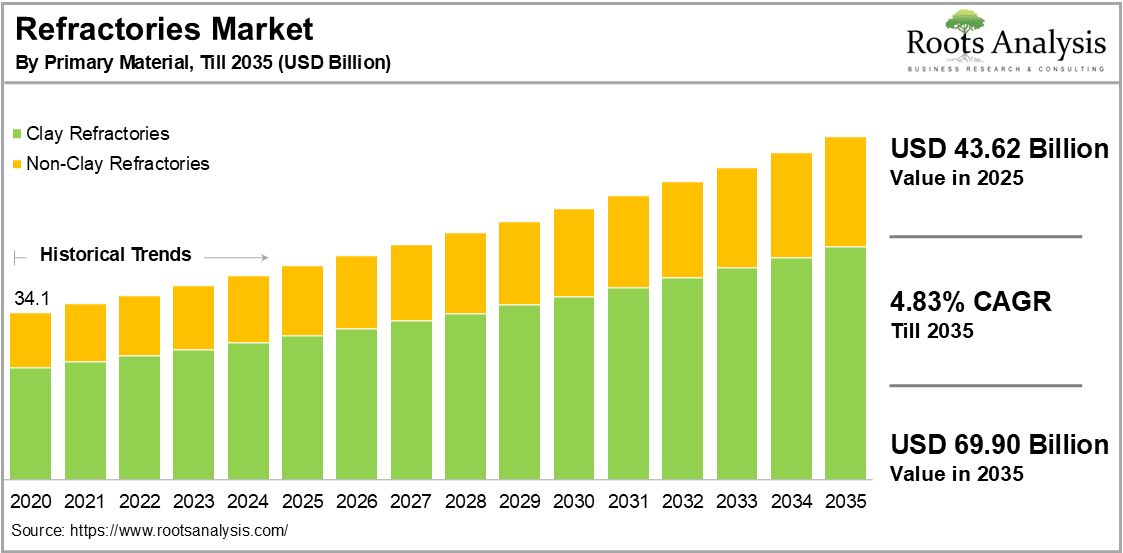
The global refractories market size is expected to rise from USD 43.62 billion in 2025 to USD 57.88 billion by 2030, and USD 69.90 billion by 2035, representing an overall CAGR of 4.83% till 2035.
 |
To learn more about this report, request a free sample copy
Refractories are specialized, inorganic, non-metallic materials engineered to withstand extremely high temperatures, mechanical stress, and chemical corrosion. These materials are typically composed of alumina, silica, magnesia, and other ceramics, and are tailored to resist specific thermal and chemical challenges encountered in industrial processes.
Essential for lining furnaces, kilns, reactors, and other high-temperature processing units, refractories protect the structural integrity of industrial equipment and ensure efficient, continuous operation in sectors, such as steel, cement, glass, and non-ferrous metals.
The refractories market sits at the intersection of industrial innovation and operational reliability. As manufacturing processes become more advanced and environmental regulations tighten, the industry is witnessing a notable shift toward sustainable, high-performance solutions.
Refractories Market Share Insights
The refractories market report presents an in-depth analysis of the various companies that are involved in offering refractory solutions, across different segments, as defined in the table below:
Refractories Market: Report Attributes / Market Segmentations
| Key Report Attributes | Details | |
| Historical Trend | Since 2020 | |
| Forecast Period | Till 2035 | |
| Market Size 2025 | $ 43.62 Billion | |
| Market Size 2035 | $ 69.90 Billion | |
| CAGR (Till 2035) | 4.83% | |
| Form |
|
|
| Primary Material |
|
|
| Alkalinity |
|
|
| End Use Industry |
|
|
| Geographical Regions |
|
|
| Leading Market Players |
|
|
| PowerPoint Presentation (Complimentary) | Available | |
| Customization Scope | 15% Free Customization | |
| Excel Data Packs (Complimentary) |
|
|
Refractories Market Segmentation
Which Form of Refractories Will Dominate the Market?
The refractories market is segmented into the refractory bricks (shaped) and monolithic (unshaped) refractory sub-segments, based on their form. Notably, the refractory bricks (shaped) sub-segment is set to take the lead, holding a significant share of 73.78%.
This significant position of the refractory bricks market is a result of their heavy demand in the metal and non-metal industries. Refractory bricks and blocks are used to form insulating furnaces, boilers, or other thermal process vessel walls.
Further, refractory bricks are used in areas that require high resistance to heat and wear, such as the linings of furnaces, kilns, and other high-temperature processing equipment. As shaped products offer greater precision, consistency, and durability compared to unshaped refractories, the segment is leading the market.
However, the monolithic (unshaped) sub-segment is likely to grow at a relatively higher CAGR of 5.18% during the forecast period.
Why is the Clay Refractory Sub-Segment Leading the Market?
According to our refractories market forecast analysis, the clay refractories sub-segment stands out as the leading one, holding a market share of 68.86%.
This growth is being attributed to clay refractories being cheaper than non-clay refractories. Fireclay bricks and insulation products are made of clay materials and are widely consumed by the iron & steel industry. Furthermore, the easy availability of raw materials for clay refractory production is also a significant factor fueling the market growth.
Meanwhile, the non-clay refractory segment is likely to witness the fastest CAGR (5.12%) during the forecast period.
Which Alkalinity Type Will Dominate the Refractories Market?
The refractories market is segmented into acidic & neutral, and basic sub-segments, based on the alkalinity type. Of these, the acidic and neutral sub-segment stands out as the leading one, currently holding a market share of 72.72%, and this trend is unlikely to change due to its versatility and wide range of applications across industries such as glassmaking, ceramics, and cement manufacturing.
Acidic & neutral refractories, which include materials like silica (SiO2) and alumina (Al2O3), offer excellent resistance to both acidic and basic slags, allowing them to effectively function in challenging chemical environments. Their ability to meet diverse industrial needs and endure harsh conditions ensures their continued demand and market dominance.
Meanwhile, the basic refractory sub-segment is expected to witness the fastest CAGR (5.12%) during the forecast period.
Iron and Steel Industry Spearheads Refractories Market Growth
Amongst all the end use industry, currently the iron and steel industry sub-segment is set to lead the overall market, capturing a share of 37.24%.
This segment growth can be attributed to the ongoing and growing need for steel across various industries, including construction, automotive, and infrastructure. Moreover, increasing investment in infrastructure projects (such as developing roads, bridges, and buildings) from governments and private investors is further fueling the growth of this segment.
Meanwhile, the glass & ceramics sub-segment is expected to witness the fastest CAGR (5.87%).
Which Regions are Expected to See the Highest Refractories Market Demand?
The Asian refractories market exhibits dominance by capturing 36.86% of the overall current market share due to the robust industrial expansion across multiple sectors.
The region’s market dynamics are primarily shaped by China’s massive manufacturing base, India’s rapid industrialization, Japan’s technological advancement in refractory applications, and South Korea’s strong presence in the steel and electronics sectors.
The presence of major steel producers, growing infrastructure development, and increasing investments in industrial capacity expansion further fuels the demand of the refractory materials market across the region.
On the other hand, the North America market is set to witness the fastest CAGR (5.11%) during the forecast period.
Refractories Market Key Insights
The “Refractories Market: Industry Trends and Global Forecasts, Till 2035” report features an extensive study of the current market landscape, market size, and future opportunity within the global refractories market forecast period. The market report highlights the efforts of several stakeholders involved in this rapidly emerging segment of the service providers industry. Key takeaways of the market report are briefly discussed below.
Refractories Market Drivers and Challenges
What are the Key Drivers for Growth in the Refractories Market?
The refractories market is experiencing robust growth due to several key drivers. Here are some significant factors contributing to this expansion:
- Expansion of Steel and Iron Industry: The steel industry is the largest consumer of refractories, as these materials are essential for lining furnaces, converters, and ladles that operate at extremely high temperatures. The steady growth in steel production, driven by infrastructure development, urbanization, and industrialization worldwide, is a primary factor fueling demand for refractories. The shift toward more energy-efficient steelmaking processes, such as electric arc furnaces, is also creating opportunities for innovative high temperature refractories.
- Growth in Cement and Construction Sectors: Refractories play a critical role in cement manufacturing, where they are used to line kilns and maintain operational efficiency. The ongoing expansion of construction activities and infrastructure projects globally is boosting cement production, thereby increasing the need for refractory for cement industry. This trend is especially pronounced in emerging economies with rapid urbanization and large-scale construction initiatives.
- Advancements in Refractory Technology: Continuous innovations in refractory materials market, including the development of energy-efficient, durable, and environmentally friendly products, are enhancing performance and extending the lifespan of refractory linings. Technological advancements are enabling manufacturers to offer tailored solutions for specific industrial applications, further driving market growth.
- Industrialization and Infrastructure Development: The global industrial sector is expanding, with increased investments in manufacturing, energy, and heavy industries. This growth is driving demand for refractories across various applications, including glass production, petrochemicals, and non-ferrous metals processing. The focus on infrastructure development, especially in Asia, is a significant contributor to market expansion.
What Challenges Affect Refractories Production and Supply?
The current refractories market outlook suggests that players active in this domain are striving to overcome various everlasting challenges, which are as follows:
- Volatility in Raw Material Prices: The refractories market is highly sensitive to fluctuations in the prices of key refractory raw materials, such as alumina, silica, magnesite, and bauxite. Price volatility impacts the production costs and profit margins for refractory manufacturers.
- Supply Chain Disruptions: Geopolitical tensions, trade restrictions, and logistical challenges can disrupt the supply of raw materials and finished products, affecting market stability and production schedules.
- Environmental Regulations and Compliance: Strict environmental regulations regarding emissions, waste management, and resource utilization require manufacturers to invest in cleaner technologies and sustainable practices, increasing operational costs.
- High Production and Processing Costs: The manufacturing of refractories involves complex processes and significant energy consumption, leading to high production costs and potential barriers for new entrants.
- Competition from Alternative Materials: The emergence of alternative high-temperature materials and coatings, and advanced technologies, including spinel-based refractories, sprayed-cooling technology, andalusite, corundum, metakaolin-based geopolymers, porous aggregates, and rice husk ash, poses a threat to traditional refractories sustenance.
What Drives the Current Refractories Market Demand?
Currently, the impact of steel industry on refractories market is huge and the refractory for steel industry accounts for about 65-70% of global demand. This is due to fact that steel production processes require materials that withstand extreme temperatures and harsh environments.
Rising applications in the cement, glass, and non-ferrous metal industries, as well as advancements in energy-efficient refractories contribute to the overall rising refractories demand.
Advancements in Energy-Efficient Refractories to Shape the Refractories Industry?
Technological innovations are leading to the development of more durable, energy-efficient, and sustainable refractory materials, with a strong focus on products that enhance productivity, reduce emissions, and support cleaner steelmaking processes.
How is Refractories Market Growth Driven by Cement Sector?
Rising infrastructure investments and construction activities are boosting cement production, which in turn increases demand for refractories used in high-temperature cement kilns and related equipment.
How are Government Policies Influencing Refractories Market?
Government initiatives promoting infrastructure, environmental regulations, and incentives for local manufacturing and recycling are significantly shaping the refractories market, especially in developing regions.
Competitive Landscape and Key Players in Refractories Market?
The refractories market is competitive, with leading players, such as RHI Magnesia, Saint-Gobain, Imerys, Vesuvius, Calderys, and HarbisonWalker, focusing on innovation, product launches, and expanding their global reach.
These companies invest heavily in R&D to offer differentiated solutions, while also facing competition from open-source and emerging proprietary companies. Besides the above initiatives, competitors are opting for various technological innovations to strengthen their position in the global refractories market.
Recent Developments in the Refractories Market
- In May 2025, Calderys made significant progress on its major Greenfield Project in India. This project is the first production line, dedicated to acidic monolithic refractories and has entered the commissioning and ramp up phase.
- In February 2025, Calderys invested in a state-of-the-art Innovation Center in Neuwied, Germany.
- In January 2025, RHI Magnesita and MCi Carbon received a funding of EUR 3.8 million to establish the world’s first Carbon Capture and Utilisation (CCU) plant in the refractory industry in Austria.
- In January 2025, Calderys launched an expanded product range of Fast Dry refractory solutions for improved dry-out of industrial furnaces.
Refractories Market Report Coverage
The market report presents a guide to understanding different types of refractories and their applications, highlighting the capabilities of various companies engaged in this domain, across different segments. Amongst other elements, the market report includes:
- A preface providing an introduction to the full report, refractories market, 2020-2024 (Historical Trends) and 2025-2035 (Forecasted Estimates).
- An outline of the systematic research methodology adopted to conduct the study on the refractories market, providing insights on the various assumptions, methodologies, and quality control measures employed to ensure the accuracy and reliability of our findings.
- An overview of economic factors that impact the overall refractories market, including historical trends, currency fluctuation, foreign exchange impact, recession, and inflation measurement.
- An executive summary of the refractories market insights captured during our research. It offers a high-level view of the current state of the market and its likely evolution in the mid-long term.
- A detailed assessment of the refractories market landscape, based on several relevant parameters, including year of experience, company size, location of headquarters, and ownership structure.
- Elaborate profiles of prominent players engaged in the refractories market, featuring information on their year of establishment, location of headquarters, company size, company mission, company footprint, management team, contact details, financial information, operating business segments, refractories market portfolio, moat analysis, recent developments, and an informed future of refractories systems.
- A qualitative assessment of the various megatrends ongoing in the refractories market, including rising steel and cement production, technological advancements, sustainability and green solutions and expansion in end-use industries.
- An analysis highlighting the key unmet needs across refractories market industry, featuring market research on refractories industry analysis generated from real-time data on unmet needs as identified from social media posts, recent publications, industry blogs and the views of key opinion leaders expressed on online platforms.
- An in-depth analysis of various patents that have been filed / granted related to refractories market and its components, based on various parameters, such as type of patent, patent publication year, patent age and leading players
- A detailed analysis of recent developments in the refractories market domain, based on relevant parameters, such as year of initiative, type of initiative (partnerships and collaborations, expansions, funding and product launches), geographical distribution and most active players (in terms of number of recent developments).
- Key winning strategies framework that helps in analyzing the level of competition within an industry, by tracing the key market activities, including partnership, funding, and expansion of leading players
- A qualitative analysis highlighting the five competitive forces prevalent in the refractories market industry, including threats for new entrants, bargaining power of suppliers, bargaining power of customers, threats of substitution and rivalry among existing competitors.
- A discussion on affiliated refractories market trends, key drivers and challenges, under a SWOT framework, which are likely to impact the industry’s evolution, along with a Harvey ball analysis, highlighting the relative effect of each SWOT parameter on the overall refractories market.
- A value chain analysis features a discussion on various stakeholders involved in the development of the market, from suppliers to end-users.
- A detailed estimate of the current market size and the potential growth future of refractories market initiatives over the next decade. Based on multiple parameters we have provided an informed estimate on the market evolution during the forecast period 2025-2035. The report also features the likely distribution of the current and forecasted opportunity within the refractories market. Further, in order to account for future uncertainties and to add robustness to our model, we have provided three forecast scenarios, namely conservative, base, and optimistic scenarios, representing different tracks of the industry’s growth.
- Detailed projections of the current and future market across various forms, such as refractory bricks (shaped) and monolithic (unshaped).
- Detailed projections of the current and future market across various primary materials, such as clay refractory and non-clay refractory.
- Detailed projections of the current and future market across alkalinity, such as acidic, basic, and neutral.
- Detailed projections of the current and future market across various end use industries, such as cement, glass, iron & steel, non-ferrous metals, power generation and others.
- Detailed projections of the current and future refractories market across various geographical regions, such as North America (US, Canada, Mexico and other North American countries), Europe (Austria, Belgium, Denmark, France, Germany, Ireland, Italy, Netherlands, Norway, Russia, Spain, Sweden, Switzerland, UK and other European countries), Asia (China, India, Japan, Singapore, South Korea and other Asian countries), Middle East and Africa (Egypt, Iran, Iraq, Israel, Kuwait, Saudi Arabia, UAE and other MEA countries), Latin America (Brazil, Chile, Colombia, Venezuela and other Latin American countries) and rest of the world (Australia, New Zealand and other countries).
Glossary
- Dolomite: Dolomite is a mineral made of calcium and magnesium carbonate (CaMg(CO3)2). It is used as a basic refractory material in steelmaking because it resists high temperatures and erosion.
- Electric Arc Furnace (EAF): An electric arc furnace is a type of furnace that heats materials using an electric arc between electrodes. It is widely used in steelmaking and can reach temperatures up to 1,800°C.
- Fireclay: Fireclay is a type of clay that can withstand very high temperatures without melting or deforming. It is mainly composed of alumina and silica and is used to make fireclay bricks for lining furnaces and kilns.
- Kiln: A kiln is a high-temperature oven or furnace used for firing, drying, or baking materials, such as ceramics, glass, or minerals. It is commonly used in industries, such as pottery, cement, and ceramics.
From the Author’s Desk
Author’s View on Refractories Market
The refractories market is experiencing robust growth, driven by the rising demand for materials that can withstand extreme heat and harsh environments in industries, such as steel, cement, glass, and energy. Refractories provide essential benefits, like high-temperature resistance, chemical stability, and durability, making them indispensable for lining furnaces, kilns, and reactors. As industrial processes become more advanced and energy-efficient, refractories are playing a crucial role in enabling innovation, improving productivity, and supporting sustainable manufacturing worldwide.
About Authors
Lead Author: Anmol Bali
Lead Reviewer: Yash Tyagi
Chief Editor: Ronit Sharma
Customization Opportunities
At Roots Analysis, we genuinely care about your success and understand that your business requirements are unique. While our refractories market research report provides valuable insights, we recognize that they might not cover every aspect you need to make well-informed strategic decisions. To account for that, we offer 15% free report customization tailored to your specific needs. Whether you require additional quantitative analysis, qualitative insights, or any other information related to the refractories market, reach out us today at: support@rootsanalysis.com