
Lowest Price Guaranteed
Slides
213
Last Updated
August 2025
View Count
10853
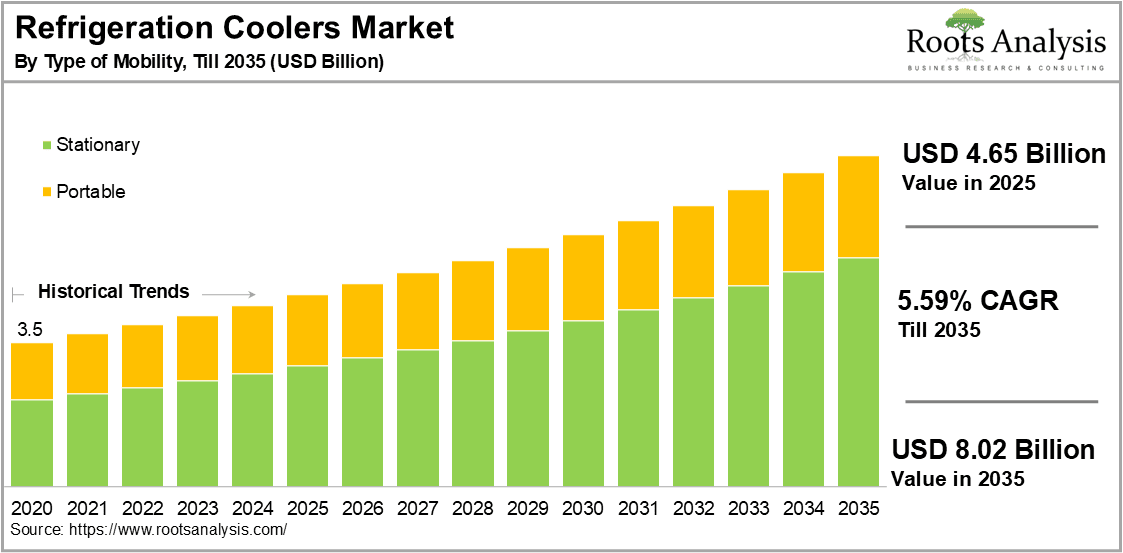
The global refrigeration coolers market, valued at USD 4.4 billion in 2024, is projected to reach USD 4.65 billion in 2025 and USD 8.02 billion by 2035, representing a CAGR of 5.59% during the forecast period.
 |
The new research study consists of global refrigeration coolers market analysis, mega trends, patent analysis, porter five forces, SWOT analysis, value chain analysis and other strategic frameworks.
Refrigeration coolers are systems designed to reduce and maintain the temperature of a space, substance, or system below that of its surroundings. This cooling effect is achieved by extracting heat from a low-temperature reservoir and transferring it to a higher-temperature one.
These coolers address several critical problems across various industries. Primarily, they combat food spoilage by slowing down the microbial activity that causes decay, thereby extending the shelf life of perishable goods. Additionally, refrigeration coolers provide thermal comfort in residential, commercial, and industrial settings and enable the safe storage and transportation of temperature-sensitive products, such as pharmaceuticals and chemicals.
The refrigeration coolers market is experiencing robust growth driven by multiple factors. Increasing consumer demand for frozen and chilled products, influenced by changing lifestyles and increasing urbanization, plays a significant role. The expansion of the organized retail sector, including supermarkets and hypermarkets, boosts sales of refrigeration coolers, such as walk-in coolers, and beverage coolers. In addition, technological advancements and the increasing prevalence of fast-service restaurants, especially in developing countries, are creating substantial opportunities for market expansion. Growing awareness and stringent enforcement of food safety regulations are further bolstering the demand for reliable refrigeration solution market. Finally, the surge in e-commerce has fueled the need for efficient cold chain logistics, driving increased demand for refrigeration coolers that ensure optimal temperatures are maintained during the storage and transport of perishable goods.
The refrigeration coolers market report presents an in-depth analysis of the various companies that are involved in offering refrigeration coolers solutions, across different segments, as defined in the table below:
| Key Report Attributes | Details | |
| Historical Trend | Since 2018 | |
| Forecast Period | Till 2035 | |
| Current Market Size | $ 4.65 Billion | |
| Market Size 2035 | $ 8.02 Billion | |
| CAGR (Till 2035) | 5.59% | |
| Type of Components |
|
|
| Type of Refrigerant |
|
|
| Type of Coolers |
|
|
| Areas of Application |
|
|
| Type of Cooling Technology |
|
|
| Type of Mobility |
|
|
| By End-Users |
|
|
| Type of Enterprise |
|
|
| Geographical Regions |
|
|
| Leading Market Players |
|
|
| PowerPoint Presentation (Complimentary) |
Available | |
| Customization Scope | 15% Free Customization | |
| Excel Data Packs (Complimentary) |
|
|
The global refrigeration coolers market is segmented into various types of components, such as air coolers, compressors, condensers, and evaporators. According to our global refrigeration coolers market size analysis, the compressor segment will augment the segment's growth with the largest market share of over 54.56% by the next decade. This market growth is largely due to their widespread use across residential, commercial, and industrial applications, coupled with their essential role in energy efficiency and system performance. Additionally, the growing demand in refrigeration compressors market for energy-efficient and eco-friendly compressors, driven by stringent regulations and technological advancements, is further strengthening the market growth.
On the other hand, it is worth highlighting that the evaporator segment is expected to witness the fastest CAGR of around 6.87% during the forecast period. This rapid growth can be attributed to the rapid growth of refrigeration systems market in emerging economies and the food & beverage industry. Innovations in evaporator design, such as microchannel and compact evaporators, are enhancing efficiency and reducing costs, driving their growth.
The market is segmented into various types of refrigerants such as ammonia, brine, CO2, glycol, HFC/HFO, hydrocarbon blends, NH3, propane, and other types of refrigerants. According to our refrigeration coolers growth forecast, the HFC/HFO segment will augment the segment's growth with the largest market share of over 35.68% by the next decade. HFCs have been widely used due to their excellent thermodynamic properties and compatibility with existing refrigeration systems. However, with increasing environmental regulations phasing out high-GWP (Global Warming Potential) refrigerants, HFOs are gaining traction as they offer lower GWP and improved environmental performance. The transition from HFCs to HFOs, driven by regulatory compliance and sustainability goals, ensures the continued dominance of this segment in the market.
Furthermore, the hydrocarbon blends segment is expected to witness a growth of CAGR of 7.86% during the forecast period. This growth is fueled by their low environmental impact, as they have negligible ozone depletion potential (ODP) and very low GWP.
The market is segmented into various types of coolers, such as built-in coolers, display coolers, industrial coolers, and portable coolers. According to our analysis, the industrial coolers segment will increase the market share of refrigeration coolers by 54.26% during the forecast period. The growing demand for efficient cooling solutions in industrial processes, coupled with the expansion of cold chain logistics and the need for temperature-sensitive storage, is fueling the market growth and dominance of this segment.
Furthermore, the portable coolers segment is expected to witness the fastest CAGR of around 6.23% during the forecasted period. This growth is driven by their versatility, convenience, and increasing use in residential, commercial, and outdoor settings. The rise in outdoor recreational activities, camping, and events, along with the growing demand for compact and energy-efficient cooling solutions, is driving the growth of this segment.
The market is segmented into various areas of application, such as agriculture, chemical storage, food and beverage, and pharmaceuticals. According to our analysis, the food and beverage segment will increase the market share of refrigeration coolers by 64.18% during the forecast period. This growth is due to the extensive use of refrigeration systems in food processing, storage, and retail cooler market, including supermarkets, restaurants, and cold storage facilities. The growing demand for perishable goods, the expansion of the cold chain, and the need to maintain food safety and quality are key drivers of this segment's dominance.
Furthermore, the pharmaceuticals segment is expected to witness the fastest CAGR of around 7.29% during the forecast period. The pharmaceutical industry relies heavily on refrigeration for the storage and transportation of temperature-sensitive drugs, vaccines, and biologics. The increasing demand for healthcare services, the growth of biopharmaceuticals, and the need for stringent temperature control in vaccine distribution (especially post-COVID-19) are driving the rapid adoption of advanced refrigeration coolers.
The market is segmented into various types of cooling technology, such as absorption, magnetic refrigeration, thermoelectric, and vapor compression. According to our analysis, the vapor compression segment will increase the market share of refrigeration coolers by 64.6% during the forecast period. This growth is due to its high efficiency, reliability, and ability to handle a wide range of cooling capacities. It is extensively applied in residential, commercial, and industrial refrigeration systems, including air conditioners, refrigerators, and freezers.
On the other hand, the magnetic refrigeration segment is expected to witness the fastest CAGR of around 7.81% during the forecast period. Magnetic refrigeration is an emerging technology that offers several advantages, such as higher energy efficiency, reduced environmental impact, and the absence of harmful refrigerants. Although still in the early stages of commercialization, its potential for sustainable refrigeration technology solutions is driving significant research and development efforts.
The market is segmented into various types of mobility, such as portable and stationary. According to our analysis, the stationary segment will increase the market share of refrigeration coolers by 74.6% during the forecast period. Stationary refrigeration systems, such as built-in coolers, industrial coolers, and fixed commercial refrigeration units, are widely used in applications like food storage, supermarkets, pharmaceuticals, and industrial processes. Their ability to provide consistent and large-scale cooling, along with their integration into existing infrastructure, makes them indispensable across various sectors.
Furthermore, the portable segment is expected to witness the fastest CAGR of around 6.21% during the forecasted period. This growth is driven by their flexibility, convenience, and increasing use in residential, outdoor, and small-scale commercial settings. The rise in outdoor activities, events, and on-the-go lifestyles, coupled with advancements in portable cooler technology, is driving the growth of this segment.
The market is segmented into various end-users, such as commercial, industrial and residential. According to our analysis, the commercial segment will increase the market share of refrigeration coolers by 67.63% during the forecasted period. The surge in consumer demand for fresh and frozen products, coupled with the expansion of quick-service restaurants and grocery chains, has significantly boosted this segment. Additionally, the increasing adoption of energy-efficient and eco-friendly refrigeration systems in commercial spaces further cements its dominant position in the market.
Furthermore, the industrial segment is expected to witness the fastest CAGR of around 5.98% during the forecasted period. This growth is fueled by the critical role industrial refrigeration plays in sectors like food processing, pharmaceuticals, and chemical manufacturing, where maintaining precise temperature control is essential.
The market is fragmented into two types of enterprises, namely large and small and medium enterprises. Currently, the large enterprise segment is expected to dominate the segment with 60.34% of the market share as demand for refrigeration coolers is rising among large enterprises. However, small and medium enterprise segments are expected to witness a relatively higher (24.78%) growth rate until 2035. This is ascribable to their agility, innovation, focus on niche markets, and ability to adapt to changing customer preferences and market conditions.
This segment highlights the distribution of refrigeration coolers market share by regions, such as North America, Europe, Asia, Latin America, Middle East and North Africa, and the rest of the world. According to our regional analysis, Asia currently exhibits dominance with 37.69% of overall market share. The market is driven by the rapid growth of the commercial refrigeration market as well as industrial applications. Further, environmental regulations and increasing awareness towards sustainable practices is also fueling the market growth.
The “Refrigeration Coolers Market, Till-2035: Industry Trends and Global Forecasts” report features an extensive study of the current market landscape, market size and future opportunity within the refrigeration coolers market forecast period. The market report highlights the efforts of several stakeholders involved in this rapidly emerging segment of the service providers industry. Key takeaways of the global refrigeration coolers market report are briefly discussed below.
The global refrigeration coolers market growth is expected to be driven by several key factors including the rising demand for food preservation and storage solutions due to a growing global population and shifting consumer preferences towards healthier diets. Urbanization and the expansion of e-commerce in food and grocery deliveries have increased the need for refrigeration in logistics and transportation, particularly within cold chain logistics for temperature-sensitive products.
Technological advancements in energy-efficient cooling systems, such as improved insulation, sustainable refrigerants, and smart refrigeration integrating IoT for remote monitoring, are also propelling market growth as businesses seek to reduce energy consumption and operating costs. The growth of retail chains, like supermarkets and hypermarkets, alongside increasing investments in refrigerated warehouses and a rising demand for frozen and processed foods, further contributes to the expansion of the refrigeration coolers market.
According to the refrigeration coolers competitive landscape analysis, with the presence of several small and large companies, the market is experiencing intense competition and changing market dynamics. From large multinational companies to local players, companies are striving to enhance their competitive edge. In terms of market share, large enterprises and multinational companies are dominating the market. The key players are using strategies such as partnerships, acquisitions, ventures, innovations, novel product launches, R&D and geographical expansions to solidify their position in the industry.
Despite the strong market growth projection, there are several challenges in the refrigeration coolers market. One of the primary issues is stringent regulations regarding energy efficiency and refrigerant usage, which can lead to substantial costs for businesses striving to comply. Smaller companies often struggle to navigate this complex regulatory landscape due to a lack of specialized knowledge and resources, impacting their profitability and competitive positioning.
Additionally, the high installation and maintenance costs of advanced refrigeration coolers, especially those using low GWP refrigerants, can pose a financial barrier, particularly for small businesses. The industry also grapples with the need to transition to refrigerants with reduced Ozone Depletion Potential (ODP) and Global Warming Potential (GWP), which presents a challenge for original refrigeration equipment market and operators. Balancing compliance with operational efficiency remains a critical concern, particularly as regulations continue to tighten.
With respect to regional industry insights, Asia is likely to dominate the market for the forecast period. The dominance of this region is majorly influenced by the government subsidies for establishing cold chain networks which are further expanding the cold chain infrastructure throughout the region. The growth in commercial areas, such as retail stores, cafes, supermarkets, mini stores, and hospitality centers in Asia has increased the demand for food products which is further fueling the growth of the refrigeration coolers market.
Examples of leading refrigeration coolers manufacturers (which have also been captured in this market report, arranged in alphabetical order) include AHT Cooling Systems, Beverage-Air, Blue Star, CABERO, Carrier, Centauro, Daikin, Danfoss, Electrolux, Emerson, Evapco, Friterm, Frigidaire, General Electric, Gree Electric, H. Güntner, Haier, Hitachi, Johnson, Kelvion Holding, KFL SRL, Kigali Refrigeration, Koxka, Lennox, LG, Lu-Ve SPA, Mitsubishi, Modine Manufacturing, Onda, Panasonic, Refrion, Rivacold, Roen, Samsung, Stefani, Sub-Zero, Thermofin, Thermokey, Thermo King, Trane, Walter, and Whirlpool.
The market report presents an in-depth analysis, highlighting the capabilities of various companies engaged in this domain, across different segments. Amongst other elements, the market report includes:
At Roots Analysis, we genuinely care about your success and understand that your business requirements are unique. While our refrigeration coolers market research reports provide valuable insights, we recognize that they might not cover every aspect you need to make well-informed strategic decisions. To account for that, we offer 15% free report customization tailored to your specific needs. Whether you require additional quantitative analysis, qualitative insights, or any other information related to the refrigeration coolers market, reach out us today at: support@rootsanalysis.com