
Lowest Price Guaranteed
Slides
244
Last Updated
August 2026
View Count
13508
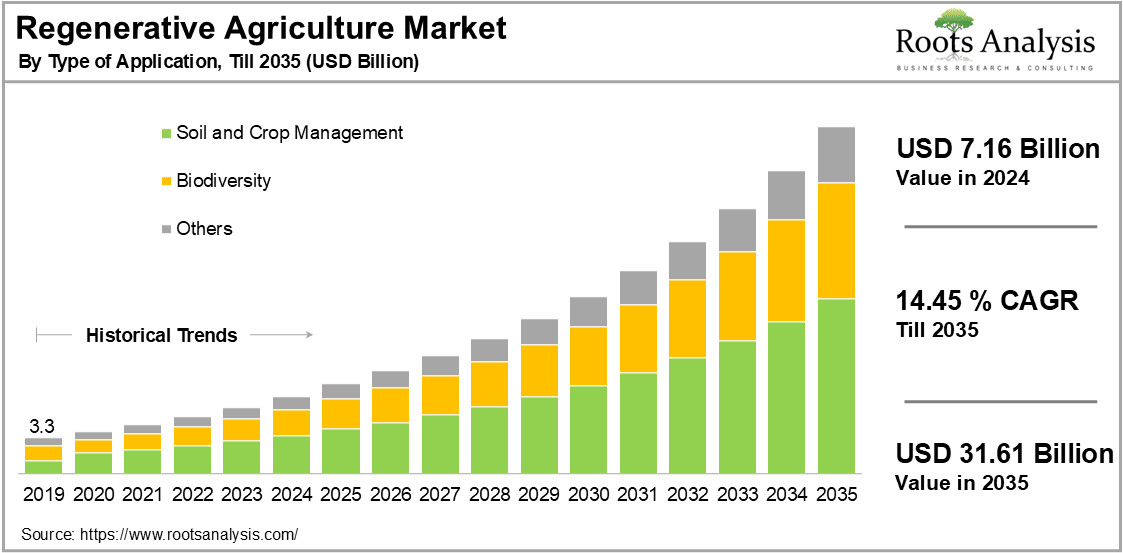
The regenerative agriculture market size is projected to grow from USD 7.16 billion in 2024 to USD 31.61 billion by 2035, representing a CAGR of 14.45%, during the forecast period till 2035.
 |
To learn more about this report, request a free sample copy
The new research study consists of regenerative agriculture market and trends analysis, detailed market forecast analysis, and provide actionable strategic recommendations.
In recent years the growing concern of soil degradation and the negative environmental impact of conventional farming processes has created the need for more sustainable agricultural practice similar to regenerative agriculture. In 1980s, the first introduced regenerative agriculture is an approach of farming that goes beyond sustainability to restore and enhance the soil fertility, environment, and ecosystem. The purpose of regenerative agriculture is to rebuild natural resources, improve biodiversity, increase farm resilience, water management and conservation, carbon sequestration, and climate mitigation. Due to these aspects, the regenerative agriculture market is witnessing an acceleration in the adoption of regenerative agricultural practices. Some of these practices are agroforestry, cover cropping, no-till farming, silvopasture, and more which offer a holistic solution that not only provides environmental and social benefits but also boosts economic conditions.
Apart from benefits, some significant driving factors are amplifying the market potential such as growing support from governments, farmer welfare associations, and organizations. For example, in September 2024, the International Finance Corporation (IFC) a member of the World Bank Group collaborated with Agreena, a Danish climate fintech company to promote sustainable farming in Eastern Europe. This collaboration emphasizes increasing financial access for farmers transitioning to regenerative agriculture and helping banks meet their green finance targets. Moreover, emerging regenerative agriculture trends like a hike in the adoption of data-driven farming, precision farming, and high investment in regenerative practices are creating lucrative opportunities for industry players which will magnify the market outlook. Overall, influenced by these factors, the market is projected to thrive during this forecast period.
The regenerative agriculture market report presents an in-depth analysis of the various companies that are involved in offering regenerative agriculture, across different segments, as defined in the table below:
| Key Report Attributes | Details | |
| Historical Trend | Since 2019 | |
| Forecast Period | Till 2035 | |
| Current Market Size | $ 7.16 Billion | |
| Market Size Value by 2035 | $ 31.61 Billion | |
| CAGR (Till 2035) | 14.45% | |
| Type of Practice |
|
|
| Type of Application |
|
|
| Geographical Regions |
|
|
| Leading Market Players | ||
| PowerPoint Presentation (Complimentary) |
Available | |
| Customization Scope | 15% Free Customization | |
| Excel Data Packs (Complimentary) |
|
|
The market is segmented into a variety of practices such as agroecology, agroforestry, aquaculture, biochar & terra preta, holistically managed grazing, no-till and pasture cropping, silvopasture, and others. As per this regenerative agriculture market report, the agroforestry segment is projected to hold a maximum of (~44%) of the market share by 2035. Numerous benefits of agroforestry are the major factors behind the segment dominance. Agroforestry integrates trees and shrubs into crop and livestock systems that enhance soil health by adding organic matter through leaf litter and root biomass. This practice aids in boosting soil fertility and provides a long-term nutrient source for crops which minimizes the need for synthetic fertilizer. However, the no-till and pasture cropping segment is likely to expand at a higher CAGR of (15.7%) during this projection timeframe. This can be attributed to its broad environmental, economic, and resilience-building benefits such as less soil erosion, reduced carbon sequestration, and enhanced water retention.
Based on the type of application, the regenerative agriculture market is categorized into biodiversity, operation management, soil and crop management, and others. According to our regenerative agriculture market analysis, the soil and crop management application is anticipated to hold the largest (~48%) of the market share by 2035. This trend will likely remain mainly due to a wide range of practices from crop yield to farm sustainability that directly impact soil health. The cruciality of healthy soil in more resilient crops and stable yields enhances the need for soil health management in agricultural practices, thereby fueling market growth. It also helps nitrogen fixation, nutrient cycle, and water retention which are vital for overall soil and crop management. Whereas the biodiversity segment is poised to witness a faster (15.28%) CAGR throughout this forecast period. The advantages of regenerative agricultural practices provide solutions that improve biodiversity by offering pest and disease resistance, soil restoration methods, and microbial diversity. Also, agroforestry benefits and crop rotation in biodiversity contribute to boosting the market progress.
This segment highlights the distribution of the regenerative agriculture market across various geographical regions, such as North America, Europe, Asia, Latin America, the Middle East and North Africa, and the rest of the world. In terms of revenue, North America is estimated to capture (~49%) of the market share and will retain its leading position till 2035. Furthermore, Asia is projected to grow speedily with the highest CAGR of (16.24%) over this projection period. The factor behind the region’s growth can be ascribed to an upsurge in government support and policy initiatives to provide subsidies and financial incentives to promote sustainable and regenerative agriculture. Also, scarcity of water, land degradation, and increasing demand for organic products are spurring the market growth in Asia.
The “Regenerative Agriculture Market, Till-2035: Industry Trends and Global Forecasts" report features an extensive study of the current market landscape, market size, and future opportunities within the regenerative agriculture market, during the given forecast period. The market report highlights the efforts of several stakeholders involved in this rapidly emerging segment of the service providers industry. Key takeaways of the regenerative agriculture market report are briefly discussed below.
Significantly, the increasing environmental concerns and climate change are key drivers to lift the market demand. In recent years, the incidence of soil degradation and biodiversity loss has continued to surge as conventional farming practices have degraded soil quality and decreased biodiversity which negatively impacts food production. Thus, regenerative agricultural technology becomes the boon that helps restore soil health, enhance biodiversity, and address ecological challenges. Furthermore, mounting consumer demand for sustainable products and growing corporate sustainability commitments are attributed to forward market expansion as modern consumers demand transparency in how products are grown and sourced. Therefore, large companies are employing sustainability strategies and investing in regenerative supply chains that aid them in building credibility and encourage farmers to adopt climate-smart agriculture practices. Moreover, technological advancement in agriculture and a rise in public-private partnerships coupled with government support are also expected to spur the regenerative agriculture market growth during this projection timeframe.
Several, successful regenerative agriculture companies along with emerging startups and nonprofit research institutions are collectively reshaping the competitive landscape of the regenerative agriculture market. Among the categories, prominent companies like Unilever, General Mills, Nastle, Cargill and others stimulate market growth. These industry players are constantly striving to maintain their position with their strong focus on technology, advisory services, sustainable product lines and the carbon market. Further, emerging agritech startups and innovators are competing in the market through their continuous efforts to develop advanced tools and sustainable agriculture solutions that help improve soil health monitoring, crop management, and carbon sequestration in agriculture practice. They are also aligning with growing industrial trends like consumer demand for sustainable food which generates ample regenerative agriculture investment opportunities for market players.
Despite several advantages, the market can be confined due to some restraining factors such as high transition costs and limited awareness of regenerative agriculture benefits and knowledge among farmers. Illustratively, shifting from traditional regenerative practices can be expensive as it needs equipment, inputs like biofertilizers potential changes in land management. Additionally, many farmers are not familiar with regenerative practices and have a lack of access to training which can be a challenge for high adoption of the technology. Consequently, these factors may reduce the market potential and hamper the overall growth.
With regard to the regenerative agriculture market regional insights, the higher adoption of sustainable farming techniques indicates North America’s dominance in the global market for regenerative agriculture. Particularly, in the US and Canada government policies on sustainable farming play a pivotal role in the growth of the market. They offer subsidies, incentives, and research funding to encourage regenerative agricultural practices that contribute to a high market demand in the region. Also, the presence of the global leading companies in North America and advanced agricultural technology notably surges demand for regenerative agricultural solutions. Besides, the continuous research in agricultural innovation enables more efficient regenerative techniques such as no-till farming, crop rotation, and agroforestry. Likewise, innovation in precision agriculture, data analytics, and IoT empower farmers to optimize regenerative practices, and aid in the region’s leading position in the global marketplace.
Examples of key regenerative agriculture service providers involved in the regenerative agriculture market (which have also been captured in this market report, arranged in alphabetical order) include Aker Technologies (US), Aranya (India), Cargill (US), CIBO Technologies (US), Continuum (US), Danone (France), General Mills (US), Genesis (US), Grounded (South Africa), Indigo Agriculture (US), Kiss the Ground (US), Nestlé (Switzerland), Regen (US), Rodale Institute (US), Ruumi (US), Savory Network (US), Serenity Kids (US), Soil Capital (Belgium), Terramera (Canada), Tortuga Agriculture (US), Unilever (Netherlands), and Vaday (India). This market report includes an easily searchable excel database of all the companies who have adopted the regenerative agriculture market.
The market report presents an in-depth analysis, highlighting the capabilities of various companies engaged in this domain, across different segments. Amongst other elements, the market report includes:
At Roots Analysis, we genuinely care about your success and understand that your business requirements are unique. While our market research reports provide valuable insights, we recognize that they might not cover every aspect you need to make well-informed strategic decisions. To account for that, we offer 15% free report customization tailored to your specific needs. Whether you require additional quantitative analysis, qualitative insights, or any other information related to the regenerative agriculture market, reach out us today at: support@rootsanalysis.com