


 Download Free Sample
 Buy Now
Market Size
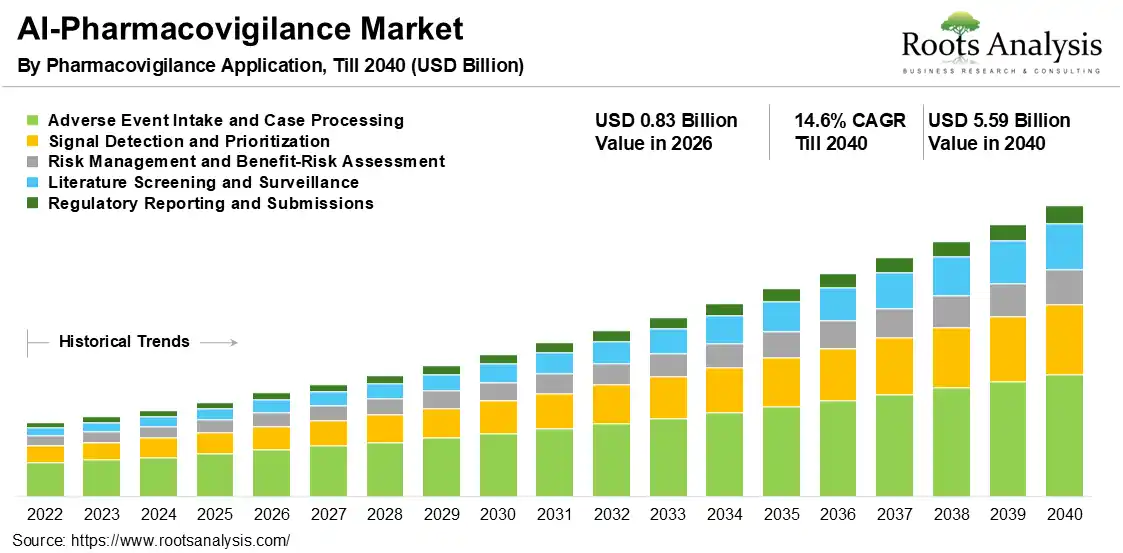
The global AI-powered pharmacovigilance market is expected to rise from USD 0.83 billion in 2026 and is projected to reach USD 5.59 billion by 2040, growing at a CAGR of 14.6% over the forecast period 2026 to 2040, driven by rising safety-data complexity.
See What’s in the Full Report – Request Your Complimentary Insights!
Market Report: Key Takeaways
- Based on deployment model, cloud-based solutions are both dominant and fastest-growing, holding 58.0% share in 2026 and expanding at 16.1% CAGR through 2040, driven by scalable global safety operations.
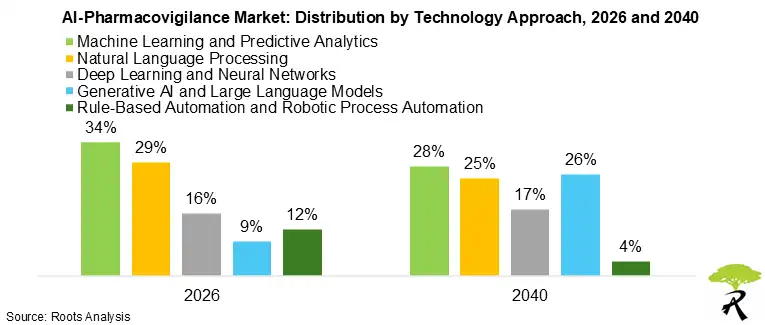
- Based on technology approach, machine learning and predictive analytics capture 34.0% market share in 2026, whereas generative AI registers a 23.6% CAGR through 2040, supported by agentic workflow automation.
- Based on pharmacovigilance application, adverse event intake and case processing capture 41.0% market share in 2026, whereas signal detection registers a 16.9% CAGR through 2040, supported by broader safety datasets.
- Based on end user, pharmaceutical companies capture 53.0% market share in 2026, whereas contract research organizations register a 17.7% CAGR through 2040, reflecting greater safety-process outsourcing.
- Based on geography, North America captures 39.0% market share in 2026, whereas Asia-Pacific registers a 17.6% CAGR through 2040, supported by regional pharmaceutical digitalization.
AI-Powered Pharmacovigilance Market Outlook
Automation is shifting pharmacovigilance from rule-based processing toward AI-led intake, prioritization, and safety intelligence. Earlier deployments focused on databases, coding support, and repetitive workflow automation. Current demand centers on cloud pharmacovigilance platforms that combine natural language processing, machine learning, and generative AI. Buyers now expect multilingual intake, faster duplicate detection, stronger narrative generation, and broader signal coverage. This shift favors vendors that integrate validated intelligence across global safety operations.
Growth reflects rising case volumes, expanding safety data sources, and tighter expectations for explainable AI and GxP validation. Regulatory direction now reinforces human oversight, model credibility, auditability, and risk-based governance. In January 2026, the FDA and European Medicines Agency issued joint principles for responsible AI across medicine development and post-market surveillance. These requirements reward platforms that combine automation with documented controls.
Through 2040, the AI pharmacovigilance market will remain high growth, although expansion will moderate as cloud penetration matures. Generative artificial intelligence will gain share through summarization, translation, coding assistance, and agentic workflow orchestration. Signal detection will also expand as organizations connect regulatory reports, literature, trials, and real-world data. In June 2026, Graph Safety entered Google Cloud Marketplace with AI-native intake and safety-intelligence modules. Long-term growth remains strong but compliance-sensitive.
AI-Powered Pharmacovigilance Market Dynamics
AI-Powered Pharmacovigilance Market Drivers
The AI pharmacovigilance market grows as safety teams automate labor-heavy case intake while expanding surveillance coverage. Adverse event intake and case processing hold 41.0% share in 2026, reflecting mandatory collection, coding, assessment, and reporting workloads. Cloud-based solutions hold 58.0% share and support standardized upgrades across global teams. Machine learning also remains the leading technology because validated models already support duplicate detection, classification, forecasting, and signal prioritization.
AI-Powered Pharmacovigilance Market Restraints
Validation requirements restrain adoption because regulated users must prove model credibility, explainability, auditability, and human control. Generative AI can accelerate narratives and coding, yet uncontrolled outputs create review burdens and compliance exposure. Legacy safety databases also limit integration across literature, clinical trials, regulatory sources, and patient channels. The FDA risk-based credibility framework and CIOMS guidance raise entry costs for vendors lacking documented governance, testing, and change-control processes.
AI-Powered Pharmacovigilance Market Opportunities
Signal detection creates the strongest expansion opportunity as organizations connect regulatory reports, literature, clinical data, electronic health records, and claims. This application will grow at 16.9% CAGR through 2040, while electronic health records and claims data will expand at 19.7%. Contract research organizations also offer a scalable channel through shared safety infrastructure. In April 2026, Parexel acquired Vitrana to add an integrated AI-enabled pharmacovigilance platform.
AI-Powered Pharmacovigilance Market Challenges
Operational complexity remains the central challenge because pharmacovigilance systems must process multilingual, incomplete, duplicated, and differently structured evidence. Models must preserve traceability from source intake through medical coding, causality review, and regulatory submission. Regional reporting rules further complicate global deployment, particularly for vendors serving pharmaceutical companies and outsourced safety providers. Competitive advantage will depend on domain-specific models, configurable workflows, validation evidence, and reliable escalation to qualified human reviewers.
AI-Powered Pharmacovigilance Market Size Estimation Methodology
- As a starting point, the analysis defined the AI pharmacovigilance market around software and technology-enabled safety workflows. Conventional safety databases without identifiable AI functions were excluded, alongside broad outsourced pharmacovigilance revenues. Historical values from 2022 through 2026 were normalized across calendar years, currencies, and scope definitions. This produced a consistent base for comparing case-processing automation, signal detection, literature surveillance, and regulatory reporting.
- Moving forward, demand was estimated using regulatory submission counts, adverse event reporting volumes, clinical trial databases, marketed product portfolios, and literature-screening workloads. Pharmaceutical, biotechnology, contract research, and service-provider demand received separate adoption assumptions. The model also considered workflow intensity, including intake, validation, medical coding, narrative generation, causality support, and submission routing. These variables linked safety activity directly to software use and automation demand.
- Building on this, supply-side evidence covered vendor product portfolios, deployment announcements, cloud marketplace availability, platform integrations, funding activity, and acquisition activity. Revenue exposure was assessed by separating AI-native modules from broader regulatory, clinical, and quality software suites. Vendor tiering distinguished end-to-end leaders, specialist providers, and emerging platforms. This prevented large adjacent software businesses from overstating the addressable AI pharmacovigilance market.
- Drawing upon these, 2026 segment shares were assigned according to observed maturity and current workflow adoption. Cloud-based deployment received 58.0%, machine learning and predictive analytics received 34.0%, and case processing received 41.0%. Pharmaceutical companies received 53.0% because product sponsors retain legal safety obligations. Each share was checked against available deployment patterns, data requirements, regulatory responsibilities, and platform capabilities.
- The projected value was then extended through 2040 using segment-specific adoption curves rather than one uniform growth rate. Generative AI received the strongest technology expansion at 23.6% CAGR, reflecting translation, summarization, coding support, and agentic orchestration. Electronic health records and claims data received 19.7% CAGR because longitudinal evidence supports active surveillance. Mature rule-based automation received slower growth as buyers shift spending toward integrated intelligence.
- Finally, the forecast was reconciled across deployment, technology, application, data source, end user, and geography. Regional checks compared North America’s 39.0% 2026 share with Asia-Pacific’s 17.6% CAGR through 2040. The overall curve was calibrated to a 14.6% CAGR, with faster enterprise adoption followed by moderation as cloud penetration matures. Sensitivity tests varied adoption speed, validation costs, outsourcing levels, and scope boundaries.
AI-Powered Pharmacovigilance Market Share Insights
Market Share by Deployment Model
According to our analysis, cloud-based deployment leads because it lowers infrastructure costs and supports standardized upgrades across global safety teams. Mature multitenant platforms also simplify scalability, validation, collaboration, and regulatory reporting across multiple jurisdictions. In August 2025, ArisGlobal announced a multiregional LifeSphere deployment using its modern multitenant cloud platform.
Cloud-based solutions will also grow fastest as providers embed AI agents directly within validated safety applications. Subscription pricing, rapid deployment, secure data access, and configurable models will broaden adoption among smaller organizations. In April 2025, Veeva announced AI agents across Vault applications, including safety, within its established cloud-software environment.
Market Share by Technology Approach
Machine learning leads because established models already support duplicate detection, classification, forecasting, and safety-signal prioritization. Its maturity provides stronger validation histories, explainability, predictable performance, and integration with existing pharmacovigilance databases. In March 2025, Parexel outlined predictive AI applications that shift pharmacovigilance from reactive reporting toward predictive risk assessment.
Generative AI will expand fastest through case summarization, narrative generation, translation, coding assistance, and autonomous workflow orchestration. Human review, controlled prompts, auditability, and domain-specific models will support regulated enterprise adoption. In March 2025, Tech Mahindra and NVIDIA launched an agentic AI pharmacovigilance solution addressing manual delays and data overload.
Want Information on Specific Region / Segment?
Regional Analysis: North America Leads the Market and Asia-Pacific is Likely to Register Higher CAGR
Presently, North America holds a 39.0% share in 2026. North America leads through mature regulatory infrastructure, substantial pharmaceutical spending, strong capital access, and an established safety-technology ecosystem. Early adoption also benefits from large regulatory databases and active industry engagement on AI validation. In May 2025, the FDA introduced a program dedicated to AI and emerging technologies used in pharmacovigilance.
On the contrary, Asia-Pacific registers a 17.6% CAGR from 2026 to 2040. Asia-Pacific will grow fastest through pharmaceutical outsourcing, expanding clinical activity, digital infrastructure investment, and localized regulatory reporting requirements. Regional providers increasingly deploy scalable platforms supporting multilingual intake and international safety standards. In August 2025, South Korea's Selta Square adopted Oracle Argus to automate case processing and regulatory reporting workflows.
Market Ecosystem Analysis
Within the 20-company scope, nine Tier 1 leaders anchor most commercial activity, alongside five specialists and six emerging entrants. Platform convergence dominates consolidation as vendors connect case intake, signal management, regulatory data, and AI within governed safety suites. Industry standardization and FDA adoption show that regulated, human-supervised automation now drives competitive behavior.
Competitive advantage is shifting toward explainable, interoperable platforms demonstrating measurable production accuracy across multichannel safety workflows.
- ArisGlobal: In April 2025, ArisGlobal launched a context-aware NavaX agent for autonomous MedDRA coding and reviewer-supported escalation. Boehringer Ingelheim implemented NavaX in July 2025, achieving up to 90% average extraction accuracy for ICSR forms. This production evidence raises barriers for rule-based competitors and strengthens adverse event intake, coding, and case processing.
- Veeva Systems and Amazon Web Services: In October 2025, Veeva announced application-specific Safety agents using Amazon Bedrock, secure Vault access, and embedded safeguards. Veeva scheduled Safety agent availability for April 2026 within its unified Vault platform. This architecture pressures disconnected AI add-ons and strengthens cloud-based safety, quality, and regulatory workflows.
- Ennov: In December 2025, Ennov released version 11 with built-in AI supporting pharmacovigilance narrative extraction and summarization. The release reduces integration requirements for regulated teams and strengthens case intake, reporting, and hybrid compliance workflows.
- Oracle: In September 2025, Oracle presented a precision-PV stack combining Safety One, real-world data, health intelligence, and OCI AI. This convergence raises data-scale barriers for specialists and strengthens signal detection, benefit-risk assessment, claims, EHR, and regulatory-database analytics.
- IQVIA: In December 2025, IQVIA added GenAI to Vigilance Detect for extracting safety events from emails, audio, documents, and chats. Reported client results included up to 80% fewer false positives, reducing manual review across multichannel intake. The capability pressures single-channel tools and strengthens case processing from call-center, medical-information, and patient-support data.
- Sorcero: In October 2025, Sorcero added AI guardrails, AI-native data capture, and analytics across its Safety suite. These capabilities strengthen literature monitoring, ICSR identification, and cross-source signal prioritization while improving governance and auditability. The release pressures platform leaders to expose comparable controls without sacrificing configuration flexibility.
- Graph AI Services: In October 2025, Graph AI secured $3 million in seed funding led by Bessemer Venture Partners. The financing supports product development and global adoption for automated case processing, signal detection, reporting, and compliance. This lowers entry barriers for AI-native SaaS and pressures labor-intensive pharmacovigilance service models.
- Tepsivo: In February 2025, Tepsivo reported production AI assessment of literature articles and automated safety-data capture from regulatory documents. Human reviewers remained responsible for final assessment, supporting explainability and controlled deployment. This strengthens NLP-based literature screening and adverse event intake while reducing dependence on repetitive manual assessment.
Startup Companies and their Key Highlights
- Graph AI Services, Inc.
- Event type and funding amount: Seed financing of $3 million
- Month and year: October 2025
- Lead investor: Bessemer Venture Partners
- Stated purpose: Accelerate product innovation, engineering expansion, and global adoption of the Graph Safety platform
- Market implication: Expands AI-native case processing, signal detection, compliance, and reporting across North America, Europe, and Asia-Pacific
- Sorcero
- Event type and funding amount: Series B financing of $42.5 million
- Month and year: November 2025
- Lead investor: NewSpring Growth
- Participating investors: Leawood Venture Capital and Blu Ventures
- Stated purpose: Expand globally across safety, medical affairs, scientific communications, and medical-device applications
- Additional purpose: Increase research, development, customer acquisition, regulatory compliance, and platform usability
- Market implication: Accelerates Safety Insights, literature monitoring, and governed agentic AI deployment across global pharmaceutical organizations
- Tepsivo
- Event type: Production AI capability disclosure
- Month and year: February 2025
- Stated purpose: Assess literature for safety relevance, summarize adverse events, and capture data automatically from safety documents
- Market implication: Strengthens literature surveillance and case intake through human-reviewed AI within cloud pharmacovigilance workflows
AI-Powered Pharmacovigilance Market Trends / Opportunities
Generative AI Intake Automation Expanding AI-Powered Pharmacovigilance Market Platform Differentiation
Case intake is moving from isolated task automation toward generative AI orchestration across full individual case safety report workflows. In July 2025, Boehringer Ingelheim implemented LifeSphere NavaX Advanced Intake for global case intake and processing. Vendors that combine extraction, coding, narratives, and review controls can capture larger platform budgets.
Multilingual automation is becoming a core purchasing requirement for global safety operations rather than an optional productivity feature. In February 2026, ArisGlobal and TransPerfect Life Sciences embedded pharmaceutical-grade translation into LifeSphere Safety workflows. Integrated language capabilities reduce handoffs and strengthen competitive positioning in multiregional deployments.
Cloud Distribution and Multitenant Deployment Lowering Commercial Scaling Barriers
Cloud distribution is shortening procurement paths by placing validated safety applications inside familiar enterprise infrastructure. In June 2026, Graph Safety listed its intake and safety-intelligence modules on Google Cloud Marketplace. Marketplace availability can improve discoverability, contracting speed, and access to customers already using hyperscale cloud environments.
Multitenant platforms are shifting competition toward rapid upgrades, configurable validation, and standardized global operations. In August 2025, ArisGlobal announced a multiregional LifeSphere deployment across Japan, Europe, and the United States. Providers with repeatable deployment frameworks can scale faster while reducing customer-specific implementation costs.
Multisource Signal Detection Reshaping AI-Powered Pharmacovigilance Market Value Pools
Safety intelligence is expanding beyond spontaneous reports as buyers connect literature, clinical data, regulatory databases, and real-world evidence. In January 2026, Oracle launched a platform incorporating more than 129 million de-identified longitudinal electronic health records. Broader evidence access increases demand for interoperable analytics and prioritization tools.
Regulatory data availability is increasing the volume and speed of evidence available for signal detection. In August 2025, the FDA began publishing information from its primary adverse event reporting database every day. Vendors that process frequent updates with traceable prioritization can defend higher-value safety-intelligence positions.
Responsible AI Governance Raising Validation Costs and Strengthening Trusted Vendors
Responsible AI principles are making governance, explainability, and human oversight central product requirements. In January 2026, the FDA and European Medicines Agency issued joint principles covering drug safety and post-market surveillance. Vendors with documented controls and validation evidence will gain an advantage in regulated enterprise evaluations.
Risk-based model assessment is raising development costs for suppliers that cannot prove credibility across specific safety contexts. In January 2025, the FDA proposed a credibility framework for AI models supporting drug and biological product decisions. Strong governance capabilities can become a commercial moat, while weaker providers face slower adoption.
Your Business is Unique – Why Shouldn’t Your Report Be?
Market Access Considerations
Model Credibility and GxP Validation
Model credibility and GxP validation determine whether suppliers can enter regulated safety workflows. Buyers require documented training data, performance testing, explainability, audit trails, human review, and controlled model changes. The FDA’s January 2025 risk-based credibility framework formalized expectations for AI supporting drug and biological product decisions. Vendors with reusable validation packages can shorten procurement cycles, while weaker governance raises implementation costs and delays commercialization. This advantage strengthens positioning during audits and global rollouts.
Safety Data Interoperability and Traceability
Global data integration limits market access because safety platforms must connect structured and unstructured evidence without losing traceability. Regulatory databases, literature, clinical trials, electronic health records, claims, call centers, and patient-generated sources use different formats and quality controls. In January 2026, Oracle introduced a platform containing more than 129 million de-identified longitudinal electronic health records. Providers with interoperable architectures can scale into higher-value signal and benefit-risk applications. This capability supports recurring analytics revenue beyond intake.
Enterprise Procurement and Cloud Channel Access
Enterprise procurement channels influence commercialization speed because large pharmaceutical companies favor proven platforms, secure cloud environments, and established service partners. Smaller providers can improve access through marketplaces, integrations, or acquisitions that reduce perceived implementation risk. In June 2026, Graph Safety placed its AI-native pharmacovigilance modules on Google Cloud Marketplace. Channel credibility can widen customer reach, while unsupported standalone products face longer sales cycles. Partnerships therefore become a practical route to enterprise trust.
How Stakeholders Benefit from the Key Focus Areas of Our AI-Powered Pharmacovigilance Market Report
Rising safety-data complexity and responsible AI requirements make pharmacovigilance technology decisions commercially urgent. The report connects workflow demand, regulatory constraints, competitive moves, and adoption rates across technologies and regions. These findings support portfolio priorities, investment screening, platform roadmaps, partnership choices, and operational planning.
- Unmet Needs and Market Gaps in AI-Powered Pharmacovigilance Market: The report identifies where current platforms leave measurable gaps across multilingual intake, data integration, explainability, and signal prioritization. Strategy teams can compare the 41.0% case-processing share with faster-growing signal detection and real-world data opportunities. Operations leaders can use these gaps to prioritize workflow redesign. Product teams can decide whether to build, buy, or partner for missing capabilities.
- Funding and Venture Investment Opportunities in AI-Powered Pharmacovigilance Market: Funding analysis distinguishes scalable safety platforms from narrowly automated tools with limited regulatory readiness. Investors can assess Graph AI’s USD 3 million seed round in October 2025 against platform scope, cloud distribution, and validation needs. The comparison supports diligence on capital efficiency, commercialization risk, and likely follow-on funding requirements.
- Technology Innovation and Adoption Trends: Technology analysis shows machine learning leading today with 34.0% share, while generative AI expands at 23.6% CAGR. Technology executives can compare adoption curves for natural language processing, deep learning, rule-based automation, and agentic workflows. The evidence supports decisions on model architecture, integration sequencing, validation budgets, and human-review controls.
- AI-Powered Pharmacovigilance Market Competitive Landscape and Industry Analysis: Competitive analysis maps nine Tier 1 leaders, five Tier 2 specialists, and six emerging providers across the market. Business leaders can compare end-to-end platforms with focused intake, literature, signal, and cloud infrastructure offerings. The report supports vendor shortlisting, acquisition screening, differentiation planning, and decisions about entering crowded or underserved workflow segments.
- Mapping Strategic Partnerships and Ecosystem Synergies: Partnership mapping shows how vendors add language capability, cloud reach, safety expertise, and enterprise credibility. In February 2026, ArisGlobal partnered with TransPerfect Life Sciences for integrated multilingual translation. Partnership and business development teams can identify complementary providers, channel routes, and acquisition targets that reduce time to market.
- AI-Powered Pharmacovigilance Market CAGR and Growth Trends: Growth analysis separates headline expansion from the segments creating the strongest commercial upside. Finance and strategy leaders can compare the 14.6% market CAGR with contract research organizations at 17.7% and Asia-Pacific at 17.6%. The report supports geographic investment, customer prioritization, capacity planning, and revenue scenarios aligned with changing segment shares through 2040.
AI-Powered Pharmacovigilance Market: Scope of the Report
| Key Report Attributes | Details | |
| Forecast Period | Till 2040 | |
| Market Size 2026 | USD 0.83 Billion | |
| Market Size 2040 | USD 5.59 Billion | |
| CAGR (Till 2040) | 14.6% | |
| Segments Covered |
|
|
| Geographical Regions Covered |
|
|
| Key Sections Covered |
|
|
Market Segmentation
The AI-Powered Pharmacovigilance Market report presents an in-depth analysis, highlighting the capabilities of various stakeholders, based on different segments, such as deployment model, technology approach, pharmacovigilance application, safety data source, end user, geographical regions, and leading players.
By Deployment Model
- Cloud-Based
- On-Premises
- Hybrid
By Technology Approach
- Machine Learning and Predictive Analytics
- Natural Language Processing
- Deep Learning and Neural Networks
- Generative AI and Large Language Models
- Rule-Based Automation and Robotic Process Automation
By Pharmacovigilance Application
- Adverse Event Intake and Case Processing
- Signal Detection and Prioritization
- Risk Management and Benefit-Risk Assessment
- Literature Screening and Surveillance
- Regulatory Reporting and Submissions
By Safety Data Source
- Spontaneous and Solicited Adverse Event Reports
- Clinical Trial Safety Data
- Scientific and Medical Literature
- Electronic Health Records and Claims Data
- Regulatory Safety Databases
- Patient Support, Call-Center and Medical Information Data
- Social Media and Patient-Generated Data
By End User
- Pharmaceutical Companies
- Biotechnology Companies
- Contract Research Organizations
- Pharmacovigilance Service Providers
- Medical Device Manufacturers
- Regulatory Authorities
- Healthcare Providers and Research Institutions
By Geographical Regions
- North America
- US
- Canada
- Mexico
- Rest of North America
- Europe
- Austria
- Belgium
- Denmark
- France
- Germany
- Ireland
- Italy
- Netherlands
- Norway
- Russia
- Spain
- Sweden
- Switzerland
- UK
- Rest of Europe
- Asia-Pacific
- China
- India
- Japan
- Singapore
- South Korea
- Rest of Asia-Pacific
- Latin America
- Argentina
- Brazil
- Chile
- Colombia
- Venezuela
- Rest of Latin America
- Middle East and Africa (MEA)
- Egypt
- Iran
- Iraq
- Israel
- Kuwait
- Saudi Arabia
- UAE
- Rest of MEA
- Rest of the World


