AI-Powered Remote Vital Sign Camera Market by Device / Form Factor (Smartphone and Tablet Cameras, Laptop and Desktop Webcams, Fixed Room Cameras, Smart Mirrors and Health Kiosks, In-Vehicle Cabin Cameras and Embedded Smart-Device Cameras), Technology, Vital Sign / Health Indicator Monitored, Deployment Mode, Application / End Use, Geographical Regions, and Leading Players - Trends and Forecasts, 2026-2040
Market Size
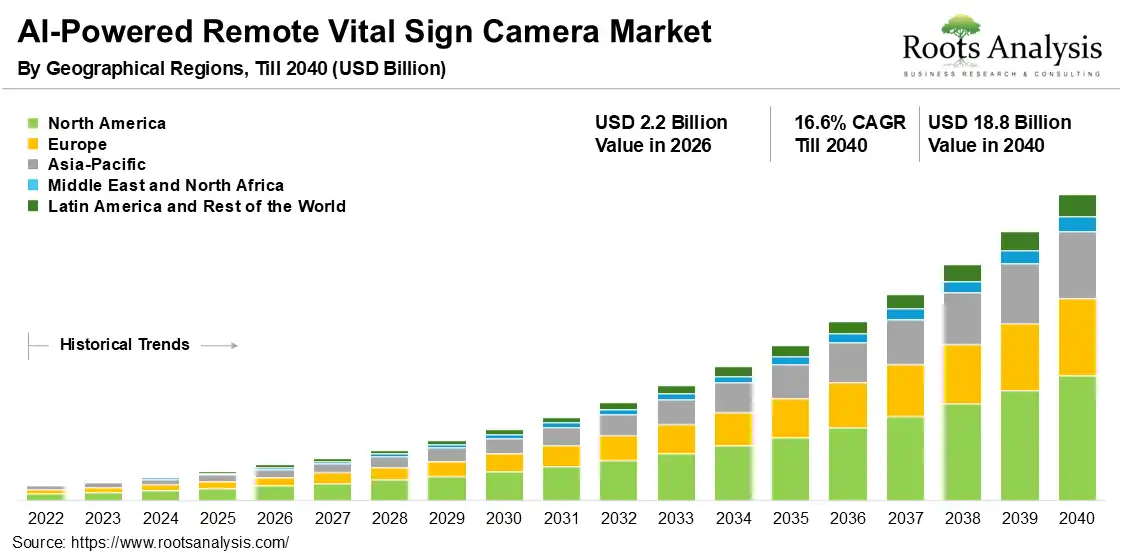
The global AI-powered remote vital sign camera market is expected to rise from USD 2.2 billion in 2026 to reach USD 18.8 billion by 2040, growing at a CAGR of 16.6% over the forecast period 2026 to 2040, driven by telehealth adoption, software-only camera measurement, and contactless monitoring workflows.
See What’s in the Full Report – Request Your Complimentary Insights!
Market Report: Key Takeaways
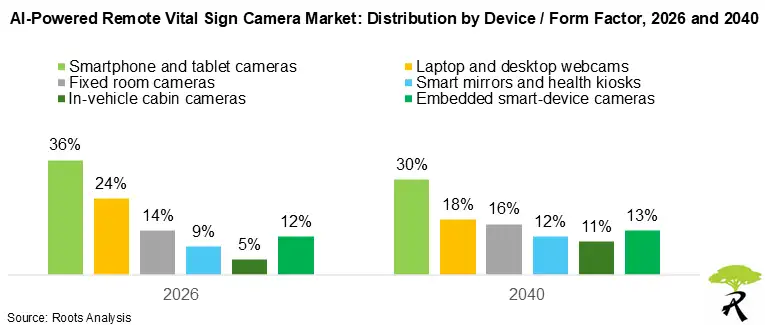
- Based on Device / Form Factor, smartphone and tablet cameras capture 36.0% market share in 2026, whereas in-vehicle cabin cameras register a 22.9% CAGR through 2040, driven by driver-monitoring expansion.
- Based on Technology, remote photoplethysmography captures 38.0% market share in 2026, whereas multispectral, infrared and depth sensing registers a 20.0% CAGR through 2040, driven by low-light and ambient-care needs.
- Based on Vital Sign / Health Indicator Monitored, pulse or heart rate captures 28.0% market share in 2026, whereas blood pressure registers an 18.4% CAGR through 2040, driven by cuffless hypertension screening.
- Based on Deployment Mode, software development kits capture 28.0% market share in 2026, whereas inpatient-room monitoring systems register an 18.8% CAGR through 2040, driven by ambient clinical observation.
- Based on Application / End Use, remote patient monitoring captures 25.0% market share in 2026, whereas elder care and residential care registers an 18.1% CAGR through 2040, driven by staffing pressure.
- Based on Geography, North America captures 41.0% market share in 2026, whereas Asia-Pacific registers a 19.2% CAGR through 2040, driven by mobile-first care models.
AI-Powered Remote Vital Sign Camera Market Outlook
Software-only measurement is moving remote vital sign camera market demand from pilot programs into regulated care workflows. Earlier adoption centered on wellness scans, telehealth intake and smartphone pulse checks. Current buying now favors FDA-cleared camera-based patient monitoring and remote photoplethysmography (rPPG). SDKs now embed telehealth vital signs capture inside existing digital-health journeys. Supply remains shaped by validation depth, camera quality, and algorithm performance across skin tones and lighting conditions.
FDA 510(k) clearances now act as a growth filter for camera-based vital signs software companies. Providers, payers and platform buyers can separate wellness claims from software as a medical device SaMD pathways. This regulatory split raises entry costs for startups pursuing clinical buyers and improves trust for procurement teams. Presage Technologies announced FDA 510(k) clearance in July 2026 for SmartSpectra Vital Signs Monitor 1.0 SDK on iOS and Android cameras.
High-growth expansion will moderate after early adoption as reimbursement, privacy review and clinical validation shape procurement. Through 2040, edge AI health monitoring, multispectral sensing and embedded smart-device cameras will gain share. Camera-specific vendors will compete on validated endpoints, integration breadth and deployment economics. NuraLogix unveiled a multi-year cardiovascular risk index in October 2025, extending AI video health assessment beyond point-in-time vitals. The outlook remains positive, with regulated use cases likely to outperform consumer-only features.
AI-Powered Remote Vital Sign Camera Market Dynamics
AI-Powered Remote Vital Sign Camera Market Drivers
FDA-cleared mobile camera workflows are pulling the remote vital sign camera market toward clinical use. Smartphone and tablet cameras hold 36.0% share in 2026 because they avoid dedicated hardware and fit telehealth intake. This device mix gives telehealth platforms a low-cost path to contactless vital signs monitoring. NuraLogix said in June 2026 that Anura Mobile Core SDK received FDA 510(k) clearance for contactless pulse-rate and breathing-rate measurement.
AI-Powered Remote Vital Sign Camera Market Restraints
Privacy scrutiny limits faster deployment in bedrooms, inpatient rooms and mental-health settings. Camera-based patient monitoring captures sensitive facial video, sleep behavior and room activity, which expands consent and data-governance requirements. Hospitals must prove observation benefits without creating unacceptable surveillance risk for vulnerable patients. The UK Information Commissioner opened a June 2026 inquiry into Oxevision and LIO bedroom cameras. The inquiry centered on patient-data protection concerns in mental-health settings.
AI-Powered Remote Vital Sign Camera Market Opportunities
Blood pressure, cardiac workload and cardiovascular-risk indicators create higher-value opportunities than basic pulse checks. Blood pressure will register an 18.4% CAGR through 2040, outpacing pulse and respiratory-rate categories. These indicators support hypertension triage, insurance screening and preventive health models with fewer external devices. Binah.ai introduced SDK 5.11 in September 2025 with cardiac workload, pulse pressure and mean arterial pressure indicators.
AI-Powered Remote Vital Sign Camera Market Challenges
Algorithm performance across lighting, motion and diverse user groups remains the central commercialization challenge. Remote photoplethysmography depends on stable facial blood-flow analysis from consumer-grade RGB video, which can vary by environment. Vendors also need validation packages that satisfy clinical buyers, platform partners and regulators. Multispectral, infrared and depth sensing will register 20.0% CAGR through 2040 because stronger signals support low-light, automotive and inpatient settings.
AI-Powered Remote Vital Sign Camera Market Size Estimation Methodology
- As a starting point, the model defined the remote vital sign camera market around camera-based capture and SDK deployment. It then added telehealth integration and embedded monitoring. Official product pages for NuraLogix, Binah.ai, FaceHeart, Lifelight, PanopticAI and Presage set the core company universe. The baseline excluded unrelated wearables, bedside monitors and hardware-only cameras without vital-sign software, keeping the forecast focused on software-enabled optical measurement.
- Moving forward, industry data from multiple credible secondary sources was normalized to a single camera-specific revenue base. The review compared reported current values, near-term CAGRs, forecast horizons and scope notes. Outlier values received lower weight when they blended broader remote patient monitoring hardware or non-camera biosensing devices. This step kept the remote vital sign camera market forecast aligned with commercial camera deployments.
- Building on this, segment shares were estimated using product availability, deployment evidence and regulatory submission counts. FDA 510(k) decisions for PanopticAI, NuraLogix, Presage, Mindset Medical and FaceHeart supported higher weighting for pulse-rate and respiratory-rate use cases. Product pages and launch data supported SDKs, mobile applications, browser-based services, smart mirrors and inpatient-room systems. These inputs also informed device and deployment-mode shares.
- Drawing upon these, technology weights were cross-checked against rPPG, transdermal optical imaging and computer vision. AI signal processing and multispectral sensing evidence informed the same check. Patent filing volumes and clinical validation signals were used as directional checks where vendor disclosures showed continued algorithm work. Standard RGB camera coverage supported rPPG leadership, while infrared and depth-sensing examples supported faster growth for ambient monitoring. Edge AI evidence informed embedded smart-device camera adoption.
- The projected value was then distributed across telehealth, remote patient monitoring and inpatient observation. Elder care, insurance and automotive safety received separate adoption logic. Remote patient monitoring received the highest 2026 application share because camera checks reduce device logistics. In-vehicle cabin cameras received the fastest device CAGR because driver-monitoring systems can add physiological safety functions. Segment CAGRs were reconciled against the overall 16.6% CAGR.
- Finally, regional forecasts were validated against FDA clearance activity, mobile-first healthcare adoption, smart-device manufacturing capacity and digital-care infrastructure. North America received the highest 2026 share because FDA pathways and telehealth procurement channels support commercialization. Asia-Pacific received the fastest CAGR because mobile access gaps, electronics ecosystems and localized digital-health platforms support scale. The regional mix also reflected Europe’s privacy review burden.
AI-Powered Remote Vital Sign Camera Market Share Insights
Market Share by Device / Form Factor
According to our analysis, smartphone and tablet cameras lead because they avoid dedicated hardware, fit telehealth intake, and support low-cost onboarding. PanopticAI reported in January 2025 that its app uses iPhone and iPad cameras for FDA-cleared pulse measurement.
In-vehicle cabin cameras will scale fastest as driver monitoring systems expand into physiological safety and wellness. trinamiX presented in June 2025 an automotive vital-sign monitoring demonstrator for vehicle occupants.
Market Share by Technology
Remote photoplethysmography leads because RGB cameras already support pulse-wave extraction across phones, tablets, laptops, and kiosks. Binah.ai described in June 2025 how rPPG extracts vital signs from standard RGB camera video.
Multispectral, infrared and depth sensing will grow fastest as deployments move into low-light, automotive, and inpatient settings. MulticoreWare and Cipia showed in January 2025 a 60GHz radar and IR-camera fusion system for occupant vital signs.
Want Information on Specific Region / Segment?
Regional Analysis: North America Leads the Market and Asia-Pacific is Likely to Register Higher CAGR
Presently, North America holds a 41.0% share in 2026. North America leads because FDA pathways, telehealth infrastructure, provider IT budgets, and venture funding support early commercialization. The region also benefits from mature RPM reimbursement workflows and established digital-health procurement channels. FDA recorded a May 2026 decision for PanopticAI Vital Signs under optical camera-based vital-sign measurement.
On the contrary, Asia-Pacific registers a 19.2% CAGR from 2026 to 2040. It will grow fastest as mobile-first healthcare, smart-device manufacturing, and digital-care access gaps support localized adoption. Hong Kong-based PanopticAI announced in January 2025 FDA clearance for an iPhone and iPad contactless pulse app.
Market Ecosystem Analysis
Commercial intensity concentrates around six software-first vendors: NuraLogix, Binah.ai, FaceHeart, PanopticAI, Mindset Medical, and Presage Technologies. Recent FDA clearances now separate regulated camera-vital platforms from wellness-only face-scan tools. Tier 2 specialists defend narrower workflow, blood-pressure, sensor, kiosk, and inpatient observation positions through validated deployments or component advantages. Platform convergence is the dominant dynamic, as SDK, mobile, web, and inpatient vendors compete around cleared workflows and integration depth.
FDA clearance is the primary commercial force reshaping behavior, especially across pulse, respiratory-rate, and blood-pressure use cases. Competitive advantage is shifting from rPPG availability toward cleared indications, multi-vital coverage, privacy-preserving integration, and ownership of clinical workflows.
- FaceHeart received another FDA clearance in April 2025 for contactless video-based respiratory-rate measurement. The clearance strengthens its SDK position beyond heart-rate, blood-pressure, SpO2, and HRV claims. It pressures wellness-only SDK providers serving telehealth and RPM buyers that require stronger clinical validation.
- NuraLogix received FDA clearance in June 2026 for Anura Mobile Core SDK pulse and respiration measurement. The clearance strengthens smartphone-based and tablet-based clinical use cases for remote vital-sign monitoring. It also raises entry barriers for camera-vital platforms without regulated pulse and breathing claims.
- Binah.ai released SDK 5.11 in September 2025 with advanced cardiac monitoring and enhanced health indicators. The update shifts competition toward broader health-marker coverage, not only basic pulse and respiratory-rate capture. It strengthens insurance, wellness, and digital-health integrations that need configurable SDK-level deployment.
- PanopticAI received FDA clearance in January 2025 for a contactless pulse-rate mobile app on iPhones and iPads. In June 2026, it added FDA clearance for contactless respiratory-rate measurement. The sequence strengthens smartphone-only RPM and pressures single-vital mobile entrants across APAC and North America.
- Mindset Medical announced FDA clearance in June 2025 for respiratory-rate measurement through phones, tablets, and laptop cameras. Xcellerant Ventures invested in October 2025 to accelerate clinician-use blood-pressure monitoring, commercialization, and partnerships. This positions Mindset against mobile RPM vendors while expanding pressure around camera-based blood-pressure roadmaps.
- Presage Technologies announced in July 2026 that SmartSpectra received FDA clearance for heart-rate and breathing-rate monitoring. Making the SDK free lowers experimentation costs for hospitals, clinics, educators, and health organizations. It raises pricing pressure on emerging SDK suppliers and strengthens clinical training and RPM deployment.
- LIO launched its next-generation inpatient mental-health platform in August 2025, combining digital rounding, ambient monitoring, and compliance reporting. The move shifts competition from spot vital capture toward fixed-room observation workflows. It strengthens inpatient-room monitoring, hospital observation, and care-compliance applications.
- Shen AI and Thryve announced a June 2025 partnership combining camera-based vitals with Thryve’s health-data API infrastructure. This pulls face-scan vitals into multimodal health datasets for insurers, chronic-care apps, and population-health platforms. It strengthens telehealth integrations and insurance-risk assessment by reducing data-integration friction.
- Sony Semiconductor Solutions announced an RGB-IR automotive cabin image sensor in October 2025. STMicroelectronics introduced human-presence detection technology for PCs, monitors, and accessories in June 2025. Together, they strengthen embedded and in-vehicle camera infrastructure needed for low-light and privacy-sensitive monitoring.
Startup Companies and their Key Highlights
- PanopticAI
- Event type: FDA 510(k) clearance for contactless respiratory-rate measurement.
- Month and year: June 2026.
- Stated purpose: add respiratory-rate monitoring to camera-only mobile vital-sign measurement.
- Market implication: accelerates smartphone and tablet camera applications for RPM and telehealth monitoring.
- Mindset Medical
- Event type: strategic investment.
- Month and year: October 2025.
- Lead investor: Xcellerant Ventures.
- Stated purpose: accelerate blood-pressure monitoring for clinician use, commercialization, and partnerships.
- Market implication: strengthens telehealth and RPM positioning beyond respiratory-rate measurement.
- Presage Technologies
- Event type: FDA 510(k) clearance and free SDK availability.
- Month and year: July 2026.
- Stated purpose: make SmartSpectra Vital Signs Monitor available to hospitals, clinics, health organizations, and educators.
- Market implication: lowers SDK adoption barriers and increases pricing pressure in clinical camera-vital deployments.
- Shen AI
- Event type: strategic partnership.
- Month and year: June 2025.
- Strategic partner name: Thryve.
- Stated purpose: combine Shen AI contactless vital-sign capture with Thryve’s health-data integration infrastructure.
- Market implication: accelerates telehealth integrations, chronic-care applications, insurer workflows, and population-health data pipelines.
- Rouast Labs
- Event type: VitalLens 2.0 model and API release.
- Month and year: October 2025.
- Stated purpose: estimate heart rate, respiratory rate, and HRV from face videos using a new model.
- Market implication: accelerates API-based HRV, wellness, stress, and cardiovascular-indicator applications for developers.
AI-Powered Remote Vital Sign Camera Market Trends / Opportunities
FDA-Cleared SDKs Turning Remote Vital Sign Camera Market Pilots into Platform Shortlists
Regulatory clearance now gives SDK vendors a sharper route into telehealth and remote patient monitoring procurement. PanopticAI received FDA clearance in January 2025 for a mobile pulse-rate app using rPPG and a 30-second smartphone-camera scan. This shifts competition from feature claims toward cleared endpoints, integration speed and evidence quality.
Mobile operating-system coverage now matters because buyers want camera-based patient monitoring inside existing app journeys. Presage Technologies announced FDA clearance in July 2026 for SmartSpectra Vital Signs Monitor 1.0 SDK on iOS and Android cameras. This creates commercial pressure on vendors that still require separate devices or narrow deployment environments.
Advanced Cardiac Indicators Expanding Remote Vital Sign Camera Market Value Beyond Pulse Checks
Higher-value endpoints are moving AI video health assessment beyond basic heart-rate and respiratory-rate measurement. Binah.ai introduced SDK 5.11 in September 2025 with cardiac workload, pulse pressure and mean arterial pressure indicators. This strengthens positioning with insurers, chronic-care platforms and preventive health providers.
Predictive risk scoring is becoming a commercial differentiator as vendors target longitudinal cardiovascular workflows. NuraLogix unveiled a multi-year cardiovascular risk index in October 2025 using AI face-scan technology. This pushes competition toward risk stratification, not only spot measurements during virtual visits.
Infrared, Depth and Cabin Sensing Opening Non-Phone Channels for Contactless Vital Signs Monitoring
Ambient monitoring is expanding the addressable base beyond smartphones, webcams and telehealth intake. LIO launched an inpatient mental-health platform in August 2025 using infrared contactless monitoring for sleep and vital signs. This creates new competition around hospital observation workflows, staff efficiency and compliance documentation.
Automotive sensing creates a faster-growth device category because cabin cameras can connect health signals with driver safety. trinamiX presented an automotive vital-sign monitoring demonstrator in June 2025 for vehicle occupants. This opens partnerships between vital-sign software vendors, camera suppliers and in-cabin monitoring platforms.
Data Protection Scrutiny Raising Inpatient Camera Procurement Standards
Clinical observation cameras now face higher scrutiny when deployments involve bedrooms, mental-health wards and vulnerable patients. The UK Information Commissioner opened a June 2026 inquiry into Oxevision and LIO bedroom cameras over patient-data protection concerns. This makes privacy governance a competitive requirement for hospital-scale rollouts.
Respiratory-rate clearance strengthens clinical credibility, but it does not remove procurement scrutiny around consent and data handling. Mindset Medical announced FDA clearance in June 2025 for a contactless respiratory-rate measurement device using smartphone, tablet or laptop cameras. Vendors need both regulatory evidence and defensible implementation controls.
Your Business is Unique – Why Shouldn’t Your Report Be?
Market Access Considerations
FDA 510(k) Clearance and Software as a Medical Device Evidence
Clinical buyers increasingly treat FDA 510(k) clearance as a minimum access requirement for vital-sign claims. This favors vendors with cleared pulse-rate or respiratory-rate endpoints, such as PanopticAI, NuraLogix, Presage, Mindset Medical and FaceHeart. The pathway raises evidence costs and slows early commercialization, but it improves buyer confidence during platform selection. Vendors without software as a medical device (SaMD) evidence face weaker positioning in provider, payer and regulated telehealth channels. Clearance strategy now shapes sales sequencing.
Patient Data Protection for Bedroom and Inpatient Cameras
Bedroom and inpatient-room cameras create access risk because observation data can include faces, sleep patterns and room activity. The UK Information Commissioner inquiry into Oxevision and LIO cameras shows how privacy review can shape deployments in mental-health settings. Hospitals need consent models, retention controls, patient-notice processes and audit trails before scaling contactless vital signs monitoring. Strong governance can become a procurement advantage against less transparent systems. Poor controls can delay ward-level expansion.
SDK Integration Breadth Across Telehealth and Remote Patient Monitoring
Platform integration determines access because SDKs hold 28.0% share in 2026 and sit inside existing care workflows. Buyers prefer remote patient monitoring SDKs that work across smartphones, tablets, laptops and browsers without new hardware logistics. Binah.ai, NuraLogix, FaceHeart, Presage and PanopticAI compete on integration breadth, endpoint coverage and validation evidence. Narrow device support can limit channel partnerships, enterprise rollout speed and long-term account expansion. Integration depth also protects renewal pricing and reduces replacement risk for channel partners.
Ambient, Kiosk and Automotive Hardware Alignment
Ambient and automotive channels require different access capabilities than telehealth camera workflows. Fixed room cameras, smart mirrors, kiosks and in-vehicle cabin cameras depend on hardware partnerships, edge processing and low-light sensing. In-vehicle cabin cameras will register 22.9% CAGR through 2040, making automotive integration a high-growth access route. Vendors with multispectral, infrared or depth-sensing compatibility can compete beyond phone-based measurement and avoid pure SDK commoditization. Hardware alignment will influence strategic partnering, system certification and customer acquisition costs.
How Stakeholders Benefit from the Key Focus Areas of Our AI-Powered Remote Vital Sign Camera Market Report
Telehealth adoption, remote patient monitoring growth and FDA-cleared camera workflows make this market commercially urgent now. The report links segment CAGRs, regulatory evidence, technology maturity and competitive positioning to decisions on entry, partnerships and product investment.
- Unmet Needs and Market Gaps in AI-Powered Remote Vital Sign Camera Market: The report identifies gaps where smartphone vitals, browser-based scans and inpatient observation still lack consistent validation. Product teams can use this evidence to decide whether to prioritize pulse, respiratory rate, blood pressure or cardiovascular-risk indicators. The analysis also shows where privacy, lighting and device variability create unmet implementation needs.
- Funding and Venture Investment Opportunities in AI-Powered Remote Vital Sign Camera Market: The report separates high-growth niches from crowded early use cases by comparing segment CAGRs and clearance activity. Investment teams can assess why in-vehicle cabin cameras, multispectral sensing and inpatient-room monitoring outpace basic webcam workflows. The evidence supports screening decisions around startups pursuing FDA-cleared endpoints or embedded platform partnerships.
- Technology Innovation and Adoption Trends: The report tracks how rPPG, transdermal optical imaging, AI signal processing, infrared sensing and edge processing shape adoption. Engineering and product leaders can use the segmentation to decide which modalities deserve near-term development resources. The technology view also explains why RGB camera workflows lead today while multispectral and depth sensing gain through 2040.
- AI-Powered Remote Vital Sign Camera Market Competitive Landscape and Industry Analysis: The report maps NuraLogix, Binah.ai, FaceHeart, Lifelight, PanopticAI, Presage, Mindset Medical and enabling sensor suppliers by role and tier. Strategy teams can compare leaders, specialists and emerging vendors across SDKs, apps, kiosks, inpatient platforms and embedded systems. This supports build, buy, partner and regional expansion decisions.
- Mapping Strategic Partnerships and Ecosystem Synergies: The report shows where telehealth platforms, insurers, hospitals, automotive systems and sensor suppliers intersect with camera-based vitals vendors. Business development teams can identify partnership routes around SDK embedding, smart mirrors, health kiosks and in-cabin monitoring. The mapping helps prioritize accounts that already need remote patient monitoring or AI video health assessment.
- AI-Powered Remote Vital Sign Camera Market CAGR and Growth Trends: The report explains why the market will expand at 16.6% CAGR through 2040 while growth shifts across device, technology and use-case categories. Planning teams can use segment forecasts to size opportunities without relying on a single headline growth rate. The CAGR view supports decisions on product sequencing, geographic focus and capital allocation.
AI-Powered Remote Vital Sign Camera Market: Scope of the Report
| Key Report Attributes | Details | |
| Forecast Period | Till 2040 | |
| Market Size 2026 | USD 2.2 Billion | |
| Market Size 2040 | USD 18.8 Billion | |
| CAGR (Till 2040) | 16.6% | |
| Segments Covered |
|
|
| Geographical Regions Covered |
|
|
| Key Sections Covered |
|
|
Market Segmentation
The AI-Powered Remote Vital Sign Camera Market report presents an in-depth analysis, highlighting the capabilities of various stakeholders, based on different segments, such as device / form factor, technology, vital sign / health indicator monitored, deployment mode, application / end use, geographical regions, and leading players.
By Device / Form Factor
- Smartphone and Tablet Cameras
- Laptop and Desktop Webcams
- Fixed Room Cameras
- Smart Mirrors and Health Kiosks
- In-Vehicle Cabin Cameras
- Embedded Smart-Device Cameras
By Technology
- Remote Photoplethysmography
- Transdermal Optical Imaging
- Computer Vision and Facial Tracking
- AI and Deep-Learning Signal Processing
- Multispectral, Infrared and Depth Sensing
- Edge and On-Device Processing
By Vital Sign / Health Indicator Monitored
- Pulse or Heart Rate
- Respiratory or Breathing Rate
- Blood Pressure
- Blood Oxygen Saturation
- Heart-Rate Variability
- Stress and Cardiovascular-Risk Indicators
By Deployment Mode
- Software Development Kits
- Mobile Applications
- Web and Browser-Based Measurement Services
- Telehealth Platform Integrations
- Inpatient-Room Monitoring Systems
- Smart Mirror and Kiosk Systems
- Automotive Driver-Monitoring Integrations
By Application / End Use
- Telehealth and Virtual Consultations
- Remote Patient Monitoring
- Hospital and Inpatient Observation
- Elder Care and Residential Care
- Insurance Underwriting and Risk Assessment
- Corporate Wellness and Preventive Health
- Automotive Driver Safety and Wellness
By Geographical Regions
- North America
- US
- Canada
- Mexico
- Rest of North America
- Europe
- Austria
- Belgium
- Denmark
- France
- Germany
- Ireland
- Italy
- Netherlands
- Norway
- Russia
- Spain
- Sweden
- Switzerland
- UK
- Rest of Europe
- Asia-Pacific
- China
- India
- Japan
- Singapore
- South Korea
- Rest of Asia-Pacific
- Latin America
- Argentina
- Brazil
- Chile
- Colombia
- Venezuela
- Rest of Latin America
- Middle East and Africa (MEA)
- Egypt
- Iran
- Iraq
- Israel
- Kuwait
- Saudi Arabia
- UAE
- Rest of MEA
- Rest of the World


