


 Download Free Sample
 Buy Now
Market Size
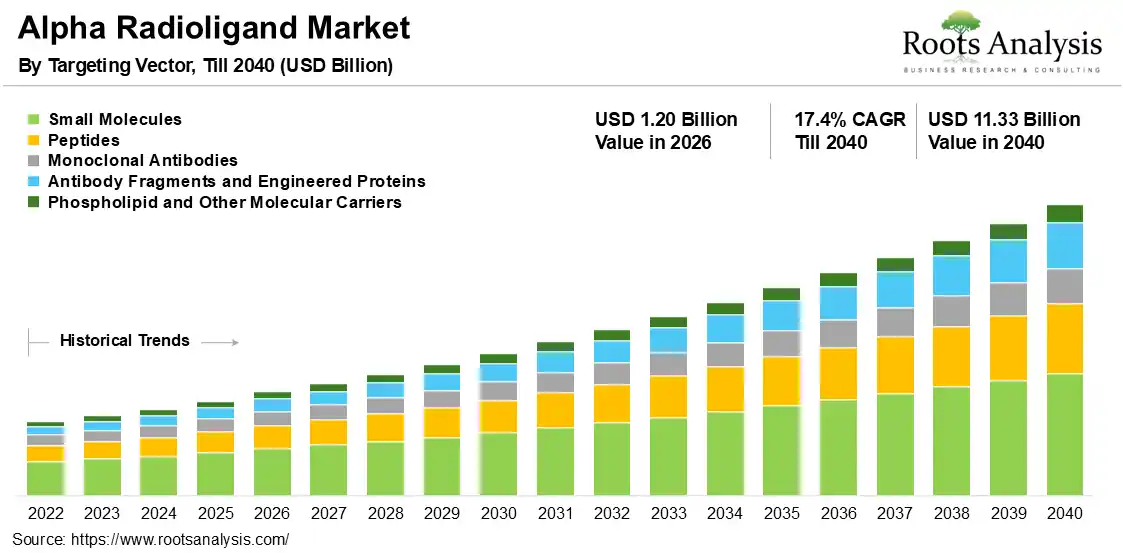
The global alpha radioligand therapy market is expected to rise from USD 1.20 billion in 2026 and is projected to reach USD 11.33 billion by 2040, growing at a CAGR of 17.4% over the forecast period 2026 to 2040, driven by expanding isotope supply and late-stage clinical programs.
See What’s in the Full Report – Request Your Complimentary Insights!
Market Report: Key Takeaways
- Based on radionuclide platform, Actinium-225 holds 39.0% in 2026. Lead-212 grows at 23.4% through 2040, driven by scalable generators.
- Based on targeting vector, Small Molecules hold 36.0% in 2026. Antibody Fragments and Engineered Proteins grow at 22.2%, driven by tunable delivery.
- Based on molecular target, Prostate-Specific Membrane Antigen holds 38.0% in 2026. Delta-Like Ligand 3 grows at 24.1%, driven by selective expression.
- Based on cancer indication, Prostate Cancer holds 39.0% in 2026. Lung and Other Neuroendocrine Carcinomas grow at 22.8%, driven by pipeline expansion.
- Based on geography, North America holds 43.0% in 2026. Asia-Pacific grows at 20.4% through 2040, driven by localized isotope investment.
Alpha Radioligand Therapy Market Outlook
The alpha radioligand therapy market is moving from a narrow commercial base toward a diversified oncology precision medicine pipeline across emerging therapeutic platforms. Actinium-225 holds 39.0% of the 2026 radionuclide platform, while lead-212 gains share through scalable generator production. Small molecules and prostate-specific membrane antigen programs still anchor global demand. Supply constraints now shift from isotope scarcity alone toward coordinated production, radiolabeling, dosimetry, manufacturing, and time-sensitive clinical delivery at commercial scale.
Growth now rests on clinical validation, regulatory recognition, and larger investments in domestic isotope capacity across major treatment markets. The United States Food and Drug Administration granted orphan-drug designation to actinium-225 satoreotide for small-cell lung cancer in January 2025. That decision supports development in a high-growth neuroendocrine indication and reduces uncertainty around regulatory positioning. It also strengthens incentives for SSTR2-targeted programs and specialized manufacturing networks.
Through 2040, the market will remain high-growth as lead-212, DLL3, engineered proteins, and Phase 3 programs gain share. Asia-Pacific will expand faster than established regions as governments and developers localize isotope production and oncology infrastructure. Novartis reported early actinium-225 PSMA activity in May 2026 and planned two late-stage studies. This transition should broaden commercial competition while preserving advantages for integrated suppliers with isotope access.
Alpha Radioligand Therapy Market Dynamics
Alpha Radioligand Therapy Market Drivers
Actinium-225 clinical validation and expanding isotope production capacity are driving the alpha radioligand therapy market. Actinium-225 holds 39.0% of the 2026 radionuclide platform, supported by versatile conjugation chemistry and growing PSMA evidence. Small molecules contribute another 36.0% of targeting-vector demand through rapid tumor penetration and established radiochemistry. These linked advantages shorten development pathways for programs using familiar targets, manufacturing methods, and treatment-center workflows.
Alpha Radioligand Therapy Market Restraints
Limited alpha-emitter availability still constrains trial enrollment, site activation, and reliable commercial scheduling. Actinium-225 programs require coordinated isotope production, radiolabeling, quality control, dosimetry, and time-sensitive delivery. Lead-212 reduces some logistics pressure through generator production and a shorter half-life, but precursor access remains essential. Developers without secured supply agreements or integrated manufacturing face higher interruption risk, weaker negotiating power, and slower movement into multicenter studies.
Alpha Radioligand Therapy Market Opportunities
Lead-212 radiopharmaceuticals create the clearest platform opportunity because their segment will grow at 23.4% through 2040. Generator-based production supports more decentralized radioligand therapy manufacturing and can reduce dependence on centralized actinium-225 supply. AdvanCell secured a 128,000-square-foot Greater Boston facility in June 2026 for lead-212 manufacturing. The move positions integrated developers to control capacity, clinical supply, and future commercial distribution.
Alpha Radioligand Therapy Market Challenges
Target diversification raises development complexity even as it expands the addressable cancer population. DLL3 will grow at 24.1%, while lung and other neuroendocrine carcinomas will expand at 22.8% through 2040. These programs require target-specific imaging, patient selection, alpha-particle dosimetry, and organ-exposure controls. Companies must align isotope choice with vector kinetics. Small molecules, peptides, antibodies, and engineered proteins create different manufacturing, clearance, and safety requirements.
Alpha Radioligand Therapy Market Size Estimation Methodology
- As a starting point, the analysis defined the alpha radioligand therapy market around alpha-emitting radionuclides linked to tumor-targeting vectors. The scope separated radionuclide platform, targeting vector, molecular target, cancer indication, development stage, and geography. Company pipelines and scientific sources established which actinium-225, lead-212, astatine-211, thorium-227, radium-223, and bismuth-213 programs belonged within the model. This boundary excluded beta-only therapies and unrelated diagnostic radiopharmaceutical activity.
- Moving forward, the 2026 baseline was reconciled across multiple credible secondary sources and verified industry disclosures. The review compared historical values from 2022 through 2025, current targeted alpha therapy activity, and the maturity of commercial assets. Divergent estimates were normalized to a consistent scope, currency basis, and treatment focus before selecting the consensus baseline. This step reduced distortion from incompatible definitions and isolated genuine alpha-radioligand demand.
- Building on this, the baseline was divided using clinical trial databases, company pipeline stages, commercial product activity, and isotope availability. Segment weights also reflected target validation, treatment-center familiarity, radiochemistry maturity, and manufacturing readiness. These indicators supported the 2026 shares for actinium-225, small molecules, prostate-specific membrane antigen, prostate cancer, commercial assets, and North America. Commercial revenue signals received greater weight than discovery-stage program counts alone.
- Drawing upon these, segment growth rates incorporated trial progression, regulatory submission timelines, orphan-drug designations, supply agreements, and disclosed facility investments. The model gave higher rates to lead-212, DLL3, engineered proteins, Phase 3 programs, and Asia-Pacific. It applied lower rates where established products faced share dilution or where isotope, logistics, and target-selection barriers limited adoption. Each rate also reflected vector kinetics, precursor access, and expected commercialization timing.
- The projected value was then calculated by applying the 17.4% overall CAGR across the forecast horizon and testing annual consistency. Segment-specific CAGRs changed each category’s share through 2040, while every dimension remained equal to 100%. Annual values were cross-checked against the implied totals, preventing independent segment assumptions from overstating the market. Share migration therefore followed explicit technology and development assumptions rather than fixed percentages.
- Finally, regional forecasts were triangulated using nuclear-medicine infrastructure, clinical activity, domestic isotope investment, manufacturing capacity, and time-sensitive distribution capabilities. Sensitivity checks tested slower trial conversion, delayed alpha-emitter production, and faster lead-212 adoption. The final model retained transparent assumptions, repeatable calculations, and segment-level checks suitable for strategy, investment, partnership, and operating decisions. Scenario outputs highlighted where supply or regulatory delays could change regional leadership.
Alpha Radioligand Therapy Market Share Insights
Market Share by Radionuclide Platform
According to our analysis, Actinium-225 leads through strong clinical validation, versatile conjugation chemistry, and substantial investment in production infrastructure. In May 2026, Novartis reported encouraging AcTION data and confirmed two Phase 3 trials for 225Ac-PSMA-617.
Lead-212 grows fastest because generator production and its shorter half-life support decentralized manufacturing and simplified logistics. In December 2025, AdvanCell received high-activity thorium-228 to scale Lead-212 production for clinical and pivotal programs.
Market Share by Development Stage
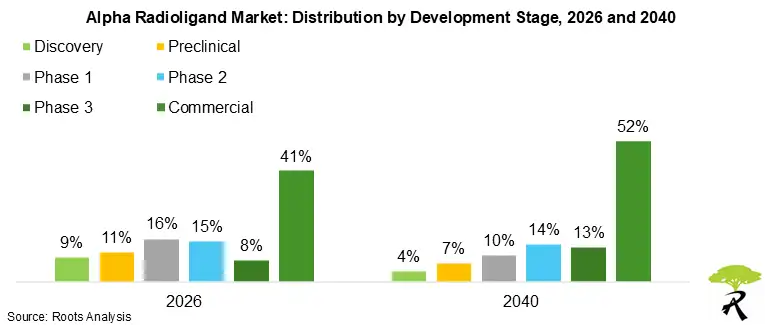
Commercial assets lead through established revenue, reimbursement experience, and treatment-center familiarity with alpha-emitting oncology products. In February 2026, Bayer reported a 24% mortality-risk reduction for radium-223 plus enzalutamide in PEACE-3.
Phase 3 expands fastest as validated targets and improving isotope supply move programs toward registration studies. In May 2026, Novartis confirmed two ongoing Phase 3 trials evaluating 225Ac-PSMA-617 in metastatic prostate cancer.
Want Information on Specific Region / Segment?
Regional Analysis: North America Leads the Market and Asia-Pacific is Likely to Register Higher CAGR
Presently, North America holds a 43.0% share in 2026. North America leads through mature nuclear-medicine networks, deep capital markets, regulatory expertise, and expanding domestic manufacturing capacity. Its ecosystem combines isotope producers, clinical centers, pharmaceutical developers, and time-sensitive radiopharmaceutical logistics. In November 2025, Novartis opened its third United States RLT facility in Carlsbad under a USD 23 billion expansion plan.
On the contrary, Asia-Pacific registers a 20.4 % CAGR from 2026 to 2040. Asia-Pacific growth reflects government funding, domestic isotope capabilities, localized clinical trials, and expanding oncology treatment infrastructure. Australia, China, Japan, and South Korea will strengthen regional development and manufacturing networks. In April 2025, Australia’s MRFF awarded AdvanCell AUD 18 million for Lead-212 targeted alpha therapy research and manufacturing capabilities.
Market Ecosystem Analysis
Eleven Tier 1 leaders control most commercial-scale isotope access and late-stage alpha activity across the 25-company database. Eight specialists provide focused clinical or production capabilities, while six emerging entrants challenge established radiopharmaceutical development models. Vertical integration now dominates consolidation, while long-term isotope contracting has become the primary commercial force reshaping competitive behavior. Advantage is shifting from targeting chemistry alone toward reliable cGMP isotope supply, regional manufacturing, and repeatable clinical-batch execution.
- In February 2026, Novartis signed a long-term actinium-225 supply agreement with Niowave for its cancer-treatment technologies. The contract raises the secured-volume barrier for smaller developers and strengthens Novartis’s actinium-based prostate cancer program.
- In December 2025, AstraZeneca extended Niowave’s actinium-225 supply arrangement for another ten years. The agreement protects Fusion-derived radioconjugate development and pressures competitors still dependent on shorter or uncontracted supply.
- In April 2025, Bayer initiated Phase 1 testing of an actinium-225 antibody targeting GPC3-positive hepatocellular carcinoma. The program broadens alpha competition beyond PSMA and strengthens antibody-based targeting within liver cancer.
- In June 2025, Orano Med expanded its Texas lead-212 research center, increasing preclinical and development capacity. In September 2025, its French ATEF facility reached dry-in status for industrial thorium-228 production. This integration raises the capital barrier for developers lacking precursor access and localized lead-212 manufacturing.
- In July 2025, ARTBIO raised $132 million to advance AB001 through Phase 2 and expand supply infrastructure. The financing strengthens lead-212 PSMA therapy and challenges centralized manufacturing through ARTBIO’s distributed AlphaDirect model.
- In February 2025, AdvanCell raised $112 million for its lead-212 prostate cancer program. In December 2025, the company initiated Phase 2 expansion across three metastatic prostate cancer settings. This progression moves lead-212 PSMA therapy into direct clinical competition with actinium-225 and lutetium-177 programs.
- In March 2026, TerraPower Isotopes announced a second actinium-225 facility and a planned twentyfold production increase. The Philadelphia investment raises the scale threshold for isotope competitors and strengthens future North American supply.
- In January 2026, Convergent Therapeutics and NorthStar expanded their agreement around dedicated manufacturing suites in Wisconsin. Co-location connects actinium-225 supply with CONV01-alpha production, reducing execution risk for the PSMA radioantibody program.
- In June 2026, Niowave signed a cGMP actinium-225 supply agreement supporting Ratio Therapeutics’ pipeline. The agreement strengthens Ratio’s clinical sourcing and pressures developers relying on spot purchases or single-source arrangements.
Startup Companies and their Key Highlights
- AdvanCell
- Event type and funding amount: Oversubscribed Series C financing, $112 million
- Month and year: February 2025
- Lead investors: SV Health Investors, Sanofi Ventures, Abingworth, and SymBiosis
- Stated purpose: Advance ADVC001 through its prostate cancer trial and support targeted-alpha development
- Market implication: Accelerates lead-212 PSMA therapy and expands an Australia-led clinical platform toward the United States
- ARTBIO
- Event type and funding amount: Series B financing, $132 million
- Month and year: July 2025
- Lead investors: Sofinnova Investments and B Capital
- Stated purpose: Advance AB001 through Phase 2 and expand manufacturing and supply-chain infrastructure
- Market implication: Strengthens lead-212 PSMA therapy and distributed isotope production for global prostate cancer trials
- Ariceum Therapeutics
- Event type: Multi-isotope supply agreement
- Month and year: October 2025
- Strategic partner: Nusano
- Stated purpose: Secure actinium-225 and lutetium-177 for Ariceum’s radiotherapeutic pipeline
- Market implication: Reduces supply risk for SSTR2-targeted therapy in small-cell lung cancer and Merkel cell carcinoma
- Ratio Therapeutics
- Event type: cGMP actinium-225 supply agreement
- Month and year: June 2026
- Strategic partner: Niowave
- Stated purpose: Support ongoing clinical trials and future targeted-radiotherapeutic programs
- Market implication: Strengthens North American isotope access for actinium-225 peptide and platform-based therapies
- Nucleus RadioPharma
- Event type and funding amount: Growth financing, $50 million
- Month and year: April 2026
- Lead investor: OrbiMed
- Stated purpose: Expand Rochester manufacturing and begin a second facility near Philadelphia
- Market implication: Adds regional CDMO capacity for short-half-life radiopharmaceuticals across clinical and commercial programs
- Convergent Therapeutics
- Event type: Expanded manufacturing and isotope-supply agreement
- Month and year: January 2026
- Strategic partner: NorthStar Medical Radioisotopes
- Stated purpose: Secure actinium-225 and dedicated manufacturing for clinical through commercial production
- Market implication: Strengthens PSMA-targeted radioantibody development for metastatic castration-resistant prostate cancer
Alpha Radioligand Therapy Market Trends / Opportunities
Actinium-225 Capacity Expansion Reshaping Alpha Radioligand Therapy Market Scale
Actinium-225 supply is becoming a strategic control point rather than a simple procurement input. Niowave broke ground on a USD 75 million production facility in May 2026 to expand domestic capacity. Greater alpha-emitter production capacity can support larger trials, steadier scheduling, and stronger bargaining power for suppliers.
Long-term supply agreements are replacing opportunistic isotope purchasing as pipelines approach registration-scale demand. Niowave and Novartis signed a global actinium-225 supply agreement in February 2026. Secured access can reduce interruption risk and protect clinical timelines, while independent developers may face higher costs or delayed expansion.
Lead-212 Generator Platforms Creating Decentralized Manufacturing Advantages
Lead-212 generator production is shifting radioligand therapy manufacturing toward more distributed operating models. AdvanCell received high-activity thorium-228 in December 2025 to scale lead-212 output for clinical and pivotal programs. Reliable precursor access can support decentralized production and simplify logistics compared with highly centralized supply chains.
Integrated facilities are turning manufacturing control into a competitive advantage for lead-212 developers. AdvanCell secured a 128,000-square-foot Greater Boston site in June 2026 for radiopharmaceutical manufacturing. Developers combining precursor access, production, and clinical programs can capture more value and respond faster to regional demand.
Validated PSMA Programs Pulling the Alpha Radioligand Therapy Market Toward Phase 3
Validated PSMA biology is pulling targeted alpha therapy programs toward late-stage development. Novartis reported early actinium-225 PSMA activity in May 2026 and disclosed plans for two late-stage studies. That progression supports Phase 3 growth and reinforces advantages for companies using established imaging, treatment, and patient-selection pathways.
Prostate cancer competition is widening as new PSMA constructs enter human testing. Blue Earth Therapeutics and University College London dosed the first Phase 1 participant in July 2026. Additional clinical entrants will raise differentiation pressure around dosimetry, safety, isotope access, and treatment sequencing.
Target and Vector Diversification Expanding Competitive White Space Beyond Prostate Cancer
DLL3 and SSTR2 programs are expanding the addressable market beyond prostate cancer. The United States Food and Drug Administration granted actinium-225 satoreotide orphan-drug designation for small-cell lung cancer in January 2025. Regulatory recognition can improve development visibility for neuroendocrine targets and attract capital toward specialized clinical programs.
Engineered proteins are creating a faster-growing alternative to conventional antibodies and small molecules. Molecular Partners and Orano Med advanced a second lead-212 Radio-DARPin candidate in June 2025. Compact, tunable constructs may improve tumor-to-organ exposure and create licensing opportunities around differentiated vector platforms.
Your Business is Unique – Why Shouldn’t Your Report Be?
Market Access Considerations
Secured Alpha-Emitter and Precursor Supply
Isotope access determines whether developers can start trials, add sites, and support registration-scale demand. Actinium-225 remains capacity constrained, while lead-212 depends on reliable thorium-228 precursor flows. Ratio Therapeutics signed a strategic actinium-225 supply agreement with PanTera in June 2026. The agreement also improves confidence that pivotal studies can recruit without preventable supply disruptions during rapid enrollment. Such agreements reduce scheduling risk, improve financing credibility, and strengthen negotiating positions against programs relying on spot availability.
Good-Manufacturing-Practice Radiochemistry and Facility Scale
Market access requires controlled radiolabeling, quality testing, release procedures, and facilities designed for short-lived radionuclides. Larger sites can support multiple clinical programs and future commercial volumes, but they require significant capital and technical expertise. TerraPower began constructing a 250,000-square-foot Philadelphia actinium-225 facility in May 2026. Facility ownership also supports process standardization across development stages and geographic markets during commercial launches. Integrated capacity can lower dependence on external manufacturers and improve delivery reliability.
Clinical Evidence, Dosimetry, and Regulatory Positioning
Novel targets require credible patient selection, organ-exposure controls, and alpha-particle dosimetry before broad adoption. Validated imaging pathways reduce development risk for PSMA programs, while emerging DLL3 and SSTR2 assets need stronger clinical evidence. The United States Food and Drug Administration granted actinium-225 satoreotide orphan-drug designation in January 2025. Theranostic companion imaging can further improve eligibility decisions and treatment planning at scale. Regulatory recognition can support trial planning, but it does not replace manufacturing or efficacy requirements.
How Stakeholders Benefit from the Key Focus Areas of Our Alpha Radioligand Therapy Market Report
Expanding alpha-emitter production and movement toward Phase 3 development make this market commercially urgent. The report connects isotope access, clinical maturity, platform choices, and regional infrastructure. These links support capital allocation, portfolio design, partnership selection, and commercialization planning.
- Unmet Needs and Market Gaps in Alpha Radioligand Therapy Market: The analysis identifies supply shortages, limited late-stage evidence, and uneven treatment-center readiness across radionuclide platforms. Portfolio leaders can compare gaps by isotope, target, indication, and development stage. This supports decisions on whether to prioritize internal development, acquire assets, or secure manufacturing capacity before advancing clinical programs. It also reveals where pipeline congestion may limit differentiation.
- Funding and Venture Investment Opportunities in Alpha Radioligand Therapy Market: The report separates capital needs for isotope production, radioligand therapy manufacturing, clinical assets, and enabling technologies. Capital-allocation committees can compare infrastructure-heavy opportunities with target-specific drug programs. This supports investment timing, syndicate design, and risk-adjusted exposure across actinium-225, lead-212, and emerging vector platforms. It also shows where supply investments can create durable advantages.
- Technology Innovation and Adoption Trends: The analysis tracks lead-212 generator models, engineered proteins, alpha-particle dosimetry, theranostic companion imaging, and target diversification. Research and development heads can see which technologies gain share and which remain constrained by supply or evidence. This supports platform selection, technical diligence, and resource allocation before competitors establish manufacturing or clinical advantages. Adoption curves clarify when promising platforms may reach commercial readiness.
- Alpha Radioligand Therapy Market Competitive Landscape and Industry Analysis: The report compares vertically integrated leaders, isotope producers, specialist developers, and emerging platform companies. Corporate strategy teams can assess pipeline maturity, manufacturing control, target focus, and regional reach. This supports competitor benchmarking, acquisition screening, market-entry sequencing, and decisions about building capabilities internally or partnering with established suppliers. The comparison reveals where integration creates defensible operating advantages.
- Mapping Strategic Partnerships and Ecosystem Synergies: The analysis maps supply agreements, licensing transactions, precursor relationships, manufacturing links, and clinical collaborations. Business development executives can identify partners that close isotope, vector, dosimetry, or distribution gaps. This supports outreach priorities, deal structure, and dependency planning across a market where no single participant controls every critical capability. Dependency mapping also exposes concentration risk across critical suppliers.
- Alpha Radioligand Therapy Market CAGR and Growth Trends: The report connects the 17.4% overall CAGR with faster growth in lead-212, DLL3, Phase 3 programs, and Asia-Pacific. Financial planners can distinguish broad market expansion from segment-specific share migration. This supports revenue scenarios, capacity planning, geographic prioritization, and sensitivity testing around clinical conversion, isotope availability, and commercialization timing. The forecast highlights when capacity commitments may become economically justified.
Alpha Radioligand Therapy Market: Scope of the Report
| Key Report Attributes | Details | |
| Forecast Period | Till 2040 | |
| Market Size 2026 | USD 1.20 Billion | |
| Market Size 2040 | USD 11.33 Billion | |
| CAGR (Till 2040) | 17.4% | |
| Segments Covered |
|
|
| Geographical Regions Covered |
|
|
| Key Sections Covered |
|
|
Market Segmentation
The Alpha Radioligand Therapy Market report presents an in-depth analysis, highlighting the capabilities of various stakeholders, based on different segments, such as radionuclide platform, targeting vector, molecular target, cancer indication, development stage, geographical regions, and leading players.
By Radionuclide Platform
- Actinium-225
- Lead-212
- Astatine-211
- Thorium-227
- Radium-223
- Bismuth-213
- Other Alpha-Emitting Radionuclides
By Targeting Vector
- Small Molecules
- Peptides
- Monoclonal Antibodies
- Antibody Fragments and Engineered Proteins
- Phospholipid and Other Molecular Carriers
By Molecular Target
- Prostate-Specific Membrane Antigen
- Somatostatin Receptor Type 2
- Delta-Like Ligand 3
- Fibroblast Activation Protein
- Glypican-3
- CD33
- Melanocortin 1 Receptor
- Other Tumor-Associated Targets
By Cancer Indication
- Prostate Cancer
- Neuroendocrine Tumors
- Hematologic Malignancies
- Lung and Other Neuroendocrine Carcinomas
- Liver Cancer
- Pancreatic Cancer
- Breast Cancer
- Other Solid Tumors
By Development Stage
- Discovery
- Preclinical
- Phase 1
- Phase 2
- Phase 3
- Commercial
By Geographical Regions
- North America
- US
- Canada
- Mexico
- Rest of North America
- Europe
- Austria
- Belgium
- Denmark
- France
- Germany
- Ireland
- Italy
- Netherlands
- Norway
- Russia
- Spain
- Sweden
- Switzerland
- UK
- Rest of Europe
- Asia-Pacific
- China
- India
- Japan
- Singapore
- South Korea
- Rest of Asia-Pacific
- Latin America
- Argentina
- Brazil
- Chile
- Colombia
- Venezuela
- Rest of Latin America
- Middle East and Africa (MEA)
- Egypt
- Iran
- Iraq
- Israel
- Kuwait
- Saudi Arabia
- UAE
- Rest of MEA
- Rest of the World


