
Lowest Price Guaranteed
Slides
214
Last Updated
June 2025
View Count
12016
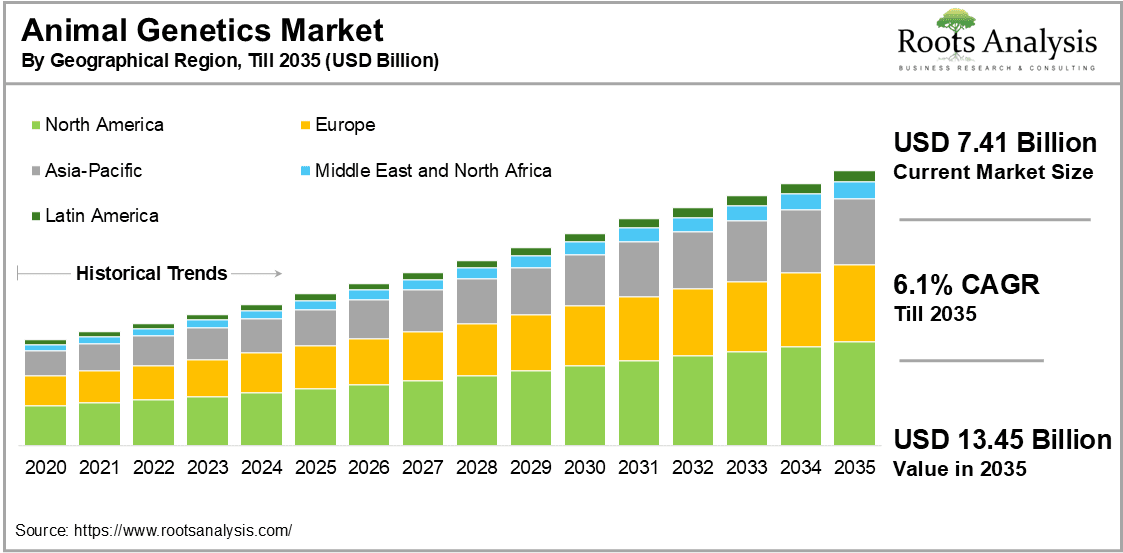
The global animal genetics market size, valued at USD 6.89 billion in 2024, is expected to grow to USD 7.41 billion in 2025 and USD 13.45 billion by 2035, representing a CAGR of 6.1% during the forecast period.
 |
To learn more about this report, request a free sample copy
Animal genetics refers to the scientific study of animal genes to understand how it influences appearance, behavior, disease resistance, disease susceptibility and productivity. Study of genes acts as a pillar of livestock development, conserving genetic diversity and developing disease-resistant animals. The animal genetics industry is rapidly evolving owing to the increasing demand for high-quality animal products, sustainable farming practices and growing companion animal health.
With availability of molecular technologies, such as next generation sequencing, CRISPR-Cas9, polymerase chain reaction and genome editing tools, researchers can significantly gain better insight on genes and modify them to develop a desired animal breed with high nutritional value. Furthermore, the growing risk of zoonotic diseases such as Ebola, rabies, anthrax and avian influenza has further increased the shift towards animal genetics by research institutes to understand disease pathogenesis, drug development and development of disease resistance livestock such as goats, cattle, pigs, buffaloes and sheep.
It is important to highlight that the animal genetics industry has been further proliferated with increasing shift towards cross breeding of livestock to blend characteristics of desired breeds. Techniques, such as embryo transfer technology, artificial insemination and super ovulation along with genetic technologies have made it possible to get the desired qualitative traits in animals.
Driven by the growing understanding of animal genetics in the livestock industry, several industrial players are undertaking strategic initiatives to develop advanced genome testing technologies. For instance, in May 2024, UltraBlack and International Brangus Breeders Associated entered into partnership with Angus Society to launch a new genetic evaluation tool (UltraSELECT) at Beef 2023. The tool has been designed for Angus Australia members breeding UltraBlack animals. These tools will utilize data from the United States and Australia, to enhance breed selection decisions and achieve strategic breeding goals.
It is worth highlighting here that, the Canadian Ministry of Agriculture and Agri-Food announced to provide approximately CAD $1.7 million to genetic traits research for beef and dairy cattle. The funding will be distributed to the non-profit association Canadian Angus Association in partnership with Holstein Canada for designing genetic evaluation tools to further understand genetic selection cattle.
Owing to the increasing technological initiatives and rising funding by government organizations, we believe that the market has a broad scope in the future for investments and innovations.
The research report provides comprehensive information on the leading players of the animal genetics industry who are presently active across various segments as mentioned in the table below.
| Key Report Attributes | Details | |
| Historical Trend | Since 2020 | |
| Forecast Period | Till 2035 | |
| Current Market Size | $ 7.41 Billion | |
| Market Size 2035 | $ 13.45 Billion | |
| CAGR (Till 2035) | 6.1% | |
| Type of Animal |
|
|
| Type of Technology |
|
|
| Type of Technique |
|
|
| Type of Genetic Material |
|
|
| Type of Testing Services |
|
|
| Type of Distribution Channel |
|
|
| End User |
|
|
| Geographical Regions |
|
|
| Key Companies Profiled |
|
|
| PowerPoint Presentation (Complimentary) |
Available | |
| Customization Scope | 15% Free Customization | |
| Excel Data Packs (Complimentary) |
Available | |
One of the key objectives of the animal genetics market report was to estimate the current size, opportunity and the market growth potential, over the forecast period, till 2035. We have provided informed estimates on the likely evolution of the market for the forecast period.
The global market analysis report also features the likely distribution of the current and forecasted opportunity within the market across various segments, such as type of animal (cattle, pigs, sheep & goats, poultry, companion animals (dogs, cats and horses) and other animals), type of technology (polymerase chain reaction, next generation sequencing, recombinant DNA, and microarray technology), type of technique (assisted reproductive technology, live animals, genome / genetic testing), type of genetic material (blood, tissue, embryo and semen), type of testing services (DNA profile testing, genetic traits testing (coat color & pattern, body size and coat traits (coat length, coat texture, shedding, furnishing and hairlessness)), genetic disease testing (infectious diseases and inherited disorders), other testing services (body features (oculocutaneous albinism (OCA) testing, muzzle length, tail length, eye color, chondrodysplasia (CDPA) (leg length), and back muscling & bulk testing) and DNA sex testing, breed discovery analysis and allergy testing)), distribution channel (private and public), end-user (veterinary hospitals, clinics, research centers, institutes, and other end users), geographical region (North America, Europe, Asia-Pacific, Middle East and North Africa, and Latin America) and leading players.
In order to account for future uncertainties associated with some of the key parameters and to add robustness to our model, we have provided three market forecast scenarios, namely conservative, base, and optimistic scenarios, representing different tracks of industry’s evolution.
All actual figures have been sourced and analyzed from publicly available information forums and primary research discussions. The financial figures mentioned in this market report are in USD, unless otherwise specified.
Based on the type of animal, the global animal genetics market size is segmented into cattle, pigs, sheep & goats, poultry, companion animals (dogs, cats and horses) and other animals. According to our analysis, presently cattle hold the highest share (42%) of the market and the trend of dominance is likely to remain unchanged during the forecast period. Cattles are currently in high demand as they provide valuable dairy products such as milk and meat. Moreover, milk-based products such as cheese and yoghurt are widely adopted in the preparation of wide range of food products, which further fueled the demand for superior breed cattle. Companies such as Neogen, Zoetis and DNA Labs India are some of the cattle genetic testing companies active in the market.
However, in the long run, companion animals’ segment is likely to grow at a higher CAGR during the forecast period. This can be attributed to the rising adoption of companion animals for emotional support. Moreover, willingness to spend extra money on companion animal health by pet parent is anticipated to drive this segment during the forecast period.
This segment highlights the distribution of global market across different types of technology such as polymerase chain reaction, next generation sequencing, recombinant DNA technology, and microarray technology. Among these, next generation sequencing is currently dominating the market by holding the highest share. This can be attributed to the fact that next generation sequencing is widely used for preparing gene libraries and allows sequencing of multiple genes to understand the genome role in animals’ growth and disease pathogenesis.
Moreover, the next generation sequencing is broadly used by veterinary research institutes to understand disease pathogenesis and selection of breeds based on genome traits. Driven by the broad usage across animal genetics, this segment will continue to grow at a substantial CAGR during the forecast period.
Based on the type of technique, the global market is segmented into assisted reproductive technology, live animals, genome / genetic testing. Currently, assisted reproductive technology accounts for the largest animal genetics market share (50%). This can be attributed to the growing emphasis on the development of cross breed animals to achieve high quality traits and improving characteristics of cattle. Assisted reproductive technologies such as embryo transfer, genetic engineering, in-vitro fertilization and artificial insemination have been widely adopted by animal breeders by exploring genetic diversity and combining characteristics of two breeds.
However, in the long run, genomic / genetic testing segment is anticipated to have highest animal genetics market growth, during the forecast period. Genetic testing plays a significant role in the selection of animal breeds based on the characteristics with higher precision. The genetic technologies advancements have further facilitated the identification of desirable gene traits such as high milk yielding, disease resistance and growth in animals, which makes genetic testing an important tool in breed selection process.
The global market is further bifurcated based on the type of testing services into DNA profile testing, genetic traits testing (coat color & pattern, body size and coat traits (coat length, coat texture, shedding, furnishing and hairlessness)), genetic disease testing (infectious diseases and inherited disorders), other testing services (body features (oculocutaneous albinism (OCA) testing, muzzle length, tail length, eye color, chondrodysplasia (CDPA) (leg length), and back muscling & bulk testing), DNA sex testing, breed discovery analysis and allergy testing).
According to our market analysis, presently, genetic trait testing accounts for the highest share (over 45%) of the market. This can be attributed to extensive usage of genetic trait testing in identifying animals with desirable traits such as meat quality, high milk, high fertility and disease resistance. In comparison to DNA profiling, genetic trait testing is a widely accepted service in animal research and breeders.
However, in the future, DNA profile testing and genetic disease testing segments are likely to attain higher animal genetics market growth, during the forecast period. This is primarily due to the growing prevalence of genetic disorders and significant reduction in animal productivity due to genetic defects. Furthermore, DNA profile testing is likely to gain momentum during the forecast period driven by the rapid usage in finding parent breed and genetic diversity study.
On the basis of genetic material, the global market is distributed across blood, tissue, embryo and semen. Based on our analysis, currently blood sample accounts for the highest market share. The convenience of extraction and easy testing procedure to understand the genetic trait has contributed to the highest share of the market. However, the semen segment is likely to grow at a steady CAGR during the forecast period. Semen contains the complete genetic material of animal (male animals) which allow researcher to analyze individual animal DNA to identify the genetic traits. The information is highly useful in breed selection with desired characteristics.
Based on the distribution channel, the global market is segmented into private and public. Currently, private segment accounts for the highest animal genetics market share. This can be attributed to the rising penetration of private companies who are presently focusing on delivering advanced genetic testing solutions and services. Furthermore, companies like Zoetis and Genus are undertaking strategic initiatives to expand their product portfolio, which is anticipated to drive this segment at a higher CAGR during the forecast period.
This segment highlights the distribution of global market into veterinary hospitals, clinics, research centers, institutes, and other end users. According to our animal genetics market analysis, currently research centers accounts for the highest share of the market. This can be attributed to the fact that research centers broadly use animal genetic testing solutions to understand the disease mechanism and how it affects humans. Furthermore, genetic testing is also utilized to understand biological similarities including neural circuity, health problems and to predict dietary roles. However, in the long run, veterinary hospitals segment is likely to grow at a higher CAGR during the forecast period. This can be attributed to growing demand for genome testing solutions to identify role of genes in diseases.
Based on our animal genetics market report, currently, North America accounts for the highest share (38%) of the market. Increasing livestock farming practices, adoption of companion animals, and rising focus on improving animal productivity to meet growing demand for animal-based products are the key factors contributing to the highest share.
In Asia-Pacific, the market for animal genetics is likely to grow at a higher CAGR during the forecast period. This can be attributed to the growing demand for dairy products and protein-rich diets and advancements in genetic technologies to improve livestock productivity are likely to bolster the growth of the market in this region.
The “Animal Genetics Market: Industry Trends and Global Forecasts, till 2035” research report features an extensive study of the focus on competitive landscape of strategic initiatives, emerging mega trends, big pharma initiatives, company profiles and key drivers and restraints. The market report highlights the efforts of several stakeholders engaged in this rapidly evolving segment of the animal genetics industry. Key takeaways of the data analysis are briefly discussed below.
Currently, the market is highly competitive, witnessing the presence of several well-established and new entrants. These industrial players are focusing on the development of next generation genetic testing solutions and services to expand research on genetic diversity of animals.
In order to leverage core competency in the market, the industrial players are taking strategic initiatives, including collaborations. For instance, in September 2024, Zoetis and Danone announced a strategic partnership to drive the sustainable practices within dairy farming by utilizing genetic technologies. Under the partnership, Danone will provide environmental stewardship and Zoetis will combine it with animal genetics expertise to innovate the breeding practices for the dairy industry.
As more industrial players focus on technological innovations in this field, the animal genetics market will remain competitive during the forecast period.
Some of the notable growth drivers that are anticipated to drive the market include increasing demand for animal-derived products and animal proteins to maintain good health. The understanding of animal genetics sets the base foundation for the development of livestock with high quality traits, which is crucial to meet growing demand for animal-based proteins.
Moreover, animal genetics also play a significant role in resolving challenges associated with animals’ growth, low nutrition, low productivity and climate-driven diseases, which are likely to be a key growth factor of the market. In addition, increasing research on animal genetics to boost the livestock productivity, understanding the emerging risk of gene associated diseases and their correlation with humans are likely to bolster the growth of this industry during the forecast period.
Some of the potential challenges in animal genetics market that are hindering its progress includes lack of skilled personnel and regulatory concerns. Notably, the industry is witnessing shortage of skilled geneticists who are well-versed with gene testing procedures, breeding methodology, identification of genetic biomarkers and gen modification techniques. Lack of skilled personnel may limit the research on animal genetics which ultimately impact market expansion. In addition, the ethical concerns and complex regulatory guidelines associated with animal gene testing may impede market growth during the forecast period.
With growing demand for animal-derived products and rising research initiatives to develop high quality livestock, technological innovations will remain the core trend in this industry. Currently, the industrial players are focusing on advanced gene technologies, such as CRISPR and marker-assisted selection. These genome editing tools help in efficient selection of desirable traits to develop healthier and disease resistant breeds. In addition, the industrial players leverage advanced data analytical tools, sensors and artificial intelligence to monitor animals heat cycle and feeding cycle in real time to improve livestock management practices.
Currently, the global market for animal genetics is expected to be valued at USD 7.41 billion and is poised to reach 13.45 billion by 2035, expected to grow at a higher CAGR of 6.1% during the forecast period. It is important to highlight here that several industrial players and government organizations are taking strategic initiatives to drive the development of advanced technologies for gene analysis. For instance, in December 2024, the USDA awarded over USD 3.25 million fund grant to new research collaboration network of animal scientists which is led by Professor Noelle Cockett, an animal geneticist at Utah State University.
With increasing research initiatives and investment in this field, the market will continue to grow at a steady rate during the forecast period, offering lucrative opportunities to industrial players for innovations.
Examples of key players engaged in this animal genetics industry (which have also been captured in this report) include ANICAM ENTERPRISES, Cobb-Vantress, GenEra, Neogen, EW Nutrition, Eurogene Ai Services, GENEX, Hendrix Genetics, Milk Source, SEMEX, TOPIGS NORSVIN, Tropical Animal Genetics, Trans Ova Genetics, URUS Group and Zoetis. This market report includes an easily searchable excel database of all the companies focusing on animal genetics.
The market report presents an in-depth analysis, highlighting the capabilities of various companies engaged in this domain across different segments. Amongst other elements, the market report includes:
Several recent developments have taken place in the animal genetics field. We have outlined some of these recent initiatives below.