Artificial Intelligence in Diagnostics Market Overview
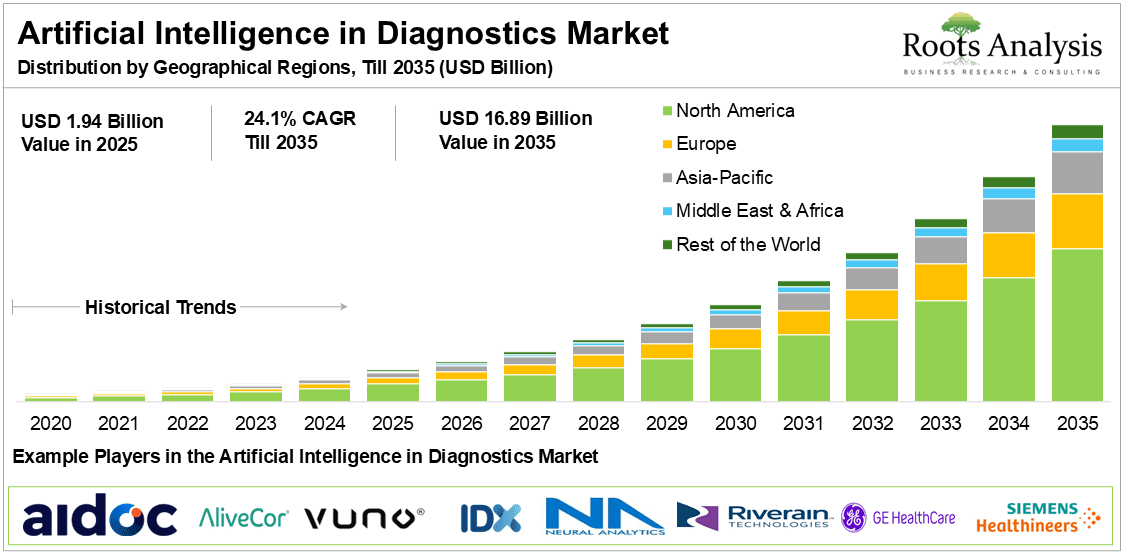
The global artificial intelligence in diagnostics market size, valued at USD 1.46 billion in 2024, is projected to reach USD 1.94 billion in 2025 and USD 16.89 billion by 2035, representing a CAGR of 24.1% during the forecast period.
To learn more about this report, request a free sample copy
Artificial Intelligence in Diagnostics Market: In Summary
- The artificial intelligence in diagnostics market is experiencing substantial growth, driven by the increasing demand for accurate, faster, and efficient diagnostic technologies. Artificial intelligence's ability to analyze vast datasets, identify subtle patterns, and minimize human error significantly enhances diagnostic speed and accuracy, aiding in proactive disease management.
- The market features a mix of well-established companies and innovative new entrants. Siemens Healthineers (Germany), GE Healthcare (US), Philips (US), Microsoft (US), Aidoc (Israel), AliveCor (US), Zebra Medical Vision (Israel) are among the prominent active players.
- These companies are actively engaging in strategic initiatives, such as product launches, and partnerships and collaborations, to strengthen their portfolios and market positions.
- In terms of component, the software segment currently holds the highest share (55%) due to the continuous adoption of AI-powered software and cloud solutions. However, the hardware segment is anticipated to exhibit a higher CAGR, driven by the integration of AI technology in hospital hardware.
- Diagnostic imaging holds the largest share, as modalities like MRI, CT-Scan, and X-Ray generate vast amounts of image data suitable for AI analysis. The in vitro diagnostics segment is projected for a higher CAGR with the rising trend towards point-of-care and molecular diagnostics.
- North America currently dominates the market share (55%) due to its advanced healthcare infrastructure and widespread adoption of AI in healthcare diagnostics. Asia-Pacific is projected to witness the highest CAGR during the forecast period. This growth is attributed to the increasing adoption of digital technologies and point-of-care diagnostics, driving demand for AI-based cloud services and software for data interpretation
- The industry is poised for continued expansion, fueled by ongoing technological advancements, increasing investments, integration of AI with wearable medical devices and the global shift towards proactive, predictive, and personalized healthcare models. Owing to the ongoing trends, the market will continue to propel at a higher CAGR in the future.
Artificial Intelligence in Diagnostics Market Introduction
AI in the diagnostics industry is gaining momentum due to the growing demand for accurate, faster, and efficient diagnosis technologies. Medical diagnosis is a process of determining diseases based on the symptoms and signs. Clinicians collect patient samples, such as blood and use conventional technologies for disease diagnosis. While conventional technologies are available for diagnosis, these technologies are often time-consuming, prone to human errors and may fail to diagnose subtle anomalies that indicate early stages of disease.
Owing to these limitations, the healthcare industry is shifting to integrate artificial intelligence in diagnostic technologies to improve accuracy, speed, and efficiency in disease diagnosis. It is worth noting that AI in oncology has already made significant transformation, enabling healthcare practitioners early diagnosis and proactive approach to treat patients. The strategic move towards AI for disease detection, predictive and preventive healthcare to address the growing concern of chronic conditions is catering the attention of industrial players for innovations.
Market players, such as Siemens Healthcare (Germany), GE Healthcare (US) and AliveCor (US) are undertaking strategic initiatives to strengthen their product portfolio. For instance, in January 2025, Philips (US) launched AI enabled CT 5300 at 23rd Asian Oceanian Congress of Radiology (ACOR) 2025. This revolutionary X-ray CT diagnosis system is equipped with advanced AI capabilities for diagnosis and screening diseases with higher accuracy. As more market players continue to innovate new AI technologies, we believe that AI in the diagnostics market will continue to expand in the future, offering enormous opportunities for investments and innovation.
Artificial Intelligence in Diagnostics Market: Report Attributes
| Key Report Attributes |
Details |
| Historical Trend |
Since 2020 |
| Forecast Period |
Till 2035 |
| Market Size 2025 |
USD 1.94 Billion |
| Market Size 2035 |
USD 16.89 Billion |
| CAGR (Till 2035) |
24.1% |
One of the key objectives of the AI in diagnostics market report was to estimate the current size, opportunity, and the market growth potential, over the forecast period, till 2035. We have provided informed estimates on the likely evolution of the market for the forecast period.
The global AI in diagnostics market analysis also features the likely distribution of the current and forecasted opportunity within the market across various segments, such as type of component, type of diagnosis, type of modality, type of technology, end user, geographical regions, and leading players.
In order to account for future uncertainties associated with some of the key parameters and to add robustness to our model, we have provided three market forecast scenarios, namely conservative, base, and optimistic scenarios, representing different tracks of industry's evolution.
Recent Developments in Artificial Intelligence in Diagnostics Market
Several recent developments in the field of artificial intelligence in diagnostic have occurred and we have outlined some of these below:
- In July 2025, Microsoft (US) launched the MAI-DxO platform, an LLM-powered diagnostic tool that has surpassed 85% accuracy in disease diagnosis. This platform leverages the “chain-of-debate” model with multiple AI agents for analyzing clinical data and interpreting diagnosis reports.
- In May 2025, Philips (US) signed a collaboration agreement with NVIDIA to leverage cutting-edge advances in artificial intelligence for MR imaging. This collaboration aims to build a foundational AI model for MRI, powered by NVIDIA’s AI computing platform to improve diagnostics workflow by enhancing MR image quality, accuracy and accelerating scan times.
- In March 2025, NVIDIA (US) signed a partnership with GE Healthcare (US) to advance their innovation in autonomous imaging with Physical AI. Both companies are also focusing on the development of autonomous X-ray technologies and ultrasound applications.
- In March 2025, Quest Diagnostics (US) entered into a partnership with Google Cloud (US). Under this partnership, Google Cloud (US) will deliver the latest generative AI technologies, and Google Cloud’s data analytic tools, including Google Agentspace to customized physician results reporting and individualized patient engagement.
Artificial Intelligence in Diagnostics Market Segmentation Insights
The market report presents an in-depth analysis of AI in diagnostics technologies developers who are currently active across various segments of the industry as mentioned below:
Artificial Intelligence in Diagnostics Market: Market Segmentation
| Market Segmentations |
Details |
| Type of Component |
- Software
- Hardware
- Services
|
| Type of Diagnosis |
- Cardiology
- Oncology
- Radiology
- Chest and Lungs
- Neurology
- Others
|
| Type of Modality |
- In Vitro Diagnostics (Molecular Diagnostics, Immunoassays & Clinical Chemistry, and Point-of-Care Tests)
- Diagnostic Imaging (MRI, CT-Scan, Ultrasound, X-Ray, and PET / SPECT & Others)
- Other Modalities
|
| Type of Technology |
- Machine Learning
- Deep Learning
- Natural Language Processing
- Computer Vision
- Predictive Analytics
|
| End User |
- Hospitals
- Diagnostic Laboratories
- Ambulatory Surgery Centers
- Other End Users
|
| Geographical Regions |
- North America
- Europe
- Asia-Pacific
- Middle East and North Africa
- Latin America
|
| Market in North America |
|
| Market in Europe |
- France
- Germany
- Italy
- Spain
- UK
- Rest of Europe
|
| Market in Asia-Pacific |
- China
- India
- Japan
- South Korea
- New Zealand
- Rest of the Asia-Pacific
|
| Market in Middle East and North Africa |
- Egypt
- Saudi Arabia
- South Africa
- United Arab Emirates
|
| Market in Latin America |
|
Industry Experts on Artificial Intelligence in Diagnostics Market
AI in diagnostics is getting bigger than ever before, driven by the consistent adoption across healthcare for early disease diagnosis. During GTC 2025, CEO Jensen Huang, NIVIDA, explain the emerging untapped opportunities in this field.
“AI computing demand is accelerating rapidly, driven by the rise of reasoning AI and agentic AI. The scale and complexity of AI workloads are transforming data center investments worldwide. Physical AI for industrial and robotics is a $50 trillion opportunity. AI-powered robotics and automation are set to transform manufacturing, logistics, healthcare and other industries, with the NVIDIA Isaac and Cosmos platforms leading the way, said CEO Jensen Huang, NVIDIA.”
Artificial Intelligence in Diagnostics Market Share Insights
Market Share by Type of Component: Which Component Holds the Highest Share of the Market?
- This segment highlights the distribution of the global market across different types of components, such as software, hardware, and services. According to the AI diagnostics market report, the software segment is dominating the market by holding 55% share of the market. The continuous acceptance of AI-powered software and cloud-solutions for diagnostic applications has fueled the demand for software, which is likely to be a key driver for this segment.
- It is worth noting that the hardware segment is likely to show higher growth potential, anticipated to grow at a higher CAGR during the forecast period. The lucrative growth is driven by the adherence of hospitals to hardware integrated with AI technology, such as machine learning in diagnostics tools to enhance workflow in the hospitals.
Market Share by Type of Diagnosis: Neurology Segment Holds the Highest Share
- The global market is further categorized across different types of diagnosis, such as cardiology, oncology, radiology, chest and lungs, neurology, and others. Among these, the radiology segment is currently dominating by holding 33% of the AI diagnostics market share. Lack of skilled radiologists, and shift towards AI-powered predictive analytical technologies has accelerated the demand for AI in radiology market to interpret vast amounts of data generated through MRI’s, X-rays, and computational technologies.
- While the radiology segment holds the highest share, the neurology segment is likely to expand at a higher CAGR in the future. This unprecedented reflects the increasing usage of AI-powered diagnostic tools / platforms for diagnosing neurological disorders, such as Alzheimer’s and Parkinson’s diseases. AI models offer higher accuracy in detecting Parkinson’s disease at an early stage using cognitive pattern and brain imaging, making it an invaluable tool for offering tailored treatment.
Market Share by Type of Modality: Diagnostic Imaging Holds the Largest Share
- Based on the type of modality, the global market is segmented into in vitro diagnostics (molecular diagnostics, immunoassays & clinical chemistry, and point-of-care tests), diagnostic imaging (MRI, CT-Scan, ultrasound, X-Ray, and PET / SPECT & others) and other modalities. According to the AI diagnostics market forecast, the diagnostic imaging segment holds the highest share due to the growing demand for AI-powered data interpretation technologies that can be integrated with diagnostics imaging modalities, such as MRI, CT-Scan, and PET / SPECT for real-time data interpretation.
- In the long run, the in vitro diagnostics segment is likely to propel at a higher CAGR during the forecast period. The rising shift towards point-of-care diagnostics and molecular diagnostics is likely to surge the usage of AI for in vitro diagnostic modalities.
Market Share by Type of Technology: Machine Learning Segment is Holding Highest Share
- The global market is further sub-divided based on types of technology, such as machine learning, deep learning, natural language processing, computer vision, and predictive analytics. Currently, machine learning is occupying the highest share of AI diagnostics market growth. Machine learning is widely used in diagnostic technologies for predictive analysis and the detection of subtle disease patterns, with solutions developed for the AI in oncology market supporting cancer-image interpretation, tumor classification, risk assessment and earlier diagnosis.
- The deep learning segment is expected to grow at a higher CAGR during the forecast period. This can be attributed to the fact that deep learning models, especially convolutional neural networks (CNNs), have revolutionized medical imaging analysis (X-rays, CT scans, MRIs, and pathology slides). They can detect subtle patterns associated with diseases, leading to improved diagnosis of conditions like cancer, diabetic retinopathy, and neurological disorders.
Market Share by End User: Hospitals Segment Holds the Highest Share
- Based on the end user, the global market is segmented into hospitals, diagnostic laboratories, ambulatory surgery centers, and other end users. Currently, the hospitals segment holds the highest share (over 45%), and the trend of dominance is likely to remain unchanged. Notably, hospitals are the primary settings of diagnostic modalities, such as MRI, CT scan, and X-ray that are widely being integrated with AI software / platforms to improve diagnosis accuracy, efficiency and managing large datasets.
- It is worth noting that the diagnostic centers segment is likely to show robust growth, anticipating registering a higher CAGR in the future. AI in diagnostic laboratories is crucial for analyzing genomic and proteomic data to identify biomarkers, and disease diagnosing for designing a tailored treatment plan.
Market Share by Geographical Regions: North America is Dominating the Market
- Based on the geographical regions, the global market is distributed across North America, Europe, Asia-Pacific, Middle East & Africa, and Latin America. According to the artificial intelligence in diagnostics market analysis, North America is occupying the highest share (55%) of the market. This highest share is due to the advanced healthcare infrastructure, and widespread adoption of AI in healthcare diagnostics to make data-driven treatment decisions for patients with chronic conditions.
- In Asia-Pacific, the market for artificial intelligence in diagnostics is likely to grow at a higher CAGR during the forecast period. This lucrative growth is due to the growing shift towards digital technologies and point-of-care testing that demands AI-based cloud services and software for data interpretation.
Artificial Intelligence in Diagnostics Market: Report Deliverables
| Report Deliverables |
Details |
Excel Data Packs
(Complimentary) |
Available |
| Key AI in Diagnostics Companies Profiled |
- Aidoc (Israel)
- AliveCor (US)
- GE Healthcare (US)
- Imagen Technologies (US)
- IDx Technologies (Japan)
- Microsoft (US)
- Neural Analytics (US)
- Riverain Technologies (US)
- Siemens Healthcare (Germany)
- Vuno (South Korea)
- Zebra Medical Vision (Israel)
(A complete list of companies captured is available in the report) |
PowerPoint Presentation
(Complimentary) |
Available |
| Customization Scope |
15% Free Customization |
Artificial Intelligence in Diagnostics Market Key Takeaways
The "Artificial Intelligence in Diagnostics Market Report: Industry Trends and Global Forecasts, till 2035" market report features an extensive study of the current market landscape, market size, market share, market growth, market trends, market value, market forecast, market outlook, statistics, and future opportunities for AI in diagnostics market players. The market research report lays emphasis on the AI-based diagnostic technologies / solutions that are being developed. Key takeaways of the market report are briefly discussed below.
Market Competitive Landscape: Competitive Landscape and Key Players in Artificial Intelligence In Diagnostics Market
The AI in medical diagnostics market landscape is characterized by the presence of well-established and new entrants. Leading active players in this domain are actively deploying AI-powered diagnostic solutions and developing new AI algorithms. In order to strengthen their positions in the market, these industrial players are leveraging mergers, acquisitions, collaborations, and partnerships.
For instance, in July 2025, the Hong Kong Polytechnic University and Peking Union Medical College Hospital signed a memorandum of understanding to integrate AI technologies and biomedicine into clinical practices. This partnership aims to advance scientific innovation and development in medical imaging, and radiotherapy.
Similar, several market players in AI in diagnostics industry are actively exploring new opportunities to strengthen their product portfolio. Some of the notable players are listed below.
- Siemens Healthineers (Germany): With over a century of legacy in medical technology, this company stand are pioneered imaging and laboratory diagnostics. The company is now heavily focused on AI to improve diagnostic precision and streamline workflows. Key solutions include AI-Pathway Companion for evidence-based decisions and AI-Rad Companion for radiology assistance
- Aidoc (Israel): This company holds specialization in diagnostic AI for radiology, enhancing speed, accuracy, and reliability. Their AI solutions analyze medical imaging in real-time to detect acute abnormalities, including brain hemorrhages, pulmonary embolisms, and cervical fractures.
- Philips (US): Philips has a long history in medical technology, now with a strong emphasis on AI-driven solutions to improve patient outcomes. Their portfolio includes Philips SmartSpeed for faster MRI imaging, AI-Powered CT Tools for liver analysis and stroke assessment, and an Advanced Visualization Workspace for integrated imaging across medical fields. Philips eCareManager supports remote patient monitoring with AI-driven insights, and their vendor-neutral systems facilitate easy adoption by hospitals.
Market Drivers: What are the Key Drivers for Growth in the Artificial Intelligence In Diagnostics Market?
The artificial intelligence in diagnostics industry market is propelled by several factors that are listed below:
Increasing Demand for Early and Accurate Diagnosis Solutions
The heightened demand for early disease diagnosis with higher precision is one of the potential drivers of the market. Notably, early disease diagnosis specifically in case of cancer and neurological conditions can help healthcare practitioners in providing optimal treatment to prevent severeness of the disease. Interestingly, the integration of AI for early disease detection can enhance speed and precision of disease diagnosis, allowing healthcare practitioners to take disease prevention and management decisions.
Rising Prevalence of Chronic Conditions: How is the Prevalence of Chronic Diseases Impacting AI in Diagnostics Market?
The growing incidence of chronic conditions has significantly increased the demand for advanced AI-powered diagnostics solutions for regular monitoring and disease management. According to the National Centers for Health Statistics, adults age 85 and older, nearly 37.3% have four or more chronic conditions. Notably, chronic conditions, such as cardiovascular diseases, respiratory illness, diabetes, and cancer require accurate and early detection for tailored interventions. The advancements in AI-powered imaging diagnostics can assist in analyzing the large datasets, making it an essential tool for providing early medical attention for disease management.
Market Challenges: What Challenges Affect the Adoption of AI-Powered Diagnostic Systems?
Despite immense demand, the market for AI in diagnostics is likely to witness several challenges that are mentioned below.
High Implementation and Operational Cost
It is worth mentioning that the deployment of AI for imaging diagnostics requires substantial investment. Some of the additional expenses include staff training, post-operational costs, and maintenance costs. These high implementations and operational costs may limit their adoption across small healthcare organizations.
Data Privacy, Security, and Regulatory Compliance
AI in pathology diagnostics generate enormous amounts of data, which is further transmitted through internet modem. The data storage and transmission through cloud networks may be prone to breaching. Handling sensitive patient data and meeting evolving regulatory requirements (such as GDPR, and HIPAA) are major concerns for AI adoption in diagnostics.
AI Algorithm Transparency and Explainability: How do Data Privacy and Algorithm Transparency Impact AI Diagnostics Adoption?
It is worth noting that many automated diagnostics systems function as “black box,” which makes it challenging for clinicians to analyze diagnosis results. The opacity associated with AI applications in health technologies tends to reduce trust from the patients, physicians as well as the regulators. In case the diagnostic support system does not offer an explanation for its diagnosis, practitioners may worry about employing it, which in turn makes patients lose faith in decisions that are not explainable. This scenario also makes it more difficult to ascertain liability when a misdiagnosis or error happens and further complicated matters.
Market Trends: What are the Emerging Trends in Explainable AI and Cloud-Based Diagnostics?
Several AI in diagnostics market trends that are shaping the industrial growth are listed below:
Integration with Digital Health and Imaging Systems to Enhance Interpretation
Healthcare personnels are integrating AI in radiology, pathology, and laboratory diagnostics tools to streamline workflow and minimize turnaround time. This integration with diagnostics modalities, such as CT scan, MRI, and X-ray improves accuracy of data, minimizes human errors and offer real-time data interpretation, which aids in early disease detection and tailored treatment planning. This collaborative approach, combining radiologist and AI readings, yields a more comprehensive and precise approach to disease detection.
Increasing Usage of AI With Wearable Medical Devices for Prediction Health Analytics
The rising shift towards wearable devices for real-time health data analysis is offering new opportunities in AI in diagnostics market demand. Wearable technology like smart watches and fitness trackers makes it easier to gather patient-generated health data (vital signs, sleep, and physical activity). This makes it possible to create customized health recommendations and proactively identify potential health challenges, shifting the focus of healthcare to provide preventative treatment.
AI in Diagnostics Market Size Analysis: How does AI improve early disease detection and diagnostic accuracy?
In 2025, the AI in diagnostics market is valued at USD 1.94 billion and is poised to reach at USD 16.89 billion by 2035. The lucrative growth reflects the increasing integration of AI technology with diagnostics modalities to enhance speed and accuracy in data interpretation. Furthermore, AI algorithms, for instance the image convolutional neural networks deep learning models, are trained on large datasets to detect subtle, complex patterns that show the presence of diseases years before they are usually diagnosed. These include tiny changes in tissues, minor shifts in medical images, or even subtle hints within biometric data. AI algorithms tend to be more accurate than human doctors in providing medical diagnostics as they do not get tired, distracted, or emotionally biases.
Artificial Intelligence in Diagnostics Market Report Coverage
The market report presents an in-depth analysis, highlighting the capabilities of various stakeholders in the AI in diagnostics industry, across different geographies. Amongst other elements, the market report includes:
- An Infographic Executive Summary
- Regulatory Scenario
- Comprehensive Database of Leading Players
- Competitive Landscape
- Porter’s Five Forces Analysis
- Company Competitiveness Analysis
- Startup Ecosystem in the AI in Diagnostics Market
- Company Profiles
- Partnerships and Collaborations
- Market Forecast and Opportunity Analysis
- Adjacent Market Analysis
- Key Winning Strategies
- Value Chain Analysis
Glossary
- Artificial Intelligence (AI): The application of intelligent machines to analyze and understand complex data, often used in healthcare to diagnose, treat, or prevent disease.
- Computed Tomography (CT): A medical imaging technique that uses computer-processed combinations of multiple X-ray measurements taken from different angles to produce tomographic (cross-sectional) images of a body.
- In-Vitro Diagnostics (IVD): Diagnostic procedures performed outside of a living organism, typically on samples, such as blood, urine, or tissue.
- Machine Learning (ML): A subset of AI that enables systems to learn from data, identify patterns, and make decisions with minimal human intervention.
- Predictive Analytics: The use of data, statistical algorithms, and machine learning techniques to identify the likelihood of future outcomes based on historical data.
From the Author’s Desk
Author’s View on Artificial Intelligence in Diagnostics Market
The AI in the diagnostics industry is rapidly growing due to the rising demand for early disease diagnosis technologies to manage chronic conditions. The market growth is further fueled by the escalating prevalence of chronic conditions and the critical need to alleviate the workload on an overburdened healthcare workforce. Despite increasing AI adoption for data interpretation in healthcare, the market players are required to address the data privacy challenges, and deployment cost. However, the overall long-term AI diagnostics market outlook remains positive due to the ongoing trends, such as integration of AI with wearables for continuous health monitoring.
Customization Opportunities
At Roots Analysis, we genuinely care about your success and understand that your business requirements are unique. While our market research reports provide valuable insights, we recognize that they might not cover every aspect you need to make well-informed strategic decisions. To account for that, we offer 15% free report customization tailored to your specific needs. Whether you require additional quantitative analysis, qualitative insights, or any other information related to the electric vehicles market, reach out to us today at support@rootsanalysis.com
Frequently Asked Questions
What is artificial intelligence in diagnostics?
It refers to the integration of artificial intelligence with diagnostic modalities, such as molecular diagnostic technologies, MRI, CT scan and ultrasound for the collection of data.What is the projected size of the global artificial intelligence in the diagnostics market by 2035?
The market for AI in diagnostics is expected to reach USD 16.89 billion by 2035.Which regions are leading the adoption of AI in diagnostics?
Currently, North America is dominating industry due to the increasing adoption of artificial intelligence for early disease diagnosis, advancement in the healthcare infrastructure and rising partnerships between industrial players.Who are the leading vendors and solution providers in the AI in diagnostics market?
Aidoc (Israel), AliveCor (US), GE Healthcare (US), Imagen Technologies (US), IDx Technologies (Japan), Microsoft (US), Neural Analytics (US), Riverain Technologies (US), Siemens Healthcare (Germany), Vuno (South Korea), and Zebra Medical Vision (Israel).What are the main applications of AI in diagnostics?
AI algorithms, particularly deep learning models, excel at analyzing complex medical images like X-rays, CT scans, MRIs, PET/SPECT scans, and ultrasounds. They can detect subtle patterns, abnormalities (tumors, fractures, and lesions) that might be missed by the human eye.What technological advancements are shaping the AI in diagnostics market?
Emergence of deep learning, advanced neural networks, and generative AI to excel the recognition pattern of visual data for higher accuracy in diagnostics are the key technological innovations in this field.