


 Download Free Sample
 Buy Now
Market Size
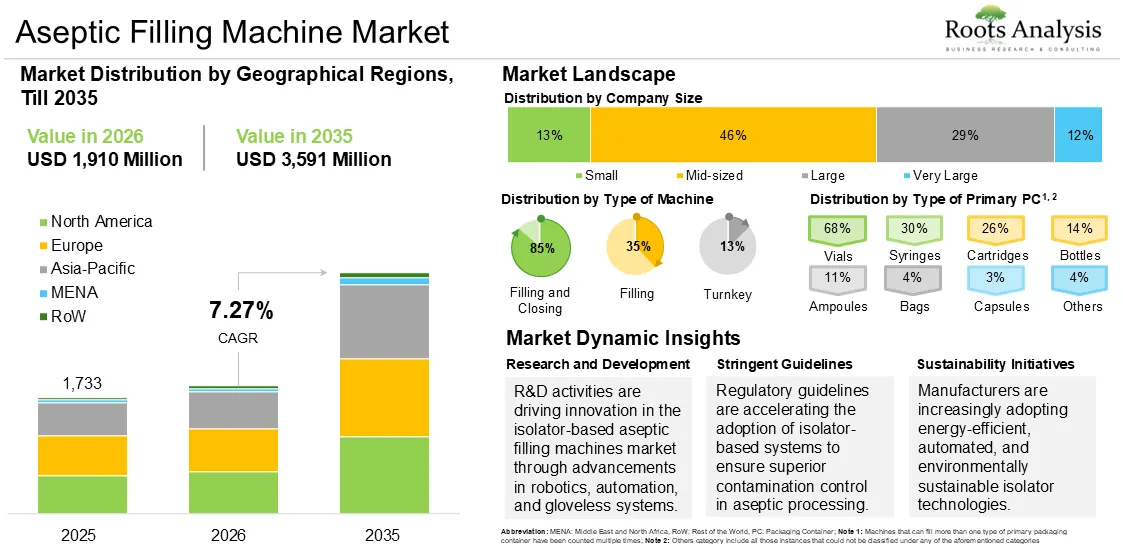
The global aseptic filling machine market, valued at USD 1,733 million in 2025, is projected to reach USD 1,910 million in 2026 and USD 3,591 million by 2035, representing a CAGR of 7.27% during the forecast period 2026 to 2035. Growth is being supported by increasing production of sterile biologics and injectable therapies, tighter contamination-control expectations, wider use of ready-to-use primary containers, and continued investment in automated and robotic fill / finish infrastructure.
See What's in the Full Report – Request Your Complimentary Insights!
Market Report: Key Takeaways
- The commercial-scale systems account for majority of the market revenues, reflecting demand for high-volume sterile manufacturing infrastructure.
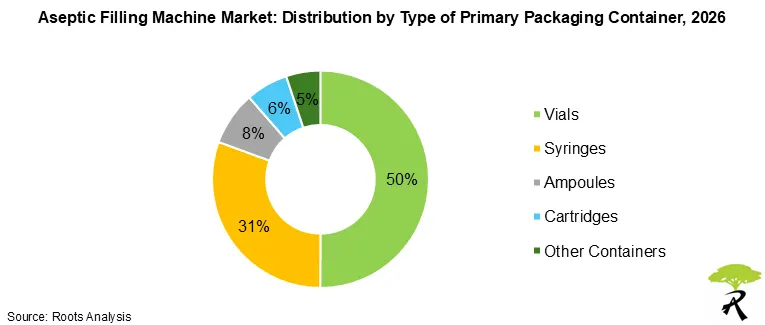
- Vials currently hold the majority of the market by type of primary packaging container, supported by their broad use across sterile injectable and biologic products.
- Medium-throughput systems account for the largest share of the market, offering a balance between filling capacity, operational flexibility and cost.
- Pharma / biotech companies represent majority of the market by end user, while CMOs / CDMOs remain important buyers of flexible aseptic filling infrastructure.
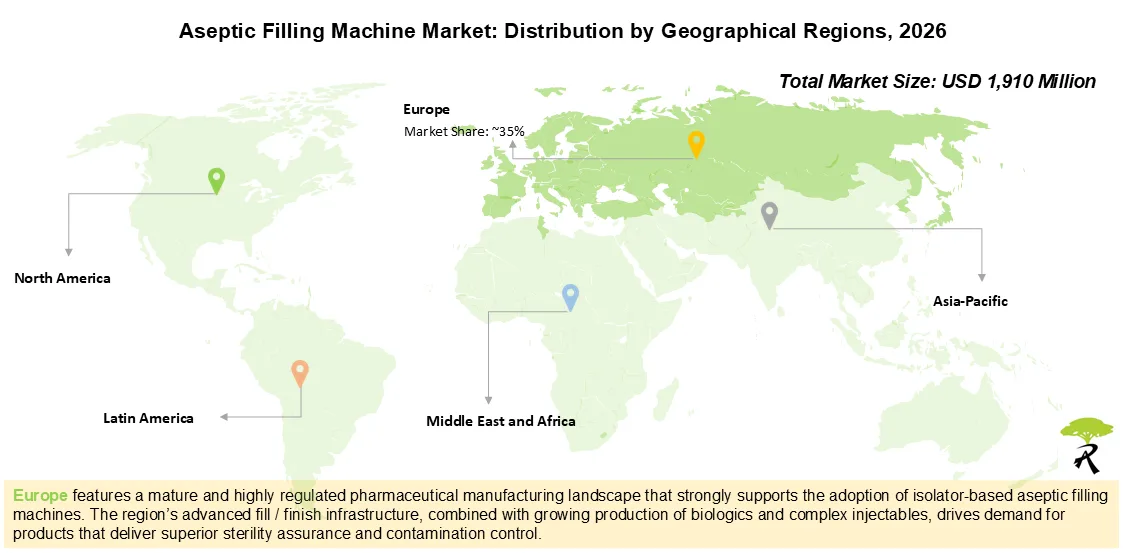
- Europe currently holds nearly 35% of the market, while Asia-Pacific is projected to grow at the fastest CAGR of during the forecast period.
Key Market Statistics
- Market Size, 2026: USD 1,910 Million
- Market Size, 2035: USD 3,591 Million
- CAGR (2026-2035): 7.27%
- Largest Region: Europe
- Fastest Growing Region: Asia-Pacific
Scope, Methodology and Industry Experts Interviews
This report defines aseptic filling machines, specifically focused on isolator-based aseptic filling machines that enclose the critical fill finish operations (filling, stoppering, and often capping of sterile containers such as vials, syringes, or cartridges) within a sealed, gas-tight barrier environment. The findings presented in this study were developed through a structured research methodology combining extensive secondary research, proprietary databases, company disclosures, regulatory filings, academic and industry publications, and primary research.
The report includes detailed transcripts of interviews conducted with the following industry participants:
Joe Hoff (Chairman and Chief Executive Officer of Automated Systems of Tacoma), stated, "The biggest unmet need in the field of aseptic filling systems is a flexible filling line, which is compatible with multiple types of primary filling containers, including vials, syringes and cartridges. From the quality assurance perspective, machines that can be easily cleaned, thereby limiting the risk of contamination, are preferred. In addition, within the pharma industry, there is a demand for machines having in-built validation function."
In addition, the market report includes transcripts of the following third-party discussions:
- Vice President, Business Development, Mid-sized Company, US
- Chief Technical Officer, Mid-sized Company, US
- Chief Executive Officer, Mid-sized Company, US
- Director of Business Development and Strategic Partnerships, Mid-sized Company, US
- Chief Executive Officer, Mid-sized Company, US
- Business Development Manager, Large Company, Germany
- Head-Strategy and Product Management Pharma Liquid, Very Large Company, Germany
- Vice President, Strategy and Global Product Management Pharma, Very Large Company, Germany
- Senior Director of Business Development, Very Large Company, US
- Site Quality Head, Executive Director, Very Large Company, US
- Chief Executive Officer, Mid-sized Company, US
What are Isolator-based Aseptic Filling Machines?
Isolator-based aseptic filling machines integrate filling, stoppering, capping and related handling operations within a physically separated, controlled environment designed to minimize contamination risk during sterile drug manufacturing. These systems are used for products that must be filled aseptically, including many biologics, vaccines and other sterile injectables that cannot rely on terminal sterilization after filling.
Compared with conventional cleanroom filling, isolators reduce direct operator exposure to the Grade A critical processing zone. Restricted access barrier systems (RABS) also limit intervention, but isolators generally provide a higher degree of physical separation and can support lower-grade background environments when appropriately designed, qualified and operated in accordance with applicable GMP requirements. The report, therefore, treats isolator-based filling as a distinct barrier-technology segment rather than using the terms isolator and RABS interchangeably.
What is Driving Aseptic Filling Machine Market Growth?
- Rising Demand for Biologics and Injectable Therapies: The increasing shift towards injectable drugs and rising number of injectable molecules is driving the demand for isolator-based aseptic filling machines. Further, there has been an increase in utilization of isolators in aseptic fill / finish operations, owing to the fact that they offer isolation from non-sterile environment for biologics that cannot be terminally sterilized. Several proteins cannot withstand heating, and other chemical or physical processes necessary for sterilization, thereby, necessitating isolator-based aseptic filling processes (and the increased use of isolators) to ensure product sterility without compromising the integrity of these sensitive biologics.
- Stringent Regulatory Requirements: Revised regulatory frameworks, particularly the EU GMP Annex 1 guidelines emphasizing contamination control strategies, have accelerated the adoption of isolator-based aseptic filling machines. These regulations mandate reduced human intervention in Grade A environments and require robust barrier technologies to ensure sterility assurance. Further, isolators offer superior separation between the operator and the critical processing zone compared to conventional cleanrooms or basic RABS setups. Pharmaceutical companies are therefore investing in isolator-equipped filling lines to achieve compliance, facilitate easier validation, and mitigate the risk of product recalls or regulatory non-conformance. The global influence of these standards is driving consistent demand across major manufacturing regions.
Recent Developments in the Aseptic Filling Machine Market
- Syntegon: In May 2026, launched SynTiso, a fully integrated aseptic filling line with a robotic handling system for high-throughput pharmaceutical manufacturing.
- Kindeva Drug Delivery and OPTIMA: signed an agreement, in May 2026, for the installation of two new, compact and high-performance turnkey lines with isolators for RTU-syringes, designed to deliver maximum efficiency and product safety.
- IMA and ProSys: signed an agreement, in February 2026, that provides for the purchase of most of the latter company's shares.
Your Business is Unique – Why Shouldn't Your Report Be?
Aseptic Filling Machine Market Trends
- Partnerships and Collaborations: Strategic partnerships are pivotal for aseptic filling equipment providers to build more integrated manufacturing solutions. Collaborations increasingly bring together filling technology with isolators, automation, environmental monitoring and modular manufacturing infrastructure enabling pharmaceutical companies to source a greater proportion of their aseptic processing requirements through coordinated technology platforms. This can reduce integration challenges, simplify qualification and validation activities, and support faster deployment of new aseptic filling capacity. Recent collaborations, including EREA and PcVue France in March 2025, demonstrate the continued emphasis on technology integration. In parallel, acquisitions represented the second-most common type of partnership identified in our analysis, with 13 transactions. Such agreements enable equipment manufacturers to add complementary technologies, expand their product portfolios and develop broader end-to-end aseptic processing capabilities. In the coming years, the ability to provide integrated, automated and flexible filling solutions is likely to become an increasingly important competitive differentiator for companies operating in this market.
Pay Only for What You Need – The Best Way to Optimize
Market Segments
Based on the research, we have segmented the aseptic filling machine market into scale of operation, type of primary packaging container, system throughput, end user, and geographical regions.
- By Scale of Operation: Clinical Scale, Commercial Scale
- By Type of Primary Packaging Container: Vials, Syringes, Ampoules, Cartridges, Capsules, Other Containers
- By System Throughput: Low, Medium, High
- By End User: Pharma / Biotech Companies, Contract Manufacturing Organizations
- By Geographical Regions: North America, Europe, Asia-Pacific, Middle East and North Africa, Rest of the World
Market Segmentation Analysis
Commercial Scale Driving the Market by Scale of Operation
Commercial-scale systems currently account for the largest share (more than 90%) of the isolator-based aseptic filling machine market due to the increasing demand for high-volume sterile drug manufacturing, requiring commercial-scale isolator-based aseptic filling machines to ensure efficient, accurate, and compliant production.
Vials Lead by Type of Primary Packaging Container
Vials currently capture the majority share (50%) within the isolator-based aseptic filling machine market driven by their broad use across injectable drugs and biologics, compatibility with established filling and closing processes, and availability in both bulk and ready-to-use formats support continued demand. Where terminal sterilization of the filled product is not feasible, vials can be processed through validated aseptic workflows, including washing, depyrogenation / sterilization or RTU handling depending on the container format.
Medium Throughput Systems Will Lead Aseptic Filling Machine Industry
Medium-throughput systems currently account for majority of the market share driven by the widespread adoption of these systems, as they offer an optimal balance between filling capacity, operational efficiency and cost. The market for high-throughput systems is likely to grow at a relatively higher CAGR of 7.5% during the forecast period. This is due to the ability of high level of throughput systems to deliver faster filling speeds, higher productivity and consistent performance in large-scale pharmaceutical production.
Pharma / Biotech Companies Lead the Market by End User
Pharma / biotech companies capture the majority share within the isolator-based aseptic filling machine market, as a result of the extensive adoption of these machines to support large-scale production of sterile injectable drugs and biologics. This trend is likely to remain the same in the future as well, owing to the robust expansion of injectable drug pipelines, the growing complexity of biopharmaceutical products that require stringent contamination-free processing, and increasing emphasis on regulatory compliance for ensuring product safety and efficacy throughout their lifecycle.
Market Regional Insights
Europe Will Drive Future Market Expansion
Europe currently accounts for the highest share (nearly 35%) of the overall market, owing to the presence of established pharmaceutical giants, advanced manufacturing infrastructure, high adoption of cutting-edge isolator and robotic aseptic technologies, and significant investments in sterile fill-finish capabilities for biologics, vaccines, and high-value injectables.
Asia-Pacific is the Fastest Growing Region
Asia-Pacific is expected to register the fastest CAGR during the forecast period owing to the rapid pharmaceutical production, lower manufacturing costs, expansion of domestic manufacturing capacity, and supportive government initiatives aimed at strengthening healthcare in this region.
Get an Instant Quote in 10 Minutes. Lowest Price Guaranteed
Key Players Profiled in the Isolator-based Aseptic Filling Machine Market
Examples of key companies profiled in this market report include AST, Bausch+Ströbel, Dara Pharma, Groninger, IMA Group, Marchesini Group, OPTIMA, Syntegon and Tofflon. The complete list of close to 55 companies is available in the full report, which also includes an easily searchable Excel database of companies worldwide. Additional named organizations referenced elsewhere in this report's underlying data reflect initiatives undertaken across the isolator-based aseptic filling machine ecosystem, not an endorsement relationship with Roots Analysis.
Report Deliverables and Customization
Alongside the core market report, clients receive complimentary Excel data packs covering the isolator-based aseptic filling machine market landscape, product competitiveness analysis, partnerships and collaborations, and market forecast and opportunity analysis. A complimentary PowerPoint presentation summarizing the full report is also included, and 15% free customization scope is available on request. The report is designed to support R&D and regulatory affairs teams and pharmaceutical business development benchmarking their capabilities, capacity and competitive positioning.
Report Authorship
This report was authored by Simriti Gupta, part of Roots Analysis healthcare and pharma research practice, with a focus on the isolator-based aseptic filling machine market, including technology trends, competitive landscape, and adoption across pharmaceutical and biotechnology companies. All findings are based on proprietary databases, executive interviews, and regulatory analysis, and were subject to internal peer review prior to publication.
Independence and Non-Affiliation
Roots Analysis is an independent secondary and primary market research publisher. This report is not affiliated with, endorsed by, or produced on behalf of any company named or profiled within it, including all key players, and industry expert interviewees referenced above.
Roots Analysis' findings draw on a combination of secondary research and primary interviews with industry experts, of the kind referenced above, to validate market sizing, segment shares, and forecast assumptions independently of any single company's disclosures.


