
Lowest Price Guaranteed
Pages
214
Last Updated
July 2026
View Count
12988
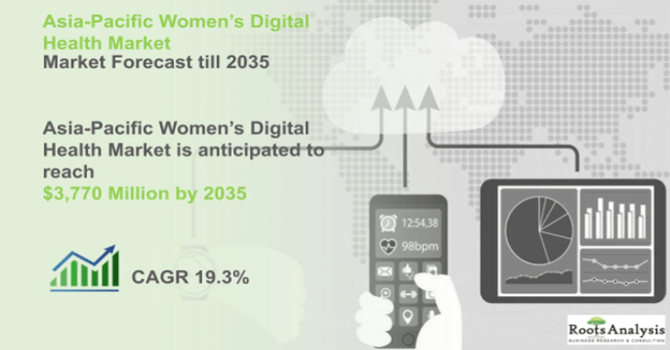
The Asia-Pacific women's digital health market is estimated to grow at a CAGR of 19.3% during the forecast period. The market is likely to cross USD 3,770 million by 2035.
To learn more about this report, request a free sample copy
The Asia-Pacific women's digital health industry is experiencing a transformative shift owing to the increasing adoption of technologies to empower women in managing general and reproductive health. In recent years, the escalating incidence of infectious and chronic diseases among women has underscored the requirement for innovative technologies that can assist in the early detection, management, and treatment of diseases in women. Notably, women are likely to experience reproductive health-associated concerns and general wellness concerns that cover post-pregnancy issues, obesity, anxiety, postpartum depression, HIV, breast cancer, cervical cancer, and osteoporosis.
As per the recent report of the Asia-Pacific Resource and Research Center for Women, every year nearly 265,884 Asian women are diagnosed with cervical cancer, and around 42,735 deaths have been reported from the disease. Considering the necessity of maintaining female reproductive, fertility and general health, various FemTech companies in Asia-Pacific are continuously investing in R&D to develop diagnostic tools, services, devices including smart wearables gadgets and applications to address women’s health issues. FemTech industry refers to the group of companies providing digital health solutions including diagnostic tools, devices and services to track and maintain women's health issues.
Further, several women’s health companies are gaining momentum in Asian countries through partnerships, educational programs and community building to educate women about health issues and benefits of using digital technologies to monitor health conditions on time. For instance, in the Q1 2023 series, FemTech Association of Asia entered into partnership with Women’s Health Innovation Series-Asia with an aim of bringing conferences on women's Health and FemTech to Southeast Asia. The purpose of this event is to collaborate with industrial leaders and offer them a platform for sharing their thoughts and showcasing technological advancements to develop digital health solutions for Asian markets. Further, the conference has also provided enormous investment and partnership opportunities across the Asian women’s digital health market for driving innovation. With ongoing efforts and initiatives taken by key industrial players to explore trends and opportunities in the Asia-Pacific women's digital health industry to deliver cost effective solutions, it is believed that the market will grow at a steady rate during the forecast period.
The research report presents detailed analysis of women’s digital health industry across various segments mentioned in the table below:
| Key Report Attributes | Details | |
| Historical Trend | 2019-2023 | |
| Base Year | 2023 | |
| Forecast Period | 2024-2035 | |
| Market Size in Asia-Pacific (2024) | USD 498 million | |
| Market Size in Asia-Pacific (2035) | USD 3,770 million | |
| Based on Type of Solutions |
|
|
| Based on Therapeutic Application Areas |
|
|
| Distribution Based on Countries |
|
|
| Key Companies Covered in the Asia-Pacific Women's Digital Health Market |
|
|
| PowerPoint Presentation (Complimentary) |
Available | |
| Customization Scope | 15% Free Customization | |
|
Excel Data Packs (Complimentary) |
|
|
The aim of in-depth analysis on Asia-Pacific women's digital health market was to offer comprehensive information about the ongoing market evolutions, growth opportunities, and future scenarios to help stakeholders make an informed decision about investment in this field. We have also covered information about the estimated revolution of women's digital health tools in Asia-Pacific for the projected period 2024-2035. The market research report covers year-wise discussion over the current market scenario, emerging opportunities, and future growth that has been segmented across various regions as mentioned in the table above.
In order to depict the strength of our market analysis model and future uncertainties, we have covered three forecast scenarios over the conservative, base, and optimistic scenarios, predicting different records of industrial growth. Various insights represented in Asia-Pacific women's digital health market report have been held by detailed discussions with different industrial leaders and stakeholders. All the factual figures and images covered in the market report have been analyzed and sourced from primary research discussion and publicly available information.
The Asia-Pacific women's digital health market revenue has been distributed across Applications / Software, Devices, and Services based on the type of solutions. Driven by the increasing adoption of advanced applications for managing reproductive health/fertility in women, the Asia-Pacific market is witnessing steady growth across different countries. The women's digital health app market in Asia-Pacific is estimated to reach around USD 3,593 million by 2035.
The Asia-Pacific women’s digital health market is segmented into fetal health, general wellness, menstrual cycle, pelvic care, reproductive health / fertility, and other therapeutic areas. According to our projection, the women's digital health market in Asia-Pacific has been projected to grow at a steady rate owing to the increasing usage of apps, devices, and services for diagnosing and monitoring women's diseases. In terms of services, currently the Asia-Pacific women's digital health market holds 17% of the global WDH market share in 2024 and the trend is likely to change during the forecast period.
The “Asia-Pacific Women’s Digital Health Market - Distributed by Type of Solutions (Applications / Software, Devices and Services), Therapeutic Application Areas (Fetal Health, General Wellness, Menstrual Cycle, Pelvic Care, Reproductive Health / Fertility, and Other Therapeutic Areas), and Asia-Pacific (China, Japan, India, Singapore, Malaysia and Rest of the World): Industry Trends and Regional Forecasts, Till 2035”. The market report covers a detailed analysis of the current and future market landscape, offering well-informed decisions on the growing opportunities and investment in Asia Pacific region of the global women's digital health market over the next decades. The study underlines an in-depth analysis, highlighting various industry stakeholders' diverse capabilities in this field.
The potential factors driving Asia-Pacific women's digital health solution market includes growing awareness about women's health issues and the importance of early diagnosis for managing diseases. Further, the widespread integration of smart technologies and tools to prioritize disease management in remote areas is a major driver contributing to the market's growth. The ongoing supportive initiatives from various industrial and non-industrial leaders established in the Asia-Pacific region for the development of advanced digital health solutions are driving the women's digital health solution industry in the region.
Data security and privacy are some significant challenges that impede the widespread adoption of women's digital health applications. Additionally, the limited access to technology in certain underserved or rural areas of Asian countries may restrict the market growth during the forecast period. Maintenance of cultural sensitivity in the context of women's digital health applications can be difficult due to the different cultural practices across diverse Asia-Pacific regions. Moreover, navigating complex regulatory guidelines related to healthcare data exchange, medical devices, and telehealth services across the Asia-Pacific region can be challenging.
The increasing usage of digital technologies and applications for disease monitoring provides significant opportunities for industrial stakeholders to drive growth in this field. Currently, researchers are emphasizing the development of fertility and pregnancy monitoring applications that offer features such as fertility insights, ovulation tracking, and pregnancy monitoring. These advanced applications cater to the emerging need for family planning and disease tracking. Further, integrating artificial intelligence for personalized healthcare insight is a potential opportunity for key industrial leaders. These women's health apps and devices can leverage artificial intelligence-based algorithms to provide tailored treatment plans.
The Asia-Pacific women's digital health market future outlook revolves around integrating telehealth services, artificial intelligence integration, and personalized health insight to offer powerful tools for reproductive health management.
The key players have developed various apps and software that can be utilized across multiple therapeutic applications, including reproductive health / fertility, menstrual cycle tracking, general wellness, pelvic care, and fetal health. Currently, with a targeted women population of 707.8 million, the adoption rate of reproductive health / fertility apps in China is likely to increase from 2.8% in 2024 to 4.6% by 2035. In Japan, the adoption rate of reproductive health / fertility apps will grow from 9.6% in 2024 to 15.6% by 2035. This can be attributed to the growing awareness among women about the adverse impact of diseases on overall health.
Asia-Pacific women's digital health device market is estimated to hold 11% of the overall market share. Based on the devices, the market has been segmented into digital basal thermometers, HearBEAT, and fertility tracking devices. Currently, with a women population of 13.6 million, the adoption rate of digital basal thermometers is 1.5% in Australia. Further, the adoption rate of HeraBEAT is 0.5% in 2024, owing to the increasing demand for ovulation tracking devices.
Presently, 41% of women of fertility age have underscored the demand for fertility and menstrual cycle tracking devices to conceive naturally. The adoption rate of Mira Analyzer (Menstrual cycle tracking device) is estimated to be around 0.3% in 2024 and is poised to reach 0.6% by 2035. In China, with a women population of 707.8 million, the projected adoption rate of Elvie Trainer (General wellness tracking device) is estimated to be 0.1% in 2024.
Examples of key companies engaged in Asia-Pacific women’s digital health market (which have also been profiled in this market report; the complete list of companies is available in the full report) include Fermometer, Halza, Hubble Connected, Maya Digital Health, Nuvo, Niramai, Vivant and Willow.
This women's digital health market report includes an easily searchable Excel database of all the companies providing women's digital health products in Asia-Pacific.
Several recent developments have occurred in the Asia-Pacific women's digital health market. We have outlined some of these recent initiatives below. These developments, even if they took place post the release of our market report, substantiate the overall market trends outlined in our analysis.