Assisted Living Technologies Market Overview
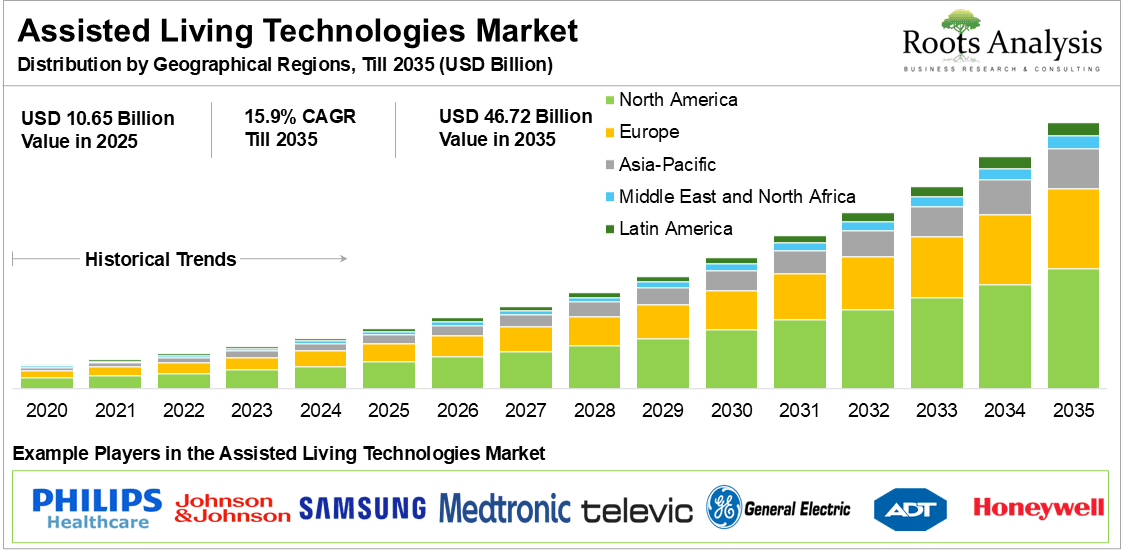
The global assisted living technologies market size, valued at USD 8.86 billion in 2024, is projected to reach USD 10.65 billion in 2025 and USD 46.72 billion by 2035, representing a CAGR of 15.9% during the forecast period.
To learn more about this report, request a free sample copy
Assisted Living Technologies Industry: In Summary
- The expanding global population of older adults is driving a significant demand for assisted living technologies that empower them to manage daily activities more independently and safely.
- Tech-driven medical solutions, such as wearable medical devices, medical management systems, emergency home systems and movement tracking systems will be the key trends of this market.
- With an unprecedented growing demand, the market is expected to grow at a CAGR of 15.9% during the forecast period.
- In terms of products, wearable devices segment holds the dominating positions due to the convenience of usage and real-time data monitoring abilities.
- In terms of region, North America is holding the leading position in assisted living technologies market due to the growing adoption of advanced tech-based solutions for managing chronic conditions and increasing investment in healthcare infrastructure to assist geriatric patients for living a quality life.
- The market in Asian region is expected to grow at a higher CAGR during the forecast period. This growth is primarily fueled by a significant geriatric demographic and a rise in government initiatives promoting healthcare technology advancements in this region to support quality life.
Assisted living technologies industry is continually evolving driven by the growing demand across geriatric population to live quality life. With growing age, there is high chance of chronic illness, mental illness, and physical disabilities due to cell degeneration. Furthermore, conditions, such as arthritis, Parkinson’s disease, and respiratory illness can lead to functional limitation. As per the latest stats of the World Health Organization, by 2030, 1 out of 6 people will be aged 60 years or more. As people age, some common conditions, such as refractive errors, hearing loss, osteoarthritis, dementia, and depression may likely increase the requirement for supportive assistance to perform day-to-day tasks along with medication.
In order to support geriatric population, assisted living technologies emerged as a revolutionary approach. It encompasses a broad range of tech-driven solutions, such as wearable medical devices, emergency home systems, medication management devices, and moment tracking systems. These solutions help to monitor health parameters, send alerts for medication / aid in nurse call systems, aid in hearing, vision, and prevent accidental falls. With the integration of assisted living technologies, healthcare professionals can deliver quality care to geriatric patients beyond hospital settings.
In addition, the integration of smart home solutions, such as voice-controlled assistance, smart lighting and thermostats allow aging people with cognitive limitations to create an adaptive environment for quality living without being dependent on caregivers. Owing to the growing aging population and emerging technology needs, this industry offers breakthrough opportunities to industrial players for technological innovations that aid in living quality life.
Notably, companies like Philips Healthcare (Netherland), Honeywell (US) and PointClickCare (Canada) are increasing their initiatives to develop smart hardware and software solutions for personalized care. For instance, in January 2025, iWOW (Singapore), introduced two groundbreaking age-tech products, namely the BOP Monitor and BOP Presence at CES 2025. These products are a part of a comprehensive suite of IoT solutions aims to detect accidental fall and monitor the moment of senior at home to keep them safe. With consistent engagement of industrial players towards innovation, we believe assisted living technologies market will grow steadily during the forecast period.
Assisted Living Technologies Market: Report Attributes
| Key Report Attributes |
Details |
| Historical Trend |
Since 2020 |
| Forecast Period |
Till 2040 |
| Market Size 2025 |
USD 10.65 Billion |
| Market Size 2035 |
USD 46.72 Billion |
| CAGR (Till 2035) |
15.9% |
One of the key objectives of the assisted living technologies market report was to estimate the current size, opportunity, and the market growth potential, over the forecast period, till 2035. We have provided informed estimates on the likely evolution of the market for the forecast period.
The global assisted living technologies market analysis report also features the likely distribution of the current and forecasted opportunity within the market across various segments, such as type of component, type of product, end user, geographical regions, and leading players.
In order to account for future uncertainties associated with some of the key parameters and to add robustness to our model, we have provided three market forecast scenarios, namely conservative, base, and optimistic scenarios, representing different tracks of industry’s evolution.
Prevailing geriatric patient safety concerns, medication requirement to manage chronic conditions, and demand for smart technologies to ease their living with limited mobility has validated the demand for assisted living technologies. Industrial players are taking strategic initiatives to launch AI-powered assisted living technologies, software, and apps to provide a seamless care for the aging population.
Recent Developments in Assisted Living Technologies Market
Several recent developments in the field of assisted living technologies industry have occurred, and we outlined some of these below.
- In May 2025, NtelCare (US) announced its new partnership with Vavyar (Germany). This partnership aims to deliver proactive solutions for bed exit alerts and fall detection, offering new ways for predictive care in eldercare facilities. These two companies are launching contactless monitoring systems that feature radar sensors and multimodal AI for passive remote non-intrusive monitoring.
- In May 2025, AltumView (Canada) released the veta version of Phase 2 of its latest “Advanced Fall Detection” feature powered by the latest VLM (Large Vision Language AI Model) that can capture all type of accidental falls, including vertical falls, blocked by furniture and other.
- In March 2025, MIT World Peace University (India) developed IoT-enabled tablet and capsule dispenser specifically designed to automate medication management and remote patient monitoring of medicine. This automated medication dispenser ensures timely medication dispensing and assist patients with complex dosing schedules.
Assisted Living Technologies Market Segmentation Insights
The market report provides comprehensive information on assisted living technology providers who are currently active across various segments of the industry as mentioned in the table below.
Assisted Living Technologies Market: Market Segmentation
| Market Segmentations |
Details |
| Type of Component |
- Hardware (Sensors, Camera, Display Systems and Accessories)
- Software & App
- Services (B2B and B2C)
|
| Type of Product |
- Smart Home Devices
- Wearable Devices
- In-Home Cameras
- Personal Emergency Home Systems
- Home Safety & Security Systems
- Medication Management Devices
- Others
|
| End User |
- Assisted Living Facilities
- Nursing Homes
- Rehabilitation Centers
- Homecare Settings
- Hospices
- Others
|
| Geographical Regions |
- North America
- Europe
- Asia-Pacific
- Middle East and North Africa
- Latin America
|
| Market in North America |
|
| Market in Europe |
- France
- Germany
- Italy
- Spain
- UK
- Rest of Europe
|
| Market in Asia-Pacific |
- China
- India
- Japan
- South Korea
- Rest of the Asia-Pacific
|
| Market in Middle East and North Africa |
- Egypt
- Saudi Arabia
- United Arab Emirates
|
| Market in Latin America |
|
Assisted Living Technologies Market Share Insights
Market Share by Type of Component: Hardware Segment Holds the Highest Share
- This segment highlights the distribution of global market across different types of components, such as hardware (sensors, camera, display systems and accessories), software & app, and services (B2B and B2C). Currently, by holding nearly 35% of the assisted living technologies market share, hardware segment is dominating the market. Hardware, such as display systems, sensors, communication devices, medical equipment, smart home systems, and cameras are the core part of assisted living technologies for tracking patient movement and health condition.
- Being the crucial component of assisted living technologies, the hardware segment will continue to dominate the market and is expected to grow at a higher CAGR during the forecast period.
Market Share by Type of Product: Wearable Devices Segment is Dominating the Market
- Based on the type of product, the global market is segmented into smart home devices, wearable devices, in-home cameras, personal emergency home systems, home safety & security systems, medication management devices, and others. According to the assisted living technologies market report, the wearable devices segment holds the largest share of the market. This can be attributed to the growing usage of wearable devices, such as smart watches, medical devices, and trackers for remote patient monitoring. By collecting useful information of patient health parameters, wearable devices allow healthcare practitioners to deliver precise care.
- Notably, in the future, smart home devices segment is likely to grow at a higher CAGR during the forecast period. The integration of IoT and artificial technologies in smart home appliances helps in managing a variety of tasks, which is beneficial for elder people with restricted mobility. The large-scale adoption is likely to foster its demand in future to manage households’ cores so elderly people can live quality life.
Market Share by End User: Homecare Segment Holds the Largest Share
- Based on the end user, the global market is segmented into assisted living facilities, nursing homes, rehabilitation centers, homecare settings, hospices, and others. According to our projection, currently homecare settings hold the largest assisted living technologies market share. This is potentially due to the increasing demand for wearable technologies and smart care solutions to manage elderly patient chronic conditions at home.
- Notably, with the rising burden of geriatric population with chronic conditions, healthcare experts are continually seeking remote care technologies to facilitate remote care on time. Driven by the high demand, homecare settings segment will continue to grow at a substantial CAGR during the forecast period.
Market Share by Geographical Regions: Regional Analysis
North America is Holding Largest Share
- The global market is distributed across different geographical regions, such as North America, Europe, Asia-Pacific, Middle East and North Africa, and Latin America. Presently, North America holds the highest share of the market.
- Several factors, such as robust healthcare infrastructure, particularly its well-developed network of assisted living facilities, nursing homes, and home care providers, fosters a strong environment for the integration and adoption of advanced assisted living technologies. Further, the continuous penetration of telehealth services and smart home solutions has further driven the market in this region.
Asia-Pacific Region Grow at Higher CAGR
- Additionally, the market for assisted living technologies grows substantially, representing a higher CAGR during the forecast period in Asia-Pacific. Notably, countries like China, Japan, and India are experiencing a steady increase in their elderly population, who are at a high risk of developing chronic conditions such as osteoporosis, arthritis, and neurological disorders. This demographic shift is creating high demand for assisted living technologies that can support independent living, enhance safety, and provide continuous health monitoring for seniors in the region.
- Moreover, government organizations are encouraging smart tech-driven solutions to delivery optical healthcare services to geriatric population, which underscore the demand for assisted living technologies in Asian region.
Assisted Living Technologies Market: Report Deliverables
| Report Deliverables |
Details |
Excel Data Packs
(Complimentary) |
Available |
| Key Assisted Living Technologies Providing Companies Profiled |
- 2PCS Solutions (Austria)
- ADT (US)
- Alcove (UK)
- Bay Alarm Medical (US)
- CareTech (US)
- Chubb Community Care (Switzerland)
- Cogvis Software and Consulting (Austria)
- Essence Group (Israel)
- General Electric (US)
- Gnomon Informatics (Greece)
- GrandCare Systems (US)
- GreenPeak Technologies (Netherlands)
- Honeywell International (US)
- Independa (US)
- Legrand (France)
- Lively (California)
- Philips Healthcare (Netherland)
(A complete list of companies captured is available in the report) |
PowerPoint Presentation
(Complimentary) |
Available |
| Customization Scope |
15% Free Customization |
Assisted Living Technologies Market Major Takeaways
The “Assisted Living Technologies Market Report: Industry Trends and Global Forecasts, till 2035” market report features an extensive study of the current market landscape, market size, market share, market growth, market trends, market value, market forecast, market outlook, statistics, and future opportunities for assisted living technologies industrial players. The market research report lays emphasis on the assisted living technologies that are being developed. Key takeaways of the market report are briefly discussed below.
Competitive Market Analysis: Is Assisted Living Technologies Market Competitive?
Presently, assisted living technologies industry features a mix of well-established and startup companies. Notably, industrial players, such as Honeywell (US), and General Electric (US)are expanding their product portfolio and taking strategic initiatives to strengthen their position in the market.
Moreover, the key focus on industrial players will be on the integration of IoT, AI technologies and predictive analysis to enhance real-time data tracking. In addition, market expansion through customization for diverse cultures and lifestyles represents another significant strategy.
Top Innovations of the Leading Assisted Living Technologies Industrial Players
In order to stand robust in this industry, the market leaders are pursuing several key strategies for launching new products and technological innovations. Some of the latest innovations of these companies are mentioned below.
- Honeywell (Smart Home Solutions, US): This company is well known as a global leader of smart home hardware manufacturers. It is important to mention that Honeywell has been working on security systems and environmental control devices that helps to keep elderly population safe and create optimal environment in homes. The current innovation includes AI-powered predictive analytics technologies and smart home solutions integrated with IoT sensors.
- Philips Healthcare (Telehealth Solutions, Netherland): This company is highly acknowledged for providing advanced healthcare technologies that facilitate remote care to patients. Philips Healthcare key products include telehealth solutions and remote monitoring devices. Currently, the company is highly focused on integration of clinical grade monitoring sensors and devices for healthcare specialists to manage chronic conditions in elder patients.
- Siemens (Smart Safety Systems, Germany): This company is highly focused on smart building systems, such as safety systems and energy management systems. For instance, Siemens’s sophisticated systems like SiPass integrated to manage who enters and exits a building or specific areas, often using credentials, biometrics, and integrated with other security layers.
- PointClickCare (Cloud-Based Care Management Platforms, Canada): The company offer software solutions and care management platforms for healthcare professionals and patients. Their key focus is on the development of cloud-based comprehensive care platforms that can facilitate remote consultation to manage chronic conditions of elderly patients.
- Lucira Health (At-Home Diagnostic Solutions, US): Lucira is known as a global leader of home testing technologies, telehealth integration and remote diagnostics. Currently, the company is highly emphasizing virtual care program implementation to offer remote consultation to the geriatric population.
Notably, these prominent industrial players are driving innovation in assisted living through advanced smart home, telehealth, safety, and cloud-based platforms. These focus on integrating AI, IoT, and remote monitoring aimed at enhancing the quality living of the elderly population and patients with restricted mobilities. As market players continue to innovate assisted living technologies, it is expected that market will grow steadily during the forecast period.
Market Drivers: What are the Top Assisted Living Technologies Market Drivers?
Growing Aging Population with Mobility Issues
The primary driver behind unprecedented growth of assisted living technologies market is the growing aging population. It is worth mentioning that the demographic transition has created huge demand for assisted living technologies to support independent living while ensuring healthcare accessibility and safety. In addition, the patients with neuromusculoskeletal and restricted mobility issues required assisted living technologies to perform day to day activities. Hence, the growing demand for assisted living technologies for quality of life is expected to be a key driver of the market.
Technological Advancements in Assisted Living Technologies
Notably, the significant technological advancements, particularly in IoT, AI, and big data analytics have dramatically enhanced the capabilities of assisted living solutions, enabling more sophisticated monitoring, predictive capabilities, and autonomous response systems. Improved internet connectivity has facilitated the widespread adoption of these technologies, creating seamless integration between devices and care networks. Furthermore, the integration of these technologies provides real-time data tracking to avoid accidental fall injuries.
Market Challenges and Risk Mitigations: What are the Key Factors Influencing the Growth of the Assisted Living Technologies Market and Strategies Companies Are Using to Address Them?
High Initial Investment Limit the Adoption
Despite promising growth, several factors may create challenges for the market players. For instance, the high initial investment costs represent a major barrier to adoption, particularly for individual consumers and smaller care facilities. Furthermore, the complex integration requirements of assisted living technologies often necessitate substantial upfront expenditure, limiting market penetration in price-sensitive segments.
In order to reduce the upfront cost of assisted living technologies, market players are increasingly offering flexible pricing models, including subscription-based services and leasing options, which allow facilities and individuals to spread out costs and reduce upfront financial burdens. In addition, the market players are focusing on developing modular and scalable solutions that enable phased implementation, allowing smaller facilities to start with essential features and expand as budgets permit.
Inadequate Training for Effective Implementation
In addition, inadequate training for effective implementation also hinders optimal utilization of available technologies. Interoperability issues between devices from different manufacturers create significant technical challenges. It is worth mentioning that assisted living technologies collect sensitive personal and health data. Thus, privacy concerns represent a growing challenge for market participants.
In order to mitigate the concern, industry players are investing heavily in comprehensive training programs, often incorporating user-friendly interfaces and intuitive design to minimize the learning curve for caregivers and end-users. Furthermore, a collaborative approach is emerging, with companies advocating for and adhering to open standards and APIs (Application Programming Interfaces) to enhance interoperability between different devices and systems.
Market Opportunities: What are the Significant Assisted Living Technologies Market Trends?
Integration of AI Technology
The assisted living technologies industry is experiencing rapid evolution through the integration of advanced technologies. AI implementation for personalized care represents a transformative trend. Notably, the integration of AI technologies enables systems to adapt to individual needs and preferences while providing predictive insights for preventive intervention. Furthermore, these AI-powered solutions can teach user patterns and anticipate needs, creating truly responsive care environments.
Wearable Devices for Continuous Health Monitoring
However, wearable devices and AI-driven predictive analytics represent particularly promising opportunities, enabling continuous health monitoring and proactive intervention. These technologies can identify subtle changes in health status or behavior patterns, facilitating early intervention and preventive care.
Market Size Analysis: What Will be The Major Innovations in the Assisted Living Technologies Market?
The global assisted living technologies market size, valued at USD 10.65 billion in 2025 and is projected to reach USD 46.72 billion by 2035. It is worth noting that industrial players are consistently focusing on technological innovations to make assisted living technologies more accessible to patients.
One of the major innovations that is gaining prominence is the integration of voice-controlled interfaces as natural interaction mechanisms for assisted living technologies. This integration will provide intuitive control options that accommodate physical limitations and technological unfamiliarity. Furthermore, these interfaces reduce barriers to technology adoption while enhancing accessibility for diverse user populations.
Assisted Living Technologies Market Report Coverage
The market report presents an in-depth analysis, highlighting the capabilities of various stakeholders in the assisted living technologies industry, across different geographies. Amongst other elements, the market report includes:
- An Infographic Executive Summary
- Market Landscape of Assisted living technologies Developers
- Technology Competitiveness Analysis
- Company Profiles
- SWOT Analysis
- Market Impact Analysis
- Market Forecast Analysis
From the Author’s Desk
Author’s View on Assisted Living Technologies Market
The future of assisted living technologies industry is characterized by the increasing chronic conditions among elderly population that demand tech-driven solutions for remote consultation, safety, and disease management. Future market evolution will likely be characterized by increasing integration between standalone systems, creating comprehensive care ecosystems that seamlessly connect residents, caregivers, healthcare providers, and family members. Advances in AI capabilities will enable more personalized and predictive care models, while improved interoperability standards will address current fragmentation challenges. As the market matures, we anticipate consolidation among providers, with successful companies offering integrated hardware-software solutions that combine monitoring capabilities, data analytics, and intuitive user interfaces.
Glossary
- Assisted Living Technologies: It refers to the tools and technologies, such as wearable devices, smart home technologies, IoT sensors and cloud-based platforms that aid in assisting elderly population in managing diseases, prescriptions, safety management.
- Wearable Medical Devices: It refers to a form of device that has biosensors to analyze, collect and transmit valuable health information. These medical devices play a significant role in managing chronic conditions.
- Smart Prescription Management: It refers to the software-based solutions that are used by healthcare professionals’ patients and pharmacies to streamline prescription processes.
Frequently Asked Questions
What are assisted living technologies?
It refers to state-of-the-art technology or software-based solutions that helps in managing diseases remotely.What is the current market size of assisted living technologies?
The current assisted living technologies market size is likely to be USD 10.65 billion in 2025.What is the CAGR of assisted living technologies market forecast?
The global market for assisted living technologies is likely to grow at a CAGR of 15.9% till 2035.Which geographical segment is likely to capture majority share in the assisted living technologies market analysis, by 2035?
North America is dominating the assisted living technologies market.How big is the assisted living technologies industry?
The global market size for Assisted living technologies is likely to reach USD 46.72 billion in 2035.Which are the leading companies in the assisted living technologies market?
2PCS Solutions (Austria), ADT (US), Alcove (UK), Bay Alarm Medical (US), CareTech (US), Chubb Community Care (Switzerland), Cogvis Software and Consulting (Austria), Essence Group (Israel), General Electric (US), Gnomon Informatics (Greece), GrandCare Systems (US), GreenPeak Technologies (Netherlands), Honeywell International (US), Independa (US), Johnson & Johnson (US), Legrand (France), Lively (California), and Philips Healthcare (US). What are the factors driving the market for assisted living technologies?
Shortage of care providing staff, rising chronic conditions in geriatric population and growing demand for advanced technology-based solutions to provide remote care to the patients.