
Lowest Price Guaranteed
Slides
227
Last Updated
June 2026
View Count
13574
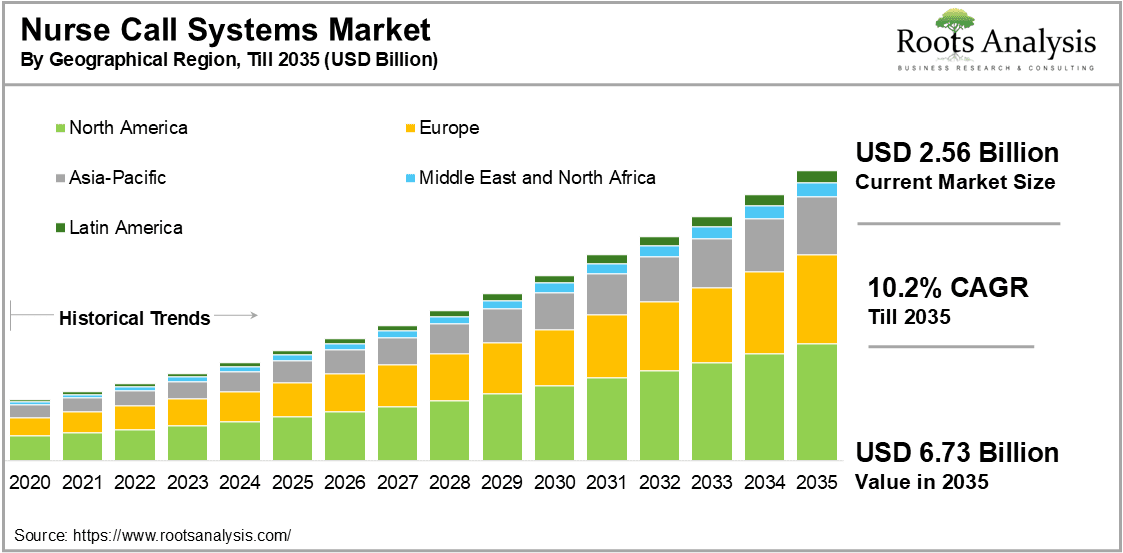
The global nurse call systems market, valued at USD 2.28 billion in 2024, is projected to reach USD 2.56 billion in 2025 and USD 6.73 billion by 2035, representing a CAGR of 10.2% during the forecast period.
To learn more about this report, request a free sample copy
Nurse call systems are a standard communication tool designed for healthcare systems to alert nursing staff when a patient requires assistance. These systems have call cords / buttons placed near the patient bed or reachable areas so patients can access to request medical assistance. With real-time notification alert systems, nurses can promptly provide care to patients particularly during emergencies such as accidental fall, breathing difficulties, chest pain and other chronic conditions.
Moreover, the nurse call system is beneficial to enhance communication, patient safety and overall working efficiency within the healthcare industry. It is worth noting that the demand for advanced nursing call systems has increased significantly due to the growing shift towards remote care for managing chronic conditions specifically for patients with restricted mobilities. Furthermore, the growing trend for value-based care and implementation of digital health solutions for advanced patient monitoring has contributed to the adoption of nurse call systems.
Considering the ongoing necessity, several industrial players have undertaken strategic initiatives in this field to develop advanced nurse call software and solutions to enhance patient care and optimize nurse workflow. For instance, in October 2024, Abridge, Mayo Clinic and Epic conjointly rolled out the latest generative AI ambient documentation workflow for nurses. Driven by the growing technological innovations, we believe that the market for nurse call systems will continue to expand at a steady rate during the forecast period.
The market report provides comprehensive information on industrial players who are currently active across various segments of the industry as mentioned in the table below.
| Key Report Attributes | Details | |
| Historical Trend | Since 2020 | |
| Forecast Period | Till 2035 | |
| Current Market Size | USD 2.56 Billion | |
| Market Size 2035 | USD 6.73 Billion | |
| CAGR (Till 2035) | 10.2% | |
| Type of Technology |
|
|
| Type of Call System |
|
|
| Type of Application Area |
|
|
| End User |
|
|
| Geographical Regions |
|
|
| Key Companies Profiled |
|
|
| PowerPoint Presentation (Complimentary) |
Available | |
| Customization Scope | 15% Free Customization | |
| Excel Data Packs (Complimentary) |
Available | |
One of the key objectives of nurse call systems market report was to estimate the current size, opportunity and the market growth potential, over the forecast period, till 2035. We have provided informed estimates on the likely evolution of the market for the forecast period.
The global nurse call systems market analysis report also features the likely distribution of the current and forecasted opportunity within the market across various segments, such as type of technology (wired communication equipment, wireless communication equipment, and hybrid nurse call systems), type of call system (button-based systems, integrated communication systems, digital and mobile nurse call systems, intercom systems, basic audio / visual nurse call systems, and other call systems), type of application area (alarms & communications, medical emergencies, wanderer control, workflow optimization, fall detection & prevention, and visitor management), end user (hospitals, ambulatory surgery centers, nursing homes, medical assisted living centers, long-term care facilities, clinics, physician offices, rehabilitation centers, outpatient departments, and other end users), geographical region (North America, Europe, Asia-Pacific, Middle East and North Africa, and Latin America) and leading players.
In order to account for future uncertainties associated with some of the key parameters and to add robustness to our model, we have provided three market forecast scenarios, namely conservative, base, and optimistic scenarios, representing different tracks of industry’s evolution.
All actual figures have been sourced and analyzed from publicly available information forums and primary research discussions. The financial figures mentioned in this market report are in USD, unless otherwise specified.
Based on the type of technology, the global nursing call systems market is segmented into wired communication equipment, wireless communication equipment, and hybrid nurse call systems. Currently, the wired communication equipment segment accounts for the highest share (61%) of the market. The healthcare industry is focusing on installing two-way communication systems and integrated solutions as they are secured, less expensive and ensure faster communication with patients as they are immune to radio-frequency disturbance. Real-time communication with wired communication systems facilitates quick monitoring in hospitals and optimizes workflow to enhance patient outcomes.
However, as the healthcare infrastructure is shifting to digital solutions, in the future wireless communication technology is expected to gain significant traction, anticipated to grow at a higher CAGR during the forecast period. Wireless communication systems such as smartphones, handheld devices and apps enabled easier communication with nursing staff beyond geographical limitations. More recently, a trend has been seen with the healthcare facilities upgrading to wireless nurse call systems. In February 2025, England based St Leonard's Hospice installed wireless nurse call systems throughout the in-patient unit and Wellbeing Hub. Another US based Dayspring Assisted Living & Care Facility, upgraded its nurse call systems to the wireless devices.
Driven by the growing shift towards remote care, medical facilities can leverage wireless communication systems to provide optimal care on time. Moreover, wireless communication is excellent for patients with restricted mobility to call for medical care instantly.
The global market is bifurcated based on the type of call system into button-based systems, integrated communication systems, digital and mobile nurse call systems, intercom systems, basic audio / visual nurse call systems, and other call systems. According to our projection, currently button-based systems account for the highest nurse call systems market share (47%). This can be attributed to the ease of access and high adoption rate in hospitals.
It is important to highlight here that integrated communication systems also hold a substantial share of the market, and the trend is likely to remain unchanged during the forecast period. This can be attributed to the fact that integrated solutions offer a comprehensive set of tools, such as pagers, nurse call system, EMR and phones within a single system. These systems eliminate the requirement for using multiple devices to receive messages and alert signals from patients. Additionally, the high demand for intuitive call systems to handle patients specifically in emergencies is expected to drive the growth of integrated communication systems.
However, as the healthcare industry is shifting to digital / smart call systems, it is expected that digital and mobile nurse call systems segment is likely to grow at a higher CAGR during the forecast period. Moreover, digital / smart call systems can be preferred for immediate medical attentions, which is expected to drive its demand in the future to facilitate smooth medical operations.
This segment highlights the distribution of global market based on type of application into alarms & communications, medical emergencies, wanderer control, workflow optimization, fall detection & prevention, and visitor management. As per our nursing call systems market analysis, currently alarms & communications segment accounts for the highest share (over 35%) of the market. This can be attributed to the alarms & communication systems playing a significant role in offering timely care to the patients and facilitating coordinated communication between patients and nursing staff. Further, growing integration of advanced features, such as real-time location tracking and customizable alerts to meet patients’ preferences is likely to bolster the use of alarms & communications call systems.
However, in the future, workflow optimization and fall detection & prevention segment are likely to grow at a higher CAGR during the forecast period. This can be attributed to the increasing incidence of accidental patient falls in hospitals due to poor mobility and requirement of effective workflow operational solutions for resource allocation in hospitals.
Based on the end user, the global market is distributed into hospitals, ambulatory surgery centers, nursing homes, medical assisted living centers, long-term care facilities, clinics, physician offices, rehabilitation centers, outpatient departments, and other end users. According to our nurse call systems market forecast, currently the hospital segment dominates the market with a share of 56%. With increasing patient flow, medical emergencies and rising adoption of digital solutions, the hospital settings are adopting nurse call systems to deliver optimal care to the patient and manage workflow.
However, the clinics’ segment is likely to grow at a higher CAGR during the forecast period. With increasing preferences of personalized care and rising number of private clinics, the demand for nurse call systems has significantly increased in this segment. These solutions help to response on time during emergencies and patients request, which is likely to fuel its demand for clinics segment during the upcoming years.
Amongst the geographical regions, presently North America holds the highest nurse call systems market size (40%). This can be attributed to the increasing adoption of digital healthcare solutions to facilitate instant care for the patients in hospitals. Furthermore, favorable environment for the adoption of tech-driven solutions and presence of tech giants who are consistently focusing on providing tailored communication devices, software and applications to facilitate two-way communication between patients and nursing staff.
In Asia-Pacific, the market for nurse call systems is likely to bolster at a higher CAGR during the forecast period. This is driven by the growing geriatric population with chronic conditions that necessitated the demand for nurse call systems for instant medical attention. Moreover, the growing patient admission in hospitals for the treatment of chronic conditions has further contributed to the unprecedented growth of the market in this region.
The “Nurse Call Systems Market: Industry Trends and Global Forecast, till 2035” research report features an extensive study of the focus on competitive landscape of strategic initiatives, emerging mega trends, company profiles and key drivers and restraints. The market report highlights the efforts of several stakeholders engaged in this rapidly evolving segment of the nurse call systems industry. Key takeaways of the market data analysis are briefly discussed below.
The market landscape for nurse call systems has several small, specialized companies that are focused on development of nurse call systems. The primary aim of these industrial players is to drive the development of innovative calling systems, solutions, software and applications that facilitate instant communication with care givers. For instance, in August 2024, Fanvil launched latest update in Alpha (Nurse Call System) V1.0 Beta. This latest update packed advanced features to offer emergency call solutions and nurse call solutions for geriatric patients and caregivers.
However, the market does have the presence of a few multi-national device developers such as Honeywell and Baxter International . As more market leaders continue to accelerate their efforts to develop innovative nurse call solutions, we believe that nurse call systems market will remain competitive during the forecast period.
Increasing geriatric population with chronic conditions has positively influenced the nurse call systems market growth during the forecast period. It is important to highlight here that nurse call system has proven to be beneficial for elderly population in communicating with care providers at hospitals and in home settings to get instant medical attention. Additionally, the growing demand for advanced solutions to reduce operational workflow and streamlining care providing services has further fueled the demand for nurse call systems in hospitals. Additionally, growing penetration of digital healthcare solutions and rising expenditure by healthcare industry on communication systems are the key drivers of the market.
Despite high demand, the market players are witnessing several challenges that need to be resolved for widespread adoption. Some of the potential challenges in nurse call systems market include high cost associated with implementation and interoperability problems.
Furthermore, the additional installation expenses, training modules and software upgrade expenditure has further increased the cost of nurse call systems. Sometime, false alarms may also disrupt the working efficiency of the staff. It is important to highlight here that the interconnected nurse call devices that run on software and cloud-services are vulnerable to cyberattacks. Hence, cybersecurity concern is a prominent challenge that needs to be addressed for widespread adoption.
Some of the notable trends that are shaping the industry includes patient-centric calling devices, two-way communication system and integration of mobile devices. Furthermore, industrial players are emphasizing artificial intelligence -driven patient care solutions and patient centric healthcare app for regular monitoring and care providing. The integration of these digital AI-powered solutions has further necessitated the demand for advanced nurse care solutions to streamline communication within healthcare facilities. An example of this is a wearable BioButton, developed by BioIntelliSense. This monitoring device, worn like a patch, records vital signs of patients and transmits the data to nurses. Its AI algorithm also alerts the nurses of the patient’s condition.
As digital technologies continue to evolve in the future for real-time patient care, the demand for communication devices to facilitate remote care and in-patient care is likely to increase, offering opportunities to industrial players for driving innovations.
Currently, the global nurse call systems market is valued at USD 2.56 billion and is expected to reach USD 6.73 billion by 2035. Driven by the increasing demand for advanced calling systems for instant medical attention, this market is expected to be driven at a CAGR of 10.2% during the forecast period.
It is worth noting that the market players are focusing on strategic collaborations and partnerships to expand product portfolio and development of advanced products. For instance, in January 2025, Sensio (Care Tech Leader) announced a long-term strategic agreement with Lovett Care to facilitate the development of sensor technology RoomMate and digital nurse call system. With consistent interest towards innovation of industrial players, this market will remain investible and grow at a steady rate during the forecast period.
Examples of key players engaged in this nurse call systems industry (which have also been captured in this report) include Ascom Holding, Austco Healthcare, Critical Alert Systems, Cornell Communications, Honeywell International , Hill-Rom Holding, JNL Technologies, Rauland, Stanley Healthcare, TekTone Sound and Signal and West-Com Nurse Call Systems. This market report includes an easily searchable excel database of all the companies focusing on nurse call system software and solutions.
The market report presents an in-depth analysis, highlighting the capabilities of various companies engaged in this domain across different segments. Amongst other elements, the market report includes:
Several recent developments have taken place in the field of nurse call systems. We have outlined some of these recent initiatives below.