
Lowest Price Guaranteed
Slides
223
Last Updated
October 2025
View Count
14622
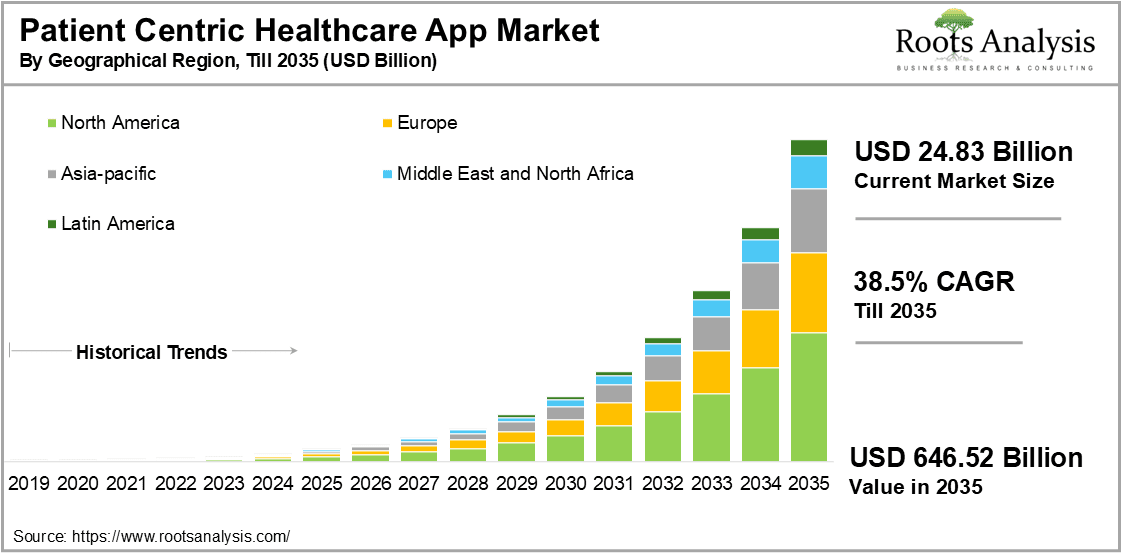
The patient centric healthcare app market, valued at USD 15.07 billion in 2024, is projected to grow to USD 24.83 billion in 2025 and USD 646.52 billion by 2035, representing a CAGR of 38.5% during the forecast period.
 |
To learn more about this report, request a free sample copy
Patient-centric healthcare application has become an integral part of healthcare system, enabling instant access to medication, virtual consultation and medical resources. It is a form of digital platform that is specifically designed to facilitate communication between healthcare providers and patients to take proactive decisions for treatment. These patient-centric healthcare applications cover a broad range of features, such as appointment scheduler, medical reminder, health education resources and telemedicine consultations. The demand for patient-centric healthcare applications has significantly increased to address the ongoing concern of chronic conditions.
In a recent report published by Center for Disease Control and Prevention estimated that nearly 129 million people in the United States have at least one chronic disease. It is important to highlight here that chronic conditions such as heart disease, diabetes, cancer and hypertension require regular monitoring for managing diseases. In such instances, patient centric healthcare apps offer a convenient way to connect with healthcare providers for appropriate guidance and manage disease condition. These digital healthcare applications help to reduce emergencies, overall treatment cost and offer remote facilities to patients with restricted mobility. The demand for patient-centric healthcare applications has been further fueled by the growing penetration of smart wearable devices and telehealth services to bridge the gap between healthcare facilities and patients.
The growing shift towards patient-centric apps for remote treatment has offered enormous opportunities to industrial players. However, the current focus is to develop more patient concentric applications, integration of AI-powered tools and patient centric design to facilitate virtual consultation, disease management and educating patients about diseases. For instance, in August 2024, Target RWE announced the launch of engage™ (a new patient-centric platform) that can be leveraged by healthcare providers, study sites and patients to capture protocol-specific patient-reported outcome (PRO) measures, digital reports, clinician-reported outcomes in the real world. As stated by Michael W. Fried (Chief Medical Officer, Target RWE) "We are excited to launch engage™ which will be instrumental in supporting our ongoing strategic partnership with the American Association of the Study of Liver Disease (AASLD) and their Cirrhosis Quality Collaborative (CQC) initiatives."
In addition to technological innovations, several industrial players are raising partnerships and investments to enhance their product portfolio. For instance, in June 2024, Cipher Health (a global patient-centered communication solution provider) announced receiving capital investment from Atalaya Capital Management supporting continuous growth and expansion of patient-centric communication solutions and services.
Driven by the growing investment and application launch, we believe that the patient centric healthcare app market will continue to expand steadily during the forecast period.
The market report provides in-depth information on the leading players who are currently active across various segments of the patient centric healthcare app industry.
| Key Report Attributes | Details | |
| Historical Trend | Since 2019 | |
| Forecast Period | Till 2035 | |
| Current Market Size | USD 24.83 billion | |
| Market Size 2035 | USD 646.52 billion | |
| Market CAGR | ~38.5% | |
| Type of Technology |
|
|
| Type of Operating System |
|
|
| Type of Application |
|
|
| End User |
|
|
| Geographical Region |
|
|
| Key Companies Profiled |
|
|
| PowerPoint Presentation (Complimentary) |
Available | |
| Customization Scope | 15% Free Customization | |
| Excel Data Packs (Complimentary) |
Available | |
One of the key objectives of the patient centric healthcare app market report was to estimate the current market size, opportunity and the market growth potential, over the forecast period, till 2035. We have provided informed estimates on the likely evolution of the market for the forecast period.
Additionally, the market report features the likely distribution of the current and forecasted opportunity within the market distributed across various segments such as mode of operation (phone-based, web-based, and hybrid patient-centric apps), type of application (wellness management (fitness, lifestyle and stress, and diet & nutrition) and disease & treatment management (healthcare providers / insurance, medication reminders & information, women’s health & pregnancy and disease-specific) and other applications), geographical region (North America, Europe, Asia-Pacific, Middle East and North Africa, and Latin America), and leading players.
To account for the uncertainties associated with the development of patient centric healthcare app and to add robustness to our model, we have provided three market forecast scenarios, portraying the conservative, base and optimistic tracks of the market’s evolution.
All actual figures have been sourced and analyzed from publicly available information forums and primary research discussions. Financial figures mentioned in this market research report are in USD, unless otherwise specified.
Based on the type of technology, the global patient centric healthcare app market is segmented into phone-based apps, wearable patient-centric apps and web-based apps. Currently, phone-based apps account for the highest share of the market driven by the higher adoption of smartphones and wearable devices for healthcare mobility solutions that support patient monitoring apps. Additionally, phone-based applications are easier to use, cost-effective, offer quick access to healthcare services and promote real-time communication, making it a valuable tool for offering patient monitoring and virtual consultation.
Moreover, phone-based apps offer greater compatibility with android operating systems and iOS systems. This higher compatibility ensures broader patient population reach and foster a seamless connection between health providers and patients. Driven by the growing access to phone-based apps, this segment is likely to remain dominant and continue to grow at a higher CAGR rate during the forecast period.
This segment further bifurcates the global patient centric healthcare app market into windows, android, iOS and other operating systems. According to our market data analysis, android operating systems holds the majority of the share (50%), driven by widespread adoption. It is important to highlight here that android has open-source nature that supports wide range of applications on smartphones and tablets. Owing to its diverse supporting nature, android is a preferable choice among global population, which is the primary reason for highest growth rate.
Several other factors such as easy integration with wide range of healthcare services-based applications and Google has further support the highest share of the segment. Considering widespread adoption, this segment will continue to maintain its robust position in the market and is likely to grow at a higher CAGR during the forecast period.
This segment highlights the distribution of global patient centric healthcare app market based on type of application into wellness management (fitness, lifestyle and stress, and diet & nutrition) and disease & treatment management (healthcare providers / insurance, medication reminders & information, women’s health & pregnancy and disease-specific) and other applications.
According to our projection, disease and treatment management segment is currently holding the dominating position in the market. It is primarily attributed to the fact that patient centric healthcare applications are widely adopted to monitor vital health signs, such as blood pressure, glucose level and heart rate. This consistent monitoring helps in managing chronic conditions, such as hypertension, diabetes and cardiovascular diseases. Furthermore, these applications also play a significant role in educating patients bour disease awareness and how to manage diseases remotely, anticipated to be a key growth driver of this segment.
However, in the long run, it is anticipated that wellness management segment is likely to grow at a higher CAGR during the forecast period. With growing awareness about overall well-being and fitness management, a large population is adopting wellness management applications for achieving overall well-being. Furthermore, wellness apps have been adopted for stress management and mental health support, which further supported the lucrative growth of this segment during the forecast period.
Based on the end user, the global market is segmented into home use, hospitals and clinics. Based on our analysis, currently hospitals account for the largest patient centric healthcare app market share. Hospitals are the primary adopter of patient centric healthcare applications to monitor large population of patients within clinical settings. These patient centric healthcare apps can easily integrate with electronic health records for quick access, allowing clinicians to offer value-based treatment. Moreover, the rising adoption of digital healthcare solutions for disease management remotely has further contributed to the high demand for patient centric healthcare app in hospitals so healthcare experts can offer optimal care to the patients.
Based on the geographical region, the global patient centric healthcare app market is distributed across North America, Europe, Asia-Pacific, Middle East and North America, and Latin America. According to our projection, North America is dominating the market, accounting for 40% of the overall revenue share. This is likely to be the result of the high adoption of digital healthcare solutions across healthcare sector and population to facilitate instant access to treatment. Furthermore, advanced technological infrastructure and rising shift towards personalized treatment to enhance patient care has further fueled the market growth in this region.
However, in Asia-Pacific, the market for patient centric healthcare app is anticipated to grow at a higher CAGR during the forecast period. This is primarily due to the higher expenditure for advancement in healthcare infrastructure and increasing government support to integrate digital healthcare services and solutions to meet with ongoing concern of diseases in this region.
The “Global Patient Centric Healthcare App Market: Industry Trends and Global Forecasts, till 2035” report features an extensive study of the current market landscape, market size and future opportunity within the patient centric healthcare app industry, during the given forecast period. The market report highlights the efforts of several stakeholders involved in this rapidly emerging segment of the healthcare IT industry. Key takeaways of the market data analysis are briefly discussed below.
According to our global patient centric healthcare app market analysis, this industry is moderately competitive featuring well-established and new entrants. Majority of the players are focusing on upgrading applications by adding innovative features, such as healthcare predictive analytics, AI-driven health monitoring and chatbot to facilitate real-time data collection and communication. However, majority of the focus is on designing user-friendly healthcare applications so geriatric population can use for disease management.
Moreover, the industrial players are also emphasizing the advanced security measures to safeguard patient information. Overall, the market will remain competitive featuring several small, mid-sized and large industrial players who are currently engaged in the domain for technological innovations.
The global market for patient centric healthcare app is propelled by the rising expansion of telehealth services and personalized treatment. Notably, patients are currently demanding individualized treatment to meet their preferences for quality care. In addition, a large pool of patients is expressing their keen interest in smartphone applications that allow them to consult with healthcare professionals remotely for disease management and health consultation without standing in the long queues for hours.
Furthermore, the increasing expansion of telehealth services for diagnosis, consultation and treatment in homes has further contributed to the growth of the market. It is worth noting that telehealth services combined with patient centric healthcare applications help to bridge the gap between clinicians and patients, offering a robust pathway to offer healthcare services in rural areas. As patients are prioritizing digital healthcare applications for scheduling appointments and virtual consultations, we believe that the patient centric healthcare app market will continue to expand at a steady rate during the upcoming years.
Although the adoption rate of patient centric healthcare app is growing unpreceded there are some constraints that need to be addressed. One of the biggest challenges for market players is data privacy and security when sharing healthcare data through applications to healthcare practitioners on different systems. However, the industrial players have already taken strategic initiatives aiming to enhance healthcare cybersecurity measures to ensure data safety and security when transferring through different networks. In addition to security concerns, the integration challenges with different healthcare systems and technological platforms may limit the adoption of patient centric healthcare apps.
Despite challenges, the market continues to expand exponentially driven by the emerging trends in this field. Some of the top patient centric healthcare app market growth factors are integration of augmented reality, artificial intelligence and patient engagement. AR and VR have become more prevalent in designing healthcare applications with enhanced audio, video and multi-sensory modalities to deliver more realistic consultation experience to patients.
Furthermore, the market players are focusing on AI chatbots to facilitate communication in real-time, which further opens enormous opportunities to take strategic initiatives in this industry. It is important to highlight here that the industrial players and government organizations are undertaking initiatives to increase awareness about patient centric healthcare applications among population to enhance engagement. These factors will contribute to the patient centric healthcare apps market growth.
The global patient centric healthcare app industry is currently valued at USD 24.83 billion and is anticipated to reach USD 646.52 billion by 2035. Driven by the growing preferences for patient specific treatment and remote health monitoring trend, the patient centric healthcare app industry is anticipated to grow at a CAGR of 38.5% during the forecast period. Notably, several market players are increasing their research efforts to develop the latest patient centric apps and technologies. For instance, in November 2024, MedAdvisor Solution launched Telehealth Functionality within MediAdvisor App in order to enhance access to telehealth services so patients can manage their medicine prescriptions from anywhere. Driven by the growing efforts of various industry stakeholders, we believe that the market will remain investible for long term.
Examples of key players engaged in this domain (which have also been captured in this report) include Allscripts Healthcare Solutions, Athenahealth, Bayer, Boston Scientific, Hill-Rom Services (Baxter International), iPatientCare, Koninklijke Philips, Merck, Mobilesmith, Pfizer and Siemens Healthineers (Siemens). This market report includes an easily searchable excel database of all the companies focusing on the development of patient centric healthcare apps.
Several recent developments have taken place in the patient centric healthcare app industry. We have outlined some of these recent initiatives below.