
Lowest Price Guaranteed
Slides
246
Last Updated
August 2025
View Count
10449
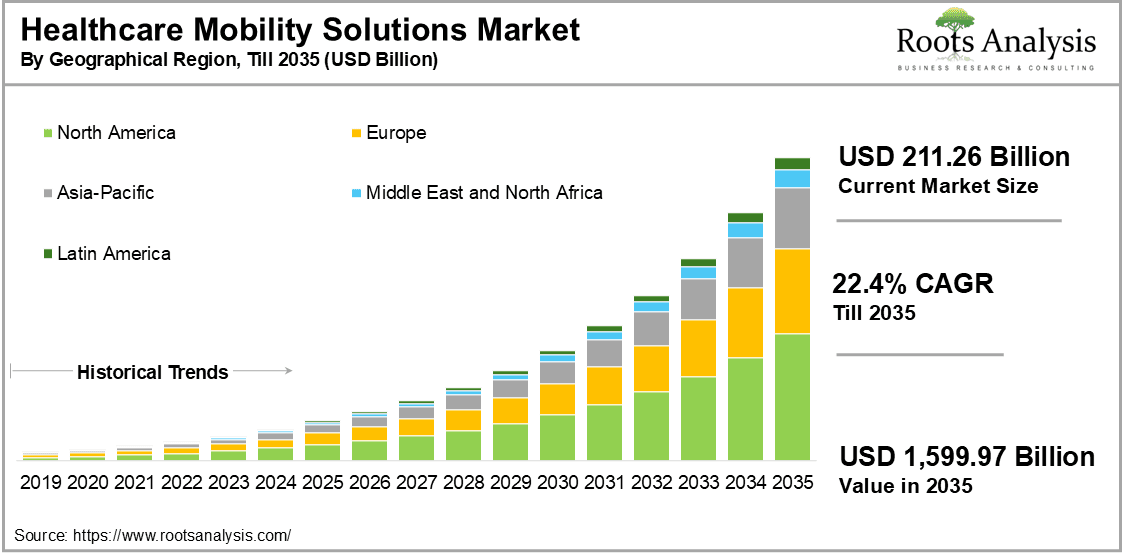
The global healthcare mobility solutions market, valued at USD 163.9 billion in 2024, is projected to reach USD 211.3 billion in 2025 and USD 1,599.9 billion by 2035, representing a CAGR of 22.4% during the forecast period.
 |
To learn more about this report, request a free sample copy
Healthcare mobility solutions refer to the use of mobile applications, devices and platforms to monitor and track patient mobility during patient admission and discharge. Further, healthcare mobility solutions, such as enterprise mobility also serve as an invaluable tool for tracking staff movement beyond conventional clinic environment through devices such as laptop, smartphones and tablets connected with internet. It is important to highlight here that the demand for healthcare mobility solutions has significantly increased due to the growing incidence of chronic conditions that demand immediate medical attention beyond geographical settings.
A recent report published by Centers for Disease Control and Prevention stated that one in five people in the US reside in rural areas and they are more likely to die early due to heart diseases, chronic lower respiratory disease and cancer. Majority of the diseases including heart disease and cancer are preventable, however due to limited access to healthcare services, the risk of death is high. With integration of healthcare mobility solutions, clinicians can enhance connectivity and build a strong communication medium to provide optimal care irrespective of locations. Additionally, the rising shift towards patient-centric treatment and point-of-care services has further fueled the demand for healthcare mobility solutions to make treatment more accessible to the patients. The demand has been further increased by the growing adoption of digital healthcare services (such as virtual health services) to provide remote care to the patients.
Given the ongoing demand for advanced healthcare mobility solutions, several industrial players are seeking to expand technology integration and e-health solutions to make healthcare treatment more convenient. However, the major focus will be on designing AI-driven diagnostic solutions, metaverse in healthcare and incorporation of RFID technology (smart labels) to enhance enterprise mobility.
For instance, in June 2024, Rude Group announced a strategic partnership with Mobile-health Network Solutions in order to provide access to the telehealth services and solutions affordable and reachable to everyone. As stated by Terence Zou (Chief Executive Officer and Co-Founder, Ryde Group)," We are committed to the well-being of our driver-partners. This business partnership gives them and their families convenient access to healthcare solutions, fostering a strong and loyal driver community for Ryde. We also believe this marketing collaboration strengthens Ryde's position as a super mobility app by tapping into MaNaDr's sizable user base."
Similarly, several market players are taking strategic initiatives to develop and make the applications accessible, and digital healthcare services which is anticipated to drive the healthcare mobility solutions market at a faster rate during the projected period.
The research report provide in-depth information about leading players of the industry who have been active across various segments of the market as mentioned in the table below.
| Key Report Attributes | Details | |
| Historical Trend | Since 2019 | |
| Forecast Period | Till 2035 | |
| Market Size 2035 | USD 1,599.97 billion | |
| CAGR (Till 2035) | ~22.4% | |
| Type of Product & Service |
|
|
| Type of Application |
|
|
| End User |
|
|
| Key Geographical Region |
|
|
| Key Companies Profiled |
|
|
| PowerPoint Presentation (Complimentary) |
Available | |
| Customization Scope | 15% Free Customization | |
| Excel Data Packs (Complimentary) |
Available | |
One of the key objectives of the healthcare mobility solutions market report was to estimate the current market size, opportunity and the market growth potential, over the forecast period, till 2035. We have provided informed estimates on the likely evolution of the market for the forecast period.
Additionally, the market report features the likely distribution of the current and forecasted opportunity within the market distributed across various segments such as type of product & service (enterprise mobility platforms mobile devices and mobile applications), type of application (enterprise solutions (patient care management (patient monitoring, case management, medication administration, patient ID (PPID) / patient tracking, specimen collection and tracking, dietary and nutrition, infectious disease monitoring / field data collection and other patient care management solutions), operation management (patient admissions / discharge, revenue management / billing, claims processing, asset and facilities management, materials management and other operation management solutions), work force management (scheduling, time and attendance management and other workforce management solutions), and mHealth applications (chronic care management, exercise, weight loss, women’s health, sleep monitoring, medication management and other mHealth applications)), end user (healthcare providers, payers and patients), geographical region (North America, Europe, Asia-Pacific, Middle East and North Africa, and Latin America), and leading players.
To account for the uncertainties associated with the development of healthcare mobility solutions and to add robustness to our model, we have provided three market forecast scenarios, portraying the conservative, base and optimistic tracks of the market’s evolution.
All actual figures have been sourced and analyzed from publicly available information forums and primary research discussions. Financial figures mentioned in this market research report are in USD, unless otherwise specified.
Based on the type of product & service, the global healthcare mobility solutions market is segmented into enterprise mobility platforms mobile devices and mobile applications. Among these, presently mobile devices holds the highest share (34%) of the market and the trend of dominance is likely to remain unchanged during the forecast period. This dominance is primarily due to ease of access, portability and real-time information tracking. Furthermore, medical devices can be integrated with RFID readers, barcode scanners and other wearable technologies to enable optimization of patient data and workflow.
However, with growing penetration of telehealth services, it is expected that mobile applications segment will register higher CAGR during the forecast period. Mobile applications offer seamless connectivity between patients and healthcare providers. It fosters a breakthrough communication for scheduling appointments, checking health records and order the medications remotely. Moreover, mobile applications also enable clinicians to monitor vital health signs on time, the information helps to improve patient outcomes by offering instant medical attention.
This segment highlights the distribution of global market value across different type of application, into enterprise solutions (patient care management (patient monitoring, case management, medication administration, patient ID (PPID) / patient tracking, specimen collection and tracking, dietary and nutrition, infectious disease monitoring / field data collection and other patient care management solutions), operation management (patient admissions / discharge, revenue management / billing, claims processing, asset and facilities management, materials management and other operation management solutions), work force management (scheduling, time and attendance management and other workforce management solutions), and mHealth applications (chronic care management, exercise, weight loss, women’s health, sleep monitoring, medication management and other mHealth applications). It is important to highlight here that enterprise solutions account for the majority of healthcare mobility solutions market share (56%). This can be attributed to the fact that enterprise solutions offer numerous tools and solutions that offer seamless coordination with mobile applications and telehealth platforms that helps healthcare practitioners in delivery optimal guidance for disease management remotely.
It is important to highlight here that mHealth applications segment is anticipated to register a higher CAGR during the forecast period. This can be attributed to the growing adoption of wearable technologies, telehealth services and mobile applications that helps in monitoring disease progression remotely and share vital information with healthcare practitioners for optimal treatments. mHealth applications can easily integrate with smart wearables (specifically wearable medical devices) for seamless data sharing, which further contributes to the high growth rate of this segment.
On the basis of end user, the global market is segmented into healthcare providers, payers and patients. According to our projection, currently healthcare segment accounts for the highest share (46%) of the market. This can be attributed to the fact that healthcare mobility solutions offer instant access to patient records and movement, which is helpful to manage workflow in hospitals effectively. Moreover, the rapid adoption of healthcare mobility solutions for managing administrative tasks has further contributed to the highest share of the healthcare segment.
However, in the long run, we believe that healthcare payers will show lucrative healthcare mobility solutions market growth potential and is expected to register a higher CAGR during the forecast period. This highest growth rate is likely to be the result of high adoption of remote patient monitoring and mobile devices that helps to monitor diseases and identify complications associated with disease at an early stage. Real time monitoring of disease helps healthcare payers in verifying the claims and reduce fraudulent activities, enhancing overall efficiency.
Based on the geographical region, the global market is distributed into North America, Europe, Asia-Pacific, Middle East and North Africa, and Latin America. According to our healthcare mobility solutions market analysis, North America is dominating the market, accounting for 42% of overall revenues share. North America witness higher adoption rate of smart wearable technologies and telehealth services for proactive treatment decisions. Furthermore, the leading players established in North America are consistently focusing on cutting-edge technologies such as generative AI, and cybersecurity to ensure real-time data collection and data security.
However, in Asia-Pacific, the market for healthcare mobility solution is expected to grow at a substantial share driven by the rising healthcare infrastructure, large population with chronic conditions and increasing demand for personalized treatment approach. Additionally, the growing initiatives by the government for the adoption of healthcare IT and mobile health solutions has further contributed to the lucrative growth of market in Asian countries.
The “Global Healthcare Mobility Solutions Market: Industry Trends and Global Forecasts, till 2035” market report features an extensive study of the current market landscape, market size and future opportunity within the healthcare mobility solution industry, during the given forecast period. The market report highlights the efforts of several stakeholders involved in this rapidly emerging segment of the healthcare IT industry. Key takeaways of the research report are briefly discussed below.
Currently, the market landscape of healthcare mobility solutions has the presence of several well-established and new entrants. Top players like Apple, OMRON, Wipro and Oracle are taking strategic initiatives to facilitate the development of tech-driven healthcare mobility solutions. For instance, in February 2024, OMRON Healthcare India entered into strategic collaboration with AliveCor India in order to introduce AI-based handheld ECG technology-based home healthcare device into the Indian market. This advanced handheld technology enables early detection cardiovascular diseases and management. Similarly, a lot of industrial players are currently accelerating their efforts for the development of innovative healthcare mobility solutions, which is anticipated to keep the market competitive throughout the projection period.
Some of the promising drivers that are accelerating the market includes rising adoption of digital healthcare solutions for remote disease monitoring and high demand for quality care. It is important to highlight here that digital healthcare solutions such as smartphones, remote monitoring devices, and wearable technology has played a significant role in accessing healthcare information and virtual consultation to enhance patient experience. Thus, with the growing adoption of digital healthcare solutions, there has been surge in the demand for healthcare mobility solutions. Furthermore, the growing focus on personalized treatment to enhance quality healthcare has further fueled the requirement of healthcare mobility solutions to facilitate communication between patients and healthcare provider for remote monitoring. These factors are collectively contributed to the healthcare mobility solutions market growth.
In January 2025, AirStrip Technologies announced the acquisition of DECISIO® Health in order to expand clinical decision support capabilities, and result in better patient monitoring and response to critical clinical scenarios. Through this deal, AirStrip Technologies will be able to integrate mobile capabilities and data visualization with predictive analysis. As stated by Hari Radhakrishnan (Founder, DECISIO Health)," We are thrilled to join forces with AirStrip. Our shared vision of leveraging technology to improve clinical decision-making makes this a natural fit, and we are excited to see how our combined expertise will push the boundaries of what is possible in healthcare."
Despite of the growing demand, there are several challenges that may limit the adoption of healthcare mobility solutions. Some of the potential challenges include interoperability and data security concerns. The digital healthcare solutions rely on cloud services and internet for sharing data across different systems. Interoperability and data security has been a major concern while sharing data create a significant barrier in adopting healthcare mobility solutions. This data security concern has necessitated strategic initiatives to provide robust cybersecurity systems to ensure complete authenticity and security of data transmission.
Healthcare mobility solutions industry is witnessing an upsurge driven by the ongoing trends and initiatives for technological innovations. Some of the potential opportunities are telehealth services, augmented reality / virtual reality integration, emergence of healthcare data intelligence and telemedicine. It is important to highlight here that the integration of healthcare data intelligence and AI based tools helps to automate the repetitive tasks for managing patient flow, such as admission, readmission record, medicine prescription and emergencies. In order to make healthcare industry more streamlined, several industrial players are focusing on integrating data intelligence and generative AI to enhance precision for personalized treatment experience.
Additionally, the penetration of AR / VR and robotics allow accurate diagnosis, surgeries planning and rehabilitation. Moreover, these technologies helps to customize the therapeutic plans to meet with individual patients preferences. Notably, the penetration of these advance technologies has offered significant opportunities to industrial players for taking strategic initiatives, such as cutting-edge technology that aid in bridging the gap between healthcare services and rural areas.
The global healthcare mobility solutions market is expected to be valued at USD 211.26 billion in 2025 and is anticipated to reach USD 1,599.97 billion by 2035. It is important to highlight here that the key players of industries are forging several partnership agreements which is likely to propel technological innovations in this industry. For instance, in March 2024, NetSfere and KPJ Pasir Gudang Specialist Hospital (Malaysia) enter into partnership for the deployment of secure enterprise messaging platform to offer a secure communication medium to healthcare staff.
As stated by Chee Leng Loy (Senior Vice President of Asia Pacific and Middle East, NetSfere)," Permitting caregivers to discuss information swiftly and avoid potential data breaches is what healthcare systems need during this technological era so they can improve patient care. NetSfere provides healthcare systems with a convenient and frictionless way to share ideas, files and data without compromising productivity, security or compliance." Owing to the increasing partnerships between industrial players, this market will continue to grow at a CAGR of 22.4% during the forecast period.
Examples of key players engaged in this domain (which have also been captured in this report) include Apple, AirStrip Technologies, GE HealthCare, IBM, Koninklijke Philips, MCKESSON, Microsoft, OMRON Healthcare, Oracle, Wipro and Zebra Technologies. This market report includes an easily searchable excel database of all the companies focusing on healthcare mobility solutions.
Several recent developments have taken place in the healthcare mobility solutions industry. We have outlined some of these recent initiatives below.