
Lowest Price Guaranteed
Pages
199
Last Updated
September 2025
View Count
11274
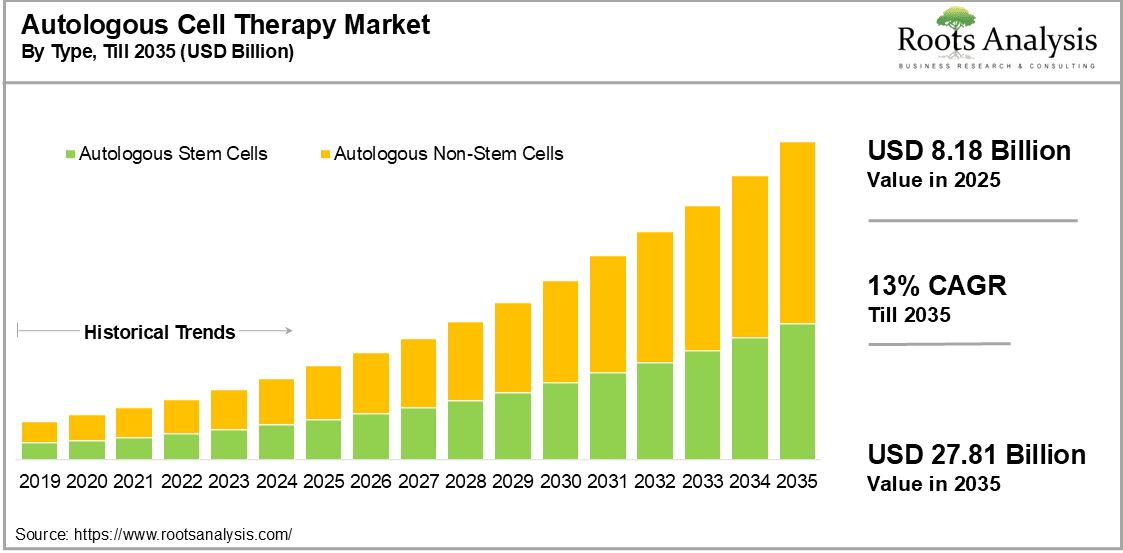
The global autologous cell therapy market is expected to grow from USD 8.18 billion in 2025 to USD 27.81 billion by 2035, representing a higher CAGR of 13% during the forecast period.
 |
To learn more about this report, request a free sample copy
Regenerative medicine is a new paradigm in the healthcare industry to treat patients with autoimmune conditions, cancer and neurological conditions. With availability of advanced technologies, such as genetic engineering and molecular technology, pharmaceutical companies has achieved success in developing autologous stem cell therapy and non-stem cell therapies.
These therapies have been developed by using patients’ own stem cells, immune cells and specialized T cells that are re-engineered to generate an immune response. It is important to highlight here that autologous stem cell therapies and non-stem cell therapies reduced the risk of immunological reactions and bio-incompatibility which makes it an exceptional therapy to treat diseases. Notably, the ability to trigger a natural immune response has caught significant attention of healthcare professionals to treat broad range of disease indications including cancer, multiple sclerosis, and rheumatoid arthritis.
Owing to the significances offered by autologous therapies, several industrial players are focusing on the development of advanced stem cell-based therapies. In December 2024, Ryoncil® (remestemcel-L-rknd), the USFDA approved an allogeneic (donor) bone marrow-derived mesenchymal stromal cell (MSC) therapy. This therapy has shown significant potential to treat steroid-refractory acute graft-versus-host disease (SR-aGVHD) in pediatric patients (2 months and older).
With accelerated approval from the USFDA, several industrial players are taking strategic initiatives for technological innovations that help to explore more applications autologous cell therapies beyond cancer and autoimmune diseases. For instance, in November 2024, Nature Cell (a Korean biotechnology company) announced the success of autologous adipose stem cells that are delivered into spinal cavity of patient to treat Parkinson’s disease. This therapy has been developed by Japan Angel Stem Cell in collaboration with R Bio by using stem cell culture media produced by Nature Cell.
Driven by the growing penetration of industrial players and USFDA support, we believe that the autologous stem cell and non-stem cell therapies market will continue to grow at a steady rate during the forecast period, making it investible for long term.
The market research report presents an in-depth analysis companies that are involved in global autologous cell therapy industry, across different segments, as defined in the table below:
| Key Report Attributes | Details | |
| Historical Trend | Since 2020 | |
| Forecast Period | Till 2035 | |
| Market Size 2025 | USD 8.18 Billion | |
| Market Size 2035 | USD 27.81 billion | |
| Market CAGR | 13% | |
| Type of Therapy |
|
|
| Type of Source |
|
|
| Type of Product |
|
|
| Therapeutic Area |
|
|
| End Users |
|
|
| Geographical Regions |
|
|
| Key Companies Profiled |
|
|
| PowerPoint Presentation (Complimentary) |
Available | |
| Customization Scope | 15% Free Customization | |
| Excel Data Packs (Complimentary) |
Available | |
One of the key objectives of the autologous cell therapy market report was to estimate the current market size, opportunity and the market growth potential, over the forecast period, till 2035.
We have provided informed estimates on the likely evolution of the market for the forecast period. Additionally, the market report features the likely distribution of the current and forecasted opportunity within the market distributed across various segments, such as type (autologous stem cells and autologous non-stem cells), type of source (T-cells and mesenchymal stem cells), type of product (cellular therapy products, recombinant proteins, gene therapy products and by-products), type of application (autoimmune diseases, cancer, neurodegenerative disorders, cardiovascular disease, orthopedic diseases, and other applications), end users (hospitals, ambulatory surgical centers, research facilities and other end users), geographical regions (North America, Europe, Asia-Pacific, Middle East and North Africa, and Latin America), and leading players.
To account for the uncertainties associated with the development of advanced autologous cell therapies and to add robustness to our model, we have provided three market forecast scenarios, portraying the conservative, base and optimistic tracks of the market’s evolution.
All actual figures have been sourced and analyzed from publicly available information forums and primary research discussions. Financial figures mentioned in this market research report are in USD, unless otherwise specified.
Based on type therapy, the global market is segmented into autologous stem cells and autologous non-stem cells. According to our autologous cell therapy market analysis, autologous non-stem cells account for the highest share (nearly 60%) of the market. Autologous non-stem cell based therapies, such as CAR-T cell therapy have shown significant potential in the treatment of cancer and autoimmune disorders.
Further, the non-stem cell-based therapies have been adopted on a large scale driven by enhanced biocompatibility and minimal risk of immune response. However, in the long run, autologous stem cells segment is likely to grow at a higher CAGR during the projected period. This can be attributed to the growing understanding of extensive applications in clinical settings.
This segment highlights the distribution of global market is segmented into different types of sources, such as T-cells and mesenchymal stem cells. According to our autologous cell therapy market forecast, currently, mesenchymal stem cells account for the highest share of the market. This can be attributed to the fact that mesenchymal stem cells has the potential to differentiate into different types of cells and holds immunomodulatory properties which makes it ideal for the treatment of wide range of disease indications including cancer, neurological and autoimmune disorders. Furthermore, mesenchymal stem cells can easily isolate from a variety of sources, such as adipose tissues, bone marrow, umbilical cord and other cells, which makes it a valuable source for the development of autologous stem cell therapies.
However, it is worth mentioning here that T-cells segment is anticipated to register a higher CAGR during the forecast period. This can be attributed to the growing usage of T-cell based therapies for the treatment of cancer. Furthermore, the T-cells are also used for the development of autologous stem cell therapies, gene therapies and cell based therapies, which is anticipated to fuel the demand.
This segment highlights the distribution of global market based on the type of product into cellular therapy products, recombinant proteins, gene therapy products and by-products. Among these, cellular therapy products segment is dominating the autologous cell therapy industry and the trend is likely to remain unchanged during the forecast period. Cellular therapy products have been extensively used for the treatment of genetic disorders and cancer.
Moreover, cellular therapies has also shown higher efficacy in regenerative medicine to restore tissue or cellular function. However, it is worth mentioning here that recombinant proteins are also holding a substantial share of the market driven by the growing adoption of recombinant proteins for treating chronic diseases.
It is interesting to highlight here that gene therapy products segment is likely to grow at a higher CAGR during the forecast period. This can be attributed to the growing advancements in genetic engineering tools that help in the development of targeted non-stem cell therapies for targeting a wide range of diseases particularly intractable diseases.
Based on the therapeutic area, the global market is segmented into autoimmune diseases, cancer, neurodegenerative disorders, cardiovascular disease, orthopedic diseases, and other therapeutic areas. According to our projection, currently cancer occupies the highest autologous cell therapy market share (nearly 40%) and the trend is likely to remain unchanged during the forecast period. This can be attributed to the growing approval of autologous non-stem cell therapies, such as CAR-T cell therapies and stem cell based therapies to treat different type of cancers. Furthermore, the growing focus on the development of advanced autologous stem cell therapies to target solid tumors has further contributed to the highest share of this segment.
However, it is worth mentioning here that neurological disorders segment is likely to grow at a higher CAGR during the forecast period. This lucrative growth is likely to be the result of growing usage of stem cell based therapies for the treatment of neurodegenerative disorders.
Based on the end user, the global autologous cell therapy market is segmented into hospitals, ambulatory surgical centers, research facilities and other end users. According to our projection, hospitals account for the highest share of the market. Hospitals are currently primary users of autologous stem cell therapies. Furthermore, the advanced healthcare infrastructure required to deliver advanced autologous stem cell therapies has further contributed to the highest growth of this segment during the forecast period. Driven by the widespread adoption, this segment will continue to remain dominant during the forecast period and is poised to grow at a higher CAGR over the forecasted period.
The global autologous cell therapy market is distributed across different geographical regions, such as North America, Europe, Asia-Pacific, Middle East and North Africa, and Latin America. According to our projection, currently North America accounts for the highest share (more than 40%) of the market. This can be attributed to the growing incidence of cancer and chronic conditions that have underscored the requirement of advanced autologous stem cell therapies to treat patients. Additionally, the supportive guidelines, advanced healthcare infrastructure and increasing research by industrial players for the development of stem cell therapies has further contributed to the highest share of this region.
However, in Asia-Pacific, the market is expected to register a substantial CAGR during the forecast period. This is likely to be the result of growing research on regenerative medicine and healthcare expenditure to support the adoption of autologous stem cell based therapies for the treatment of a broad range of disease indications in this region.
The “Autologous Cell Therapy Market Report: Industry Trends and Global Forecasts, till 2035” research report features an extensive study of the focus on competitive landscape of strategic initiatives, emerging mega trends, big pharma initiatives, company profiles and key drivers and restraints. The market report highlights the efforts of several stakeholders engaged in this rapidly evolving segment of the autologous cell therapy market. Key takeaways of the market report are briefly discussed below.
Currently, the market landscape features the presence of well-established and new entrants with required technical expertise to develop advanced autologous cell therapies. These industrial players are taking strategic initiatives followed by collaborations and partnerships. For instance, in October 2024, Aspen Neuroscience entered into the license agreement with Cell X Technologies aiming to advance Aspen’s plan for automating the iPSC stage of its autologous manufacturing platform. Under this agreement, Aspen will harness the bioinformatics-based platform to support the development of personalized cell based therapies. Furthermore, several research programs have been initiated by the industrial players and academic institutes to enhance the awareness of autologous cell therapies. Overall, the market seems highly competitive featuring the presence of several small, mid-sized and large companies who are presently exploring more applications of autologous and stem cell therapies.
Some of the significant growth drivers that are propelling the market growth in this field include the rising prevalence of cancer and chronic diseases, such as diabetes and cardiovascular diseases. According to the report of National Institute of Health, in 2024, around 2,001,140 new cancer cases and 611,720 cancer deaths are projected to occur in the United States. This alarming rise in the incidence of cancer has necessitated the demand for advanced stem cell based and non-stem cell based therapies for the treatment of cancer patients.
It is important to highlight here that the key players are focusing on the development of advanced stem cell therapies to treat chronic conditions. For instance, in November 2024, a new therapy names Lantidra® has been approved by the FDA for the treatment of Type 1 diabetes. This therapy has been developed by the pancreatic islet cell and has shown significant potential to lower blood glucose level. Several other factors that are driving growth in the market include the advancements in autologous stem cell based therapies for regenerative medicine.
Despite high demand, some bottlenecks may hinder the market progress during the projected period. Some of the major challenges include stringent guidelines associated with the approval of stem cell based therapies and high cost of treatment. It is important to highlight here that complexities associated with the separation, modification and processing of living cells from donors or patients may create challenges in the development of advanced therapies.
Additionally, the process of separating stem cells requires high quality control and advanced technologies which may hinder the market progress. Furthermore, the average cost of autologous stem cell therapy may range from USD $5,000 to $15,000 per cycle. The high cost may create challenges in the adoption of autologous stem cell therapies across the globe.
The market for autologous cell therapy is witnessing an upward trajectory driven by growing research and technological innovations. Currently, the industrial players are focusing on integrating advanced technologies and cutting-edge technologies, such as artificial intelligence and molecular technologies that aid in cell separation, manipulation and expansion of stem cells.
Furthermore, standard technologies have been designed to deliver stem cells for the development of autologous cell therapies. For instance, in July 2024, STEMCELL Technologies has launched CellPore™ Transfection system that advance cell engineering research and the development of innovative cell therapies to treat broad range of disease. This advanced technology is also known as mechanoporation helps to squeeze cells to create temporary pores on the cell membrane for cargo delivery. As stated by Kim Raineri, (Chief Technology Officer, Aspen Neuroscience) “This is a major step in our mission to develop and deliver personalized cell replacement therapies for people with unmet medical needs, starting with Parkinson’s disease”. Additionally, the growing research to explore application of autologous therapies in regenerative medicine is anticipated to be a key driver for the market.
The global autologous cell therapy market is currently valued at USD 8.18 billion. Driven by the growing research on autologous stem cell therapies and non-stem cell based therapies, this market is expected to reach USD 27.81 billion by 2035, representing a compounded annual growth rate of 13% during the forecast period. It is important to highlight here that several industrial players are taking strategic initiatives, such as collaboration and partnerships to develop stem cell therapies and deliver at targeted sites.
For instance, in September 2024, Tesla BioHealing and Cell Biotechnology enter into a strategic collaboration for the development and delivery of advanced stem cell based therapies. Under this partnership, both partners will combine groundbreaking technologies to empower the amplification of autologous stem cells and development of stem cells. Owing to the growing partnerships, we believe that the market will remain competitive and investible for a long term, offering enormous opportunities for driving innovations.
Examples of key companies active in autologous cell therapy industry (which have also been profiled in this market report; the complete list of companies is available in the full report) include Anterogen, Adaptimmune Therapeutics, AgonOx, Avotres, Bristol-Myers Squibb Company, BioCardia, CARsgen Therapeutics, Gilead Sciences, Holostem, Iovance Biotherapeutics, IASO BioTherapeutics, ImmunoAdoptive Cell Therapy (ImmunoACT), Johnson & Johnson, JW (Cayman) Therapeutics, Kyverna Therapeutics, Novartis, Obsidian Therapeutics, Pharmicell and Vericel. This market report includes an easily searchable excel database of all the companies providing autologous cell therapies.
The market report presents an in-depth analysis, highlighting the capabilities of various companies engaged in this domain across different segments. Amongst other elements, the market report includes:
Several recent developments have taken place in the field of autologous cell therapy industry. We have outlined some of these recent initiatives below.