
Lowest Price Guaranteed
Pages
223
Last Updated
December 2025
View Count
19280
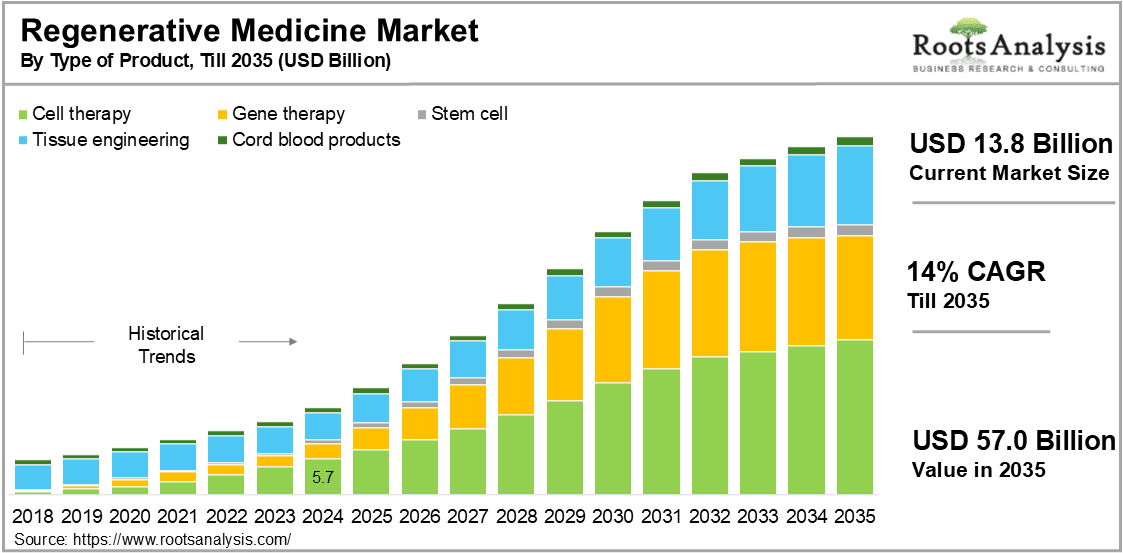
The global regenerative medicine market is valued at USD 13.8 billion in 2024 and is poised to reach USD 57.0 billion by 2035. It is expected to expand at a higher CAGR of ~14% during the forecast period.
The market for regenerative medicine is witnessing remarkable growth owing to the growing focus on repairing damaged tissue and organs. Regenerative medicine is an emerging therapeutic field emphasizing replacing or repairing damaged tissues to restore function lost due to disease, injuries, and aging. In addition to restoring damaged cell / tissue function, regenerative medicinal therapies have shown significant potential in managing chronic disease conditions such as Alzheimer's disease, Parkinson's disease, diabetes, renal diseases, and others. The field of regenerative medicine integrates approaches such as cellular therapies, medical devices, tissue engineering, and robotics to identify solutions for initiating the natural healing process.
Based on the type of products, the regenerative medicine market is segmented into gene therapies, cell therapies, cell-based immunotherapy products, cord blood/progenitor cell therapies, tissue engineering, scaffolds, hydrogels, collagen, and other products. According to our projections, currently cell therapies accounts for the highest share of the market. The highest growth share is likely to be the result of increasing research on cell therapies and growing adoption for targeting diseases at molecular level. However, in the long run, gene therapies will grow at a higher CAGR driven by its capability to target desirable sites. Gene therapies have also been adopted to target rare diseases such as spinal muscular atrophy. Furthermore, the growing research on the gene therapies for wide range of neurological diseases is likely to be the key reason for the highest growth share of the segment.
 |
Based on the type of therapeutic area, the market is distributed into dermatological disorders, musculoskeletal disorders, immunological disorders, inflammatory diseases, oncological disorders, cardiovascular disorders, ophthalmological disorders, and other disorders. Currently, oncological disorders accounts for the highest share of the market. This can be attributed to the increasing usage of regenerative therapies such as cell and gene therapies for the treatment of cancer. Furthermore, the growing focus on CAR-T cell therapy that has shown positive outcomes in the treatment of patients with blood cancer and other form of cancers is likely to be the key reason for the highest growth share. It is important to highlight here that owing to the increasing demand for cell and gene therapies for targeting oncological disorders, this segment will continue to grow at a higher CAGR of 17.62% during the forecast period.
Based on the type of end user, the global market is distributed into hospitals and clinics, commercial industries, government, and academic research institutes, and other end users. According to our projection, currently hospitals accounts for the highest regenerative medicine market share. This can be attributed to the fact that hospitals have a significant demand for regenerative medicine for the treatment of wide range of diseases including oncological, orthopedic, neurological conditions and cardiovascular disorders. Moreover, hospitals and clinics have advanced technology-based infrastructure that is required for the delivery of regenerative therapies to the patient. Owing to the growing adoption of regenerative medicines in hospitals, this segment will continue to grow at a higher CAGR during the forecast period.
Based on the key geographical region, the regenerative medicine market is bifurcated into North America, Europe, Asia-Pacific, the Middle East and North Africa, and Latin America. According to our projection, currently North America accounts for the largest share, capturing 58.40% of overall revenue share. This can be attributed to the advanced infrastructure in hospitals and clinical settings for administration of regenerative therapies. Further, growing adoption of cell / gene therapies in this region and supportive regulatory guidelines by the FDA are the prominent reason behind unprecedented growth.
It is anticipated that in Europe, the regenerative medicine industry will continue to grow at a higher CAGR of 18.79% during the forecast period. This lucrative growth potential is due to the supportive government guidelines and favorable reimbursement policies. In Asia-Pacific, the market for regenerative medicines will grow at a substantial rate driven by the ongoing government initiatives to support cell therapies and growing concern of chronic diseases.
The “Regenerative Medicine Market: Industry Trends and Global Forecasts, till 2035” market report highlights the efforts of several stakeholders engaged in this rapidly emerging segment of the pharmaceutical industry. Key takeaways of the market report are briefly discussed below.
Currently, the regenerative medicine market witnesses the presence of several industrial leaders and research organizations engaged in clinical studies and development of these therapies to target a wide range of disease indications. Driven by the growing advancements in stem cell and gene therapies, the key players active in this industry are expanding their research and development process to uncover new applications of regenerative medicines. In order to maintain a competitive edge, key companies active in this domain are expanding their product portfolio and enter into strategic collaborations.
Additionally, even established pharmaceutical companies are paving their way into the market. In December 2024, Japan based Sumitomo Chemical and Sumitomo Pharma announced a joint venture for their regenerative medicine business. The new entity named RACTHERA is expected to begin operations in February 2025.
Rapid advancements in genomic research and cell / gene therapies are expected to propel the usage of stem cell-based regenerative therapies in the treatment of diseases and injuries. It is worth noting here that stem cell-based regenerative therapies are currently being evaluated in clinical trials to restore the damaged cells in various serious diseases such as Alzheimer's and cancer. Furthermore, the rising increasing number of stem cell regenerative therapies in clinical trials for neurodegenerative diseases and spinal cord injuries are expected to influence the market positively during the forecast period.
Driven by the widespread use of regenerative therapies in medical aesthetic treatment, the regenerative medicine market is projected to grow exponentially from 2024 to 2035. Notably, regenerative medicinal therapies and adipose-derived stem cell treatments are currently being used for natural tissue augmentation in medical procedures like facial rejuvenation and breast reconstruction. Furthermore, stem cell-based regenerative therapies and techniques have been employed to reduce the appearance of the scar that results from accidental injuries and hair restoration. For instance, in March 2024, Aderans Company and Stemson Therapeutics signed a licensing agreement under the terms of which Stemson received exclusive global rights for research, development, and commercialization of hair regeneration therapeutic products that are based on Aderan’s patented cell therapy technology.
Considering the ongoing efforts to expand the application of regeneration therapies in cosmetic treatments, the regenerative medicine market is likely to grow at a steady rate in the coming years.
Complex regulatory guidelines for the approval of regenerative medicine influence market growth. In order to get approval for the commercialization of regenerative therapies, regulatory authorities must adhere to efficacy, safety, and ethical considerations. The complex process of regulatory approval requires substantial investment and time. Furthermore, the lack of reimbursement policies associated with stem-cell-based regenerative therapies and slow adoption by people due to the high treatment cost may hinder growth during the forecast period. Pharmaceutical companies are required to initiate collaborative efforts to navigate the intricate pathways and get successful approval from the regulatory agencies.
The growing demand for regenerative or stem cell therapies to address age-related diseases such as neurodegenerative diseases, osteoarthritis, and age-related macular degeneration has provided enormous opportunities to drive innovation in this industry. Furthermore, technological advancements such as tissue engineering, 3D bioprinting, and nanotechnology are creating new possibilities for the development of regenerative medicine treatment to repair / replace damaged tissues such as ligaments, bones, and tendons. It is worth highlighting here that in July 2021, BlueRock Therapeutics received approval from the FDA for its DA01 (pluripotent stem cell-derived dopaminergic neuron therapy) for the treatment of Parkinson's disease. Additionally, the growing demand for generative therapies for the treatment of patients with damaged cells and organs due to chronic disease conditions has become a prominent factor driving the regenerative medicine market growth.
As the regenerative medicine products move through the clinical trial stages and in to commercialization, the demand for contract services is anticipated to witness a rise. In order to be prepared for the opportunity, CDMOs are positioning themselves and strengthening their portfolio of services. In December 2024, RTI Surgical, a regenerative medicine CDMO rebranded itself as Evergen in order to consolidate the services from its previous acquisitions of Cook Biotech and Collagen Solutions. CMOs offering gene / cell therapy manufacturing are also expanding their capacity through setting up new manufacturing facilities. In a recent instance, Canada based CDMO OmniaBio opened a new Ai enabled manufacturing facility in the region in October 2024.
The global market for regenerative medicine is currently valued at USD 13.8 billion and is poised to reach USD 57.0 billion by 2035. This lucrative growth potential is likely to be the result of higher adoption rate of cell / gene therapies to treat chronic conditions and cancer. However, the ongoing research on regenerative medicines has shown promising results in the treatment of neurological conditions. Owing to the increasing research, the market will grow at a higher CAGR of ~14% during the forecast period.
Examples of the key players that are engaged in the development of regenerative medicine products include (the complete list of leading companies is also provided in the details report of the market) Amgen, Aspect Biosystems, AstraZeneca, Baxter, Integra LifeSciences, Medtronic, MiMedx, Novartis, Shenzhen SibionoGeneTech and Smith & Nephew. This market report includes an easily searchable excel database of all the regenerative medicine companies worldwide.
The market study report on regenerative medicine highlights an in-depth analysis of various companies engaged across various segments in this growing industry, as listed below in the table.
| Key Report Attributes | Details | |
| Historical Trend | Since 2019 | |
| Forecast Period | Till 2035 | |
| Current Market Size | USD 13.8 Billion | |
| Market Size 2035 | USD 57.0 Billion | |
| CAGR, till 2035 | ~14% | |
| Distribution by Products |
|
|
| Type of Therapeutic Area |
|
|
| Type of End Users |
|
|
| Key Geographical Region |
|
|
| Key Companies Profiled |
|
|
| PowerPoint Presentation (Complimentary) |
Available | |
| Customization Scope | 15% Free Customization | |
| Excel Data Packs (Complimentary) |
Available | |
The primary aim of the regenerative medicine market report was to estimate the market size, opportunities, growth trends, and future growth potential of the industry. Based on multiple parameters, such as through primary validations, clinical studies outcomes, and collaborations, we have provided an informed estimate of the market evolution during the forecast period, till 2035.
The market report also features the likely distribution of the current and forecasted opportunity for regenerative medicine developers in the overall market across various segments, such as Products (Gene Therapies, Cell Therapies, Cell-Based Immunotherapy Products, Cord Blood/Progenitor Cell Therapies, Tissue Engineering), Therapeutic Area (Dermatological Disorders, Musculoskeletal Disorders, Immunological Disorders, Inflammatory Diseases, Oncological Disorders, Cardiovascular Disorders, Ophthalmological Disorders, and Other Disorders), End User (Hospitals and Clinics, Commercial Industries, Government and Academic Research Institutes and Other End Users) and Key Geographical Regions (North America, Europe, Asia-Pacific, Middle East and North Africa and Latin America) and key players.
In order to account for future uncertainties associated with some of the key parameters and to add robustness to our model, we have provided three regenerative medicine market forecast scenarios, namely conservative, base, and optimistic scenarios, representing different tracks of the industry’s evolution. All actual figures have been sourced and analyzed from publicly available information forums and primary research discussions. Financial figures mentioned in this market report are in USD, unless otherwise specified.
Several recent developments have taken place in the field of regenerative medicine, some of which have been outlined below. These developments, even though they took place post the release of our market report, substantiate the overall market trends that we have outlined in our analyses.