Market Outlook
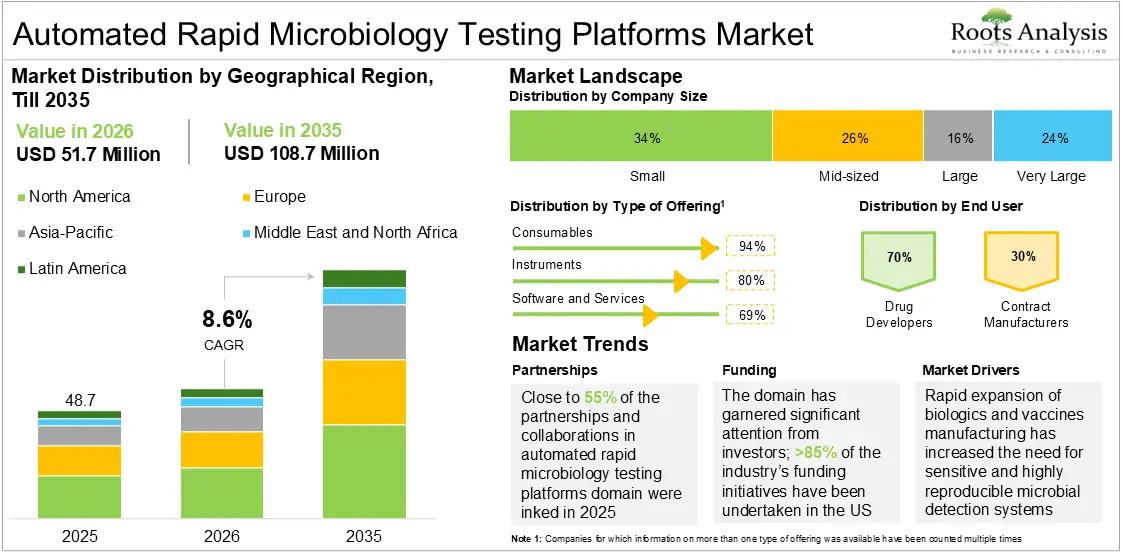
The global automated rapid microbiology testing platforms market, valued at USD 48.7 million in 2025, is projected to reach USD 51.7 million in 2026 and USD 108.7 million by 2035, representing a CAGR of 8.6% during the forecast period 2026 to 2035.
To learn more about this report, request a free sample copy
Market Report: Key Takeaways
Market Size & Trends
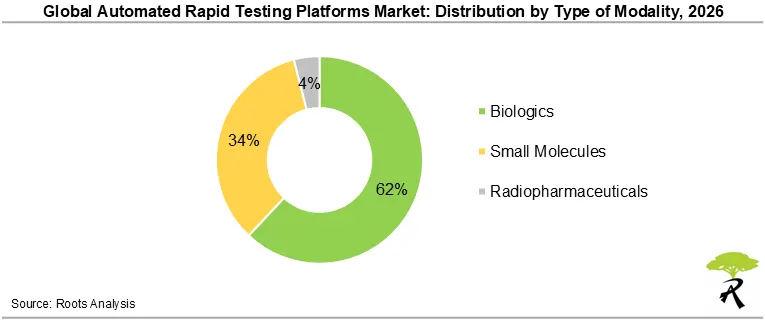
- In terms of type of modality, biologics accounts for the highest share (over 60%) of the current market.
- With respect to type of offering, consumables dominate the current market.
- Based on the method of testing, growth-based methods capture the largest share of the current market; this trend is unlikely to change in the future.
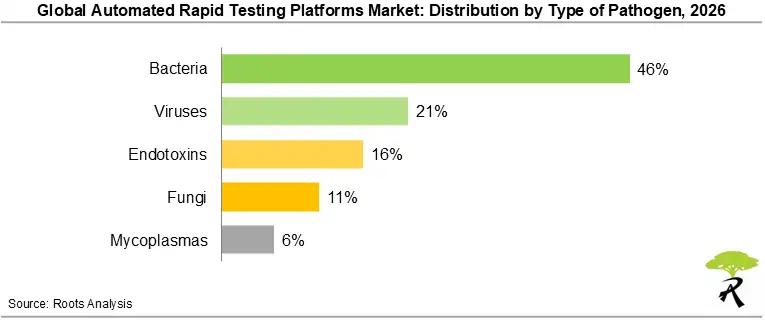
- Among the types of pathogens, bacteria capture the most (more than 45%) of the current market.
- By application area, sterility testing dominates the current market.
- Based on end user, drug developers capture the largest share of the current market.
- In terms of geographical regions, North America currently holds the highest market share (around 45%).
Key Market Statistics
- Market Size in 2026: $51.7 Million
- Estimated Market Size in 2035: $108.7 Million
- CAGR (2026-2035): 8.6%
- North America: Largest market in 2026
- Asia-Pacific: Fastest growing region
Market Introduction
Automated rapid microbiology testing platforms are transforming microbial detection by significantly reducing the time required to identify and characterize microorganisms compared to conventional culture-based methods. By integrating automation with advanced technologies such as molecular diagnostics, mass spectrometry, and digital imaging, these platforms enable faster, standardized, and more reliable testing across clinical, pharmaceutical, and biotechnology laboratories.
The growing demand for shorter turnaround times, stringent regulatory expectations for sterility assurance, and the increasing complexity of biologics and advanced therapeutics are accelerating the adoption of automated microbiology solutions. Healthcare providers and pharmaceutical manufacturers are investing in these platforms to improve laboratory productivity, minimize manual intervention, and support timely decision-making without compromising testing accuracy.
Recent industry trends indicate a strong shift toward intelligent microbiology laboratories, where automated platforms are increasingly integrated with artificial intelligence, laboratory information management systems (LIMS), and real-time data analytics. This digital transformation is enabling predictive quality control, enhanced traceability, remote monitoring, and seamless regulatory compliance, making microbiology testing more scalable and operationally efficient.
Looking ahead, automated rapid microbiology testing platforms are expected to become a strategic investment rather than merely a laboratory upgrade, particularly as pharmaceutical production, cell and gene therapies, and precision medicine continue to expand. Further, companies offering integrated, high-throughput, and interoperable automated microbiology testing solutions are well positioned to address the evolving needs of healthcare and life sciences organizations. Their ability to enable faster product release, strengthen contamination control, and support data-driven laboratory operations is expected to create significant growth opportunities in the market.
Leading Companies in the Automated Rapid Microbiology Testing Platforms Market
| Company |
Headquarters |
YoE |
Flagship Platform |
Core Technology |
Key Application Area |
| BD |
US |
1897 |
BD Kiestra™ Laboratory Automation |
Automated inoculation, incubation, plate imaging, and result reporting |
Clinical bacteriology lab automation |
| bioMérieux |
France |
1963 |
BIOFIRE® FILMARRAY® TORCH |
Multiplex PCR |
Infectious disease / syndromic testing |
| Bruker |
US |
1960 |
MALDI Biotyper® |
MALDI-TOF mass spectrometry |
Microbial identification |
| Cepheid |
US |
1996 |
GeneXpert® System |
Automated molecular diagnostics / PCR |
Near-patient and core-lab infectious disease testing |
| Copan Diagnostics |
US |
1994 |
WASPLab® |
Full laboratory automation, digital microbiology, and AI-assisted plate reading |
Clinical microbiology laboratories |
| Merck KGaA |
Germany |
1668 |
Milliflex® Rapid System 2.0 |
ATP bioluminescence, membrane filtration, and image analysis |
Pharma, biotech, and personal care quality control |
| Rapid Micro Biosystems |
US |
2006 |
Growth Direct® System |
Automated growth-based digital imaging |
Pharmaceutical quality control |
Abbreviation: YoE: Year of Establishment
Market Segmentation
Based on the research, we have segmented the Automated Rapid Microbiology Testing Platforms Market into type of modality, type of offering, method of testing, type of pathogen, application area, end user and geographical regions.
By Type of Modality
- Biologics (Monoclonal Antibodies, Vaccines, Cell and Gene Therapies, and Other Biologics)
- Small Molecules
- Radiopharmaceuticals
By Type of Offering
- Consumables
- Instruments
- Software and Services
By Method of Testing
- Growth-based Methods
- Nucleic Acid-based Methods
- Cellular Component-based Methods
- Viability-based Methods
- Immunological Methods
- Microfluidic Methods
- Other Methods
By Type of Pathogen
- Bacteria
- Viruses
- Fungi
- Endotoxins
- Mycoplasmas
By Application Area
- Sterility Testing
- Bioburden Testing
- Microbial Identification
- Endotoxin Testing
- Mycoplasma Testing
By End User
- Drug Developers
- Contract Manufacturers
By Geographical Regions
- North America
- Europe
- Asia-Pacific
- Middle East and North Africa
- Latin America
Automated Rapid Microbiology Testing Platforms Market Key Insights
What are the Key Drivers of Growth in the Automated Rapid Microbiology Testing Platforms Market?
- Rising Demand for Faster Microbiological Results Across Regulated Industries: Traditional microbiological testing methods often require several days to generate results, delaying product release and increasing inventory holding costs. Automated rapid microbiology testing (RMT) platforms significantly reduce turnaround times through technologies such as ATP bioluminescence, flow cytometry, nucleic acid amplification, and automated imaging. One example is Charles River Laboratories' Celsis Advance II™ platform, which employs ATP bioluminescence technology for sterility testing and delivers results within 24–48 hours versus the conventional 5–7 days.
- Increasing Regulatory Emphasis on Quality Assurance and Data Integrity: Global regulatory agencies are encouraging manufacturers to adopt advanced analytical technologies that strengthen contamination control, process monitoring, and data reliability. Automated rapid microbiology platforms support regulatory compliance by providing standardized workflows, electronic data capture, audit trails, and reduced operator variability. The growing implementation of quality-by-design (QbD), Process Analytical Technology (PAT), and digital quality management systems is further driving the adoption of automated rapid microbiological testing solutions.
What are the Main Challenges Affecting Market Growth?
- High Capital Investment and Implementation Costs: Automated rapid microbiology testing platforms require substantial upfront investment for instrumentation, software integration, laboratory automation infrastructure, and personnel training. In addition, ongoing maintenance, consumables, and system validation expenses increase the total cost of ownership. These financial barriers limit adoption among small and mid-sized pharmaceutical manufacturers, contract testing laboratories, and food producers with constrained budgets.
- Limited Standardization Across Diverse Sample Types and Applications: No single automated rapid microbiology platform is universally suitable for every microorganism, product matrix, or testing application. Variations in sample characteristics, microbial loads, and industry-specific testing requirements often necessitate customized workflows or complementary conventional testing methods. This lack of universal applicability can complicate platform selection, increase operational complexity, and slow widespread adoption across multiple end user industries.
Recent Developments in the Automated Rapid Microbiology Testing Platforms Market
- In June 2026, bioMérieux launched GENE-UP® TYPER SLM, a real-time PCR solution for rapid Salmonella root-cause analysis in food industry environments. The platform enables faster strain discrimination and supports automated decision-making for food safety and contamination control workflows.
- In June 2026, Symcel launched caloTrace, a biocalorimetry-based platform for rapid microbial testing and biocalorimetry applications. The system offers independently loaded calorimetric channels, random-access operation, and automated result interpretation, supporting rapid microbial detection and QC workflows.
- In April 2026, Q-linea received US FDA 510(k) clearance for the expanded ASTar® Gram-negative Blood Culture test menu. ASTar is an automated phenotypic antimicrobial susceptibility testing platform that delivers results directly from positive blood cultures in around 6-7 hours, supporting faster treatment optimization in bloodstream infections.
Industry Experts on the Rapid Microbiology Testing Platforms Market
Driven by the increasing adoption of testing systems that combine automated sample handling, incubation, and rapid microbial detection to improve testing consistency and reduce manual intervention, the rapid microbiology testing platforms market is poised for significant growth in the coming years.
Commenting on this Stacey Ramsey (Senior Manager, Microbial Applications Lab at Charles River Laboratories), stated that: "The pharmaceutical market is also tackling more challenging therapies than it targeted before, including orphan diseases, rare cancers, and infections previously thought to be untreatable. Herein lies a new challenge: for these therapies to succeed, quality control can no longer take 14 days. Rapid microbial methods (RMMs) are no longer a luxury but a necessity"
Discussions with multiple stakeholders in this domain influenced the opinions and insights presented in this study. The automated rapid microbiology testing platforms market report includes detailed transcripts of interviews conducted with the following individuals:
- Founder and Managing Director, Small Organization, Germany
- Chief Operating Officer and Chief Financial Officer, Small Organization, Switzerland
- Senior Vice President of Sales, Small Organization, United States
- Head of Business Development, Small Organization, Canada
- Technical Sales & Marketing Coordinator, Small Organization, United Kingdom
- Founder and Chief Operating Officer, Small Organization, Netherlands
In addition, the market report includes transcripts of the following third-party discussions:
- President, Small Organization, United States
- Commercial Director, Very Large Company, Germany
- Senior Manager, Very Large Organization, United States
- Microbiology Supervisor, General Manager, Very Large Organization, United Kingdom
- Global Subject Matter Expert - Testing Solutions, Very Large Organization, Switzerland
- Senior Commercial Applications Expert, Very Large Organization, United States
- Manager, Global Product Management, Very Large Organization, Germany
- Country Head: Industrial Application, Very Large Organization, France
- Product Manager, Mid-sized Company, Switzerland
- Product Manager, Mid-sized Company, Switzerland
Market Share Insights
Which Type of Modality Accounts for the Largest Share in the Automated Rapid Microbiology Testing Platforms Market?
- Currently, the biologics segment is expected to account for the highest market share (over 60%) owing to the inherently high sterility requirements and complex manufacturing processes associated with biologics production. This has led manufacturers to increasingly adopt automated rapid microbiology testing platforms to enable faster sterility testing.
- The radiopharmaceuticals segment is likely to grow at a higher CAGR (13.1%) during the forecast period. This is primarily because radiopharmaceutical manufacturing requires extremely rapid microbial quality testing due to the short half-life of many radioactive isotopes. Conventional microbiological methods, which can take several days, are incompatible with the time-sensitive production and release requirements of these products. Automated rapid microbiology testing platforms enable faster sterility and bioburden assessments, allowing manufacturers to minimize release delays, reduce product wastage, and improve supply chain efficiency.
Regional Analysis: Which Regions are Showing the Fastest Growth in Automated Rapid Microbiology Testing Platforms Industry?
North America: Dominating the Market by Securing the Highest Share
According to our projections, North America is likely to capture the largest share (~45%) of the current automated rapid microbiology testing platforms market share. This is due to the region's strong presence of biopharmaceutical manufacturing facilities producing biologics and small molecules, which require rapid, highly sensitive microbiological quality control. Since these products are manufactured in aseptic environments and often have short shelf lives, manufacturers are increasingly replacing conventional culture-based methods with automated rapid microbiology testing platforms. Manufacturers are adopting these platforms to accelerate batch release, reduce inventory holding costs, and minimize the risk of costly batch failures. Additionally, North America has one of the highest adoption rates of Industry 4.0, laboratory automation, electronic quality management systems (eQMS), and digital manufacturing technologies. This facilitates seamless integration of automated microbiology platforms into existing quality control workflows.
Further, we anticipate that the market in the Asia-Pacific region will grow at a relatively faster pace through 2035. This is driven by the region's transition from cost-driven pharmaceutical manufacturing to value-driven, globally compliant production. For instance, the region's expanding exports to regulated markets such as the US and Europe have compelled manufacturers to implement advanced, validated rapid microbiological testing methods that improve operational efficiency while meeting stringent global quality expectations.
Among the Type of Pathogen, Which Segment Holds the Highest Share in the Automated Rapid Microbiology Testing Platforms Market?
- Currently, the bacteria segment is likely to account for the largest share of the automated rapid microbiology testing platforms market forecast size (with >45% share). This is primarily because bacterial detection technologies are comparatively more mature and commercially validated, with automated platforms based on ATP bioluminescence, flow cytometry, automated imaging, and nucleic acid amplification. These technologies offer high sensitivity and shorter turnaround times for a broad range of bacterial species.
- The viruses segment is likely to grow at a higher CAGR during the forecast period. The increasing regulatory scrutiny surrounding adventitious virus detection, growing adoption of viral vector manufacturing for gene therapies, and rising global production of mRNA and recombinant vaccines are accelerating demand for automated, high-throughput viral testing solutions.
Scope of Automated Rapid Microbiology Testing Platforms Market Report
| Key Report Attribute |
Details |
| Historical Trend |
Since 2021 |
| Forecast Period |
Till 2035 |
| Market Size 2026 |
$ 51.7 Million |
| Market Size 2035 |
$ 108.7 Million |
| CAGR (Till 2035) |
8.6% |
| Segments Covered |
- Type of Modality
- Type of Offering
- Method of Testing
- Type of Pathogen
- Application Area
- End User
- Geographical Regions
|
| Key Players |
(A complete list of players captured is available in the report) |
PowerPoint Presentation
(Complimentary) |
Available |
| Customization Scope |
15% Free Customization |
Excel Data Packs
(Complimentary) |
Available |
Frequently Asked Questions
What are automated rapid microbiology testing platforms?
These platforms are advanced laboratory systems that detect, enumerate, and identify microorganisms in a few hours rather than days.How big is the automated rapid microbiology testing platforms market?
The market for automated rapid microbiology testing platforms is estimated to be around USD 51.7 million in 2026.What is the projected growth of the automated rapid microbiology testing platforms market?
The market is likely to grow at a CAGR of 8.6% during the forecast period from 2026 to 2035.Which region holds the highest market share in the automated rapid microbiology testing platforms industry?
Presently, North America captures ~45% of the overall industry.Who are the leading players specializing in the automated rapid microbiology testing platforms market?
BD, bioMérieux, Charles River Laboratories, Lonza, Merck, Neogen, Rapid Micro Biosystems, and Thermo Fisher Scientific.