
Lowest Price Guaranteed
Pages
210
Last Updated
July 2026
View Count
11379
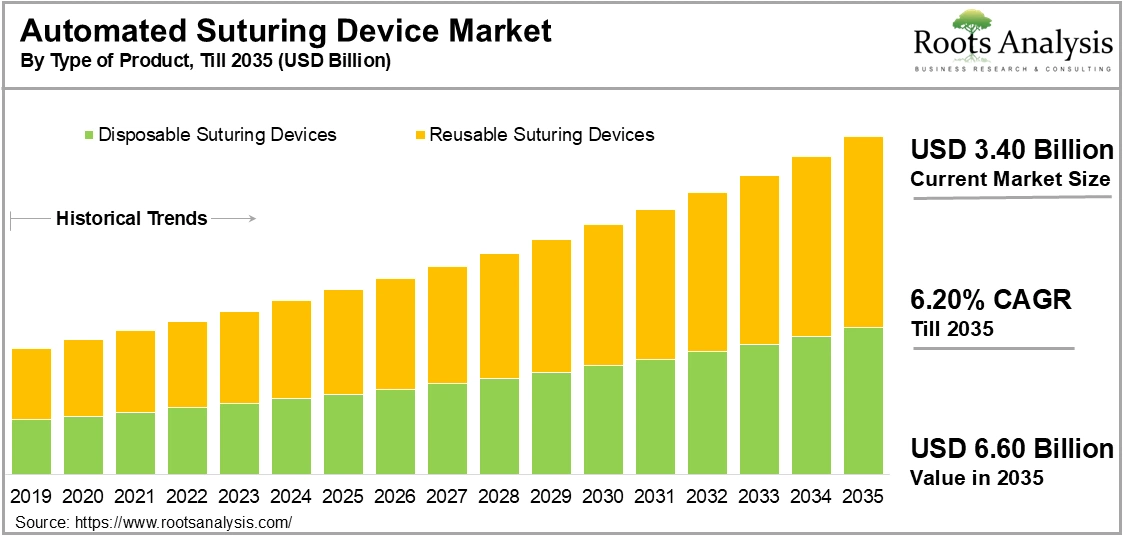
The global automated suturing devices market is estimated to grow from 3.40 billion in 2024 to USD 6.60 billion by 2035, at a CAGR of 6.20% during the forecast period, till 2035.
 |
To learn more about this report, request a free sample copy
Automated suturing device is a medical device that is used to seal tissue after surgical procedure with higher precision and control. These suturing devices have immensely simplified tissue ligation process, allowing surgeons to perform suturing with a minimally invasive approach. Given by the growing preferences for minimally invasive surgeries to heal wounds, there has been a surge in the demand for automated suturing devices for surgeries. Automated suturing devices offer several advantages such as enhanced efficiency, accuracy in ligating wounds during surgeries, thereby promoting healing. Furthermore, owing to its minimally invasive nature, several surgeons are adopting automated suturing devices in various medical fields including gynecology, orthopedics, cardiovascular and ophthalmology surgical procedures.
It is worth noting that the growing prevalence of obesity resulted in widespread adoption of bariatric surgery, which further contributed to the growth of the automated suturing devices market. Israel based company Nitinotes is developing an automated suturing device with an integrated endoscope to allow Endoscopic Sleeve Gastroplasty procedure in obese patients. The device named EndoZip™ is currently under review for CE mark, which is expected in early 2025. In order to meet the growing demand for automated suturing devices, several device developers have increased their efforts for driving innovations in this industry. An India based start-up De Novo Bio Innovations is developing SutureSure automated suturing device. The founder of the company, Dr. Nikhil Mamoria mentioned in a recent interview “SutureSure will help doctors and surgeons by preventing needlestick injuries significantly with its innovative suture cartridges and needle-driving mechanism. It will also empower doctors to do suturing effortlessly with just two clicks. Suturing will be faster and more accurate during fast-paced, stressful, and potentially understaffed environments,” The successful launch of innovative automated suturing devices illustrates enormous opportunities to industry stakeholders for the enhancement of product portfolio.
It is worth mentioning that industry stakeholders are leveraging collaborations and partnerships to increase their efforts for the development of advanced automated suturing devices. As more industrial stakeholders continue to expand their research efforts on innovative surgical procedures and advanced wound care suture solutions, we believe that the automated suturing devices market will grow at a steady pace during the forecast period.
The market study report covers an in-depth analysis of leading players who are currently active across different segments of this growing industry as mentioned in the table below.
| Key Report Attributes | Details | |
| Historical Trend | Since 2019 | |
| Forecast Period | Till 2035 | |
| Market Size 2035 | USD 6.60 billion | |
| Market CAGR | 6.20% | |
| Type of Product |
|
|
| Type of Application |
|
|
| Type of End User |
|
|
| Key Geographical Region |
|
|
| Key Companies Profiled |
|
|
| PowerPoint Presentation (Complimentary) |
Available | |
| Customization Scope | 15% Free Customization | |
| Excel Data Packs (Complimentary) |
Available | |
One of the key objectives of the market report was to estimate the current market size, future opportunity and the market growth potential, over the forecast period, till 2035. We have provided informed estimates on the likely evolution of the market for the forecast period.
The automated suturing device market analysis also features the likely distribution of the current and forecasted opportunity within the market across various segments, such as distribution by distribution by type of product (disposable suturing devices and reusable suturing devices), type of application (ophthalmic surgeries, cardiac surgeries, orthopedic surgeries, gastrointestinal surgeries, gynecological surgeries, dental surgeries, neurological surgeries and other applications), end users (hospitals, ambulatory surgical centers, and other end users), geographical regions (North America, Europe, Asia-Pacific, Middle East and North Africa, and Latin America), and leading players. In order to account for future uncertainties associated with some of the key parameters and to add robustness to our model, we have provided three market forecast scenarios, namely conservative, base, and optimistic scenarios, representing different tracks of industry’s evolution.
All actual figures have been sourced and analyzed from publicly available information forums and primary research discussions. The financial figures mentioned in this market report are in USD, unless otherwise specified.
Based on the type of product, the global market is segmented into disposable suturing devices and reusable suturing devices. According to our market analysis, currently reusable automated suturing devices account for the largest share (57%) of the market. This dominance is due to the fact that reusable suturing devices offer exceptional infection resistance which helps to reduce tissue damage during surgical procedures. Furthermore, these reusable suturing devices are easily accessible and affordable, making it an ideal option for surgical procedures. However, the disposable suturing device is expected to exhibit higher CAGR during the forecast period driven by the increase in surgical procedures and rising number of geriatric populations with chronic diseases. Furthermore, disposable suturing devices reduce the risk of hospital acquired infection and eliminate the requirement of sterilization.
The global automated suturing devices market is segmented on the area of application into ophthalmic surgeries, cardiac surgeries, orthopedic surgeries, neurological surgeries and other applications. According to our projection, currently cardiac surgeries occupy the highest share (29%) of the market owing to the increasing incidence of cardiovascular disorders that require surgical procedures for treatment. However, in the long run, orthopedic surgeries segment is expected to grow at a higher CAGR during the forecast period. This lucrative growth is due to the growing geriatric population with orthopedic issues and rising trauma cases.
This segment highlights the distribution of global market across different types of end user into hospitals, ambulatory surgery centers and other end users. Among these, currently hospitals account for the highest automated suturing devices market share (56%) and are expected to remain dominant during the forecast period. The dominance is primarily due to the favorable reimbursement policies, advanced healthcare facilities and growing usage of handheld automated suturing devices to close wounds during surgeries in hospitals. Furthermore, hospitals are the primary healthcare settings to receive treatment during emergencies and accidental injuries, which is expected to be a significant reason for the highest share. Driven by the ease of accessibility and increasing number of surgical operations in hospitals, this segment will continue to grow at a higher CAGR during the forecast period.
The global automated suturing devices market is distributed across key geographical regions such as North America, Europe, Asia-Pacific, Middle East and North Africa, and Latin America. It is worth mentioning here that North America currently holds the highest share (35%) of the overall market. North America has an advanced healthcare infrastructure and higher adoption rate of advanced techniques such as surgical robots and automated suturing for performing surgical procedures. Furthermore, the ongoing technological advancements within robotic-assisted surgery is likely to propel the growth of automated suturing device industry in this region.
However, in Asia-Pacific, the market for automated suturing devices is expected to grow at a higher CAGR during the forecast period owing to the growing incidence of chronic diseases such as diabetes, cardiovascular disorder and cancer. Furthermore, the growing demand for minimally invasive surgical procedures specifically in the field such as general surgery, cardiology and orthopedics has contributed to the widespread adoption of automated suturing devices. Additionally, the growing government initiatives for healthcare infrastructure advancements and innovation in medical technology is likely to be the key reason for the highest growth rate during the forecast period.
The “Automated Suturing Devices Market: Industry Trends and Global Forecasts, till 2035”; market report features an extensive study of the current market landscape, market size, market share, market forecast, market outlook and future opportunities for the players active in this industry. The market research report also features an in-depth analysis, highlighting the capabilities of various industry stakeholders engaged in the market.
Presently, the market landscape features the presence of several well-established and new entrants who are currently holding the required expertise to develop automated suturing devices for a broad range of surgeries. The big players include medical device companies such as Medtronic, Boston Scientific and Smith & Nephew. In order to leverage competitive edge, various industry leaders are presently focusing on research and development activities followed by collaborations as well as partnership for product portfolio enhancement. However, the primary focus of the device developers will be on technological innovations that aid in wound healing process with minimally invasive approach. Overall, the market seems highly fragmented, featuring the presence of small, medium-sized and large players.
The global market is propelled by various factors such as growing demand for minimally invasive treatment and rising risk of chronic conditions. A recent report of Centers for Disease Control and Prevention stated that, nearly 129 million people in United States are suffering from at least one chronic disease. Therefore, this increasing chronic illnesses across the globe has surged the demand for minimal invasive procedures such as laparoscopic surgery, endoscopic surgery, arthroscopy and hysteroscopy. Furthermore, the high prevalence of obesity has increased the shift towards bariatric surgery which further raised the demand for automated suturing devices. Moreover, the growing incidence of accidental injuries has underscored the requirement of advanced automated suturing devices to bind tissues for faster wound healing.
Despite huge demand, the market for automated suturing device is witnessing several challenges that may impede the growth of this domain during the forecast period. Some of the potential challenges include lack of skilled personnel and availability of advanced wound care treatment options. It is important to highlight here that various companies are focusing on the development of advanced wound care solutions including alginate dressing, hydrocolloid dressing and foam dressing. These dressings can avoid the need for suturing at all. Moreover, some players have developed advanced surgical suturing substitutes such as negative pressure wound therapy, topical oxygen therapy, hyperbaric oxygen therapy and adhesives. Hence, the availability of alternative suturing solutions may limit the adoption of automated suturing devices.
The growing number of surgical volumes across the globe has underscored the requirement of automated suturing devices that allow surgeons to perform surgeries with higher efficiency and precision. Furthermore, the key industrial leaders are focusing on advanced surgical technology such as surgical robots for robot-assisted surgeries which has further risen the demand for automated suturing devices. In order to make a strong foothold in the market, various industrial stakeholders are emphasizing collaborations, partnerships and making considerable investments for technological advancements in this field. Additionally, government organizations are taking strategical initiatives to support the development of medical technologies including automated suturing devices, which is anticipated to offer enormous opportunities to drive innovation in this field.
The global automated suturing devices market size is estimated to grow from 3.40 billion currently to USD 6.60 billion by 2035. Driven by the rising demand for minimal invasive surgical procedures, the market is expected to grow at a higher CAGR of 6.20% during the forecast period.
Key market players that are engaged in the development of automated suturing devices are (in alphabetical order) Apollo Endosurgery, Baxter International, BD, Boston Scientific, Braun Melsungen, DemeTECH, EndoEvolution, Ethicon, LSI Solutions, Medtronic, Mellon Medical, R.Bard, Surgical Specialties, SuturTek, and Smith and Nephew. This market report includes an easily searchable excel database of all the automated suturing device companies worldwide.
Several recent developments have taken place in the field of automated suturing device. We have outlined some of these recent initiatives below.