


 Download Free Sample
 Buy Now
Market Size
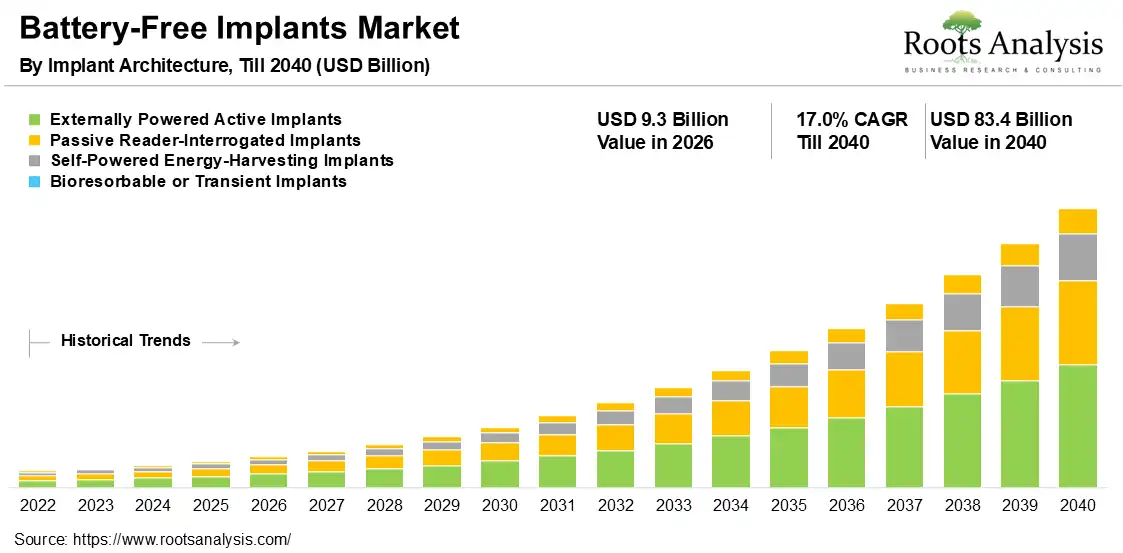
The global battery-free implants market is expected to rise from USD 9.3 billion in 2026 to reach USD 83.4 billion by 2040, growing at a CAGR of 17.0% over the forecast period 2026 to 2040, driven by wireless power transfer, miniaturization, and fewer replacement surgeries.
See What's in the Full Report – Request Your Complimentary Insights!
Market Report: Key Takeaways
- Based on powering technology, near-field inductive coupling captures 32.0% market share in 2026, whereas optical or photovoltaic powering registers a 22.3% CAGR through 2040, supported by visual prosthesis commercialization.
- Based on implant architecture, externally powered active implants capture 44.0% market share in 2026, whereas bioresorbable or transient implants register a 21.9% CAGR through 2040, supported by transient electronics breakthroughs.
- Based on clinical application, cardiac rhythm management and hemodynamic monitoring captures 29.0% market share in 2026, whereas retinal and visual restoration registers a 21.0% CAGR through 2040, supported by clinical validation of photovoltaic prostheses.
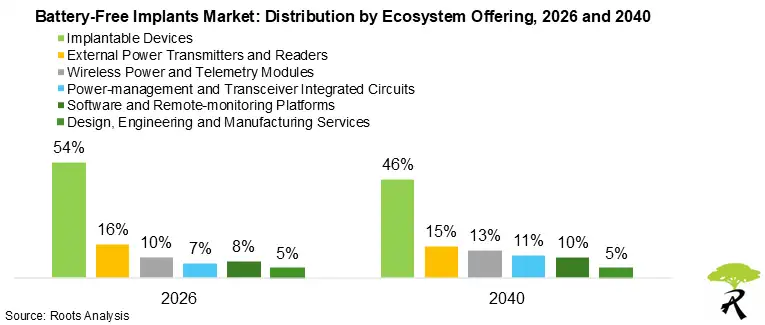
- Based on ecosystem offering, implantable devices capture 54.0% market share in 2026, whereas power-management and transceiver integrated circuits register a 20.8% CAGR through 2040, supported by ultralow-power semiconductor miniaturization.
- Based on geography, North America captures 40.0% market share in 2026, whereas Asia-Pacific registers a 19.5% CAGR through 2040, supported by localized launches and expanding implant access.
Battery-Free Implants Market Outlook
Battery-free implant development is shifting from isolated passive sensors toward programmable therapeutic and diagnostic platforms. Near-field inductive coupling still holds 32.0% of 2026 revenue because mature coils support cochlear, neural, and sensing applications. Externally powered active implants also command 44.0% of architecture revenue. Current demand favors smaller implanted components, adjustable external controllers, and continuous telemetry. Providers also seek fewer battery-replacement procedures across cardiac, neurological, ophthalmic, and urologic care.
Wireless power transfer, semiconductor miniaturization, and reimbursement progress now drive the battery-free implants market. Hospitals gain clinical value when compact implants reduce revision exposure while external hardware supports programming and follow-up. Regulatory recognition also lowers commercialization risk. In July 2026, Neuspera Medical reported proposed Medicare outpatient payment parity with established sacral neuromodulation devices. The proposal strengthened the economic case for batteryless therapy adoption.
Through 2040, the market will remain high-growth, although expansion moderates as established applications mature after 2034. Optical or photovoltaic powering will expand at 22.3% CAGR, while bioresorbable or transient implants will grow at 21.9%. Science Corporation's October 2025 PRIMA results showed restored functional central vision, supporting confidence in photovoltaic retinal implants. Competitive advantage will increasingly depend on clinical evidence, external-device usability, specialized chips, and reimbursement alignment.
Battery-Free Implants Market Dynamics
Battery-Free Implants Market Drivers
Wireless power transfer and miniaturized electronics remove the implanted battery, reducing component volume and replacement exposure. Near-field inductive coupling captures 32.0% of 2026 revenue because mature coils support efficient transcutaneous power delivery. Externally powered active implants hold 44.0% of architecture revenue, reflecting demand for programmable stimulation, diagnostics, and telemetry. These capabilities strengthen adoption across cardiac monitoring, neuromodulation, cochlear restoration, and implantable biosensors.
Battery-Free Implants Market Restraints
Power-transfer efficiency limits device depth, orientation tolerance, and energy availability across anatomical sites. Near-field inductive systems lose share from 32.0% in 2026 to 25.0% by 2040 as alternative technologies gain. External transmitters also require alignment, charging routines, and patient adherence. Developers must balance tissue heating, communication reliability, packaging, and biocompatibility, which extends engineering cycles and raises validation costs before clinical deployment.
Battery-Free Implants Market Opportunities
Photovoltaic retinal implants, transient electronics, and ultralow-power integrated circuits create the strongest expansion pathways. Optical or photovoltaic powering will grow at 22.3% CAGR, while bioresorbable implants will advance at 21.9%. In March 2026, Science Corporation raised $230 million to support PRIMA commercialization and clinical expansion. Capital providers can prioritize platforms that combine validated function, specialized hardware, and scalable manufacturing.
Battery-Free Implants Market Challenges
Clinical evidence, regulatory review, reimbursement, and external-device usability determine commercialization speed more than component novelty alone. Cardiac applications lead with 29.0% of 2026 revenue because established specialist infrastructure and payment pathways support adoption. Emerging ophthalmic and cortical systems face longer evidence-building requirements. Companies must prove durable outcomes, safe wireless energy delivery, reliable telemetry, and workable patient routines before hospitals replace conventional battery-powered alternatives.
Battery-Free Implants Market Size Estimation Methodology
- As a starting point, the model defined battery-free implants by internal power architecture, not by therapeutic category. It included externally powered, passively interrogated, photovoltaic, acoustic, and energy-harvesting platforms. Conventional rechargeable implants remained outside the scope when an electrochemical battery stayed inside the body. This boundary prevented cochlear, cardiac, sensing, and neuromodulation revenues from being counted without validating their battery free configuration.
- Moving forward, analysts assembled five independent market estimates and normalized their scope to the battery-free implants market. They compared forecast years, including applications, device architectures, and wireless power assumptions before lowering weights for broader implantable electronics scopes. The team reviewed annual company disclosures, product portfolios, and regulatory submission counts. Commercial launch evidence then tested whether modeled demand matched visible industry activity.
- Building on this, the forecast linked each segment to relevant adoption indicators. Clinical trial databases and regulatory approval timelines informed neuromodulation, retinal, cardiac, and sensing uptake. Patent filing volumes and technical publication activity supported optical, ultrasonic, transient, and energy-harvesting adoption curves. External transmitter availability, specialist implantation infrastructure, and established reimbursement pathways helped distinguish near-term commercialization from laboratory-stage potential.
- Drawing upon these, segment shares were calibrated against product maturity, implantation volumes, clinical evidence, and ecosystem depth. Near-field inductive coupling received the largest 2026 weighting because mature coil infrastructure supports several established applications. Faster growth assumptions applied to photovoltaic powering, bioresorbable architectures, ophthalmic locations, and power-management integrated circuits. Each share path was reconciled annually so technology, architecture, application, offering, and regional totals remained at 100%.
- The projected value was then extended through 2040 using adoption curves that reflected regulatory progress, manufacturing readiness, and clinical substitution rates. Early years retained stronger expansion as newly cleared platforms entered controlled commercialization. Growth moderated after 2034 as mature cardiac, cochlear, and inductive applications approached wider penetration. The model produced a 17.0% overall CAGR while allowing faster segments to gain share and established categories to lose relative weight.
- Finally, analysts tested the forecast through bottom-up and top-down checks. Bottom-up validation used implantable-device demand, external power hardware, telemetry modules, integrated circuits, software, and engineering services. Top-down validation compared regional healthcare capacity, specialist networks, semiconductor supply, venture funding, regulatory activity, and reimbursement behavior. Sensitivity testing adjusted approval timing, adoption speed, pricing pressure, and technology substitution to identify realistic upside and downside ranges.
Battery-Free Implants Market Share Insights
Market Share by Implant Architecture
According to our analysis, externally powered active implants lead because external hardware can deliver controllable energy without enlarging the implanted component. Their programmable operation supports stimulation intensity, telemetry, diagnostics, and follow-up adjustments within established regulatory workflows.
Bioresorbable or transient implants will benefit from postoperative monitoring needs that require only temporary operation. Dissolvable materials can eliminate removal procedures while reducing infection risks and long-term foreign-body exposure.
Market Share by Ecosystem Offering
Implantable devices lead because they capture the greatest clinical value and command regulatory-grade pricing. Device developers also integrate specialized packaging, electrodes, sensors, biocompatible materials, telemetry, and implantation tools.
Power-management and transceiver integrated circuits will grow through lower power consumption and greater channel density. Standardized ultralow-power chips can shorten development cycles across sensing, neural recording, stimulation, and telemetry platforms.
Want Information on Specific Region / Segment?
Regional Analysis: North America Leads the Market and Asia-Pacific is Likely to Register Higher CAGR
Presently, North America holds 40.0% market share in 2026. North America leads through advanced implant centers, venture funding, semiconductor expertise, and established medical-device reimbursement. Its regulatory infrastructure also supports breakthrough designation, pivotal studies, specialized manufacturing, and controlled commercial deployment. In April 2025, the FDA approved EBR Systems' WiSE CRT System for selected cardiac resynchronization patients. The approval strengthened the region's position in clinically validated, wirelessly powered cardiac implants.
On the contrary, Asia-Pacific grows at a 19.5% CAGR from 2026 to 2040. Asia-Pacific will expand through larger eligible populations, improving hospital infrastructure, and localized production of electronic components. Government-supported digital health systems and expanding specialist networks will improve access across China, India, South Korea, and Southeast Asia. In June 2025, Cochlear launched its Nucleus Nexa system across several Asia-Pacific markets. The rollout demonstrated faster regional adoption of advanced implant platforms and market-specific commercialization strategies.
Market Ecosystem Analysis
The supplied roster contains four Tier 1 leaders, ten specialists, and six emerging entrants across twenty companies. Commercial activity remains concentrated among established device platforms and specialists with approved cardiovascular, auditory, sensing, and neuromodulation products. Acquisition-driven consolidation dominates, demonstrated by Edwards' Vectorious acquisition and Boston Scientific's agreement to acquire Nalu Medical. The primary commercial force shifts power, controls, and monitoring into external readers, wearables, smartphones, and connected clinical software. Competitive advantage increasingly depends on miniature implants, simplified interfaces, clinical evidence, and scalable market-access capabilities.
- Abbott received FDA approval in February 2026 for CardioMEMS HERO, its next-generation pulmonary-artery pressure reader. The device weighs 60% less than its predecessor and supports daily pressure transmission to clinicians. The upgrade strengthens external-reader and remote-monitoring offerings while raising usability standards for competing cardiac sensor platforms.
- Edwards Lifesciences fully acquired Vectorious Medical Technologies in September 2025, with the transaction valuing Vectorious at $497 million. Vectorious' V-LAP implant measures left-atrial pressure and transmits information supporting physician-directed heart-failure management. The acquisition strengthens cardiovascular sensing while raising strategic-value benchmarks for independent hemodynamic-monitoring developers.
- Neuspera secured FDA approval in June 2025 for integrated sacral neuromodulation treating urinary urge incontinence. Its miniaturized implant receives energy from an externally worn therapy disc, eliminating an implanted battery. The approval strengthens urologic and pelvic applications while reducing concerns involving battery-pocket complications and replacement procedures.
- BlueWind obtained FDA clearance in December 2025 for an enhanced Revi wearable supporting its implantable tibial neuromodulation system. The updated external component offers a simplified interface and supports long-term urgency urinary incontinence treatment. This clearance pressures competing pelvic-neuromodulation companies to improve wearable convenience, manufacturing scalability, and patient-controlled therapy delivery.
- Boston Scientific agreed in October 2025 to acquire Nalu Medical's remaining equity for approximately $533 million. Nalu's battery-free micro-implant receives wireless power from an externally worn disc and uses smartphone controls. The transaction validates micro-IPG economics and raises commercial-scale requirements for independent chronic-pain neuromodulation specialists.
- Science Corporation submitted its PRIMA retinal implant for CE marking in June 2025. PRIMA uses a photovoltaic subretinal implant powered through infrared signals transmitted by specialized glasses. The submission advances optical powering and retinal restoration while establishing a regulatory benchmark for wireless visual prostheses.
- Science raised $230 million through a Series C round in March 2026. The company allocated capital toward PRIMA commercialization, research, manufacturing infrastructure, operations, and additional retinal-disease trials. This financing creates substantial clinical-evidence and manufacturing barriers for smaller optical implant developers.
- Motif Neurotech received an FDA investigational device exemption in April 2026 for its RESONATE early feasibility study. The study evaluates Motif's wirelessly powered XCS cortical implant for adults with treatment-resistant depression. The milestone advances neural and cranial applications while testing an externally powered, home-based cortical neuromodulation model.
Startup Companies and their Key Highlights
- BlueWind Medical Ltd.
- Event type and funding amount: Equity and debt financing totaling $47.8 million
- Month and year: May 2026
- Stated purpose: Expand Revi commercialization, sales operations, and market-access initiatives
- Market implication: Accelerates North American urologic and pelvic neuromodulation by broadening provider and patient access
- Nalu Medical, Inc.
- Event type and funding amount: Growth funding commitment of up to $50 million
- Month and year: September 2025
- Strategic partner: Trinity Capital
- Stated purpose: Support commercial expansion, the next-generation Therapy Disc, and long-term peripheral-nerve stimulation evidence
- Market implication: Accelerates battery-free chronic-pain neuromodulation and raises capital requirements for independent PNS competitors
- Science Corporation
- Event type and funding amount: Series C financing totaling $230 million
- Month and year: March 2026
- Stated purpose: Fund PRIMA commercialization, manufacturing expansion, operations, research, and additional retinal-disease trials
- Market implication: Accelerates photovoltaic retinal restoration across European and United States regulatory pathways
- Motif Neurotech
- Event type: FDA investigational device exemption
- Month and year: April 2026
- Stated purpose: Conduct the RESONATE feasibility study of the XCS implant for treatment-resistant depression
- Market implication: Moves magnetoelectric cortical neuromodulation into human evaluation and tests an at-home therapy architecture
- Vectorious Medical Technologies Ltd.
- Event type and transaction value: Full acquisition, with Vectorious valued at $497 million
- Month and year: September 2025
- Strategic partner: Edwards Lifesciences
- Stated purpose: Incorporate V-LAP left-atrial pressure monitoring into Edwards' cardiovascular technology portfolio
- Market implication: Accelerates cardiovascular sensing while reinforcing acquisition-led consolidation among wireless hemodynamic-monitoring platforms
- Neuspera Medical, Inc.
- Event type: FDA approval
- Month and year: June 2025
- Stated purpose: Commercialize integrated sacral neuromodulation for urinary urge incontinence
- Market implication: Accelerates battery-free pelvic neuromodulation and lowers barriers associated with battery replacement and implant-pocket complications
Battery-Free Implants Market Trends / Opportunities
Battery-Free Implants Market Neuromodulation Shift Expanding Reimbursement Competition
Batteryless neuromodulation is moving from specialist trials toward reimbursed commercial pathways. In July 2026, Neuspera Medical reported proposed Medicare outpatient payment parity with established sacral neuromodulation devices. Payment alignment can narrow hospital adoption barriers and intensify competition against conventional battery-containing systems.
Long-term outcome evidence is becoming essential for differentiation in urologic neuromodulation. BlueWind Medical reported sustained response, safety, and patient satisfaction from its three-year OASIS study in February 2026. Platforms with durable evidence can support physician confidence, payer discussions, and broader commercialization while weaker datasets delay procurement.
Wirelessly powered cortical implants are opening premium therapeutic niches with high evidence requirements. The FDA authorized Motif Neurotech's first-in-human feasibility study for treatment-resistant depression in April 2026. Early regulatory access can attract partners and capital, but clinical execution will determine whether miniature brain implants achieve defensible market positions.
Photovoltaic and Transient Platforms Diversifying the Battery-Free Implants Market
Photovoltaic powering is creating a commercial route for visual restoration without implanted batteries or connecting cables. Science Corporation's October 2025 PRIMA results showed functional central vision improvement in geographic atrophy patients. Clinical validation supports the segment's 22.3% CAGR and strengthens the competitive position of light-powered retinal platforms.
Transient electronics are expanding the addressable market beyond permanent implanted devices. Northwestern University reported a light-activated, dissolvable pacemaker in April 2025. Temporary systems can serve postoperative monitoring or therapy while avoiding removal procedures, creating partnership opportunities across materials, packaging, and wireless activation.
Specialized Chips and Smaller Controllers Reshaping Ecosystem Bargaining Power
Ultralow-power chips are becoming strategic bottlenecks as implant dimensions shrink and channel requirements increase. MintNeuro and Motif Neurotech formed a multiyear neural-interface chip supply partnership in May 2026. Proprietary semiconductor access can shorten development cycles and give platform developers stronger control over performance, supply continuity, and intellectual property.
Smaller external controllers are improving wearability without increasing implanted volume. Nalu Medical introduced a Therapy Disc that was 39% smaller by volume in August 2025. Better external hardware can improve adherence and brand preference, making controller design a commercial differentiator rather than a supporting accessory.
Power-management and transceiver integrated circuits will gain share as developers demand lower consumption and greater channel density. Starfish Neuroscience highlighted ultralow-power miniature electrophysiological electronics in May 2025. Standardized chip platforms can reduce engineering time, creating scale advantages for suppliers serving multiple sensing, stimulation, and telemetry programs.
Your Business is Unique – Why Shouldn't Your Report Be?
Market Access Considerations
FDA Evidence and Wireless-Safety Requirements
FDA authorization depends on clinical benefit, reliable telemetry, biocompatibility, and safe energy transfer through tissue. Motif Neurotech received permission to begin a first-in-human feasibility study for its wirelessly powered cortical implant in April 2026. Developers without regulatory expertise, implant-grade testing, and long-term follow-up capabilities face slower entry. Strong evidence programs create differentiation but increase capital needs before meaningful commercialization. This burden favors teams with integrated clinical, engineering, quality, and regulatory capabilities at scale.
Reimbursement Alignment and Hospital Economics
Payment classification can determine whether hospitals adopt batteryless systems despite favorable technical performance. Neuspera Medical reported proposed Medicare outpatient payment parity with established sacral neuromodulation devices in July 2026. Comparable reimbursement can reduce budget resistance and support procedure growth. Companies lacking coding, coverage, or payment alignment must fund evidence generation while competing against entrenched battery-powered alternatives. Favorable procedure economics can accelerate hospital contracting and physician training investments across target centers.
External Controller Usability and Patient Adherence
Battery-free implants shift power, programming, and communication requirements toward wearable transmitters or readers. Nalu Medical reduced its Therapy Disc volume by 39% in August 2025, showing how external hardware design affects commercial usability. Poor alignment, charging routines, or uncomfortable wear can limit adherence and physician confidence. Compact controllers strengthen product positioning without increasing implanted volume or replacement risk. Simple patient training and reliable daily operation can also reduce support costs after implantation.
How Stakeholders Benefit from the Key Focus Areas of Our Battery-Free Implants Market Report
Battery-free implants combine a 17.0% market CAGR with growing demand for smaller devices and fewer replacement procedures. Wireless power transfer, photovoltaic activation, transient electronics, and ultralow-power chips now shape commercial urgency. This report supports portfolio selection, capital allocation, technology roadmaps, partnership choices, and market-entry planning.
- Unmet Needs and Market Gaps in Battery-Free Implants Market: The report identifies gaps across retinal restoration, physiological sensing, drug delivery, and batteryless neuromodulation. Retinal and visual restoration will grow at 21.0% CAGR, while ophthalmic implant locations will expand at 20.8%. Product strategy teams can compare unmet clinical demand with evidence requirements. This supports decisions about which indications, implant locations, and patient pathways deserve early investment.
- Funding and Venture Investment Opportunities in Battery-Free Implants Market: The report connects financing signals with clinical stage, platform maturity, and commercialization needs. BlueWind Medical secured $47.8 million in May 2026. Science Corporation closed a $230 million financing round in March 2026. Investment committees can compare capital intensity across platforms to support valuation, diligence, syndication, and follow-on funding decisions.
- Technology Innovation and Adoption Trends: The analysis ranks technology adoption by current share and long-term growth. Near-field inductive coupling leads with 32.0% in 2026, while photovoltaic powering grows at 22.3% CAGR. Engineering and product leaders can assess when to defend mature coil platforms or fund optical, ultrasonic, transient, and energy-harvesting systems. This supports research budgets, prototype priorities, and intellectual-property strategy.
- Battery-Free Implants Market Competitive Landscape and Industry Analysis: The report maps Tier 1 device leaders, specialist suppliers, and emerging platform developers across six ecosystem offerings. Implantable devices hold 54.0% of 2026 revenue, while power-management integrated circuits grow at 20.8% CAGR. Corporate development teams can identify crowded device categories and underdeveloped enabling layers. This supports build, buy, licensing, and market-positioning decisions.
- Mapping Strategic Partnerships and Ecosystem Synergies: The ecosystem map connects implant developers with semiconductor, telemetry, wireless-power, engineering, manufacturing, software, and external-controller capabilities. MintNeuro and Motif Neurotech formed a multiyear chip partnership in May 2026. The agreement shows how component access can shape platform performance. Business development teams can screen partners by technical fit, supporting supplier selection, co-development, licensing, and manufacturing decisions.
- Battery-Free Implants Market CAGR and Growth Trends: The forecast separates overall 17.0% growth from faster technology, architecture, application, offering, and regional curves. Asia-Pacific grows at 19.5% CAGR, while optical powering, transient implants, and integrated circuits exceed 20%. Finance and operations leaders can align launch sequencing with adoption speed and infrastructure readiness. This supports capacity planning, regional investment, revenue scenarios, and risk-adjusted targets.
Battery-Free Implants Market: Scope of the Report
| Key Report Attributes | Details | |
| Forecast Period | Till 2040 | |
| Market Size 2026 | USD 9.3 Billion | |
| Market Size 2040 | USD 83.4 Billion | |
| CAGR (Till 2040) | 17.0% | |
| Segments Covered |
|
|
| Geographical Regions Covered |
|
|
| Key Sections Covered |
|
|
Market Segmentation
The Battery-Free Implants Market report presents an in-depth analysis, highlighting the capabilities of various stakeholders, based on different segments, such as powering technology, implant architecture, clinical application, implant location, ecosystem offering, geographical regions, and leading players.
By Powering Technology
- Near-Field Inductive Coupling
- Resonant Magnetic Coupling
- Far-Field Radio-Frequency Powering
- Ultrasonic or Acoustic Powering
- Optical or Photovoltaic Powering
- In-Body Energy Harvesting
By Implant Architecture
- Externally Powered Active Implants
- Passive Reader-Interrogated Implants
- Self-Powered Energy-Harvesting Implants
- Bioresorbable or Transient Implants
By Clinical Application
- Neurostimulation and Neuromodulation
- Cardiac Rhythm Management and Hemodynamic Monitoring
- Cochlear and Auditory Restoration
- Retinal and Visual Restoration
- Physiological Sensing and Diagnostics
- Orthopedic Healing and Smart Implants
- Drug Delivery and Localized Therapy
By Implant Location
- Neural and Cranial
- Cardiovascular
- Ophthalmic
- Otologic
- Musculoskeletal
- Urologic and Pelvic
- Other Soft-Tissue Sites
By Ecosystem Offering
- Implantable Devices
- External Power Transmitters and Readers
- Wireless Power and Telemetry Modules
- Power-Management and Transceiver Integrated Circuits
- Software and Remote-Monitoring Platforms
- Design, Engineering and Manufacturing Services
By Geographical Regions
- North America
- US
- Canada
- Mexico
- Rest of North America
- Europe
- Austria
- Belgium
- Denmark
- France
- Germany
- Ireland
- Italy
- Netherlands
- Norway
- Russia
- Spain
- Sweden
- Switzerland
- UK
- Rest of Europe
- Asia-Pacific
- China
- India
- Japan
- Singapore
- South Korea
- Rest of Asia-Pacific
- Latin America
- Argentina
- Brazil
- Chile
- Colombia
- Venezuela
- Rest of Latin America
- Middle East and Africa (MEA)
- Egypt
- Iran
- Iraq
- Israel
- Kuwait
- Saudi Arabia
- UAE
- Rest of MEA
- Rest of the World


