
Lowest Price Guaranteed
Pages
331
Last Updated
July 2026
View Count
29101
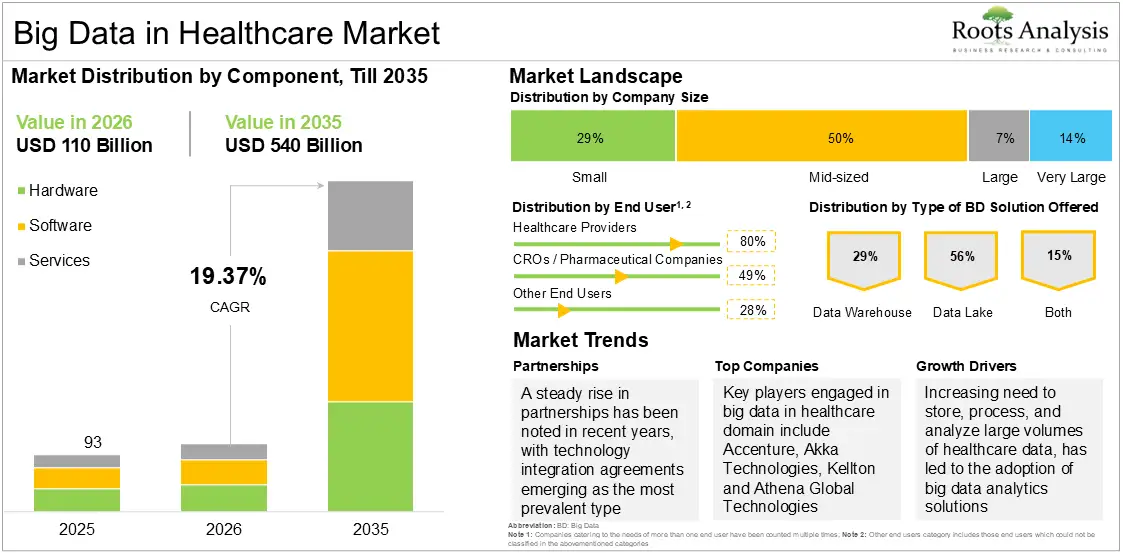
The global big data in healthcare market, valued at USD 93 billion in 2025, is projected to reach USD 110 billion in 2026 and USD 540 billion by 2035, with a 19.37% CAGR during the forecast period 2026 to 2035.
To learn more about this report, request a free sample copy
The new research study consists of current big data in healthcare market trends, detailed competitor’s analysis, key market insights, market impact analysis, and market forecast and opportunity analysis. The growth in the big data analytics in healthcare market size over the next decade is likely to be the result of anticipated increase in adoption of AI-enabled solutions and rise in the demand for personalized medicine.
Big data in healthcare refers to the large amount of unstructured data obtained from various sources, such as medical research / journals, biometric data, electronic medical records, Internet of Medical Things (IoMT), social media, payer records, omics research and data banks. Integrating this diverse and complex unstructured data into traditional databases poses a significant challenge in terms of data structuring and standardization, which is essential to ensure compatibility and enable effective analysis.
However, recent advancements in big data analytics tools, artificial intelligence, and machine learning have revolutionized the conversion of big data in healthcare into valuable and actionable information. These technological breakthroughs have revolutionized various aspects of healthcare, enabling data-driven decision-making, improving diagnostics, facilitating personalized treatment approaches and empowering patients with self-service options (including online portals, mobile applications, and wearable devices).
Further, big data analytics tools play a crucial role in pharmaceutical R&D by expediting drug discovery and development processes. Driven by the growing demand for business intelligence solutions, surge in unstructured data, and the increasing focus on the development of personalized medicine, the global market for big data in healthcare is poised to experience sustained market growth during the forecast period.
The big data in healthcare market research report presents an in-depth analysis of the various companies that are engaged in the global big data in healthcare industry, across different segments, as defined in the table below:
| Key Report Attribute | Details | |
| Historical Trend | Since 2018 | |
| Forecast Period | 2026-2035 | |
| Future Trend | Till 2035 | |
| Current Market Size | $110 Billion | |
| CAGR | 19.37% | |
| Component |
|
|
| Deployment Option |
|
|
| Application Area |
|
|
| Healthcare Vertical |
|
|
| Economic Status |
|
|
| End User |
|
|
| Geography |
|
|
| Key Companies Profiled |
|
|
| PowerPoint Presentation (Complimentary) |
Available | |
| Customization Scope | 15% Free Customization | |
| Excel Data Packs (Complimentary) |
|
|
One of the key objectives of this market report was to estimate the current market size, opportunity and the future growth potential of the big data in healthcare market, over the forecast period. Based on multiple parameters, likely adoption trends and through primary validations, we have provided an informed estimate on the market evolution during the forecast period, till 2035.
The market report also features the likely distribution of the current and forecasted opportunity within the big data in healthcare market across various segments, such as component (hardware, software and services), type of hardware (storage devices, networking infrastructure and server), type of service (descriptive analytics, diagnostic analytics, predictive analytics, and prescriptive analytics), type of software (electronic health record, practice management software, revenue cycle management software, and workforce management software), deployment option (cloud-based and on-premises), application area (clinical data management, financial management, operational management, and population health management), healthcare vertical (healthcare services, medical devices, pharmaceuticals, and other verticals), end user (clinics, health insurance agencies, hospitals, and other end users), economic status (high income countries, upper-middle income countries, and lower-middle income countries), geography (North America, Europe, Asia, Middle East and North Africa, Latin America and rest of the world), and leading players.
In order to account for future uncertainties associated with some of the key parameters and to add robustness to our model, we have provided three market forecast scenarios, namely conservative, base, and optimistic scenarios, representing different tracks of the industry’s evolution.
The opinions and insights presented in the market report were influenced by discussions held with stakeholders in the industry. The report features detailed transcripts of interviews held with the following industry stakeholders:
Further, all actual figures have been sourced and analyzed from publicly available information forums and primary research discussions. Financial figures mentioned in this market report are in USD, unless otherwise specified.
On the basis of component, the market is segmented into hardware, software, and services.
Based on the big data in healthcare market forecast, the hardware segment dominates (around 40%) the market. This high share is largely due to increasing requirement of strong and reliable hardware infrastructure in healthcare organizations before any software or analytics capability can be effectively deployed. Further, IT procurement heads and infrastructure managers in healthcare prioritize hardware investments to ensure data availability, system uptime, and compliance with data security regulations. In addition, the increasing deployment of connected medical devices, digital imaging systems, and real-time patient monitoring equipment has further expanded the hardware demand across the healthcare industry.
On the other hand, software is likely to grow at a higher CAGR during the forecast period. This growth is driven by the rising adoption of electronic health records (EHRs), practice management tools, revenue cycle management software, and workforce management platforms. As healthcare organizations continue to mature in their data capabilities, software solutions are increasingly seen as the next layer of investment built on top of an established hardware infrastructure.
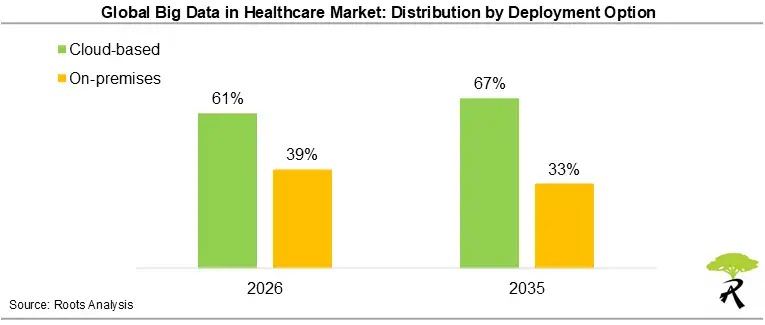
On the basis of deployment option, the global market is segmented into on-premises and cloud-based.
According to our market analysis, the cloud-based deployment mode accounts for the highest (more than 60%) market share. This dominance is due to the rapid adoption of public cloud and software-as-a-service (SaaS) models, across healthcare. Moreover, healthcare organizations are shifting toward this model to leverage its inherent scalability, lower upfront capital costs, and the ability to seamlessly integrate real-time data from telehealth and remote patient monitoring devices.
Notably, the cloud-based segment will continue to grow at the highest CAGR during the forecast period. This can be attributed to the growing availability of healthcare specific cloud solutions with built-in compliance features for regulations such as HIPAA and GDPR, which has further reduced adoption barriers across the healthcare sector. As a result, the accelerating shift toward flexible and scalable infrastructure positions cloud-based deployment as the fastest-growing segment in the market.
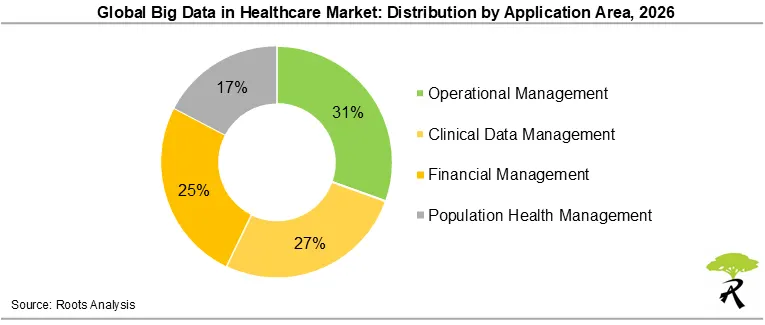
Based on application area, the big data in healthcare market is segmented into clinical data management, financial management, operational management, and population health management.
Currently, the operational management segment captures the majority (around 30%) of the big data in healthcare market share. This leadership is driven by healthcare providers’ growing focus on using data analytics to improve resource utilization, workforce planning, patient flow, and hospital capacity management. As patient volume continues to rise alongside staffing shortages and increasing cost pressures, healthcare organizations are adopting big data platforms to integrate information from electronic health records (EHRs), scheduling systems, financial databases, and connected medical devices.
By consolidating clinical and operational data, these platforms enable hospitals to streamline workflows, optimize asset utilization, reduce operational inefficiencies, and enhance decision-making. They also support value-based care initiatives by improving operational performance while maintaining high-quality patient outcome. As a result, operational management has emerged as one of the most established and widely adopted applications of big data in healthcare.
Among these segments, population health management is likely to grow at a higher CAGR as compared to other application areas in the coming years. This can be attributed to the increasing demand for disease management strategies (which can be facilitated through the implementation of big data) as well as the shifting focus of healthcare industry towards value-based care. Further, healthcare executives and public health leaders are increasingly investing in population health platforms that can aggregate data from multiple sources including claims, clinical records, and social determinants of health to identify at risk groups and design targeted interventions.
Furthermore, the national health programs and accountable care organizations are allocating growing budgets toward population health management tools to reduce avoidable hospitalizations and control long-term care costs. This convergence of policy momentum, chronic disease burden, and value-based reimbursement incentives positions population health management as the most dynamic growth area within the application segment.
On the basis of end users, the global market is segmented across clinics, health insurance agencies, hospitals, and other end users.
According to our report, hospitals segment currently holds the highest market share. This dominance is driven by the large scale integration of clinical and operational analytics to manage complex patient volumes and intensive Electronic Health Record (EHR) data. The growing integration of analytics in healthcare also reflects a primary focus on centralized data governance and the immediate need to optimize multi departmental workflows.
Conversely, the clinics segment is projected to witness the highest CAGR (22.2%) during the forecast period. This rapid growth is fueled by the increasing affordability of cloud-based analytics that allow smaller ambulatory centers to adopt predictive tools for specialized patient care.
This segment highlights the distribution of big data in healthcare market across various geographies, such as North America, Europe, Asia, Latin America, Middle East and North Africa, and rest of the world regions.
According to our projections, the big data analytics in healthcare market in North America accounts 60% of the overall market share, and this trend is unlikely to change in the future. The region benefits from a highly developed healthcare infrastructure, strong government support for health IT adoption, and the presence of leading big data technology vendors headquartered across the US and Canada. Moreover, healthcare organizations in North America operate within a well-defined regulatory environment that mandates digital record-keeping and data reporting, creating a sustained and structured demand for big data solutions.
It is worth highlighting that the market in Asia is expected to grow at a relatively healthy CAGR (21.29%), during the forecast period, till 2035. This rapid growth is fueled by the expanding healthcare infrastructure, rising digital health investments by governments across China, India, and Asian nations. In addition, the growing middle-class population seeking improved healthcare access are collectively driving strong market momentum in the region. The combination of favorable government digitization policies and increasing private sector participation are the key reasons for the highest CAGR of this region.
The “The “Big Data in Healthcare Market’’, till 2035: Industry Trends and Global Forecasts” report features an extensive study of the current market landscape, market size and future opportunities within the big data in healthcare market, during the given forecast period. The market report highlights the efforts of several stakeholders engaged in this rapidly emerging market segment of the healthcare industry. Key takeaways of the big data analytics in healthcare market report are briefly discussed below.
The emerging applications of big data analytics in healthcare market are transforming the way healthcare is delivered, offering numerous benefits and opportunities. By harnessing the power of big data, healthcare professionals can gain valuable insights and improve various aspects of patient care. Big data analytics tools facilitate the development of personalized medicine by analyzing patient data to identify patterns and make precise diagnoses. It also allows disease prevention and early intervention through predictive analytics, helping to mitigate risks and improve population health. Additionally, big data analytics solutions play a crucial role in optimizing healthcare operations, resource allocation, and improving patient outcomes.
The current market landscape features the presence of over 405 companies offering a variety of big data analytics services, ranging from consulting, implementation, data management and storage to technical support and component maintenance services. Overall, the big data analytics in healthcare market seems to be well-fragmented, featuring the presence of very small, small, mid-sized, large, and very large companies having the required expertise to offer big data services across different healthcare verticals, including pharmaceutical, medical devices, healthcare services and other verticals. It is worth mentioning that around 65% of the players offering big data analytics services are based in North America.
Stakeholders in the big data analytics industry have forged several partnerships with other healthcare organizations to drive technological advancements in the healthcare industry. In October 2023, Marengo Asia Hospital entered into a strategic partnership with Oracle to adopt Oracle’s enterprise resource planning solution in order to optimize former’s internal processes and obtain a unified view of business operations. Earlier in June 2023, Google Cloud and Mayo Clinic forged an alliance to introduce generative artificial intelligence into the healthcare industry. The primary objectives of this partnership were to enhance clinical workflows, simplify information retrieval for clinicians and researchers, and ultimately improve patient outcomes. Such big data in healthcare market trends are expected to drive market growth during the forecast period.
Several factors, such as the growing need to store, process, and analyze large volumes of healthcare data, have led to the adoption of big data analytics solutions in the healthcare industry. With the advent of digital solutions, including electronic medical records and wearable devices, healthcare organizations are generating large amounts of data on a daily basis.
In fact, on an average, a hospital can generate around 50 petabytes of patient data and operational data per day. Furthermore, the amount of data generated by the healthcare industry is anticipated to grow at an exponential rate, with a CAGR of more than 35% until 2026. The ability to effectively analyze and derive insights from this vast amount of unstructured data is crucial for improving operational efficiency, and decision-making in the healthcare industry.
The focus on population health management is another driver for the big data in healthcare market. As healthcare shifts from a fee-for-service model to a value-based care model, there is a greater emphasis on preventive care and public health. This shift highlights the importance of leveraging big data in healthcare to analyze demographic data, generate insights, and drive positive outcomes for patients.
Additionally, big data analytics plays a crucial role in optimizing care management and addressing the complex issue of social determinants of health. All these factors, along with the increasing adoption of artificial intelligence enabled healthcare solutions are anticipated to fuel the big data in healthcare market growth during the forecast period.
Driven by the rapid advancements in technology and the emerging trend of digital transformation across the healthcare industry, big data in healthcare market is anticipated to grow at an CAGR of 19.06% during the forecast period till 2035. The market growth is primarily fueled by the keenness shown by the healthcare providers to adopt data-driven solutions, coupled with the substantial support and initiatives from governments worldwide.
Examples of key companies engaged in the big data in healthcare industry (which have also been captured in this market report, arranged in alphabetical order) include Accenture, Akka Technologies, Altamira.ai, Amazon Web Services. Athena Global Technologies, atom Consultancy Services (ACS), Avenga, Happiest Minds, InData Labs, Itransition, Kellton, Keyrus, Lutech, Microsoft, Nagarro, Nous Infosystems, NTT data, Oracle, Orange Mantra, Oxagile, Scalefocus, Softweb Solutions, Solix Technologies, Spindox, Tata Elxsi, Teradata, Trianz (formerly CBIG Consulting), Trigyn Technologies, and XenonStack. This market report includes an easily searchable excel database of all the companies offering big data analytics services for a variety of applications in healthcare industry worldwide.
Several recent developments have taken place in the big data in healthcare industry, some of which have been outlined below. These developments substantiate the overall big data in healthcare market trends that we have outlined in our analyses.