
Lowest Price Guaranteed
Pages
447
Last Updated
September 2026
View Count
3203
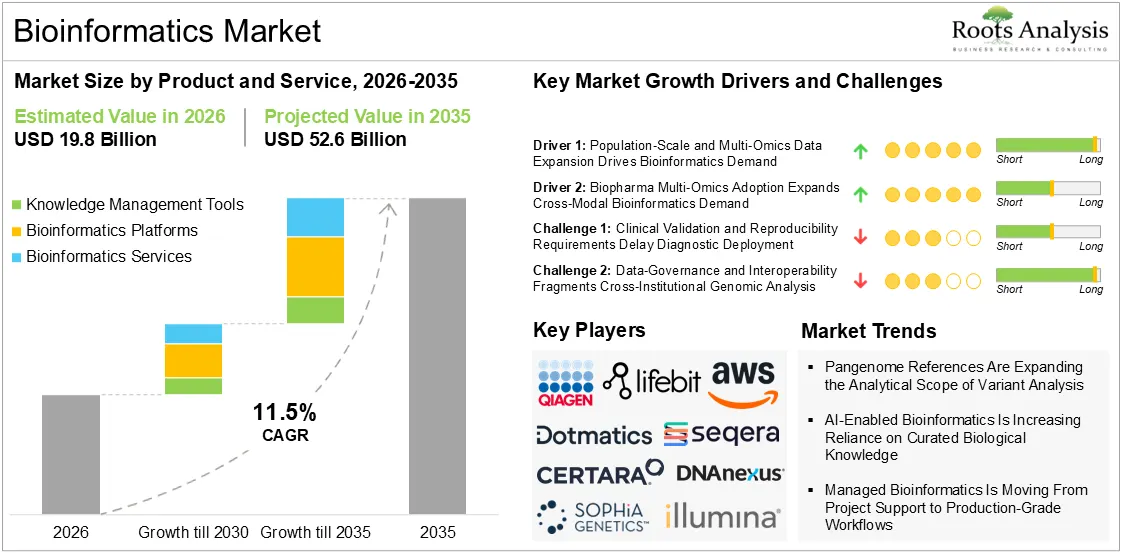
The global bioinformatics market was valued at USD 17.3 billion in 2025 and is estimated at USD 19.8 billion in 2026. It is projected to reach USD 52.6 billion by 2035, representing an 11.5% CAGR from 2026 to 2035. Expanding multi-omics workloads, production-grade analytical workflows and clinical interpretation needs are increasing demand for specialized bioinformatics platforms and services.
To learn more about this report, request a free sample copy
Bioinformatics evolves from stand-alone sequence processing toward integrated analytical environments that connect biological data, curated knowledge, workflow execution and scientific or clinical interpretation. Sequencing remains a foundational input, but the analytical burden is broadening as genomic and transcriptomic data are combined with proteomic, cellular, phenotypic and clinical information. Higher data heterogeneity increases the need for harmonization, provenance, cross-modal analysis and reproducible interpretation. Commercial value is therefore shifting beyond discrete tools toward platforms and services that can manage complex workflows across multiple data types and decision stages.
This shift is also changing purchasing behavior across the market. Pharmaceutical and biotechnology companies use integrated platforms, specialized knowledge and expert services across discovery and translational programs, whereas clinical laboratories require validated pipelines, controlled updates and reliable reporting for patient testing. Large research programs increasingly need secure environments that can analyze distributed datasets without compromising governance, and managed delivery is gaining relevance where internal teams do not want to maintain every orchestration and monitoring layer. The market is consequently expanding around higher-value integration, interpretation and workflow operations, although adoption remains conditioned by data quality, interoperability, reproducibility, regulatory and institutional governance, and the ability to validate evolving analytical methods for high-stakes applications.
Bioinformatics demand is created through interactions among scientific teams, data-producing programs, software and knowledge providers, and specialist service partners. Pharmaceutical and biotechnology teams combine internal expertise with curated knowledge, multi-omics analysis and external interpretation, while hospital laboratories emphasize validated workflows and reporting. Academic groups often mix public resources and open-source tools with commercial platforms when scale or specialist expertise is required.
Because data and analytical responsibility pass between organizations, interoperability, provenance and validation influence which products can fit existing workflows. Suppliers therefore compete on connecting data types, preserving traceability and reducing operational handoffs, not only on algorithm performance. The report covers bioinformatics-specific products and services, whereas wet-lab data generation and generic infrastructure remain outside its scope. The competitive landscape includes providers spanning curated biological knowledge, analytical platforms, clinical interpretation, workflow orchestration and secure research environments.
| Company | Year of Establishment | Headquarters | Bioinformatics Products and Services | Applications | Recent Industry Activity |
| QIAGEN Digital Insights(QIAGEN N.V.) | 2014 | US | Specialized Knowledge Management Tools; Sequence Analysis and Variant Interpretation; Structural and Functional Analysis | Genomics and Transcriptomics; Proteomics; Cheminformatics and Drug Design | QIAGEN and NVIDIA are integrating graph-based AI with curated biomedical knowledge for target and biomarker discovery. |
| SOPHiA GENETICS | 2011 | Switzerland | Sequence Analysis and Variant Interpretation; Multi-Omics Integration; Data Analysis and Interpretation | Genomics and Transcriptomics | Two major U.S. health systems signed to deploy SOPHiA DDM for up to 60,000 patients annually. |
| DNAnexus | 2009 | US | Multi-Omics Integration; Other Bioinformatics Platforms; Cloud and Managed Bioinformatics; Consulting and Custom Development | Genomics and Transcriptomics; Proteomics | DNAnexus and Oracle are integrating genomic interpretation with patient history inside Oracle Health EHR workflows. |
| Illumina (BioInsight / informatics) | 1998 | US | Sequence Alignment and Mapping; Sequence Analysis and Variant Interpretation; Multi-Omics Integration; Cloud and Managed Bioinformatics | Genomics and Transcriptomics; Proteomics | Illumina expanded localized DRAGEN analysis in China through its Bioinformatics Mobile Workstation in July 2026. |
| Amazon Web Services(AWS HealthOmics) | 2006 | US | Cloud and Managed Bioinformatics | Genomics and Transcriptomics | Exact Sciences adopted AWS HealthOmics to modernize and operate production bioinformatics workflows in April 2026. |
| Lifebit | 2017 | UK | Other Bioinformatics Platforms; Cloud and Managed Bioinformatics | Genomics and Transcriptomics | Genomics England selected Lifebit to build its next-generation secure research environment in July 2026. |
Human variant analysis is beginning to adopt pangenome and graph references because a single linear reference cannot represent the full range of population diversity and structural variation. The change expands requirements for mapping, variant calling, annotation and benchmarking, particularly in difficult genomic regions. Evidence of this shift is visible across both research infrastructure and commercial software. Human Pangenome Reference Consortium Data Release 2 broadened the shared reference to 232 individuals, and the 2026 1000 Chinese Pangenome study generated 1,116 diploid assemblies that captured substantial sequence absent from conventional references. Illumina DRAGEN already supports pangenome graph workflows, showing that the reference-model transition is moving into operational analysis. Adoption will remain gradual as established benchmarks and clinically validated pipelines continue to rely on conventional references.
Bioinformatics providers are increasingly pairing AI with curated biological knowledge and provenance-rich datasets rather than treating model output as self-sufficient interpretation. This reflects a practical requirement in target discovery and clinical analysis, where users need traceable biological context to judge whether AI-generated relationships are credible. In May 2026, QIAGEN and NVIDIA announced graph-based AI that combines NVIDIA BioNeMo with QIAGEN curated knowledge bases for disease mechanisms, targets and biomarkers. NIH Bridge2AI is similarly advancing AI-ready datasets, tools and best practices. Together, these initiatives show that AI adoption is increasing the value of curated knowledge, harmonized data and evidence provenance as grounding layers for bioinformatics workflows.
Managed bioinformatics is increasingly being adopted for recurring research and diagnostic workflows that require reliable execution at scale rather than occasional access to cloud computing. The model is gaining traction because orchestration, monitoring, reproducibility and infrastructure management can be standardized across repeated analyses while scientific teams focus on analytical design and interpretation. Exact Sciences' 2026 migration of fragmented in-house workflows to AWS HealthOmics provides direct production evidence of this operating shift, and expanding health-system use of external genomic analytics shows the same pattern in clinical settings. Managed delivery therefore represents a change in how bioinformatics operations are run, with external platforms taking on more workflow execution even as laboratories retain responsibility for validation, governance and analytical quality.
Clinical laboratories are integrating bioinformatics, advanced analytics and AI more directly into molecular testing as assays generate more complex data and interpretation requirements. The shift makes analytical infrastructure part of test development and clinical production rather than a downstream support layer. MD Anderson's January 2026 collaboration with SOPHiA GENETICS to develop bioinformatics pipelines and an NGS oncology test illustrates this convergence between assay design, molecular interpretation and computational workflow. Donna Hansel, M.D., Ph.D., Division Head, Pathology and Laboratory Medicine at MD Anderson, stated:
"Our collaboration with SOPHiA GENETICS reflects how our lab is evolving and integrating advanced analytics and AI to better interpret complex molecular information."
Primary research discussions with multiple stakeholders in this domain influenced the opinions and insights presented in this study. The bioinformatics market report includes transcripts of the following discussions:
In addition, the bioinformatics report includes transcripts of the following third-party discussions:
Based on the research, we have segmented the bioinformatics market into various key segments outlined below.
| Market Segments | Sub-segment Details | |
| Products and Services | Knowledge Management Tools; Bioinformatics Platforms; Bioinformatics Services | |
| Type of Knowledge Management Tools | Generalized Knowledge Management Tools; Specialized Knowledge Management Tools | |
| Type of Bioinformatics Platforms | Sequence Analysis and Variant Interpretation; Sequence Alignment and Mapping; Sequence Manipulation; Structural and Functional Analysis; Multi-Omics Integration; Other Bioinformatics Platforms | |
| Type of Bioinformatics Services | Data Analysis and Interpretation; Database Construction, Curation and Management; Cloud and Managed Bioinformatics; Consulting and Custom Bioinformatics Development; Other Services | |
| Application | Genomics and Transcriptomics; Proteomics; Metabolomics; Cheminformatics and Drug Design; Molecular Phylogenetics; Others | |
| Use Case | Drug Discovery and Development; Precision Medicine; Clinical Diagnostics; Biomarker Discovery; Research and Academic Use; Other Use Cases | |
| End User | Pharmaceutical and Biotechnology Companies; Academic and Research Institutes; Contract Research Organizations (CROs); Hospitals and Clinical Diagnostic Laboratories; Others | |
| Geography | North America; Europe; Asia-Pacific; Latin America; Middle East and Africa | |
Regional Outlook: North America Maintains Market Depth While Asia-Pacific Builds New Bioinformatics Capacity
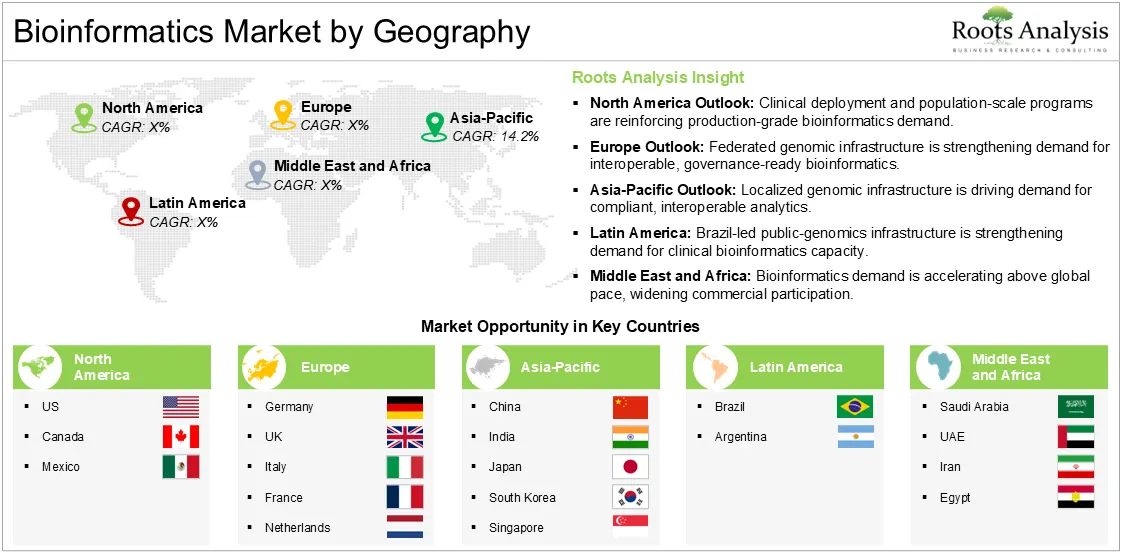
North America accounts for 40.0% of the global bioinformatics market in 2026, supported by the concentration of pharmaceutical R&D, established bioinformatics suppliers, population-scale genomic programs and increasing use of genomic analysis in clinical settings. Large research infrastructures are also becoming more analytically intensive as genomic information is linked with health records and additional molecular data. The All of Us Research Program now combines population-scale whole-genome and clinical datasets, while rising US genomic-analysis volumes indicate that bioinformatics is increasingly moving into recurring operational use. Canada is reinforcing this regional base through national precision-health infrastructure. The combination gives North America a comparatively mature commercial environment in which research, drug development and clinical programs already generate sustained demand for platforms, knowledge resources and analytical services.
Asia-Pacific is projected to record the fastest regional growth at 14.2% CAGR through 2035 as genomic infrastructure is being developed simultaneously across research, healthcare and nationally governed data environments. GenomeIndia has established a whole-genome resource covering more than 10,000 individuals, Australia has committed up to A$74 million to genomics health research, and China is implementing federated analysis models aligned with national data rules. Japan is also advancing GA4GH-aligned genomic knowledge infrastructure. These developments are extending the number of institutions capable of generating and using large biological datasets, while local governance requirements are increasing the need for secure and interoperable analytical environments. With commercial bioinformatics penetration still less mature than in North America, this infrastructure buildout creates substantial room for new platforms, service and locally compliant deployment demand.
Bioinformatics platforms dominate the global market in 2026, reflecting their position as the key reusable execution layer across sequence analysis, variant interpretation, structural and functional analysis and increasing multi-omics workflows. Once implemented, platforms can standardize analytical pipelines and support repeated processing across larger datasets without requiring specialist labor to increase at the same pace as analytical volume. This makes software-based execution suitable for recurring research, drug-development and clinical workflows in which reproducibility and throughput are increasingly important. Current informatics portfolios from Illumina, SOPHiA GENETICS and DNAnexus illustrate the breadth of this operating role, extending from secondary analysis and interpretation to integrated multi-omics environments. The category's current scale therefore reflects the depth with which repeatable software workflows are already embedded across the bioinformatics lifecycle.
Bioinformatics services are projected to record the fastest growth (higher CAGR) during the period 2026-2035 as increasing analytical complexity reinforces the need for specialized implementation, validation, interpretation and managed operation. Organizations increasingly require specialist support for pipeline development, implementation, validation, interpretation and ongoing workflow operation, particularly when internal bioinformatics teams are limited or analytical systems must operate reliably at production scale. Managed execution is also converting some infrastructure and orchestration responsibilities into recurring external service requirements. The Exact Sciences deployment of AWS HealthOmics illustrates this shift from fragmented internal workflow management toward externally operated bioinformatics infrastructure. As datasets become more heterogeneous and analytical environments more operationally demanding, a larger proportion of bioinformatics spending is therefore becoming addressable through specialist and managed services.
Sequence analysis and variant interpretation segment hold the largest bioinformatics platforms share in current year, supported by the long-established role of sequencing in oncology, inherited disease, population genomics and biomedical research. The category occupies a high-value analytical stage where processed sequence data are converted into variants, annotations and biologically interpretable findings that can inform downstream research or clinical decisions. Its installed workflow base is reinforced by recurring genomic-analysis volumes and continued investment in interpretation software. SOPHiA GENETICS reported substantial analysis activity in early 2026, while Illumina continues to extend variant-analysis and interpretation functionality across its informatics portfolio. This maturity, combined with the breadth of sequencing applications already in routine use, sustains the category's largest current platform revenue base.
Multi-omics integration is projected to expand fastest within bioinformatics platforms at a higher CAGR as analytical questions increasingly require genomic, transcriptomic, proteomic and other molecular layers to be interpreted together. The value of these platforms lies not simply in handling additional data types, but in preserving biological relationships across datasets that would otherwise be processed in separate analytical environments. Integrated platforms reduce handoffs between separate tools and preserve relationships across data types, which is increasingly important for target discovery, biomarker research and translational analysis. Illumina Connected Multiomics and DNAnexus provide current examples of platforms built for cross-modal analysis, while UK Biobank's population-scale proteomics expansion is increasing the volume of non-genomic data that must be integrated with existing genomic resources. The integration layer therefore captures a growing share of incremental platform demand as multi-omics analysis moves from specialist projects toward broader research workflows.
Data analysis and interpretation, currently, dominates the bioinformatics services revenue, reflecting its role at the point where computational outputs are converted into biologically or clinically actionable findings. Complex genomic and multi-omics workflows frequently require specialist interpretation to relate variants, pathways and molecular signals to disease context, phenotype and supporting evidence. This creates a broader and more persistent service requirement than database management or implementation-led assignments alone. The requirement is particularly pronounced in clinical bioinformatics, where analytical interpretation operates alongside validation, technical management and controlled production processes. A 2025 Genome Medicine consensus involving 13 clinical bioinformatics units identified these competencies as integral to production practice, supporting the continued concentration of specialist service demand in analysis and interpretation.
Cloud and managed bioinformatics is projected to expand fastest within bioinformatics services at a 20.2% CAGR as organizations externalize workflow orchestration, monitoring and scalable execution. Managed environments allow repeated pipelines to run with standardized infrastructure and observability, reducing the operational burden of maintaining separate systems for growing sample volumes. Exact Sciences' use of AWS HealthOmics to replace fragmented in-house bioinformatics infrastructure provides direct evidence of this model in production. As research and diagnostics shift toward recurring workflows, managed delivery captures a larger share of the operational work required to keep analytical pipelines available and reproducible.
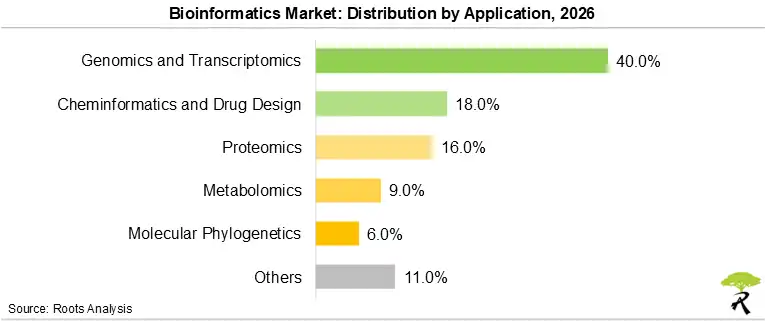
The genomics and transcriptomics application segment represents 40.0% of the global market in 2026, supported by the long-established use of sequence-derived analysis across population studies, drug discovery and clinical testing. Mature reference resources, reusable pipelines and extensive variants and transcript interpretation infrastructure make these applications a recurring source of bioinformatics demand. NIH reported in June 2026 that All of Us had released more than 535,000 whole-genome sequences linked with nearly 482,000 electronic health records. Programs of this scale illustrate the institutional depth of genomics analysis and the continuing need for software, knowledge resources and analytical services.
Proteomics is projected to grow at a faster rate (CAGR) as high-throughput protein measurement expands, and biopharma increasingly uses protein-level signals to connect molecular mechanisms with phenotypes. Larger proteomic datasets require normalization, annotation, pathway analysis and integration with genomic and clinical information. UK Biobank is scaling measurements to as many as 5,400 proteins across 600,000 samples, creating a population-scale analysis requirement. Illumina's SomaLogic acquisition further links proteomic data with broader informatics capabilities, reinforcing the shift toward integrated protein and multi-omics analysis.
Drug discovery and development capture a larger share of the global market in 2026 because bioinformatics is applied repeatedly across target identification and validation, biomarker discovery, patient stratification and translational analysis. Each stage generates distinct analytical requirements, which sustains demand for curated knowledge, platforms and specialist interpretation throughout the R&D lifecycle. The Billion Cell Atlas, with AstraZeneca, Merck and Eli Lilly as founding pharmaceutical participants, demonstrates current industry use of large human biological datasets for target validation and AI model development. This breadth of use supports the category's largest current revenue share.
Clinical diagnostic is projected to expand fastest among use cases at a higher CAGR as genomic analysis moves into recurring patient-testing workflows. Routine testing requires validated pipelines, controlled changes, reproducible interpretation and clinically usable reporting, which creates ongoing demand for bioinformatics platforms and specialist services once assays enter production. SOPHiA GENETICS' 2026 agreements with two integrated US health systems envisage genomic testing for up to 60,000 patients annually. Such deployment scale shows how bioinformatics demand is becoming embedded in operational diagnostic pathways rather than remaining confined to exploratory analysis.
Federated bioinformatics expands access to protected genomic and clinical datasets by moving approved analytical workflows to the data instead of requiring participating institutions to centralize sensitive information. This approach is becoming relevant for multi-institution and cross-border research because it preserves local data control while still enabling shared analysis. The European Genomic Data Infrastructure is building federated access to genomic, phenotypic and clinical data across Europe, providing current evidence that analysis-to-data models are progressing from standards development toward operating research infrastructure. As adoption expands, demand can emerge for trusted research environments, federated workflow execution, identity and access management, auditability and interoperable metadata as dedicated bioinformatics capabilities.
The opportunity will depend on whether providers can make federated environments practical across different policies, institutions and scientific workflows. Scalable offerings will require common standards, reproducible execution, policy-aware access controls, discoverability and sustainable operating models. If these capabilities mature, federated bioinformatics can support larger cross-border cohorts, rare-disease research, multi-center studies and population genomics without forcing sensitive datasets into a single repository. That creates a distinct future market for orchestration, interoperability and managed governance services designed specifically for distributed biomedical analysis.
This study assesses third-party commercial revenue from bioinformatics-specific knowledge products, software platforms and analytical, implementation, interpretation and managed services. Research draws on the Roots Analysis proprietary dataset repository, primary research inputs, company disclosures, government and regulatory sources, peer-reviewed literature, institutional programs and other authoritative industry evidence. Quantitative estimates were developed through structured secondary research, supplier and demand-side triangulation and cross-checking of adoption, technology, segment and regional indicators, with forecasts reflecting the expected evolution of market drivers, constraints and commercial participation through 2035. For further details, see the complete research methodology adopted by Roots Analysis across its market reports.
| Key Report Attributes | Details | |
| Historical Trends | Since 2022 | |
| Forecast Period | Till 2035 | |
| Market Size 2026 | USD 19.8 Billion | |
| Market Size 2035 | USD 52.6 Billion | |
| CAGR (till 2035) | 11.5% | |
| Key Companies Profiled | QIAGEN Digital Insights, SOPHiA GENETICS, DNAnexus, Illumina, AWS HealthOmics, Lifebit, Dotmatics (Siemens), Certara, Oracle Health, Seqera, Velsera, Thermo Fisher Scientific | |
| PowerPoint Presentation (Complimentary) | Available | |
| Customization Scope | 15% Free Customization Available | |
| Excel Data Packs (Complimentary) |
|
|