
Lowest Price Guaranteed
Slides
237
Last Updated
July 2026
View Count
11499
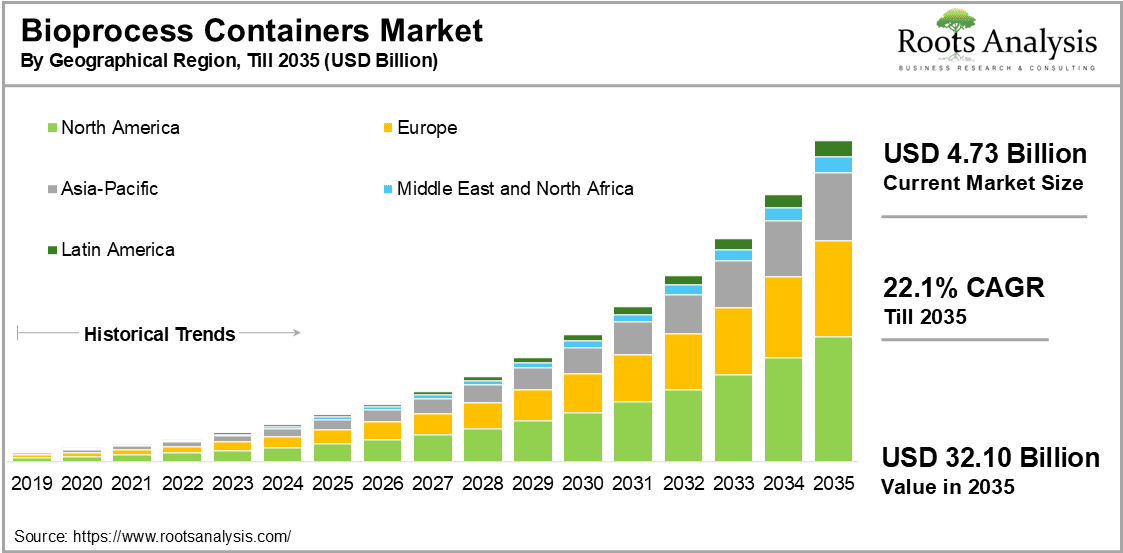
The global bioprocess containers market size is estimated to grow from USD 4.73 billion in 2025 to USD 32.10 billion by 2035, representing a compounded annual growth rate (CAGR) of 21.1% during the forecast period.
 |
To learn more about this report, request a free sample copy
Bioprocess containers refer to the form of vessels used to store, handle liquid volume and transport drugs safely. These specialized vessels also help to handle large volumes of biological materials such as buffers, cell culture and media, to ensure viability and integrity of materials throughout the manufacturing processes. With growing demand for biologics for the treatment of chronic conditions, there has been a surge in the demand for specialized containers that help to maintain drug viability. Notably, biologics are highly complex and sensitive; these products can easily degrade on encountering external stimuli such as temperature, pH and moisture.
Owing to its highly sensitive nature, these biologics require specialized containers that allow drug storage and transportation with higher efficacy and safety. Further, the stringent guidelines associated with packaging of small molecule drugs has further heightened the demand for bioprocess containers. It is important to highlight here that bioprocess containers are also used for applications such as cell cultivation, harvesting and storing sensitive biologics substances while manufacturing drugs such as monoclonal antibodies and vaccines. Moreover, the growing preferences for single-use bioprocessing technologies to reduce the risk of cross-contamination and requirement of sterilization has further supported the demand for bioprocess containers. Some of the recently launched bioprocess containers are Ultimus™ (Merck), and AllpaQ 500 PLUS Bioprocess Containers.
In order to meet the growing demand, several industry players including Danaher, Merck and Thermo Fisher Scientific are accelerating their efforts for the manufacturing of advanced bioprocess containers. However, their primary focus is on customization of bioprocess containers and cost reduction to make it sustainable for biopharmaceutical industries. It is important to highlight here that in May 2024, Novo Holdings announced the acquisition of 60% controlling stakes in Australia based company Single Use Support that provides advanced technology solutions including bioprocess containers and single use processing technologies for supporting pharmaceutical production process. As more companies proliferate in the market, we believe the bioprocess containers market will grow substantially during the forecast period.
The market research report presents an in-depth analysis of various industrial players that are involved in global bioprocess container industry, across different segments, as defined in the table below:
| Key Report Attributes | Details | |
| Historical Trend | Since 2019 | |
| Forecast Period | Till 2035 | |
| Market Size 2035 | $32.10 Billion | |
| CAGR (Till 2035) | 21.1% | |
| Type of Container |
|
|
| Type of Application |
|
|
| End Users |
|
|
| Geographical Regions |
|
|
| Key Companies Profiled |
|
|
| PowerPoint Presentation (Complimentary) |
Available | |
| Customization Scope | 15% Free Customization | |
| Excel Data Packs (Complimentary) |
Available | |
One of the key objectives of the bioprocess containers market report was to estimate the current size, opportunity and the market growth potential, over the forecast period, till 2035. We have provided informed estimates on the likely evolution of the market for the forecast period.
The market analysis also features the likely distribution of the current and forecasted opportunity within the market distributed across various segments, such as type of container (2D bioprocess containers, 3D bioprocess containers, other containers & accessories), type of application (upstream processes, downstream processes, and process developments), by end user (pharmaceutical & biopharmaceutical companies, contract research organizations & contract manufacturing organizations, academic & research institutes and other end users), geographical region (North America, Europe, Asia-Pacific, Middle East and North Africa, and Latin America) and leading players.
In order to account for future uncertainties associated with some of the key parameters and to add robustness to our model, we have provided three market forecast scenarios, namely conservative, base, and optimistic scenarios, representing different tracks of industry’s evolution.
All actual figures have been sourced and analyzed from publicly available information forums and primary research discussions. The financial figures mentioned in this market report are in USD, unless otherwise specified.
Based on the type of bioprocess container, the global market is segmented into 2D bioprocess containers, 3D bioprocess containers, and other containers & accessories. Among these, 2D bioprocess containers occupies the highest share (45%) of the market. This dominance is due to the fact that 2D bioprocess containers are widely adopted in biopharmaceutical industry for drug storage, fluid management, and cell culture media preparation. Moreover, the growing demand for biologics and cell-based therapies has further fueled the demand for bioprocess containers.
It is important to highlight here that in future 3D bioprocess containers market segment will grow at a higher CAGR during the forecast period. This can be attributed to the numerous benefits offered by the 3D containers such as adaptable designs, fast prototyping and high computability to support wide range of bioprocessing materials.
This segment highlights the distribution of the market across different type of applications, such as upstream processes, downstream processes, and process developments. Currently, upstream process accounts for the largest bioprocess containers market share (nearly 40%). This is due to the fact that bioprocess containers offer highly flexibility in media preparation, cell culturing and higher scalability for large scale production. Furthermore, the growing advancements in cell line development, fermentation technologies and rising demand for biologics has further heightened the demand for bioprocess containers for upstream processes. Owing to the growing usage for upstream processes, this segment will continue to dominate the market and is expected to grow at a higher CAGR during the forecast period.
Based on the end user, the global market is segmented into pharmaceutical & biopharmaceutical companies, contract research organizations & contract manufacturing organizations, academic & research institutes and other end users. It is worth mentioning here that pharmaceutical and biopharmaceutical companies currently hold the largest bioprocess containers market share (nearly 40%), driven by the rising research and development of advanced cell-based therapies and biologics. Moreover, the stringent guidelines provided by the regulatory authorities for the development of drugs has mandated the bioprocess containers to ensure safety of the drugs during transportation and storage.
However, it is important to highlight here that the demand for bioprocess containers has significantly increased in contract research organizations & contract manufacturing organizations. This can be attributed to the growing shift towards outsourcing of drug manufacturing which necessitated the demand for bioprocess containers. Owing to the ongoing demand, this segment is expected to grow at a higher CAGR during the forecast period.
The global bioprocess containers market value is distributed across different geographical regions, such as North America, Europe, Asia-Pacific, Middle East and North Africa, and Latin America. According to our projection, North America occupies the largest share (39%) of the market. This can be attributed to the growing number of pharmaceutical and biotech companies as well as contract manufacturers based in the region. Additionally, a number of bioprocess bag suppliers are also based in North America.
However, in Asia-Pacific, the market for bioprocess containers is likely to register a higher CAGR during the forecast period. This substantial growth is due to the heightened requirement of biologics, setting up of biologics manufacturing facilities in the region and ongoing research and development activity by industrial players.
The “Bioprocess Containers Market: Industry Trends and Global Forecast, till 2035” market report features an extensive study of the current market landscape, market size and future opportunity within the bioprocess containers industry, during the given forecast period. The market report highlights the efforts of several stakeholders involved in this rapidly emerging segment of the life sciences industry. Key takeaways of the research report are briefly discussed below.
Presently, the market landscape of bioprocess containers is moderately competitive, witnessing the presence of several small, mid-sized and large industrial players. Notably, with growing demand for bioprocess containers in biopharmaceutical industry for drug storage, several industrial players are increasing their operational efficiencies and leveraging technological advancements to enhance their product portfolio. Some of the notable examples of leading players of this industry are Danaher, Sartorius Stedim Biotech and Thermo Fisher Scientific.
It is important to highlight here that in April 2022, Thermo Fisher Scientific opened its 55,000 sq. feet single-use technology facility in Ogden which is dedicated to single-use bioprocess containers. This single-use technology facility in Ogden is worth USD 44 million and is a part of its long-term investment USD 650 million. Driven by the ongoing investments in this field, we believe that the market will remain competitive, offering lucrative opportunities to industrial players for strategic innovations.
One of the major trends that are likely to propel the bioprocess containers market is growing demand for biopharmaceuticals to treat broad range of disease indication. Notably, the biopharmaceutical drugs such as gene therapies, vaccines, antibodies and cell-based therapies are prone to degradation when comes in contact with external environment. These bioprocess containers have been designed to store biologics efficiently and prevent spoilage. Furthermore, single-use technologies reduces the risk of contamination, which further enhanced the adoption of bioprocess containers. In addition to high demand for biopharmaceuticals, the growing research and development of advanced therapeutics has underscored the requirement for bioprocessing containers.
Some of the challenges that are hindering the market growth during the projected period included stringent guidelines and challenges in freezing large volumes in controlled environment. Notably, the stringent guidelines associated with approval of bioprocess containers may create challenges for the market players. It is important to highlight here that single-use bioprocess containers lead to the generation of large amounts of single-use plastic waste, which creates difficulties in recycling materials. Moreover, freezing large volumes of liquid in bioprocess containers requires a controlled environment, which can be difficult to maintain.
Some of the notable trends that are likely to drive the market during the forecast period include increasing popularity of personalized medicine and proliferation of biomanufacturing. It is worth noting that personalized medicines, cell-based therapies and gene therapies require specialized conditions to store and transport, which further raised the demand for bioprocess containers. Furthermore, the high demand for microfluidics and organoids has further bolstered the requirement for bioprocess containers.
Furthermore, companies have reported a challenge with bag leaks, leading to cost associated with product wastage. To overcome this challenge the stakeholders in the industry are working towards the development of novel materials or coatings to make the bags and assemblies leak proof. In April 2023, Merck announced the launch of Ultimus® single-use process container film, which offers higher abrasion resistance. The company’s Mobius® 3D process containers also use film technology. Additionally, the major polymers used for manufacturing of bioprocess containers are Polyvinyl Chloride (PVC), Ethylene vinyl acetate (EVA) and Polyethylene (PE) films. Thermo Fisher Scientific launched its biobased film for bioprocess containers keeping the rising focus on sustainability in mind.
The global market for bioprocess containers is currently valued at USD 4.73 billion and is expected to reach at USD 32.10 billion by 2035. This unprecedented growth is likely to be the result of rising preferences for biologics that require specialized bioprocess containers to store these drugs. Furthermore, the rising strategic initiatives by industrial players for driving innovation in this field has contributed to the growth of this market.
As stated by Ray Mercier, president of Thermo Fisher’s single-use technologies business “Biopharma manufacturers are focused on maximizing productivity, accelerating time-to-market and generating efficiencies all while improving the overall sustainability of their operations”. These goals will create opportunities for the bioprocess container manufacturers and drive the bioprocess containers market growth over the forecast period.
Examples of key players engaged in this domain (which have also been captured in this report) include Avantor, ABEC, Antylia Scientific, Celltainer Biotech, Cellexus, Corning, Cesco Bioengineering, Danaher, Entegris, Foxx Life Sciences, Flexbiosys, Fujimori Kogyo, Keofitt, Lonza, Merck, Michelin Group, Parker Hannifin, Solida Biotech, Saint-Gobain, Satake Chemical Equipment, Stobbe Pharma, Shanghai Lepure Biotech, Sartorius Stedim Biotech, Thermo Fisher Scientific. This market report includes an easily searchable excel database of all the companies focusing on the development of single-use bioprocess containers.
Several recent developments have taken place in the bioprocess containers industry. We have outlined some of these recent initiatives below.