


 Download Free Sample
 Buy Now
Market Size
The cell line development market size valued at USD 1.46 billion in 2025, is project to reach USD 1.69 billion in 2026 and USD 4.50 billion by 2035, representing a higher CAGR of 11.5% during the forecast period 2026 to 2035.

See What’s in the Full Report–Request Your Complimentary Insights!
Market Report: Key Takeaways
- In terms of source of cell line, mammalian cells segment dominates the market with a 74% revenue share due to their critical role in producing complex proteins, monoclonal antibodies, and cell- and gene-based therapies.
- In terms of application, biomanufacturing applications account for the largest share (87%) in the current year, fueled by the rising demand for biopharmaceuticals for chronic disease treatment.
- Notably, mid-sized players lead the market with a 39% share currently, supported by growing collaborations, dedicated resources, and strong capabilities in cell line development.
- In terms of geography, North America is capturing around 40% of the market share, maintaining its dominant position in the global market. The region is projected to grow at a CAGR of 13%, driven by the presence of major biopharma companies, substantial R&D investments, and established regulatory standards that support cell line development.
Market Overview
Cell line development is a crucial process in biopharmaceutical and biotechnology research, involving the creation of stable cell lines that are capable of producing specific biologics or therapeutic proteins of interest. This process typically begins with the transfection of selected host cells, such as Chinese Hamster Ovary (CHO) or HEK 293 cells, with desired plasmids encoding the target protein. Majority of the biologics are produced using engineered CHO cell line.
Other key steps involved in cell line development include gene cloning and transfection, clone selection, and confirmatory analytics, as well as cell line characterization, expansion, and downstream evaluation. It is a complex and labor-intensive process that requires careful selection and validation of high-producing clones to ensure the quality and consistency of biologic products. Additionally, single-cell cloning to achieve monoclonality for biologics is an important requirement. Technological advancements such as site-specific integration, cell sorting technology and use of AI for real-time analysis are supporting cell line development.
The rising demand for cell lines for the development and production of biologics, including monoclonal antibodies, bispecific antibodies, recombinant proteins, and vaccines, is likely to drive cell line development market growth in the coming years. Additionally, cell lines are crucial tools used in academic and research organizations to conduct basic research, experimentation, and collaborative projects, further contributing to the market's expansion. The growth of the market is likely to be the result of the growing prevalence of chronic diseases and increasing demand for cell line development services for biopharmaceutical production.
Currently, biopharmaceutical companies are witnessing a rapid surge in the demand for biologics to treat a broad range of chronic diseases. These cell lines play an essential role in the production of various biologics, thereby urging several researchers to explore advanced technologies to boost the production of cell lines.
See What’s in the Full Report–Request Your Complimentary Insights!
Recent Developments in Cell Line Development Market
- In April 2026, OneCyte entered into a collaboration with Kemp Proteins in order to accelerate high-performance cell line development services for biopharmaceutical companies worldwide, combining single-cell analysis and protein engineering to streamline biologics production pipelines.
- In March 2026, Earendil Labs entered into a collaboration with WuXi Biologics in order to develop and manufacture bispecific/multispecific antibodies and ADCs targeting autoimmune diseases and cancer from Earendil's AI-generated pipeline.
- In May 2025, AGC Biologics collaborated with Novelty Nobility to develop cell line and master cell bank using CHEF1 platform for a bispecific antibody candidate.
Pay Only for What You Need–The Best Way to Optimize
Market Trends
- Partnerships and Collaborations: Cell line development service providers have forged several partnerships with other stakeholders to enhance their service portfolios. In a recent instance, Cytiva collaborated with Asimov, a US based synthetic biology company, to provide its customers with access to full suite of cell line development and cell culture services. Notably, in the last few years, companies based in North America and Europe have inked close to 50% of these partnerships to strengthen their cell line development capabilities.
The market is witness to several partnerships between biotech companies and cell line development companies. In May 2025, Novelty Nobility partnered with AGC Biologics for cell line development and master cell bank (MCB) development for its antibody drug conjugate, currently looking to enter phase I clinical trials. AGC Biologics will use its CHEF1 expression platform for cell line development.
- AI Integration: Cell line development companies are evaluating the latest technology such as deep learning for improving the time needed for cell line development. A German biopharmaceutical company, Eleva Biologics, has evaluated the integration of deep learning model for screening constructs for cell line development, reducing the time taken from months to days. In September 2025, Cytiva collaborated with WhiteLab Genomics to enable selection of stable cell line clones with the use of computer simulations.
As stated by Benjamin Fode, Head of genetic engineering, Eleva Biologics “The key point to take away is that we would have chosen the same constructs as the deep learning prediction model, and the outcome was comparable to what we get from four months’ wet lab work.”
Industry Experts on Cell Line Development Market
Discussions with multiple stakeholders in this domain influenced the opinions and insights presented in this study. The market report includes detailed transcripts of interviews conducted with the following individuals:
- Chief Executive Officer, Small Company in the UK
- Founder and President, Mid-sized Company in China
- President, Small Company US
- Former Vice President Bioprocessing, Large Company in the US
- Founder and Managing Director, Small Company in Germany
- Director, Business Development and Marketing, Mid-sized Company in France
- Former Business Development Manager, Large Company in Germany
- Principal Scientist and Head, R&D, Mid-sized Company in India
- Principle Scientific Advisor, Large Company in Germany
- Client Relations Manager, Mid-sized Company in the US
Cell line development domain will mark a turning point in 2025. Adam Causer, (Global Product Manager, Advanced Instruments), states, “Automation has fundamentally transformed cell screening in CLD by incorporating sophisticated imaging technologies and artificial intelligence, allowing for the high-throughput analysis of cellular images and enabling the detection of subtle phenotypic differences for selecting the most promising clones. AI-driven systems are particularly adept at reducing human error and bias in image interpretation, which enhances the consistency and reliability of the screening outcomes.”
Market Share Insights
Market Share by Source of Cell Line: Mammalian Cells Holds the Largest Share
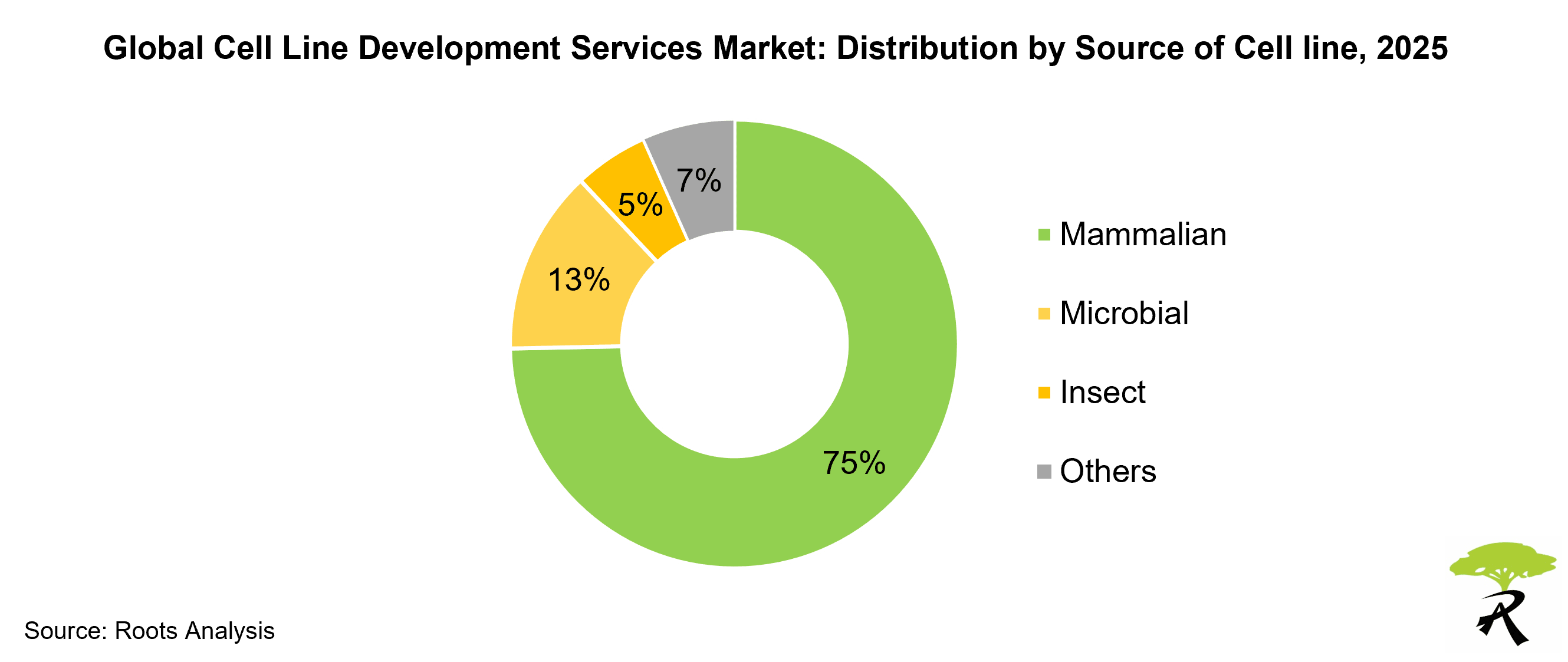
- Based on the source of cell lines, mammalian cells currently capture the highest market share (75%) by revenue. Since mammalian cell lines are the starting material for several biotherapeutic products, such as complex proteins, monoclonal antibodies, and cell and gene therapies. Additionally, these cell lines play a critical role in the development of precision medicines, which require extensive characterization to ensure their quality and safety.
- According to the cell line development market analysis, microbial cell segment is likely to be the fastest growing segment in this industry. The factors for highest share include the various benefits of these cell lines, including simple culture requirements, rapid growth, easy genetic manipulation and cost effectiveness.
Your Business is Unique – Why Shouldn’t Your Report Be?
Market Share by Application of Cell Line: Biomanufacturing Applications Holds the Largest Cell Line Development Market Share
- Based on the application of cell lines, biomanufacturing applications dominate the market by capturing 87% of the overall revenue share. This is the consequence of the high demand for therapeutics for the treatment of chronic diseases, and the biopharmaceutical industry is heavily reliant on the use of well-characterized and reproducible cell lines for producing therapeutics.
- The research and development sub segment is likely to be the fastest growing segment in this industry. This is the consequence of the fact that cell lines in research are used for various experiments, including the study of different cellular mechanisms, exploring several genotypic characteristics and understanding disease mechanics.
Market Share by Company Size: Mid-sized Players Holds the Largest Share
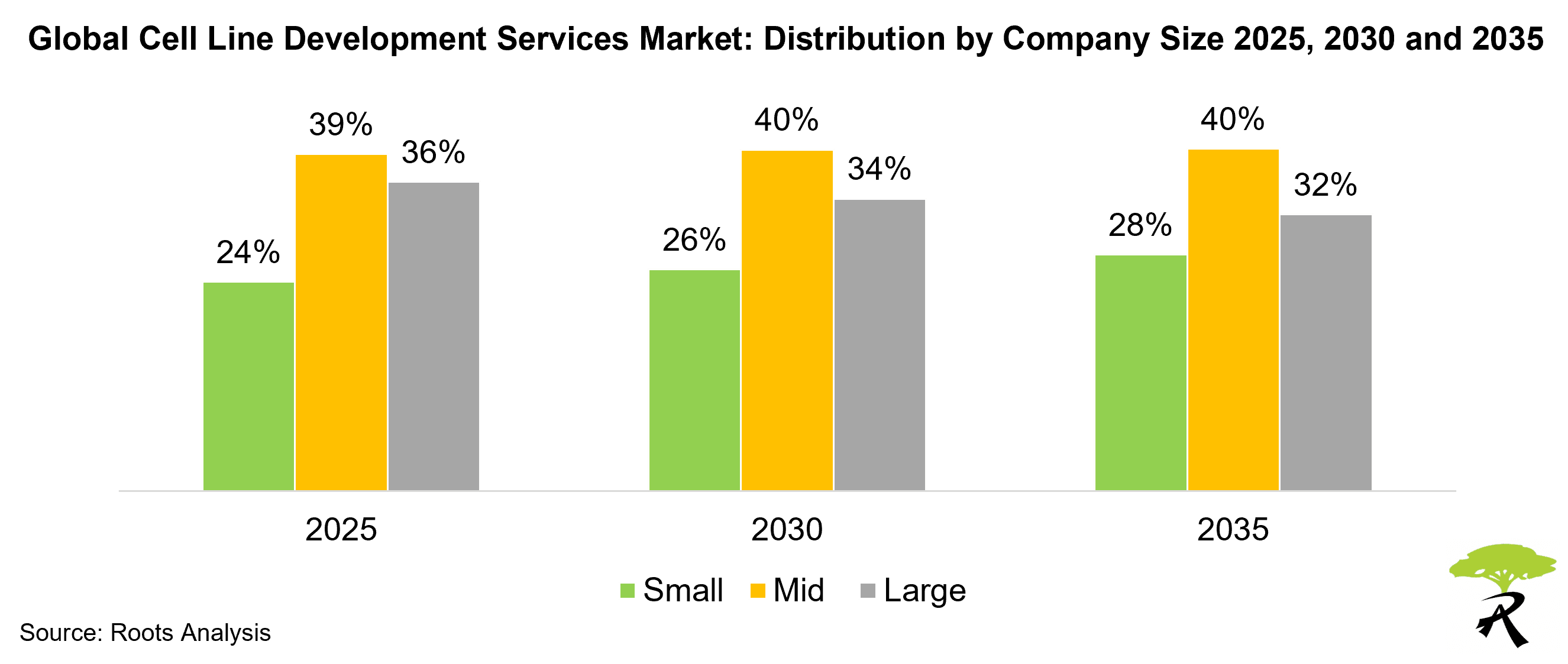
- Based on the company size, mid-sized players currently dominate the cell line development services market by capturing 39% of the overall revenue share. This is a consequence of the rise in collaborations inked by mid-sized players with other stakeholders to enhance cell line development technologies / capabilities, and dedicated resources (for the development of cell lines and identifying improvement opportunities) and capabilities possessed of these players.
- Mid-sized companies have shown significant potential to drive the market in the future, and it is likely to grow at a higher CAGR during the forecast period.
Market Share by Geographical Regions: North America to Prosper in the Cell Line Development
- According to our cell line development market report, North America is likely to capture the majority (40%) of the market share, and this trend is unlikely to change in the future.
- Further, the market in North America is anticipated to grow at a relatively faster pace at an annualized rate (CAGR) of 13%, over the given period. The factors contributing to the significant growth include the presence of various pharmaceutical and biotechnology companies in North America, as well as the significant investment in research and development initiatives. In addition, the well-defined standards in this region for the cell line development process further contributing to the market's expansion.
Market Insights
Competitive Landscape of Cell Line Development Companies
The current cell line development market landscape features close to 210 service providers having the required expertise to provide services for cell line development, across different geographical regions.
Notably, 96% of the service providers prefer using mammalian cell lines and expression systems, including (in alphabetical order) CHO, HEK, HeLa, MDCK, NS0 and Vero. Further, 55% of service providers offer microbial cell lines and expression systems, followed by insect cell lines (33%).
Get an Instant Quote in 10 Minutes. Lowest Price Guaranteed
Market Size Analysis: What is the Opportunity for Cell Line Development Services?
The global cell line development market size is likely to be worth $1.69 billion in 2026 and will reach $4.50 billion by 2035. The increasing demand for biologics and biosimilars, ongoing technological advancements, and growing research by the academic sector are the primary drivers of this market. A number of companies developing complex biologics such as bispecific antibodies and gene therapies are looking to partner with cell line development companies
Further, the rising prevalence of chronic diseases, the advent of personalized medicines coupled with various government initiatives is likely to significantly drive the growth of this market.
Regional Analysis: Which Region Holds the Largest Cell Line Development Market Share?
North America is Leading the Market
North American companies are likely to dominate the global market for cell line development in 2035, with 45% of players based in the region enhancing their service offerings. This dominance can be attributed to the strong biopharmaceutical manufacturing infrastructure, growing investments in cell therapy research, and the presence of leading contract development and manufacturing organizations (CDMOs). Moreover, ongoing technological advancements, favorable regulatory frameworks, and increasing collaborations between academic institutions and industry players further strengthen North America’s position in this domain. Notably, US has been an established market for biologics, with the presence of several leading drug developers and manufacturers. Furthermore, the biologics industry in this region is quick to adapt novel technologies that support reduced drug development timelines.
Europe: An Emerging Growth Spot
According to our market forecast, Europe is likely to grow at a relatively high CAGR (12%), during the forecast period till 2035. This is due to the availability of a skilled workforce, and well-developed supply chain and logistics networks, in the region. The strong presence of biologics CDMOs in this region, offering end-to-end services from cell line development to GMP manufacturing is also a strong driver for cell line development market growth. In September 2025, Rezon Biologics, a full service CDMO, started operations with two facilities in Gdansk and Warsaw-Duchnice.
The detailed methodology across the global cell line development industry and revenue generated across various segments is available in the full report.
Want Information on Specific Region / Segment?
What are the Key Drivers of the Market?
Several key factors, including the increase in outsourcing cell line development for biologics manufacturing, particularly monoclonal antibodies and biosimilars, as they require stable and high-yielding cell lines for large-scale manufacturing are driving the cell line development industry. Further, technological advancements, including innovations in genome editing tools like CRISPR/Cas9, have significantly improved the precision and efficiency of cell line engineering.
Market Segmentation Insights
The rising prevalence of chronic diseases and the increase in demand for cell lines to develop novel biopharmaceuticals, has created lucrative opportunities for companies in this domain. Additionally, the growing need for cell lines to study diseases at the cellular level, create models that imitate the genetic profile of the patient, and develop patient-specific therapeutics is further contributing to the market's expansion.
| Key Report Attributes | Details | |
| Historical Trend | Since 2019 | |
| Forecast Period | Till 2035 | |
| Market Size 2025 | USD 1.69 Billion | |
| Market Size 2035 | USD 4.50 Billion | |
| CAGR (Till 2035) | 11.5% | |
| Source of Cell Line / Expression System |
|
|
| Application of Cell Line |
|
|
| Company Size |
|
|
| Geographical Regions |
|
|
| Excel Data Packs (Complimentary) |
|
|
| Key Players |
|
|
| PowerPoint Presentation (Complimentary) |
Available | |
| Customization Scope | 15% Free Customization | |


