


 Download Free Sample
 Buy Now
Market Overview
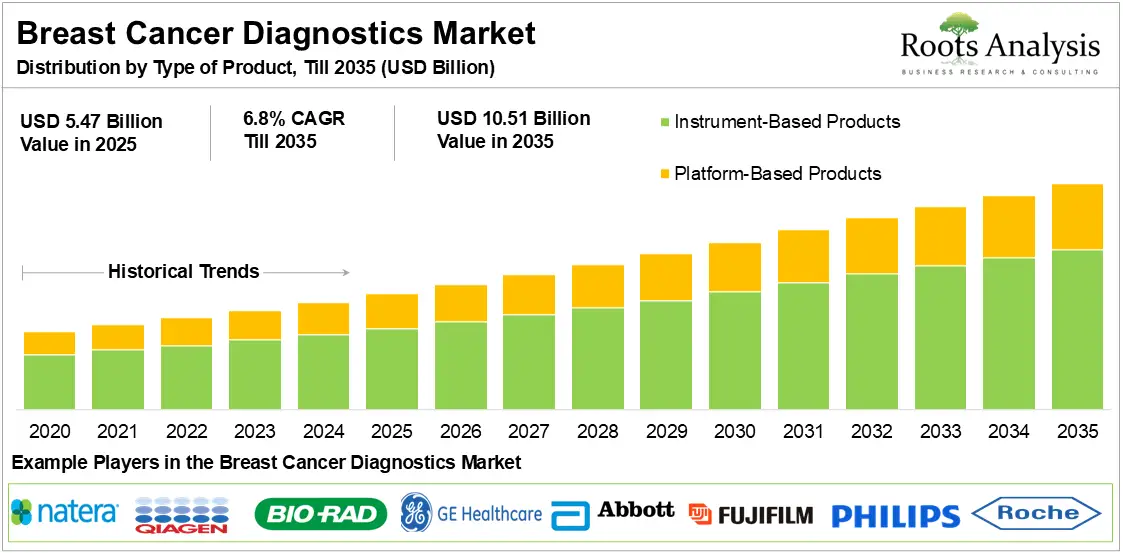
The global breast cancer diagnostics market size, valued at USD 5.05 billion in 2024, is projected to reach USD 5.47 billion in 2025 and USD 10.51 billion by 2035, representing a CAGR of 6.8% during the forecast period.
See What’s in the Full Report - Request Your Complimentary Insights!
Market Report: Key Takeaways
Market Size and Trends
- The global breast cancer diagnostics market is growing rapidly, driven by the rising prevalence of breast cancer, particularly among women and strategic collaborations between market players in oncology precision medicine and AI-driven diagnostics aim to enhance early-stage breast cancer diagnosis.
- In terms of type of diagnostics test, the imaging segment holds the largest share (53%) due to its ability to detect cancer with higher precision.
- Based on the product type, the instrument-based products (imaging and biopsy) segment dominates the market by holding 72% share.
- On the basis of regional analysis, North America accounts for 46% of the overall market share due to high prevalence, technological advancements, and government initiatives.
Key Market Statistics
- Market Size in 2025: $5.47 Billion
- Estimated Market Size in 2035: $10.51 Billion
- CAGR (2025-2035): 6.8%
- North America: Largest market in 2025
- Asia Pacific: Fastest growing region
Market Introduction
Breast cancer is highly prevalence across the globe, especially among women. As per the recent report of Breast Cancer, in 2025, nearly 316,950 women will be diagnoses with breast cancer. This high prevalence of breast cancer has created a significant burden on the healthcare industry, specifically due to lack of awareness and diagnosis at late stage. In order to increase the treatment efficacy, healthcare experts believe that early stage diagnosis can be a key to improving survival rates.
Considering the early stage detection gap, several market players are encouraging the development of advanced technologies for early diagnosis with higher precision. Notably, the market players, such as Siemens Healthineers (Germany), Philips Healthcare (Netherland) and Abbott Laboratories (US) are undertaking initiatives, such as partnerships, collaborations and investments to develop AI-based breast cancer diagnostics for early detection and treatment planning.
Do You Know That NHS Is Going to Launch World’s Biggest Trial of Artificial Intelligence in Breast Cancer?
In February 2025, the Department of Health and Social Care revealed the NHS’ biggest trial of AI in breast cancer detection alongside their dedicated cancer plan to enhance diagnosis and treatment. In this trial, five different type of AI will be deployed to read about 4,62000 of the 7,000,000 mammograms. This will be done at thirty different breast cancer screening centers which will be initiated later in 2025. However, the 2,38,000 mammograms will be scanned in conventional way by radiologist and result will be compared. If the trial is successful, this will be a key milestone for early detection of breast cancer. This trial program has been funded (£11 million) by National Institute of Health and Care Research.
The consistent focus on early breast cancer detection and penetration of government organizations alongside industrial players have made breast cancer diagnostic market immensely competitive in the future.
Market Segmentation
Based on the research, we have segmented the breast cancer diagnostics into type of test, type of cancer, type of stage, type of product, application area, end user, geographical regions, and leading players.
Breast Cancer Diagnostics Market, by Type of Diagnostics Test
- Imaging
- Biopsy
- Genomic Tests
- Blood Tests
- Other Tests
Breast Cancer Diagnostics Market, by Type of Cancer
- Invasive Lobular Breast Cancer
- Ductal Carcinoma In Situ (DCIS)
- Triple-Negative Breast Cancer
- Inflammatory Breast Cancer
- Others
Breast Cancer Diagnostics Market, by Type of Stage
- Stage I
- Stage II
- Stage III
- Stage IV
Breast Cancer Diagnostics Market, by Type of Product
- Instrument-based Products
- Imaging
- Biopsy
- Platform-based Products
- Next Generation Sequencing
- Microarrays
- PCR
- Others
Breast Cancer Diagnostics Market, by Application Area
- Screening
- Diagnostic & Predictive
- Prognostic
- Research
Breast Cancer Diagnostics Market, by End User
- Hospitals & Clinics
- Medical Labs & Diagnostics Centers
- Other End Users
Breast Cancer Diagnostics Market, by Geographical Regions
- North America
- US
- Canada
- Mexico
- Europe
- France
- Germany
- Italy
- Spain
- UK
- Rest of Europe
- Asia-Pacific
- China
- India
- Japan
- South Korea
- New Zealand
- Rest of the Asia-Pacific
- Middle East & Africa
- Egypt
- Iran
- Iraq
- Israel
- Saudi Arabia
- South Africa
- United Arab Emirates
- Latin America
- Argentina
- Brazil
Pay Only for What You Need – The Best Way to Optimize
Breast Cancer Diagnostics Market Key Insights
What are the Key Breast Cancer Diagnostics Market Drivers?
The global breast cancer diagnostic tools market is propelled by the rising incidence of breast cancer globally and rising aging population who are at greater risk of having breast cancer. It is important to highlight here that the high rising risk of breast cancer and high fatality rate has necessitated the demand for advanced diagnostics solutions for early stage diagnosis. Moreover, the heightened awareness about the benefits of early diagnosis has increased the adoption of breast imaging informatics platforms and diagnostics tools.
Will Breast Cancer Diagnostics Market Remain Competitive in the Future?
The current market landscape of breast cancer diagnostics is immensely competitive, featuring the presence of well-established, tech-giants and startup companies. Notably, the market players, such as Abbott Laboratories (US), Illumina (US), and Thermo Fisher Scientific (US) are undertaking strategic initiatives, which makes this market highly competitive. For instance, in May 2025, Illumina (US) announced the expansion of clinical oncology portfolio and in-vitro diagnostic solutions to accelerate cancer diagnosis and precision oncology for patient treatment. As more market players continue to undertake initiatives in this field, we believe that the breast cancer diagnostics industry will remain competitive in the future.
What are the Latest Advances in Early Detection for Breast Cancer?
Early detection for breast cancer has become crucial factor to treat patients, underscoring the requirement for advanced diagnostics tools and technologies. Some of the latest advances in early detection for breast cancer are listed below:
How are AI and Machine Learning Transforming Accuracy and Workflow in Breast Cancer Diagnostics?
It is worth mentioning that the market players are greatly emphasizing AI-powered mammography for accurate and real-time analysis of breast cancer. These AI algorithms act as second readers to analyze vast number of datasets in real-time. It helps in identifying subtle patterns and tumors that might got skipped through conventional approach, thereby reducing the false negative and false positive scenario during breast cancer detection. In addition, the researchers are using AI-powered mammography for early breast cancer detection to analyze genetic information and role of genome in cancer progression, making it invaluable tool for designing personalized treatment.
How Next Generation Technologies Aid in Early Disease Diagnosis?
Beyond conventional imaging technologies, the increasing innovation in next-generation imaging technologies reflects the future breast cancer diagnostics market trends. The market players are encouraging the development of technologies, such as 3D tomosynthesis for breast imaging (digital breast tomosynthesis). These technologies create 3D like images of breast for the detection of dense breast tissues. This 3D imaging also helps to distinguish between potential tumor cells and normal cells, allowing more precise diagnosis of breast cancer.
In addition, the market players are emphasizing molecular breast imaging technology. This diagnostic technology utilize radioactive tracer that highlight the metabolically active cancer cells, making it an important screening tool for breast cancer diagnosis.
Your Business is Unique – Why Shouldn’t Your Report Be?
Recent Developments in Breast Cancer Diagnostics Market
- In September 2025, Stratipath (Sweden) and Visiopharm (Denmark), the two global leaders in precision oncology and AI-driven cancer diagnostics entered into the strategic collaboration to enhance early stage breast cancer diagnosis. Under this partnership, prognostic Stratipath Breast (AI solution) of Stratipath’s will be integrated with Visiopharm’s advanced biomarker scoring algorithm for faster and accurate analysis.
- In July 2025, SimonMed has launched two latest AI-enhanced mammogram services (Mammogram+ and Mammogram+ Heart) aiming to support early breast cancer detection and preventive care.
- In June 2025, Clairity (US) received the USFDA De Novo authorization for CLAIRITY BREAST, an advanced image-based prognostic platform, which is designed to predict five-year breast cancer risk through a regular screening mammogram.
- In March 2025, GE Healthcare launched Invenia™, an automated breast ultrasound (ABUS) premium. This newly launched 3D ultrasound offer innovatives features and powered by artificial intelligence for faster and accurate screening of breast cancer.
Industry Experts on Breast Cancer Diagnostics Market
Experts believe that beyond oncology precision medicine, advances in biomarkers, diagnostics tools and personalized breast cancer screening solutions will be the future focus for better treatment outcomes.
“During 2025 American Society of Clinical Oncology (ASCO) Annual Meeting, Dr Robin Zon (ASCO President) highlighted that the efficacy of AI tool in diagnostics and decision making process has significantly increased chances of receiving targeted treatment by patients, indicating a bright future of AI tools in cancer diagnostics.”
Get an Instant Quote in 10 Minutes. Lowest Price Guaranteed
Market Share Insights
Which Molecular Diagnostic Tests For Breast Cancer Gain Momentum in the Future?
- Based on the type of test, the global market is categorized across imaging, biopsy, genomic tests, blood tests, and other tests. According to the breast cancer diagnostics market forecast, the imaging segment hold the highest share (53%) of the market. This dominance stems from the widespread usage of imaging diagnostic technologies, such as MRI, ultrasound, and mammography for breast cancer diagnosis.
- In the future, blood tests segment is anticipated to show highest CAGR during the forecast period. This can be attributed to the growing demand for minimally invasive procedures and focus on blood-based breast cancer biomarkers for the detection of breast cancer. Additionally, the increasing emphasis on liquid biopsy innovations in breast cancer diagnostics at early stage has further contributed to the highest share of this segment.

Let’s Take a Look At Front Edge Innovation in Liquid Biopsy Tests for Cancer Detection
A team of researchers at the University of Oxford developed a new liquid biopsy test that is powered by the machine learning. This test has shown promising results in detecting six different types of cancer at early stage, such as colorectal, oesophageal, pancreatic, renal, ovarian and breast.
What Type of Breast Cancer is More Prevalent in Women and Require Early Diagnosis?
- This segment highlights the distribution of global market across different type of cancer, such as invasive lobular breast cancer, ductal carcinoma in situ (DCIS), triple-negative breast cancer, inflammatory breast cancer, and others. According to the breast cancer diagnostics market report, the ductal carcinoma in situ segment is dominating the market by securing maximum share. Notably, the ductal carcinoma in situ has the potential to convert into invasive ductal carcinoma. Hence, it require early diagnosis to treat at early stage and reduce the risk of death.
- Owing to its invasive nature, the demand for advanced non-invasive imaging technologies in breast cancer screening remain high for ductal carcinoma in situ, contributing to the highest CAGR of this segment in the future.
Which Diagnostic Modalities Drive the Largest Market Share?
- The global market is further bifurcated across different type of product, such as instrument-based products (imaging and biopsy), platform-based products (next generation sequencing, microarrays, PCR and others). According to the breast cancer diagnostics industry analysis, the instrument-based products segment is accounting for the 72% of the overall market share. This highest share stems from the expanding usage of non-invasive imaging technologies in breast cancer screening for early diagnosis.
- It is worth noting that the platform-based products segment is likely to grow at the fastest CAGR during the forecast period. This lucrative growth is driven by the growing research and development of next generation platforms for early stage breast cancer diagnosis. Additionally, the availability of platforms, such as cloud-based AI radiology tools that are with multiple diagnostic modalities aid in early stage detection with higher precision. For instance,
Why Hospitals & Clinics Holds the Maximum Share of the Market?
- Based on the end user, the global market is sub-divided into hospitals & clinics, medical labs & diagnostics centers, and other end users. According to our projection, the hospitals & clinics segment is accounting for over 50% share of the breast cancer diagnostics market growth. The rising burden of breast cancer patients in hospitals is likely to fuel the requirement for advanced diagnostics solutions in breast cancer diagnosis.
- It is worth noting that the medical labs & diagnostics centers segment is likely to witness highest CAGR in the future. This lucrative growth is due to the growing government support and availability of reimbursement policies to manage disease diagnosis expenses are driving the demand for innovation early breast cancer diagnosis tests.
Unlock Deeper Insights – Schedule Your Personalized Workshop Today!
Regional Analysis: Which Region is Dominating the Market?
North America Dominate the Market
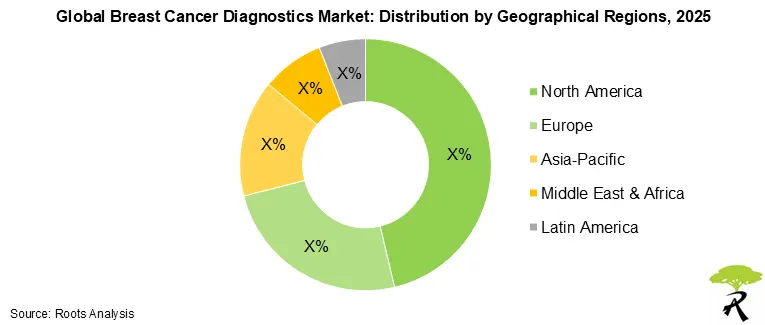
According to the breast cancer diagnosis market, the North America is dominating the market by holding 46% share of the market. Several factors, such as rising prevalence of breast cancer, increasing technological advanced and government initiatives to support early breast cancer diagnosis is fueling the market growth in this region.
Asia-Pacific Will Grow at a Higher CAGR
In Asia-Pacific, the market for breast cancer diagnostics is likely to grow at a higher CAGR. The high incidence of breast cancer, advancements in breast cancer diagnostic technologies and government initiatives to strengthen research and development activities in breast cancer is likely to drive the market growth in this region.
Breast Cancer Diagnostics Market: Report Deliverables
| Report Deliverables | Details | |
| Historical Trend | Since 2020 | |
| Forecast Period | Till 2035 | |
| Market Size 2025 | USD 5.47 Billion | |
| Market Size 2035 | USD 10.51 Billion | |
| CAGR (Till 2035) | 6.8% | |
| Segments Covered |
|
|
| Key Breast Cancer Diagnostics Companies Profiled |
(A complete list of companies captured is available in the report) |
|
| PowerPoint Presentation (Complimentary) | Available | |
| Customization Scope | 15% Free Customization | |
| Excel Data Packs (Complimentary) | Available | |
What are the Main Regulatory or Guideline Updates Impacting Breast Cancer Diagnostic Adoption?
Several regulatory guidelines that are impacting breast cancer diagnostic adoption are listed below:
- The USFDA Breast Density Reporting Mandate: This significant change in the regulatory guidelines in the US has mandate that all the mammography and breast cancer diagnostics facilities are required to inform patients for their breast density status in their mammogram reports. This new update is expected to drive the adoption of breast cancer diagnostic technologies, such as molecular breast imaging (MBI), contrast-enhanced mammography (CEM), and ultrasound.
- USPSTF Recommendations: The U.S. Preventive Services Task Force (USPSTF) has recently updated its breast cancer screening recommendations for enhance the adoption of breast cancer diagnostics. This update is now advocating for biennial mammography for women aged 40-74. This represents a shift from previous guidelines and expands the age range for routine screening, particularly for women in their early 40s.
- The USFDA Breakthrough Device Designation: The USFDA has granted Breakthrough Device Designation to several AI-based tools in 2025, such as for a companion diagnostic. This designation is intended to expedite the development and review of devices that provide more effective treatment or diagnosis for life-threatening or irreversibly debilitating diseases. This signals the FDA's willingness to support and fast-track innovative AI solutions that can improve diagnostic accuracy in oncology.


