Cardiac RPM Market by Component / Offering (Devices, Software Platforms, Monitoring Services, and Integration and Implementation Services), Monitoring Modality / Product Type, Technology / Connectivity Approach, Clinical Application, End User / Care Setting, Geographical Regions, and Leading Players - Trends and Forecasts, 2026-2040
Market Size
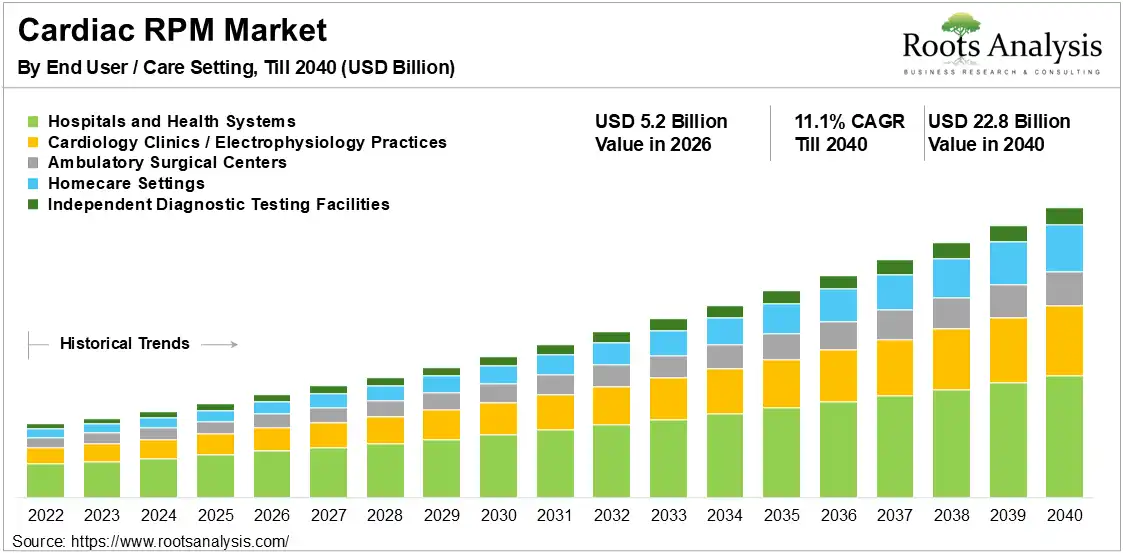
The global cardiac RPM market reached USD 5.2 billion in 2026 and is projected to reach USD 22.8 billion by 2040, growing at a CAGR of 11.1% over the forecast period 2026 to 2040, driven by rising arrhythmia burden, heart failure readmission pressure, and connected ambulatory monitoring adoption.
See What’s in the Full Report – Request Your Complimentary Insights!
Market Report: Key Takeaways
- Based on geography, North America captures 45.0% market share in 2026, whereas Asia-Pacific registers a 14.4% CAGR through 2040, driven by Japan-led ambulatory adoption and wider healthcare digitalization.
- Based on component / offering, devices capture 52.0% market share in 2026, whereas software platforms register a 13.8% CAGR through 2040, driven by dashboards, triage, and workflow automation.
- Based on monitoring modality / product type, ECG / Holter monitors capture 28.0% market share in 2026, whereas pulmonary artery pressure / hemodynamic heart failure monitors register a 15.7% CAGR through 2040, driven by heart failure decompensation prevention.
- Based on technology / connectivity approach, wearable / external monitoring devices capture 34.0% market share in 2026, whereas AI-enabled arrhythmia detection registers a 15.9% CAGR through 2040, driven by scalable rhythm interpretation.
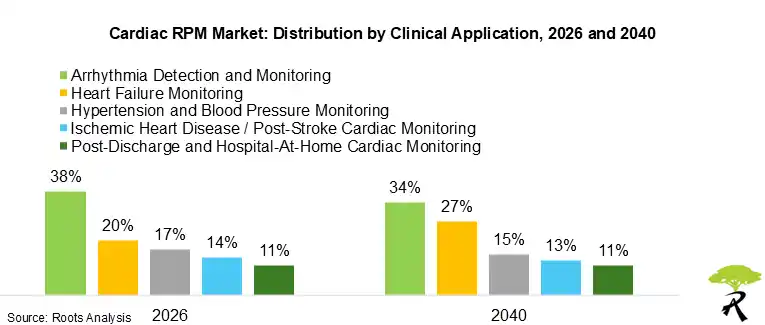
- Based on clinical application, arrhythmia detection and monitoring captures 38.0% market share in 2026, whereas heart failure monitoring registers a 13.5% CAGR through 2040, driven by readmission reduction priorities.
Cardiac RPM Market Outlook
Cardiology monitoring is moving from episodic Holter testing toward continuous, connected, and home-linked care pathways. The cardiac RPM market now combines ECG patches, mobile cardiac telemetry, CIED remote monitoring, and hemodynamic heart failure surveillance. Earlier demand centered on arrhythmia diagnosis; current demand includes post-discharge follow-up, chronic heart failure oversight, and cardiology workflow automation. Devices still lead revenue, while software platforms and monitoring services gain share. These cardiology-focused applications form part of the wider remote patient monitoring ecosystem.
Growth comes from arrhythmia burden, heart failure readmission pressure, FDA device clearances, and payer familiarity with remote monitoring workflows. Regulatory momentum supports adoption because cleared systems reduce procurement risk for hospitals and cardiology practices. In January 2026, FDA documentation showed clearance for Boston Scientific Cardiac Diagnostic Technologies’ BodyGuardian Remote Monitoring System for ambulatory arrhythmia detection and monitoring. That clearance directly supports physician confidence in extended outpatient monitoring.
Through 2040, the market remains high-growth but becomes more software-led and care-model driven. AI-enabled arrhythmia detection, cloud dashboards, enterprise telemetry, and pulmonary artery pressure monitoring gain share faster than traditional event monitors. Philips launched a smart telemetry platform in September 2025 for continuous cardiac monitoring beyond the bedside. The long-term outlook stays positive, with differentiation shifting toward integration, clinical actionability, payer access, and specialist workflow depth.
Cardiac RPM Market Dynamics
Cardiac RPM Market Drivers
Arrhythmia detection, heart failure readmission pressure, and outpatient cardiology capacity drive cardiac RPM market growth. Arrhythmia detection holds 38.0% share in 2026, supported by ECG patches, Holters, mobile cardiac telemetry, and implantable loop recorders. Heart failure monitoring grows at 13.5% CAGR through 2040, because pulmonary artery pressure surveillance helps clinicians intervene before decompensation. FDA-cleared ambulatory systems reduce hospital procurement risk and support broader physician adoption.
Cardiac RPM Market Restraints
Clinical workflow burden restrains adoption when remote cardiac monitoring devices generate large alert volumes without clear triage rules. Hospitals need EHR-integrated cardiac monitoring, diagnostic review capacity, and reimbursement-aligned documentation before scaling across cardiology networks. Integration and implementation services lose share from 8.0% in 2026 to 7.0% in 2040, showing that buyers want repeatable platforms. Vendors without workflow automation face slower enterprise conversion.
Cardiac RPM Market Opportunities
Asia-Pacific creates the clearest expansion opportunity, with 14.4% CAGR through 2040 versus 9.8% for North America. Japan, China, India, and Korea support demand through aging populations, mobile care models, and cardiology digitalization. In May 2025, iRhythm launched Zio long-term continuous ECG monitoring in Japan through Senko Medical Instrument. Early regional entrants can build channel advantage before reimbursement pathways mature.
Cardiac RPM Market Challenges
Regulatory validation, payer access, and interoperability determine which vendors scale beyond pilot deployments. AI-enabled arrhythmia detection grows at 15.9% CAGR, but clinical buyers need evidence, auditability, and specialist review workflows. Device makers also face competition from monitoring services and cloud dashboards as purchasing shifts toward complete care pathways. Companies that cannot connect devices, software, and clinician action will lose strategic accounts.
Cardiac RPM Market Size Estimation Methodology
- As a starting point, the forecast used direct remote cardiac monitoring, cardiac RPM devices, ambulatory cardiac monitoring, and wearable cardiac device anchors. Broader all-condition RPM and full cardiac rhythm management device sources served only as boundary checks. This kept the cardiac RPM market estimate focused on monitoring devices, software platforms, services, and cardiac-specific workflows. Duplicative or overly broad inputs were excluded from the consensus base.
- Moving forward, the model normalized historic and current-year anchors against 2022, 2026, and 2040 time points. Input ranges were reconciled across ECG / Holter monitors, mobile cardiac telemetry, implantable cardiac monitors, CIED remote monitoring, and pulmonary artery pressure monitoring. Each anchor was checked against the stated market scope before inclusion. This step prevented general cardiology device revenue from overstating RPM demand.
- Building on this, segment shares were assigned from recurring product, component, technology, application, end-user, and geography taxonomies. The model weighted devices, software platforms, monitoring services, and implementation services separately because buyers purchase them through different budgets. It also reflected the shift from device-led spending toward dashboards, analytics, and managed monitoring. Share movement was tested against each segment’s 2026 and 2040 position.
- Drawing upon these, validation checks used FDA 510(k) clearances, CE Mark activity, company product launches, payer-network activity, and cardiology workflow partnerships. Regulatory submission counts and clearance evidence helped test whether growth assumptions matched product availability. Examples included ambulatory arrhythmia monitoring systems, at-home ECG technologies, and pulmonary artery pressure readers. Commercial announcements were used only when the activity matched cardiac monitoring scope.
- The projected value was then built through a bottom-up segment model and a top-down consensus cross-check. Segment CAGRs were stress-tested against adoption constraints, including reimbursement familiarity, cardiologist review capacity, EHR integration needs, and homecare readiness. Faster growth was assigned to AI-enabled arrhythmia detection, heart failure monitoring, software platforms, and Asia-Pacific adoption. Slower growth was applied to event monitors and Bluetooth-connected devices.
- Finally, the annual forecast curve was smoothed to avoid sudden jumps unsupported by adoption evidence. Regional shares, offering shares, and technology shares were reviewed for internal consistency against the overall 11.1% CAGR. The final methodology favors verified industry data, named company activity, and quantified segment movement over unsupported extrapolation. This approach supports repeatable scenario updates as new FDA, payer, and launch evidence appears.
Cardiac RPM Market Share Insights
Market Share by Component / Offering
According to our analysis, devices lead because ECG patches, Holters, MCT devices, and implantable monitors remain the revenue entry point. In August 2025, InfoBionic.Ai received FDA 510(k) clearance for its MoMe ARC 1-Lead Patch.
Software platforms will expand faster as providers prioritize dashboards, AI triage, alarm filtering, and workflow automation. In September 2025, Philips launched a smart telemetry platform with data-driven cardiac monitoring and alarm management.
Market Share by Clinical Application
Arrhythmia detection leads because ECG patches, Holters, MCT, and ILRs directly address diagnostic yield. In April 2025, iRhythm presented AVALON real-world ambulatory cardiac monitoring data at HRS 2025.
Heart failure monitoring will expand fastest because readmission prevention needs continuous pressure and symptom surveillance. In February 2026, Abbott said CardioMEMS HERO supports daily PA pressure transmission to clinicians.
Want Information on Specific Region / Segment?
Regional Analysis: North America Leads the Market and Asia-Pacific is Likely to Register Higher CAGR
Presently, North America holds 45.0% share in 2026. North America leads because U.S. payers, cardiology networks, IDTFs, and hospital systems already support outpatient monitoring scale. The region also benefits from FDA pathways, reimbursement familiarity, and deep device-service ecosystems. In September 2025, Philips joined Optum Healthcare’s U.S. network, expanding MCOT and ePatch access to 3.4 million members in 22 states.
On the contrary, Asia-Pacific registers a 14.4% CAGR from 2026 to 2040. Asia-Pacific will scale faster as aging populations, mobile care models, and cardiology digitalization converge. Japan offers the clearest near-term proof, while China and India will expand demand through access-driven remote monitoring. In May 2025, iRhythm launched Zio long-term continuous ECG monitoring in Japan, with nationwide availability anticipated by July 2025.
Market Ecosystem Analysis
The scoped Cardiac RPM ecosystem contains 25 companies: eight Tier 1 leaders, twelve specialists, and five emerging entrants. Tier 1 leaders control the bulk of commercial activity across CIED monitoring, hemodynamic HF monitoring, ambulatory ECG, and ECG workflow integration. The dominant consolidation dynamic is platform convergence, especially EHR-integrated ordering, cloud analytics, and device-neutral cardiac data workflows. Competitive advantage is shifting toward validated analytics, low-friction patient adherence, and clinician workflow automation because RPM programs now compete on usable decisions.
- Medtronic reinforced the clinical value of long-term post-stroke monitoring in February 2025 through DiVERT Stroke findings. The data showed lower cardiac monitoring rates among women after stroke, supporting greater use of long-term external and insertable cardiac monitoring pathways. This pressures competitors to prove clinical utility beyond device connectivity and strengthens the post-stroke arrhythmia monitoring application.
- Abbott received FDA approval in February 2026 for CardioMEMS HERO, its next-generation pulmonary artery pressure reader. The reader is 60% lighter than the earlier model and improves daily PA pressure transmission for heart-failure care teams. This strengthens implantable hemodynamic monitoring and raises the usability bar for heart-failure RPM platforms.
- Philips moved ambulatory cardiac monitoring closer to enterprise EHR workflows through its July 2025 collaboration with Epic Aura. The integration enables ordering and ECG result review directly in Epic, reducing manual order entry and charting burden. This pressures standalone ECG monitoring providers and strengthens software platforms plus integration services for hospitals and cardiology clinics.
- iRhythm launched its Zio long-term continuous ECG monitoring service in Japan in May 2025. The system provides up to 14 days of uninterrupted ECG monitoring with a PMDA-approved deep-learned AI algorithm. This pressures wired Holter and shorter patch services, strengthening AI-enabled arrhythmia detection in Asia-Pacific ambulatory care.
- iRhythm also presented AVALON real-world data at HRS 2025 in April 2025. Zio LTCM showed higher diagnostic yield, fewer repeat tests, and lower cardiovascular-event odds versus other ACM modalities. This strengthens iRhythm’s position in long-term continuous ECG monitoring and raises evidence expectations for Baxter, Philips, and other LTCM competitors.
- AliveCor launched Kardia 12L in India in July 2025 after CDSCO approval. The handheld AI-powered 12-lead ECG system detects 35 cardiac determinations using a reduced leadset. This strengthens point-of-care and under-resourced cardiac screening, pressuring conventional ECG workflows in primary and urgent care settings.
- PaceMate gained exclusive access to PaceArt device data in August 2025 after acquiring the system from Medtronic. The company can migrate historical PaceArt data and integrate SessionSync in-clinic Medtronic device checks into PaceMateLIVE. This strengthens CIED remote monitoring workflow and creates a migration advantage for clinics replacing legacy cardiac device systems.
- PaceMate appointed a head of AI in September 2025 to convert its cardiovascular dataset into workflow automation. The company framed its AI work around reducing manual clinic tasks and generating actionable cardiac monitoring insights. This strengthens software platforms and monitoring services, especially for electrophysiology practices managing high-volume device transmissions.
- Validic and Tenovi integrated their platforms in April 2025 to combine EHR-integrated RPM with cellular-connected device capture. The partnership reduces dependence on smartphones and home Wi-Fi, which improves rural and underserved patient onboarding. This strengthens wireless / cellular connected devices and raises the infrastructure bar for enterprise RPM vendor.
- Best Buy Health faced strategic pressure in June 2025 when Current Health’s former CEO reacquired Current Health. The move followed earlier Best Buy Health impairment and restructuring signals, highlighting stress in broad retailer-led RPM models. This strengthens the relative case for focused cardiac RPM specialists with sharper workflow and reimbursement alignment.
Startup Companies and their Key Highlights
- InfoBionic.Ai
- Event type: FDA 510(k) clearance for MoMe ARC 1-Lead Patch
- Month and year: August 2025
- Stated purpose of the event: Enable extended-duration ECG monitoring through a lightweight disposable patch connected to the MoMe ARC platform
- Market implication: Accelerates wearable ECG monitoring and AI-enabled arrhythmia monitoring by reducing setup burden for patients and practices
- HeartBeam
- Event type and funding amount: USD 10.0 million underwritten public offering
- Month and year: February 2025
- Stated purpose of the event: Support commercial readiness, R&D, clinical work, regulatory projects, working capital, and general corporate purposes
- Market implication: Accelerates portable synthesized 12-lead ECG commercialization and supports the shift toward higher-fidelity at-home arrhythmia assessment
- CardioSignal
- Event type: FDA 510(k) clearance for 12-lead ECG synthesis software
- Month and year: December 2025
- Stated purpose of the event: Enable cable-free synthesized 12-lead ECG output for at-home arrhythmia assessment
- Market implication: Strengthens the portable ECG segment by moving at-home monitoring beyond single-lead and six-lead consumer ECG limitations
- Tenovi
- Event type: Strategic integration partnership
- Month and year: April 2025
- Lead investor or strategic partner name: Validic
- Stated purpose of the event: Deliver cellular-connected RPM data capture integrated into EHR workflows
- Market implication: Accelerates wireless and cellular RPM infrastructure, especially for patients without reliable smartphones or home Wi-Fi
Cardiac RPM Market Trends / Opportunities
Long-Term ECG and Mobile Cardiac Telemetry in Cardiac RPM Market Expanding Payer-Linked Service Reach
Ambulatory ECG monitoring is moving from isolated diagnostic orders into payer-network service coverage. Philips joined Optum Healthcare’s network in September 2025 for MCOT and ePatch access across eligible U.S. members. This gives scaled providers a commercial route beyond individual hospital contracts.
Long-term continuous ECG monitoring is expanding internationally as cardiology systems seek higher diagnostic yield outside hospitals. iRhythm launched Zio in Japan in May 2025 through Senko Medical Instrument. Early country launches can create distribution advantage in Asia-Pacific’s fastest-growing regional segment.
AI Arrhythmia Interpretation in Cardiac RPM Market Moving Competition Toward Software Differentiation
AI-enabled interpretation is shifting competition from device capture toward clinical decision support. AliveCor announced FDA clearance of five additional Kardia 12L cardiac determinations in January 2026. Vendors with cleared algorithms can compete on workflow value, not only hardware form factor.
Real world evidence solutions is becoming a commercial proof point for AI-powered arrhythmia detection. iRhythm presented Zio long-term monitoring data at HRS 2025 in April 2025. Evidence-backed platforms will have stronger positioning with electrophysiology practices and health-system procurement teams.
Hemodynamic Heart Failure Monitoring Shifting Growth Toward Chronic-Care Pathways
Heart failure monitoring is moving from episodic symptom checks toward daily pressure-guided surveillance. Abbott received FDA approval for CardioMEMS HERO in February 2026, supporting remote pulmonary artery pressure monitoring. This expands revenue opportunities for implantable heart failure RPM platforms and specialist monitoring workflows.
At-home ECG assessment is broadening the care pathway around early arrhythmia evaluation and post-discharge follow-up. HeartBeam received FDA clearance for cable-free synthesized 12-lead ECG technology in December 2025. Portable cardiac diagnostics will intensify competition in homecare settings and ambulatory cardiology channels.
Enterprise Telemetry and EHR Integration Creating Platform-Level Competitive Advantage
Enterprise cardiac monitoring is shifting from bedside systems toward connected telemetry that follows patients across care settings. Philips launched a smart telemetry platform in September 2025 for continuous connectivity beyond the bedside. Hospitals will favor vendors that reduce alarm burden and standardize monitoring workflows.
EHR integration is becoming a procurement requirement as remote cardiac data enters routine clinical workflows. Philips and Epic announced a July 2025 collaboration to integrate ambulatory monitoring and diagnostics services with Epic Aura. Integration depth will influence account retention and enterprise pricing power.
Your Business is Unique – Why Shouldn’t Your Report Be?
Market Access Considerations
FDA Clearance and Device-Grade Evidence
Regulatory access depends on device-grade evidence because cardiac RPM outputs influence diagnosis, monitoring, and escalation decisions. FDA 510(k) clearances help hospitals separate clinical systems from consumer wellness tools. Boston Scientific Cardiac Diagnostic Technologies’ BodyGuardian clearance in January 2026 supports arrhythmia detection and ambulatory monitoring use. Vendors with clearer regulatory pathways can scale faster through hospital procurement committees and reduce clinical adoption concerns. Regulatory credibility also supports cardiologist trust during enterprise rollouts.
Payer-Network Inclusion and Reimbursement Familiarity
Commercial access improves when monitoring services align with payer networks and reimbursable care pathways. North America leads with 45.0% share in 2026 because U.S. payers, IDTFs, and cardiology groups already support outpatient monitoring scale. Philips joined Optum Healthcare’s network in September 2025 for MCOT and ePatch access. Payer inclusion can accelerate member access, reduce provider contracting friction, and strengthen service utilization. It also gives monitoring providers a stronger route to predictable volumes.
EHR Integration and Clinical Workflow Fit
Market access increasingly depends on whether remote cardiac monitoring data fits cardiology workflows without adding manual review burden. Epic integration, dashboard usability, and alarm management shape enterprise buying decisions. Philips and Epic announced a July 2025 collaboration to integrate ambulatory monitoring and diagnostics services with Epic Aura. Vendors with electronic health records linked workflows can defend strategic accounts better than standalone device suppliers and improve renewal economics. Integration quality will also influence implementation timelines.
Specialist Review Capacity and Monitoring Operations
Scaling requires enough cardiologist, electrophysiologist, and technician capacity to convert signals into clinical action. Mobile cardiac telemetry, CIED remote monitoring, and AI-enabled arrhythmia detection all create alert-management demands. Philips launched its smart telemetry platform in September 2025 with data-driven monitoring and alarm management capabilities. Operational efficiency will shape margins for monitoring services, health-system deployments, and high-volume diagnostic programs. Buyers will prioritize platforms that reduce avoidable alerts.
How Stakeholders Benefit from the Key Focus Areas of Our Cardiac RPM Market Report
Cardiac monitoring has become commercially urgent as arrhythmia diagnosis, heart failure surveillance, and post-discharge care shift outside hospitals. The report supports decisions on segment prioritization, technology investment, partnership mapping, and route-to-market planning.
- Unmet Needs and Market Gaps in Cardiac RPM Market: The report identifies gaps in alert triage, EHR integration, homecare workflows, and heart failure monitoring coverage. Growth heads use this view to prioritize segments where clinical pain remains unresolved. Product teams use it to decide whether devices, software dashboards, or monitoring services need investment.
- Funding and Venture Investment Opportunities in Cardiac RPM Market: The report highlights high-growth investment areas, including AI-enabled arrhythmia detection, software platforms, homecare settings, and hemodynamic heart failure monitors. Capital allocators use the segment CAGRs to screen scalable opportunities. The analysis also separates verified commercial signals from areas without clear recent funding evidence.
- Technology Innovation and Adoption Trends: The report tracks adoption across ECG patches, mobile cardiac telemetry, implantable monitors, cloud dashboards, and AI-enabled arrhythmia detection. Technology leaders use these findings to benchmark product roadmaps against market movement. The analysis supports build, buy, or partner decisions across data capture, interpretation, and workflow layers.
- Cardiac RPM Market Competitive Landscape and Industry Analysis: The report maps Tier 1 leaders, Tier 2 specialists, and emerging players across device, platform, and service roles. Commercial teams use this structure to compare positioning against Medtronic, Abbott, Philips, iRhythm, AliveCor, and others. The analysis supports account targeting, white-space mapping, and competitor-response planning.
- Mapping Strategic Partnerships and Ecosystem Synergies: The report reviews payer-network moves, EHR integrations, clinical research partnerships, and provider deployments that shape market access. Business development teams use these signals to identify channel partners and integration targets. The analysis supports decisions around payer access, Epic-linked workflows, and ambulatory monitoring distribution.
- Cardiac RPM Market CAGR and Growth Trends: The report explains why the overall market grows at 11.1% CAGR through 2040 while segment performance diverges. Planning teams use this view to compare slower device categories with faster software, AI, heart failure, and Asia-Pacific growth. The analysis supports budget allocation, forecast scenarios, and regional expansion timing.
Cardiac RPM Market: Scope of the Report
| Key Report Attributes | Details | |
| Forecast Period | Till 2040 | |
| Market Size 2026 | USD 5.2 Billion | |
| Market Size 2040 | USD 22.8 Billion | |
| CAGR (Till 2040) | 11.1% | |
| Segments Covered |
|
|
| Geographical Regions Covered |
|
|
| Key Sections Covered |
|
|
Market Segmentation
The Cardiac RPM Market report presents an in-depth analysis, highlighting the capabilities of various stakeholders, based on different segments, such as component / offering, monitoring modality / product type, technology / connectivity approach, clinical application, end user / care setting, geographical regions, and leading players.
By Component / Offering
- Devices
- Software Platforms
- Monitoring Services
- Integration and Implementation Services
By Monitoring Modality / Product Type
- ECG / Holter Monitors
- Event Monitors
- Mobile Cardiac Telemetry Monitors
- Implantable Loop Recorders / Insertable Cardiac Monitors
- Pacemaker / ICD / CRT Remote Monitoring Systems
- Pulmonary Artery Pressure / Hemodynamic Heart Failure Monitors
By Technology / Connectivity Approach
- Wearable / External Monitoring Devices
- Implantable Monitoring Devices
- Wireless / Cellular Connected Devices
- Bluetooth-Connected Devices
- Cloud-Based Analytics and Dashboards
- AI-enabled Arrhythmia Detection
By Clinical Application
- Arrhythmia Detection and Monitoring
- Heart Failure Monitoring
- Hypertension and Blood Pressure Monitoring
- Ischemic Heart Disease / Post-Stroke Cardiac Monitoring
- Post-Discharge and Hospital-At-Home Cardiac Monitoring
By End User / Care Setting
- Hospitals and Health Systems
- Cardiology Clinics / Electrophysiology Practices
- Ambulatory Surgical Centers
- Homecare Settings
- Independent Diagnostic Testing Facilities
By Geographical Regions
- North America
- US
- Canada
- Mexico
- Rest of North America
- Europe
- Austria
- Belgium
- Denmark
- France
- Germany
- Ireland
- Italy
- Netherlands
- Norway
- Russia
- Spain
- Sweden
- Switzerland
- UK
- Rest of Europe
- Asia-Pacific
- China
- India
- Japan
- Singapore
- South Korea
- Rest of Asia-Pacific
- Latin America
- Argentina
- Brazil
- Chile
- Colombia
- Venezuela
- Rest of Latin America
- Middle East and Africa (MEA)
- Egypt
- Iran
- Iraq
- Israel
- Kuwait
- Saudi Arabia
- UAE
- Rest of MEA
- Rest of the World


