
Lowest Price Guaranteed
Slides
216
Last Updated
June 2026
View Count
16886
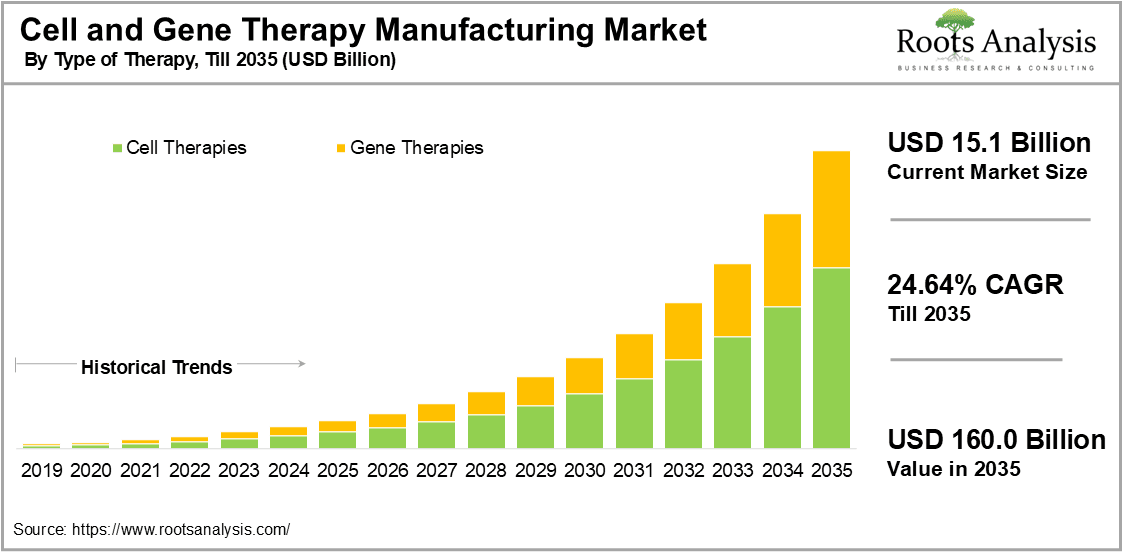
The global cell and gene therapy manufacturing market size, valued at USD 11.9 billion in 2024, is projected to reach USD 15.1 billion in 2025 and USD 160.0 billion by 2035, representing a CAGR of 26.64% during the forecast period.
To learn more about this report, request a free sample copy
Advanced therapies, such as cell and gene therapies have demonstrated utmost potential in the treatment of chronic diseases, oncological disorders and rare disorders. These therapies have been designed sophisticatedly to target disease at cellular level with higher precision and eliminate the risk of off-target effects. Cell and gene therapy offer several significances, such as targeted reaction, replacement of damaged tissues, slower down or stop inherited disorders and allow treatment of specific genes that are either non-functional or mutated.
It is important to highlight here that over 300 cell therapies are currently in clinical development stages and since 2019 more than 1,930 clinical studies on cell therapy have been initiated, indicating wider opportunities in this field. Despite the growing clinical pipeline, the manufacturing of cell and gene therapies fraught several challenges. Some of the possible challenges are targeted delivery challenges, scaling up issues, cell harvesting, maintaining cell / gene stability and adherence with regulatory guidelines. Considering these challenges, the industry players have shifted their focus to optimizing cell and gene therapy manufacturing processes.
In addition to manufacturing optimization, several technologies that have been adopted on a large scale in the cell and gene therapy manufacturing industry to achieve quality production include automation quality control processes, process analytical testing (PAT) and quality risk management (QRM).
It is important to highlight here that several industry players have taken strategic initiatives followed by the development of the latest platforms and technological innovations for accelerating cell and gene therapies manufacturing. For instance, in May 2024, Ori Biotech unveiled the IRO®, a cell and gene therapy automated manufacturing platform, to achieve greater efficiency, precision and control during the production of targeted therapies. As stated by Jason C. Foster (Chief Executive Officer, Ori Biotech), ”A new wave of cell and gene therapies holds immense promise for patients; however, to achieve the true clinical impact, therapies must be not only approvable but also accessible and affordable. Over the last five years, we’ve focused on Biology First, generating best-in-class biological data from over 500 runs with ten different partners, across different cell types and protocols to demonstrate how the IRO platform can Automate Better Biology. For too long, scientists and therapy developers have had to sacrifice biological performance for automation, not anymore.”
Moreover, the industry players are also focusing on providing contract manufacturing services to meet the ongoing demand for cell therapies. For instance, in April 2024, Pluri launched its contract development and manufacturing division (PluriCDMO) for the production of cell and gene therapies on a large scale. It is worth noting here that several significant investments have also been made by government and non-government organizations to support the manufacturing of cell and gene therapies. For instance, in September 2024, ArsenalBio raised around USD 325 million in Series C funding round in order to advance solid tumor candidates that utilize T cell engineering technology.
These ongoing investments, launch of advanced manufacturing platforms and technological innovations highlighted the key trends in the cell and gene therapy manufacturing market, which is anticipated to keep industry investible for the upcoming decades.
The market research report presents an in-depth analysis of cell and gene therapy manufacturing companies, across different segments, as defined in the table below:
| Key Report Attributes | Details | |
| Historical Trend | Since 2019 | |
| Forecast Period | Till 2035 | |
| Market Size 2025 | $15.1 Billion | |
| Market Size 2035 | $160.0 Billion | |
| CAGR (Till 2035) | 26.64% | |
| Type of Therapy |
|
|
| Type of Scale |
|
|
| Type of Mode |
|
|
| Type of Workflow |
|
|
| Type of Process |
|
|
| Type of Technology |
|
|
| End User |
|
|
| Geographical Regions |
|
|
| Key Companies Profiled |
|
|
| PowerPoint Presentation (Complimentary) |
Available | |
| Customization Scope | 15% Free Customization | |
| Excel Data Packs (Complimentary) |
Available | |
One of the key objectives of the cell and gene therapy manufacturing market report was to estimate the current size, opportunity and the market growth potential, over the forecast period, till 2035. We have provided informed estimates on the likely evolution of the market for the forecast period. The market analysis also features the likely distribution of the current and forecasted opportunity within the market distributed across various segments such as type of therapy (cell therapies (stem cell therapy and non-stem cell therapy) and gene therapies), type of scale (precommercial / R&D scale manufacturing and commercial scale manufacturing), type of mode (contract manufacturing and in-house manufacturing), type of workflow (cell processing, cell banking, process development, fill & finish operations, analytical & quality testing, raw material testing, vector production and other workflow), type of process (upstream processes and downstream processes), type of technology (fluorescence-activated cell sorting (FACS), enzyme-linked immunosorbent assay (ELISA), chromatography, next-generation sequencing (NGS), polymerase chain reaction (PCR), other technologies), end user (pharmaceutical companies, biopharmaceutical / biotechnological companies, and contract manufacturing organizations), and geographical region (North America, Europe, Asia-Pacific, Middle East and North Africa, and Latin America) and leading players .
In order to account for future uncertainties associated with some of the key parameters and to add robustness to our model, we have provided three market forecast scenarios, namely conservative, base, and optimistic scenarios, representing different tracks of industry’s evolution.
All actual figures have been sourced and analyzed from publicly available information forums and primary research discussions. The financial figures mentioned in this market report are in USD, unless otherwise specified.
The cell and gene therapy manufacturing market are segmented based on type of therapy into cell therapies (stem cell therapy and non-stem cell therapy) and gene therapies. According to our projection, cell therapies manufacturing holds the highest share (~60%) of the market. This dominance is due to increasing focus on the development of cell based therapies such as CAR-T cell therapy for treating wide range of diseases (specifically cancer). Thus, increasing demand for advanced cell therapies is contributing to the highest growth share of this segment. However, it is important to highlight here that gene therapies segment will show a substantial growth potential and is expected to register higher CAGR during the forecast period. Gene therapies have shown significant results in curing and stopping the disease progression and growing research on gene mutations and evaluation of gene therapies in treating diseases.
Many industry stakeholders are focused on bringing technological innovations in the therapy manufacturing processes so as to achieve high-throughput and attain better results. In October 2024, Forge Biologics (a part of Ajinomoto Bio-Pharma Services) launched FUEL™ manufacturing platform, consisting of HEK293 suspension Ignition™ cell line and Forge’s pEMBR 2.0™ Ad helper plasmid which provides better safety profile and high manufacturing efficiency. Such innovative platforms are aimed to support the AAV vector based gene therapy developers through efficient manufacturing processes.
This segment highlights the distribution of cell and gene therapy manufacturing market based on type of scale into precommercial / R&D scale manufacturing and commercial scale manufacturing. Currently, pre-commercial / R&D scale manufacturing dominates the market with a share of close to 70%. There are several factors, such as increasing pipeline of cell and gene therapies and rising investment in R&D scale manufacturing, that support this share. In the long run, it is estimated that commercial scale manufacturing will grow at the highest CAGR during the forecast period. This is primarily due to the growing approval of cell and gene therapy products from the USFDA. With increasing approval and availability of prominent viral vector and plasmid DNA manufacturing, the requirement of commercial scale manufacturing is expected to increase exponentially.
The global cell and gene therapy manufacturing market is categorized based on the type of mode into contract manufacturing and in-house manufacturing. It is worth mentioning that, currently, contract manufacturing accounts for the highest share (~70%) of the market. This dominance is due to the growing shift towards gene therapy manufacturing services. Further, the outsourcing services provided provide expert personnel and advanced technological support for large-scale production, which is anticipated to support the growth of this segment during the forecast period. However, it is important to highlight here that the in-house manufacturing mode is expected to register a higher CAGR during the forecast period. This is likely to be the result of growing preferences of in-house manufacturing by large scale cell therapy manufacturing to maintain quality control, cost-reduction and achieving complete flexibility in terms of manufacturing desired therapies.
Based on the type of workflow, the global cell and gene therapy manufacturing market is segmented into cell processing, cell banking, process development, biologics fill finish manufacturing, analytical & quality testing, raw material testing, vector production and other workflow. Among these, process development occupies the highest share of the market. This can be attributed to the increasing approval of cell therapies by the USFDA, resulting in higher demand for control methods for production. This process development strategies ensure higher efficiency, offer quality control and enhance safety profiles of the therapeutic candidates. Furthermore, process development can be implemented at all stages, such as cell characterization, isolation, culture media optimization, scaling up and purification.
However, the vector development workflow segment is expected to register a higher CAGR during the projected period. This is likely to be the result of increasing demand for viral vectors for the manufacturing of gene therapies. Further, viral vectors, such as AAV, retroviral and adenoviral are widely used to deliver therapies at targeted areas for the treatment of various diseases.
The global cell and gene therapy manufacturing market is distributed across various types of process, such as upstream processes and downstream processes. Currently, upstream processes dominate the market due to the high preferences for quality control during manufacturing of cell and gene therapies. It is important to highlight here that monitoring cells potency and purity at different stages of development from collection to isolation and harvesting is extremely important, anticipated to propel the upstream processes segment. Additionally, the growing focus on quality control measurement has further contributed to the upstream processes segment growth. Driven by the high demand for quality control in upstream processes, this segment will continue to grow at a higher CAGR during the forecast period.
The market for cell and gene therapy manufacturing is further segmented across various types of technology, such as fluorescence-activated cell sorting (FACS), enzyme-linked immunosorbent assay (ELISA), chromatography, next-generation sequencing (NGS), polymerase chain reaction (PCR), and other technologies. Presently, polymerase chain reaction accounts for the largest share of the market. This is primarily due to the growing adoption of polymerase chain reactions for the detection of potent genes, cells and identification of contaminants. Furthermore, the development of Droplet Digital Polymerase Chain Reaction technique to measure DNA amount in sample, allelic variants, and low abundance targets has contributed to the growth of polymerase chain reaction. However, it is important to highlight here that with growing preferences of targeted gene therapies, next-generation sequencing is expected to grow at a higher CAGR during the forecast period.
Based on the type of end user, the global cell and gene therapy manufacturing market is segmented into pharmaceutical companies, biopharmaceutical / biotechnological companies, and contract manufacturing organizations. According to our projection, biopharmaceutical / biotechnological companies segment holds the highest share of the market. This can be attributed to the fact that biopharmaceutical / biotechnological companies are the front step of innovations in cell and gene therapies. However, it is expected that contract manufacturing organizations will grow at a higher CAGR during the forecast period. This can be attributed to the growing demand for outsourcing of cell and gene therapies from third-party service providers or contract manufacturers for quality control.
Based on the type of geographical regions, the global cell and gene therapy manufacturing market is distributed into North America, Europe, Asia-Pacific, Middle East and North Africa, and Latin America. According to our projection, North America has the highest share (45%) of the market and the trend of dominance is likely to remain unchanged during the forecast period. North America has the largest base of contract manufacturing services providers to support the manufacturing of cell and gene therapies. Furthermore, increasing research on the targeted therapies for the treatment of oncological diseases and chronic diseases has contributed to the growth of this segment during the forecast period.
It is worth noting that Asia-Pacific is expected to grow at a higher CAGR during the forecast period. This is primarily due to the expanding operations of cell therapies to address the growing concern of chronic diseases. For instance, in October 2024, Teijin and Hilleman Laboratories signed a MoU to build collaborative agreement, in order to expand and promote contact manufacturing organization services of cell and gene therapies in Asia-Pacific region. The deal is aimed to bring utilize the combined capabilities of both the companies in the CGT field and support the customers located in Singapore and neighboring regions.
As stated by Raman Rao (Chief Executive Officer, Hilleman Laboratories), “This partnership with Teijin marks a significant milestone in Hilleman Laboratories’ journey to expand our capabilities in bioprocessing. By combining our expertise with Teijin’s leadership in regenerative medicine, we are pushing the boundaries of innovation to develop cutting-edge solutions. This collaboration opens new opportunities for innovation and growth, enabling us to meet the evolving needs of the global healthcare market and positioning Singapore as a hub for the next generation of advanced therapeutic products.”
The “Cell and Gene Therapy Manufacturing Market Report: Industry Trends and Global Forecasts, till 2035” market report features an extensive study of the current market landscape, market size and future opportunities for manufacturers of cell therapies, during the forecast period. Further, the report highlights the efforts of several stakeholders engaged in this rapidly emerging segment of the pharmaceutical industry. Key takeaways of the market report are briefly discussed below.
At present, the market landscape witnesses the presence of several well-established and new entrants. These industrial players have been well fragmented into in-house manufacturers and contract manufacturing organizations. In order to meet with growing demand for cell and gene therapies, various industrial players are focusing on offering contract manufacturing services and optimizing resources to accelerate the production inside the in-house manufacturing capabilities. Overall, the market seems highly competitive, leveraging several strategic partnerships and collaborations to support the development of cell therapies (including CAR T cell therapy and stem cell therapy) and gene therapies with optimal quality control. As more industrial players focus on offering contract manufacturing services, we believe this market will remain competitive throughout the projected period.
Several factors that are driving the market for cell and gene therapy includes growing prevalence of diseases and high demand for manufacturing processes for the development of advanced therapies (including stem cell manufacturing). It is important to highlight here that diseases, such as cancer, neurological disorders and inherited disorders have necessitated the demand for advanced cell and gene therapies. Cell and gene therapies have been designed with modified proteins and genes that helps to cure diseases at cellular level, making it a viable option for the treatment. Driven by the growing demand, there has been a surge in the requirement of high-tech manufacturing processes for maintaining quality control, anticipated to be a key growth factor of the market.
The Cell and gene therapy manufacturing market is experiencing several market restraints that are anticipated to limit the growth of the industry. Some of the potential challenges are high initial development cost and technological complexities. Notably, the manufacturing of cell and gene therapies requires extensive research followed by clinical trials. The requirement of a multitude of equipment, skilled personnel and technologies enhance overall expenditure, creating a significant challenge for industrial players. Additionally, the high complexity of technologies and cell and gene therapy may hinder the development process, impacting the final yielding. Moreover, the complex regulatory guidelines for approval and commercial development of cell and gene therapies may impact the market growth during the forecast period.
Some of the potential trends that are anticipated to propel the market include increasing research on cell therapies and advanced therapy medicinal products to treat a broad range of diseases. Furthermore, several industrial players are forging collaboration and partnership agreements with academic & research initiatives to advance their efforts for the manufacturing of innovative cell and gene therapies. For instance, in October 2024, Gingko and Virica Biotech announced a strategic partnership to enhance their efforts for the development of adeno-associated virus (AAV) gene therapy manufacturing platforms. Under this agreement the company will leverage Gingko’s AAV Services for gene therapy and VSE™ proprietary platform of Virica to offer innovator services and enhance AAV production. Thus, growing partnerships between industrial players emerge as a possible opportunity to drive innovations in this field.
North American region is currently dominating the industry with the highest share of 45%. This can be attributed to the fact that North America is homegrown for the well-established players who are engaged in the research and development of advanced cell and gene therapies. Furthermore, the supportive regulatory framework and growing adoption of contract manufacturing services in this region has further contributed to the highest share. In North America, the US accounts for the substantial proportion of cell and gene therapy manufacturing market share driven by the growing preferences for cell and gene therapies to treat diseases in this country.
The global cell and gene therapy manufacturing market is currently valued at USD 15.1 billion. Driven by the growing preferences for cell and gene therapies, this market is expected to reach USD 160.0 billion by 2035, representing a compounded annual growth rate (CAGR) of 26.64% during the forecast period. Currently, the market players are expanding their manufacturing capabilities in order to meet with growing demand in the field. For instance, in October 2024, Aspen Neuroscience (focused on autologous regenerative medicine) signed a licensing agreement with Cell X Technologies in order to advance the automation of iPSC stage pertaining to its autologous manufacturing platform. As stated by Kim Raineri (Chief Technology Officer, Aspen Neuroscience), “This is a major step in our mission to develop and deliver personalized cell replacement therapies for people with unmet medical needs, starting with Parkinson’s disease. In order to treat greater numbers of patients with their own cells, Aspen is developing a robust, scalable, and automated biomanufacturing system. We have worked with the Celligent platform and believe that, combined with our bioinformatics and other enabling technologies, it has the potential to successfully automate iPSC production.” With growing interest of industrial players to advance their manufacturing processes, we believe that market will continue to grow at a steady rate during the forecast period.
Examples of the key players (which have also been profiled in this report) involved in cell and gene manufacturing industry includes (in alphabetic order) Bluebird Bio, Catalent, Boehringer Ingelheim, bluebird Bio, Cellular Therapeutics, Hitachi Chemical, Lonza, Merck, Miltenyi Biotec, Novartis, Roche, Samsung Biologics, Takara Bio, Thermo Fisher Scientific and Wuxi Advanced Therapies. This market report includes an easily searchable excel database of all the companies focusing on the development of cell and gene therapy manufacturing solutions.
Several recent developments have taken place in the field. We have outlined some of these recent initiatives below.