


 Download Free Sample
 Buy Now
Central Fill Pharmacy Automation Market Overview
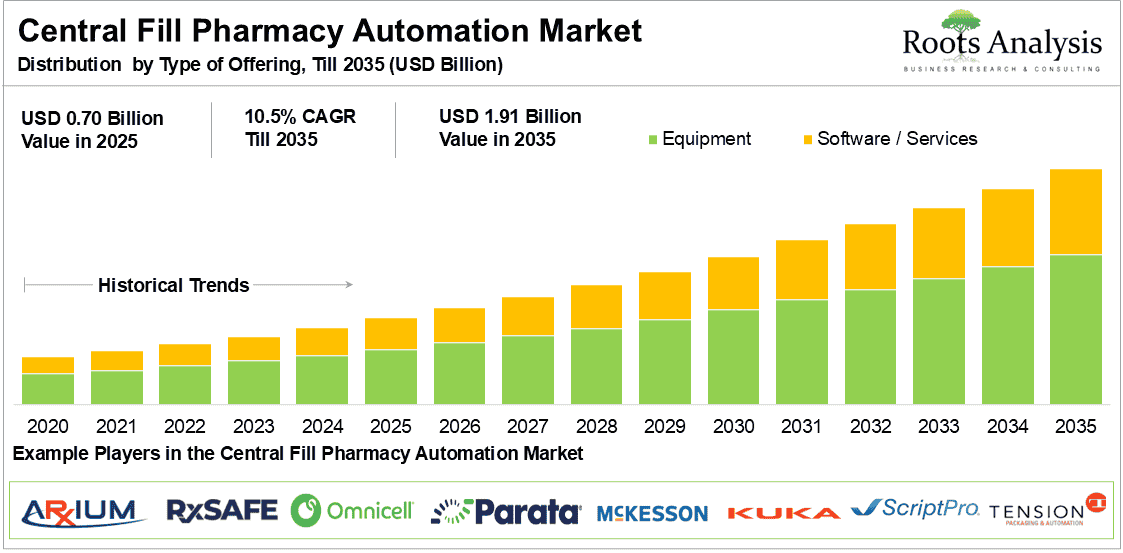
The global central fill pharmacy automation market size, valued at USD 0.62 billion in 2024, is projected to reach USD 0.70 billion in 2025 and USD 1.91 billion by 2035, representing a CAGR of 10.5% during the forecast period.
 |
- The global central fill pharmacy automation market is experiencing significant growth, driven by the increasing need for efficient and accurate medication dispensing in both hospital and retail pharmacies.
- The market for central fill pharmacy automation is expected to reach USD 1.91 billion by 2035, demonstrating a robust CAGR of 10.5% during the forecast period. This growth is fueled by factors such as the reduction of drug wastage and the rising demand for efficient pharmacy workflow optimization.
- The equipment segment dominates the market by holding nearly 65% of the revenue share. This highest share is driven by the increasing usage of automated medication dispensing, packaging, and labeling systems.
- The retail chain central fill facilities hold over 40% of the market share, leveraging automation to streamline medication dispensing. The mail-order and e-commerce pharmacy segment is expected to exhibit the highest CAGR.
- North America currently dominates the global market, accounting for nearly 45% of the overall revenue share. This is attributed to the high acceptance of automation, technological innovations, and a shift towards telehealth services.
- The market is highly competitive and fragmented, featuring the presence of several well-established, and new entrants. Notably, the market players, such as ARxIUM (Canada), Capsa Healthcare (US), ICU Medical (US), KUKA (Germany), and McKesson (US) are increasing initiatives to develop advanced central fill pharmacy automation systems.
- The market's future seems promising due to the rising technological innovations. The adoption of AI-powered solutions for real-time data collection and workflow optimization will be a significant trend. Notably, the expansion of telehealth services will also continue to transform patient experience and access to care, prompting industrial players to develop more innovative automated medication dispensing solutions.
Would Like to Preview the Actual Report?
Central Fill Pharmacy Automation Market Introduction
Central fill pharmacy automation is a form of system that helps in filling and dispensing medical prescription for hospital and retail pharmacies. These automated systems enhance accuracy by streamlining the centralized pharmacy operations, thereby reducing human errors in inventory management and medication delivery. With rising surge in telemedicine and digital health services, the demand for automation technologies has increased and pharmacists are also embracing this new trend to dispense medicine timely as well as inventory management.
Moreover, the automation tools also help to reduce drug wastage which pharmacies face due to medication expiration and overstocking. Central fill pharmacy automation systems also ensure that patients receive accurate prescription when ordered through digital platforms, further preventing incorrect fillings. Notably, the rising demand for central fill pharmacy automation has catered the industrial player’s attention to develop more automated solutions for pharmacy filling and dispensing of medication.
Market players, such as Mckesson (US), ARxIUM (Canada), Capsa Healthcare (US) and KUKA (Germany), are increasingly leveraging strategi initiatives for innovations. For instance, in July 2025, Capsa Healthcare (US) launched its consolidated services pharmacy platform (CSPP), industry’s first integrated scalable system that unifies the central fill automation and enterprise-wide distribution management into single system. Owing to the ongoing demand and rising industrial player initiatives, we believe central fill pharmacy automation market will continue to grow at a steady pace in the future.
Your Business is Unique – Why Shouldn’t Your Report Be?
Central Fill Pharmacy Automation Market: Report Attributes
| Key Report Attribute | Details | |
| Historical Trend | Since 2020 | |
| Forecast Period | Till 2035 | |
| Market Size 2025 | USD 0.70 Billion | |
| Market Size 2035 | USD 1.91 Billion | |
| CAGR (Till 2035) | 10.5% | |
One of the key objectives of the central fill finish automation market report was to estimate the current size, opportunity, and the market growth potential, over the forecast period, till 2035. We have provided informed estimates on the likely evolution of the market for the forecast period.
The global central fill finish automation market analysis also features the likely distribution of the current and forecasted opportunity within the market across various segments, such as type of offering, type of vendor, application area, type of throughput capacity, end user, geographical regions, and leading players.
In order to account for future uncertainties associated with some of the key parameters and to add robustness to our model, we have provided three market forecast scenarios, namely conservative, base, and optimistic scenarios, representing different tracks of industry’s evolution.
Recent Developments in Central Fill Finish Automation Market
Several recent developments in the field of central fill finish automation industry have occurred, and we outlined some of these below.
- In July 2025, Swisslog Healthcare (Switzerland), launched PillPick Octave, its latest model of the PillPick automated unit dose system. This newly launched system offers advanced medication, safety of patient specific medications and new functionality.
- In May 2025, Walgreens (US) aimed to double down the prescription-filling robots to cut down the cost of filling medication at its retail stores. The company also aims to free pharmacy staff’s turnaround time to fill thousands of prescriptions for patients who regularly take medication for managing high blood pressure, diabetes and other conditions.
- In May 2025, Walmart (US) announced to open the largest centralized prescription fulfillment facility in Frederic, Maryland. Walmart;s central fill pharmacy facility uses automation tools to streamline all steps of prescription fulfillment.
- In February 2025, Hanmi Pharmaceuticals (South Korea) launched Countmate, a fully automated vial dispensing machine which is tailored to meet unique preferences of the Canada and US market.
Want Information on Specific Region / Segment?
Central Fill Pharmacy Automation Market Segmentation Insights
The market report provides comprehensive information on central fill pharmacy automation industry players who are currently active across various segments of the industry as mentioned in the table below.
Central Fill Pharmacy Automation Market: Market Segmentation
| Market Segmentations | Details | |
| Type of Offering |
|
|
| Type of Vendor |
|
|
| Application Area |
|
|
| Type of Throughput Capacity |
|
|
| End User |
|
|
| Geographical Region |
|
|
| Market in North America |
|
|
| Market in Europe |
|
|
| Market in Asia-Pacific |
|
|
| Market in Middle East & Africa |
|
|
| Market in Latin America |
|
|
Industry Experts on Central Fill Pharmacy Automation Market
Central fill pharmacy automation systems play a pivotal role in today’s healthcare pharmacy. The integration of AI with central fill medication dispensing system can help to track the supply chain and make process more streamlined.
“The major impact of technology on pharmacy is the ability to track various operational and process metrics as well as clinical measures, such as drug cost per admission or number of clinical interventions. Tracking such measures is critical for the value-based care payment model as providers must report specific metrics to payers and demonstrate improvement.”, said Josh Jang Pharm D, Director of Pharmacy Analytics, McKesson Macro Helix.
Central Fill Pharmacy Automation Market Share Insights
Market Share by Type of Offering: What are the Major Product Segments Within the Central Fill Pharmacy Automation Market?
- This segment reflects the distribution of global market across different types of offering, such as equipment (automated medication dispensing systems, automated packaging and labeling systems, integrated workflow automation systems, automated tabletop counters, automated medication compounding systems, automated storage and retrieval systems, and others), and software / services (consulting, work flow optimization, facility designing, customer software development and others). Among these, the equipment segment holds nearly 65% of the central fill pharmacy market share. This dominance is due to the widespread adoption of automated medication, dispensing, packaging and labeling, medication compounding systems in pharmacies for streamlining workflow.
- It is important to note that due to the growing adoption of central fill pharmacy automation systems in pharmacies, this segment will continue to dominate and is likely to grow at a higher CAGR in the future.
Market Share by Type of Vendor: Does Equipment Vendor Continue to Maintain Dominance in the Future?
- Based on the type of vendor, the global market is categorized across different vendors, such as equipment vendors, and consulting vendors. According to the central fill pharmacy automation market forecast, the equipment vendor segment is dominating the market, and the trend is likely to remain dominant. This dominance is due to the fact that equipment vendor offer extensive range of product portfolios, including smart labels, and medical dispensing systems and offer greater accessibility to wide range of spare parts of equipment.
- It is important to highlight that the equipment vendor segment will continue to grow at the fastest CAGR during the forecast period. Equipment vendors are widely focusing on providing software and services for inventory management automation in pharmacy, which is likely to drive this segment growth in the future.
Market Share by Application Area: Why is Inpatient Pharmacy Using Central Fill Pharmacy Automation System?
- This segment highlights the distribution of global market across different application areas, such as inpatient pharmacy, outpatient pharmacy, and retail pharmacy. According to the central fill pharmacy automation market report, the inpatient pharmacy segment is dominating the industry by holding more than 40% share of the market. Central fill pharmacy automation is highly needed in inpatient pharmacy due to the complex nature of medication management.
- It is important to note that inpatient pharmacy segment will continue to grow at a higher CAGR in the future. The widespread adoption of automation technologies, such as automated dispensing cabinets, centralized fill systems, and inventory management to manage medication dispensing and management.
Market Share by Type of Throughput Capacity: Medium (5k–20k Rx / Day) Holds the Largest Share
- Based on the type of throughput capacity, the global market is segmented into Low (≤5k Rx / Day), Medium (5k–20k Rx / Day), and High (≥20k Rx / Day). According to our projection, the medium (5k–20k Rx / Day) segment occupies nearly 50% of the central fill pharmacy automation market share. Pharmacy with medium (5k–20k Rx / Day) are increasingly adopting AI in pharmacy automation systems to focus on efficient pouch packaging, barcode auditing, and optimized inventory cycling.
- Notably, the high (≥20k Rx / Day) segment is likely to grow at the fastest CAGR in the future. This lucrative growth is due to the increasing demand for high-throughput prescription fulfillment to balance dispensing, packaging and labeling along with inventory management in large pharmacies.
Market Share by End User: Does Retail Pharmacies Focus on Adopting Central Fill Pharmacy Automation Systems?
- Based on the end user, the global central fill pharmacy automation market is segmented into hospital-owned central pharmacies, retail chain central fill facilities, and mail order and e-commerce pharmacy. Based on the pharmacy automation industry analysis, the retail chain central fill facilities hold more than 40% of the market share. Retail pharmacies are leveraging the central fill pharmacy automation systems to streamline their medication dispensing and packaging cycle.
- In the future, the mail-order and e-commerce pharmacy segment is likely to exhibit a higher CAGR driven by the rising consumer preferences of online prescriptions.
Market Share by Geographical Regions: Regional Analysis of Central Fill Pharmacy Automation Adoption Rates
- The global market is distributed across North America, Europe, Asia-Pacific, Middle East and Africa, and Latin America. According to the central fill pharmacy automation market analysis, North America occupies nearly 45% of the overall revenue share. This dominance reflects the increasing acceptance of central fill pharmacy automation in pharmacies, technological innovations by industrial players and rising shift towards telehealth services.
- In Asia-Pacific, the market for central fill pharmacy automation is likely to grow at a higher CAGR during the forecast period. Increasing healthcare expenditure, adoption of telepharmacy, expanding pharmaceutical networks and government initiatives to support home healthcare is likely to grow the market in this region.
Central Fill Pharmacy Automation Market: Report Deliverables
| Report Deliverables | Details | |
| Excel Data Packs (Complimentary) |
Available | |
| Key Central Fill Pharmacy Automation Companies Profiled |
|
|
| PowerPoint Presentation (Complimentary) |
Available | |
| Customization Scope | 15% Free Customization | |
Central Fill Pharmacy Automation Market Key Takeaways
The "Central Fill Pharmacy Automation Market Report: Industry Trends and Global Forecasts, till 2035" market report features an extensive study of the current market landscape, market size, market share, market growth, market trends, market value, market forecast, market outlook, statistics, and future opportunities for central fill pharmacy automation equipment / services providers. The market research report lays emphasis on the central full pharmacy automation technologies that are being developed for pharmaceutical companies. Key takeaways of the market report are briefly discussed below.
Market Competitive Landscape: How Industrial Players are Leveraging Competition in the Market?
With the immense burden on pharmacy to meet daily prescription requirements, this market seems highly competitive. Overall, the market is highly fragmented into small, mid-sized and large companies who are aiming to develop advanced automated fill pharmacy, dispensing and workflow automation systems. Notably, the market players, such as Mckesson (US), and Omnicell (US) are focusing on strategic initiatives to leverage artificial intelligence to develop automated drug dispensing systems, automated medication compounding systems and pharmacy management software systems. As more market players focus on innovation, the automated prescription fulfillment market is likely to remain competitive in the future.
Market Size Analysis: How are Central Fill Automation Trends Shaping the Market?
In 2025, the central fill pharmacy automation market size is valued at USD 0.70 billion. Several factors, such as drug wastage due to excessive storage and rising demand for efficient tools for pharmacy workflow optimization are driving the market growth. Furthermore, the growing emphasis on data-driven logistical hubs to reduce medication errors are offering significant opportunities to market players to transform pharmacies into fully automated drug dispensing and managing eco-systems.
Market Drivers: What are the Main Drivers Fueling Demand for Central Fill Pharmacy Automation Systems?
Several central fill pharmacy automation market growth factors that are driving the market are listed below:
Lack of Skilled Labor: How Medication Error Reduction Technology Can Helps to Deal with Labor Shortage?
The pharmacy industry is witnessing a critical shortage of skilled labor and pharmacists. The lack of skilled personnel exacerbates high wage pressure, which further compels pharmacies to seek robotic prescription dispensing systems. Notably, the integration of AI based central fill pharmacy systems reduce error chances by automating the pharmacy operation, thereby reducing the labor cost of hiring skilled forces, drug wastage and enhance operational viability.
Expansion of Mail-Order and E-Commerce Pharmacy Channels: How is the Expansion of Mail-Order and E-Commerce Pharmacy Channels Affecting Market Growth?
With growing emphasis on telehealth services and remote consultation, the healthcare industry is shifting towards remote medication dispensing. This shift towards remote prescription dispensing has accelerated the growth of mail-order and e-commerce pharmacy channels. Notably, this fundamental shift towards e-commerce and mail order requires a robust pharmacy supply chain digitization system for the smooth distribution of medical prescription to consumers.
Market Challenges: What Key Challenges or Barriers are Limiting Wider Adoption of Central Fill Pharmacy Automation?
Despite the high adoption, the market for central fill pharmacy automation is witnessing several challenges that are listed below:
Regulatory Compliance Challenges in Central Fill Pharmacy Automation
It is worth mentioning that the central fill pharmacy automation industry operates within a complex regulatory landscape. Pharmacies are required to meet stringent government regulations for managing and dispensing medicine across the retailers and patients. In addition, the pharmacy industry also needs to adhere with data exchange legacy system to ensure complete safety of medication dispensing during supply. Therefore, these stringent guidelines associated with central fill pharmacy automation may pose a significant challenge for the market players.
High Capital Expenditure Requirements
Notably, the installation of central fill pharmacy system requires substantial investment which can exceed up to USD 1 million. In addition, fill pharmacy automation systems require regular maintenance and software update which further increases the overall expenditure on these systems. This significant upfront investment in equipment, software and subscription fees may create challenges for small to mid-size pharmacies.
Have Questions? Let’s Get Them Answered.
Market Trends: What are the Top Central Fill Automation Trends?
Some of the promising trends that are likely to accelerate the growth of the market are listed below:
Telemedicine and Telehealth Services Expansion
With increasing concern of chronic conditions and aging population, healthcare industry is widely accepting telemedicine and telehealth services to help patients live a quality life. Notably, the integration of telehealth with central fill pharmacy automation solutions also facilitates remote consultation, near-instant medication dispensing, and prescription verification.
This indicates that automation is transforming patient experience and access to care, which further encourages industrial players to develop more innovative solutions for automated medication dispensing.
Artificial Intelligence and Machine Learning
Notably, the future central fill pharmacy automation market is further driven by the advancements in AI capabilities and machine learning. The industrial players are focusing on the integration of AI software in central fill pharmacy platforms to enhance precision with real-time data collection approach. Interestingly, the integration of AI algorithms can help to optimize pharmacy operation and reduce medication errors to maintain a smooth supply chain.
Central Fill Pharmacy Automation Market Report Coverage
The market report presents an in-depth analysis, highlighting the capabilities of various stakeholders in the central fill pharmacy automation industry, across different geographies. Amongst other elements, the market report includes:
- An Infographic Executive Summary
- Regulatory Scenario
- Comprehensive Database of Leading Players
- Competitive Landscape
- Porter’s Five Forces Analysis
- Company Competitiveness Analysis
- Startup Ecosystem in the Central Fill Pharmacy Automation Market
- Company Profiles
- Partnerships and Collaborations
- Market Opportunity Analysis
- Adjacent Market Analysis
- Key Winning Strategies
- Value Chain Analysis
Glossary
- Automated Medication Dispensing System (AMDS): It refers to the Computer-controlled systems that automatically select, count, and package prescription medications with minimal human intervention.
- Inventory Management System: This refers to software platforms that track medication stock levels, expiration dates, and reorder requirements in automated pharmacy environments.
- Machine Learning: It is a form of artificial intelligence technology that enables systems to automatically learn and improve from experience without explicit programming.
- Mail-Order Pharmacy: It is a form of prescription fulfillment services that deliver medications directly to patients' homes, often utilizing central fill automation for processing.
From the Author’s Desk
Author’s View on Central Fill Pharmacy Automation Market
The market for central fill pharmacy automation demonstrates significant growth potential due to the widespread adoption across pharmacies, technological advancements, rising mail order and e-commerce medication services to deliver medications at home. Additionally, the market's evolution toward AI-powered, purpose-built automation solutions positions it as an essential component of future healthcare infrastructure, promising improved patient outcomes, enhanced operational efficiency, and sustainable cost management for healthcare organizations of all sizes.
Customization Opportunities
At Roots Analysis, we genuinely care about your success and understand that your business requirements are unique. While our market research reports provide valuable insights, we recognize that they might not cover every aspect you need to make well-informed strategic decisions. To account for that, we offer 15% free report customization tailored to your specific needs. Whether you require additional quantitative analysis, qualitative insights, or any other information related to the electric vehicles market, reach out to us today at support@rootsanalysis.com
Your Business is Unique – Why Shouldn’t Your Report Be?!


