
Lowest Price Guaranteed
Pages
237
Last Updated
April 2025
View Count
17326
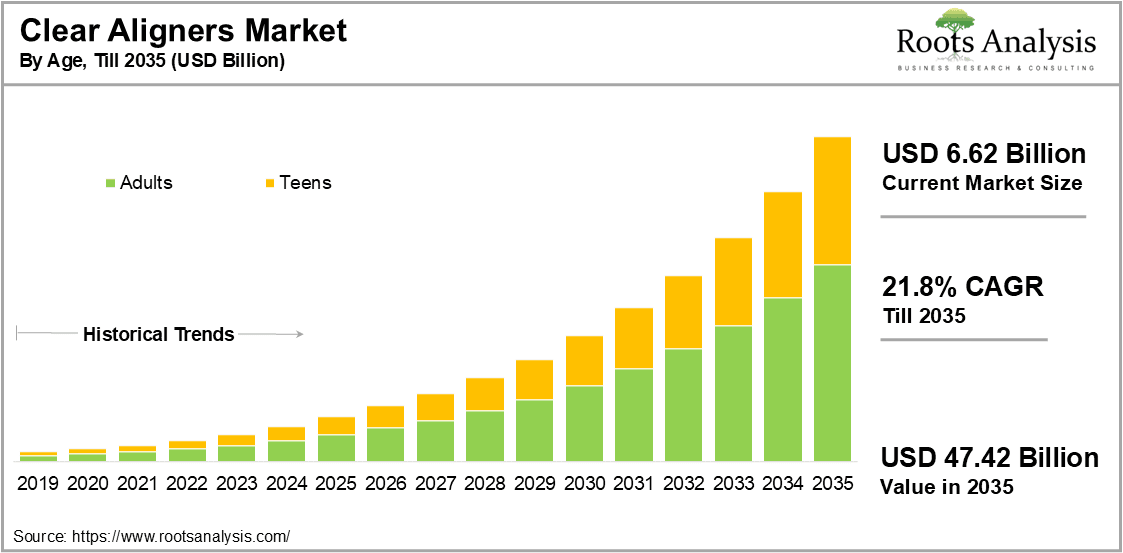
The global clear aligners market is estimated to grow from USD 6.62 billion in 2025 to USD 47.42 billion by 2035, representing a compounded annual growth rate (CAGR) of 21.8% during the forecast period.
 |
To learn more about this report, request a free sample copy
With rising technological advancements, orthodontic treatment landscape has significantly transformed, offering convenient and comfortable alternative to treat teeth misalignment. It is important to highlight here that teeth misalignment or malocclusion is one of major dental issues affecting population worldwide. A recent review report published in July 2024, the incidence of malocclusion ranged from 28.4% to 83.9% globally. The highest percentage of malocclusion patients was in Asia (61.81%). Teeth misalignment, such as crossbite, crowded teeth, overbite and underbite can result into jaw muscle pain, speech issue, and pressure from misaligned teeth can also cause headache issues. Moreover, plaque and bacteria easily build up around misaligned teeth which leads to tooth decay and other health problems.
Although traditional metal braces are available to fix alignment of teeth, these braces are uncomfortable to wear, come with dietary restrictions, require frequent orthodontist visits for maintenance and are highly visible. In order to address these challenges, clear aligners emerge as a potential solution to treat teeth malocclusion, offering convenience, comfort and minimal maintenance. Clear aligners are custom-designed mouthpieces that are used to treat misaligned and crooked teeth. These clear aligners are designed using advanced 3D dental printing, 3D modeling and computer aided design technology. Further, clear aligners are made by using thermoplastic elastomers that is nearly transparent and apply mild pressure on the teeth to correct alignment. Each series of clear aligners has to be worn for two weeks, thereby reducing the time required for treatment and dentist visits.
Owing to the benefits offered by clear aligners, patients are adopting these aligners for the treatment of malocclusion. In order to enhance its adoption, several orthodontists and industrial players are focusing on educating patients about clear aligners and their benefits over traditional braces. Moreover, several industrial players are emphasizing on technological innovations to make robust presence in the growing industry. For instance, in July 2024, Stratasys announced launch of DentaJet™, a groundbreaking dental 3D printing technology that is aimed to design clear aligners, large print trays, crowns, bridges and dental implants with higher precision while reducing the cost.
In November 2024, Align Technology announced the 2025 Annual Research Award Program that is launched to support the clinical and scientific research pertaining to orthodontics and dentistry field. As stated by Dr. Mitra Derakhshan (Vice President and Chief Clinical Officer, Align Technology), “This program continues to generate much scientific and clinical interest from university researchers around the globe to further expand the quality of treatment outcomes and patient care as well as biology of tooth movement with clear aligners. We look forward to reviewing the wide variety of applications from researchers focused on advancing the field of dental science.” As market players continue to expand their innovations, investments and technologies, we believe that clear aligners market will grow at a steady pace during the forecast period, making it investible industry for long term.
The market report provide comprehensive details on the key players of the industry who are presently active across different segments of this field as mentioned in the table below.
| Key Report Attributes | Details | |
| Historical Trend | Since 2019 | |
| Forecast Period | Till 2035 | |
| Market Size 2035 | USD 47.42 billion | |
| CAGR | ~21.8% | |
| By Age |
|
|
| Type of Material |
|
|
| End User |
|
|
| Distribution Channel |
|
|
| Duration of Treatment |
|
|
| Geographical Regions |
|
|
| Key Companies Profiled |
|
|
| PowerPoint Presentation (Complimentary) |
Available | |
| Customization Scope | 15% Free Customization | |
| Excel Data Packs (Complimentary) |
Available | |
One of the key objectives of the clear aligners market report was to estimate the current market size, opportunity and the market growth potential, over the forecast period, till 2035. We have provided informed estimates on the likely evolution of the market for the forecast period.
Additionally, the market report features the likely distribution of the current and forecasted opportunity within the market distributed across various segments such as age (adults and teens), type of material (polyurethane plastic, polyethylene terephthalate glycol, poly-vinyl chloride and other materials), end user (hospitals, dental and orthodontic clinics, and other end users), distribution channel (online and offline), type of duration (comprehensive malfunction (treatment > 12 months/ > 40 sets of aligners), medium treatments (treatment > 6-12 months/ 20-40 sets of aligners), small little beauty alignments (treatment <4-6 months/ <20 sets aligners)), geographical regions (North America, Europe, Asia-Pacific, Middle East and North Africa, and Latin America), and leading players.
To account for the uncertainties associated with the development of dental tourism and to add robustness to our model, we have provided three market forecast scenarios, portraying the conservative, base and optimistic tracks of the market’s evolution. All actual figures have been sourced and analyzed from publicly available information forums and primary research discussions. Financial figures mentioned in this market research report are in USD, unless otherwise specified.
Based on the patient age, the global clear aligners market is segmented into adults and teens. According to our analysis, currently, clear aligners for adults account for the highest share (61%) of the market. This is likely to be the result of the high prevalence of dental problems such as malocclusion in adult population. Teeth misalignment impacts speech of the individual and causes swallowing issues. Furthermore, adults are more concerned about beauty standards and dental appearance play a significant role in overall aesthetic appearance, which is expected to be key reason for widespread adoption of clear aligners by adult population.
However, in the long run, clear aligners for teens are anticipated to grow at a higher CAGR during the forecast period. This lucrative growth is due to the growing preferences of clear aligners or invisible aligners by teenager patients to avoid discomfort that occurs due to metal braces.
The global clear aligners market is segmented on the basis of type of material into polyurethane plastic, polyethylene terephthalate glycol, poly-vinyl chloride and other materials. Currently, polyurethane plastic accounts for the highest share (77%) of the market. Polyurethane plastics have higher elasticity, flexibility and durability which makes it an ideal option for designing clear aligners. Owing to the high elasticity and flexibility, polyurethane plastic can easily contour according to the individuals’ teeth anatomy. Driven by the widespread adoption of polyurethane plastic for designing clear aligners, this segment will continue to grow at a higher CAGR during the forecast period.
The global market is distributed across various end users, such as hospitals, dental and orthodontic clinics, and other end users. According to our projection, currently hospitals account for the highest clear aligners market share (nearly 40%). Hospitals have specialized facilities to perform complex aligner-based dental treatment and are equipped with experienced orthodontists. Furthermore, the orthodontists in hospitals offer advanced facilities such as 3D printing and aligner systems that help in designing clear aligners and monitoring progress.
However, in the long run, dental and orthodontic clinics segment is expected to register higher CAGR during the forecast period. This can be attributed to the growing preferences for specialized misaligned teeth treatment and personal care by the patients.
Based on the distribution channel, the global clear aligners market is segmented into online and offline channels. According to our analysis, offline channels occupy the highest share (nearly 75%) of the market. This high share is due to the fact that clear aligners are majorly distributed or sold through offline channels such as orthodontic clinics, dental offices and hospitals.
However, due to the ongoing trend of selling products direct to the consumer through online channels, this segment is likely to grow at a higher CAGR during the forecast period.
The global market is categorized based on type of duration into comprehensive malfunction (treatment > 12 months/ > 40 sets of aligners), medium treatments (treatment > 6-12 months/ 20-40 sets of aligners), small little beauty alignments (treatment <4-6 months/ <20 sets aligners). According to our projection, the medium treatments (treatment > 6-12 months/ 20-40 sets of aligners) account for the highest clear aligners market share. This can be attributed to the fact that clear aligners have been designed specifically for short treatment duration. Moreover, this medium treatment duration offers effective results based on the patients’ preferences without extending the time. Driven by the growing preferences for short-term duration treatment, this segment will continue to grow at a steady rate during the forecast period.
Based on the geographical regions, the clear aligners market value is distributed across North America, Europe, Asia-Pacific, Middle East and North Africa, and Latin America. Among these, presently North America accounts for the dominating position in the market, holding 57% of overall revenue share. This highest share is due to the fact that this region has experienced continuous research for the development of advanced orthodontic procedures such as clear aligners, implants and dental crowns to fix misaligned teeth. It is worth noting here that in 2021, 3M introduced next-generation clear aligner system, Clarity™ Aligners Flex, that allow complete customized aligners designing. In addition to technological innovations, rising awareness about wide range of clear aligners to treat misaligned teeth and increasing demand for clear aligners to meet beauty standards has further propelled the market in this region.
However, it is worth mentioning here that the market for clear aligners in Asia-Pacific is expected to grow at a higher CAGR during the forecast period. This can be attributed to the growing demand for clear aligners due to aesthetic appeal and increasing dental tourism in Asian countries like India. According to a research study conducted in India the high prevalence of malocclusion among children (8-15 years) in India is 35.40%. This high patient pool of malocclusion in Asian countries has underscored the demand for clear aligners in this region.
The “Clear Aligners Market: Industry Trends and Global Forecasts, till 2035” market report features an extensive study of the current market landscape, market size, market share, market growth, market trends, market value, market forecast, market outlook, statistics and future opportunities for clear aligners manufacturers. The market research report lays emphasis on the novel aligners that are being developed for the treatment of misaligned teeth.
Currently, the market landscape comprises of a wide array of industrial players including well-established and new entrants. Key players of the industry, such as Align Technology, Ormco and Straumann are presently focusing on the development of advanced clear aligners and printing technologies that enable custom-designing of aligner models to meet the unmet requirement of patients. Moreover, industrial players are taking strategic initiatives followed by investments, fund raising and collaborations to enhance product portfolio.
For instance, in October 2024, Barings announced to lend financial support for the Zabel Companies’ purchase of GCDL, a dental laboratory specialized in clear aligners, implant designing, orthodontic digital dentures and crowns. As stated by Scott Chappell (Managing Director, Global Private Finance Group, Barings),” With comprehensive product offerings and best-in-class customer service, GCDL provides important resources to its customers across the dental industry. We are confident Zabel’s significant experience supporting founder owned businesses develop and execute upon a well-defined strategy will position the Company for accelerated growth.” As more industrial players continue to take strategic initiatives in this field, we believe that the clear aligners market will remain competitive during the forecast period.
The market for clear aligners is witnessing an unprecedented growth driven by the rising incidence of malocclusion and increasing demand for cosmetic dentistry. According to recent research study published March 2024, WHO has ranked malocclusion has the third most critical dental health concern, impacting almost 39% to 93% of teenagers and adolescents. Thus, high penetration rate of malocclusion has increased the demand for advanced clear aligners to fixed misaligned teeth. In addition to malocclusion, the rising shift towards cosmetic dentistry to improve aesthetic appearance has further contributed to the growth of the market. Moreover, increasing awareness about clear aligners to treat misaligned teeth is gaining attention of the population across the globe.
Despite higher adoption, the market for clear aligners witnesses challenges that may hinder industry progress. Some of the top challenges are the high cost of clear aligners and availability of other treatment options. It is worth highlighting here that clear aligners are more expensive than traditional aligners. For instance, the average cost of clear aligners in United States may ranges from USD 1,200 to USD 10,000. The high cost may limit the adoption of clear aligners by patients across the globe. Additionally, the lack of medical insurance coverage or reimbursement policies may further limit the adoption of clear aligners for the treatment of misaligned teeth. Moreover, the availability of affordable traditional treatment may restraint the clear aligners market growth.
Some of the top trends that are propelling clear aligners market growth include increasing demand for clear aligners, raising research for improved products and technological innovations. Clear aligners are nearly invisible and custom-made to meet patient preferences, anticipated to be a key reason for rising adoption. Furthermore, the growing technological advances to create customized clear aligners has created enormous opportunities for industrial players to take strategic initiatives.
Some of the latest technological innovations that are driving industry are dental 3D printing, 4D printing in healthcare and AI predictive modeling that enable custom designing of clear aligners by predicting tooth movement. Dental 3D printing is helping with production challenges. Airnivol, an Italy based aligner manufacturer, is using Stratasys’ DentaJet XL 3D printer. As stated by Prof. Armando Razionale, Airnivol "The new Super High-Speed Mode allowed us to significantly increase our production of clear aligners by nearly 50%, without adding any additional labor and at a much-reduced cost per part”. Moreover, market players are focusing on material innovations such as multi-layers thermoplastic polymers that offer more flexibility and strength to clear aligners.
Presently, the global clear aligners market is expected to be valued at USD 6.62 billion in 2025. With increasing incidence of malocclusion / misaligned teeth, there has been surge in the demand for clear aligners to fix alignment of the teeth. Clear aligners are more comfortable than traditional braces and easy to clean, making it a preferable choice for the individuals requiring malocclusion treatment.
It is important to highlight here that with growing demand, several industrial players are consolidating their research by leveraging advanced technologies for the development of clear aligners. For instance, in May 2024, Ormco recently announced the launch of its new program “Spark On-Demand Program” that enabled dentists to order multiple number of Spark clear aligners and Prezurv Plus retainers. With growing initiatives by industrial leaders, we believe that the market for clear aligners will continue to grow at a CAGR of 21.8% during the forecast period.
Examples of key clear aligners manufacturing companies (which have also been profiled in this market report; the complete list of companies is available in the full report) include 3M ESPE, Align Technology, Angel Aligner, Argen, Dentsply Sirona, Envista, Glidewell, Institut Straumann (Parent Company Straumann), Henry Schein, Ormco, SmileDirect Club and TP Orthodontics. This market report includes an easily searchable excel database of all the companies developing clear aligners.
Several recent developments have taken place in the field of clear aligners, some of which have been outlined below.