
Lowest Price Guaranteed
Pages
213
Last Updated
August 2025
View Count
16553
The global compounding pharmacy market size is estimated to grow from USD 15.6 billion in 2024 to USD 31.8 billion by 2035, representing a higher compounded annual growth rate (CAGR) of ~7% during the forecast period, till 2035.
Pharmaceutical compounding is the science of customizing therapeutic drugs to meet a patient's requirements. With technical advances and a growing understanding of the human genome, pharmacists can create personalized medicine to treat specific diseases that cannot be treated with conventional drugs. It is worth noting here that patients on prolonged medication face challenges in adhering to their medication due to several factors such as allergies, intolerance towards certain substances, wrong dosage form, swallowing difficulties, and taste preferences.
Based on the type of products, the compounding pharmacy industry has been segmented into topical, oral, rectal, nasal and ophthalmic drugs. According to our market study, oral products account for the largest current share of the market, capturing 41% of the overall revenue. The highest market share can be attributed to the fact that oral medications are easy to administer, pain-free and available in different forms such as capsules, powders, tablets and even in liquid form.
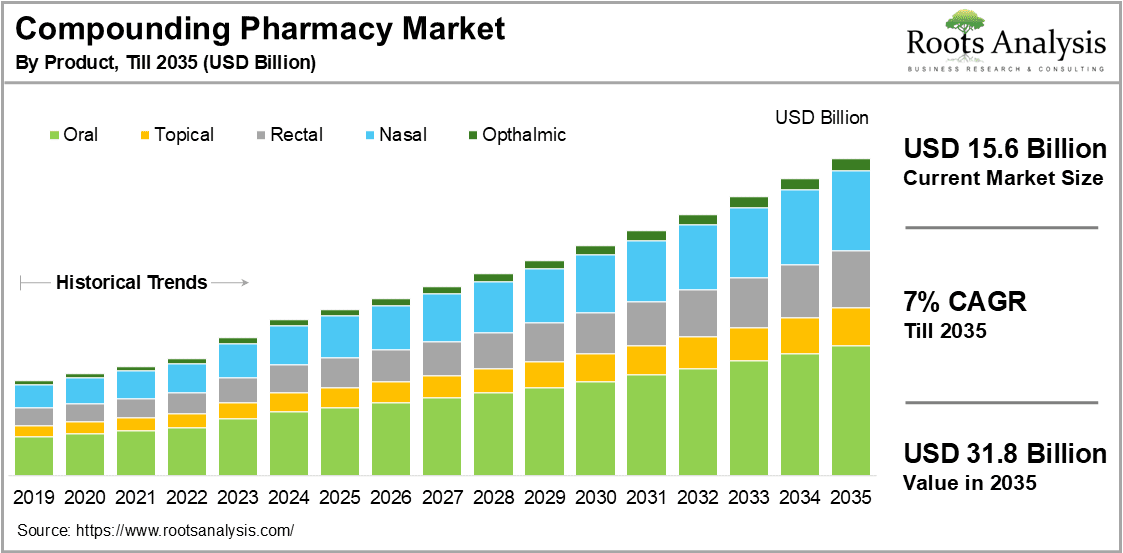 |
Furthermore, the highest preferences of oral medication by geriatric and pediatric population are likely to be the major reasons for the highest growth share of this market. It is worth highlighting here that the trend of growth is likely to remain unchanged during the forecast period and oral products will grow at a higher CAGR during the forecast period.
Based on the therapeutic applications, the global compounding pharmacy market is distributed into pain management, hormone replacement therapy, dermal disorder, nutritional supplements, and other therapeutic applications. In terms of therapeutic applications, pain management accounts for holding a significant share of the market, capturing 33% of the current revenue share. The growth of the pain management segment is likely due to the rising incidence of chronic diseases, accidents, and cancer that result in prolonged pain and discomfort. However, nutritional supplements are likely to grow at a higher CAGR during the forecast period owing to the increasing preferences for beauty and wellness products to maintain youthful skin.
Based on the sterility type, the compounding pharmacy market is segmented into sterile and non-sterile therapeutic compounds. According to our projection, sterile segment accounts for 59% of the current overall revenues. This can be attributed to the continuous demand for sterile personalized drugs to meet patient’s specific requirement.
On the basis of the type of end-user, the global market has been distributed across pediatric, adults, geriatric and veterinary users. Driven by the increasing geriatric population with chronic conditions, the adult segment accounts for the largest share, capturing 47% of the current compounding pharmacy market. The highest growth share is likely to be the result of growing incidence of chronic diseases among adults which underscores the requirement of personalized therapeutics drugs. In the long run, adults’ segment is likely to grow at a higher CAGR during the forecast period driven by the growing awareness about compounding pharmacy to treat chronic conditions.
Based on the compounding type, the market is segmented into Pharmaceutical Ingredient Alteration (PIA), Currently Unavailable Pharmaceutical Manufacturing (CUPM), Pharmaceutical Dosage Alteration (PDA), and Others. According to our projection, pharmaceutical ingredient alteration currently accounts for 37% of overall revenue share. The highest growth share can be attributed to the high demand for compounded medications that involve altered pharmaceutical ingredients to meet with patient’s specific requirements. It is worth highlighting here that the trend of growth is likely to remain unchanged during the projected period.
Based on geographical insight, the global compounding pharmacy market value has been distributed across North America, Europe, Asia-Pacific, and the rest of the world. According to our projection, North America currently occupies 44% of overall revenue share. The increasing demand for personalized medicine and high disposable income to spend on pharmacy services in North America are the key drivers that are anticipated to propel the market in this region. In order to serve the need for personalized medicine, US based LRockRx opened its Little Rock, Arkansas facility in December 2024. At the same time, some compounding pharmacies are expanding their operations such as Strive Compounding Pharmacy, which acquired a nearly 50,000 sq. ft. facility in St. Louis, MO in November 2024.” In the long run, the compound pharmacy market in Asia-Pacific will grow at a higher CAGR during the forecast period. The lucrative growth potential is likely due to the increasing geriatric population with chronic conditions that require advanced therapeutics to manage disease indications.
The “Compounding Pharmacy Market: Industry Trends and Future Forecast, till 2035” market report features a detailed study of the current market landscape, market size, market forecast and future opportunities for the compounding pharmacies, also known as outsourcing facilities. Further, the market research report underlines an in-depth analysis, highlighting the capabilities of service providers engaged in the market.
Currently, the market landscape features the presence of several well-established and small companies holding the required expertise to develop compounded pharmaceuticals. In order to maintain a competitive edge, various industrial leaders active in this field are focusing on the innovation and development of advanced drug formulation with customized active pharmaceutical ingredients. For instance, in February 2023, Harrow (a leading eye care pharmaceutical firm in the United States) announced the availability of its next generation compounded Atropine. This patent-pending compounded drug is available through ImprimixRx, Harrow’s wholly owned compounding and mail order pharmacy subsidiary.
A number of generic drug companies are also launching their compounding pharmacy arms. In January 2022, Hikma had launched its 503B outsourcing business in the US, offering sterile compounding of drugs. As the demand for compounding pharmacy increase, we believe a lot of new industrial leaders will show keen interest in this field and take considerable initiatives for the development of novel compounded drugs.
The growing aging population across the globe and the increase in demand for customized therapeutic drugs to meet individual patient's requirements are the key drivers of the compounding pharmacies market. With growing age, individuals may face chronic disease conditions such as rheumatoid arthritis, osteoporosis, diabetes, dementia, depression, hypertension, and chronic obstructive pulmonary disease. Elderly patients may require tailored therapeutic drugs for chronic condition management that conventional therapeutic drugs do not address.
Additionally, older patients may also suffer from dysphagia (swallowing difficulty), which causes problems in taking prescribed medicines. Furthermore, some patients may require multiple medications for disease management each day, resulting in adverse drug interactions. Owing to these challenges, an older person may skip their daily dosage, which makes their condition worse. In these instances, compounding medicinal drugs into one single form can eliminate the need for multiple dosages. Furthermore, compounding medication with different delivery methods, such as sublingual or torches, can solve the problem of swallowing drugs. Hence, the demand for customized medicine by the geriatric population is anticipated as a significant driver for compounding pharmacy market growth, propelling this industry during the forecast period.
The growing awareness about critical health-associated concerns such as acute depression, mood swings, erectile longevity, osteoporosis, and breast / bone health has raised the demand for compounded hormone replacement therapy. It is worth highlighting here that the growing prevalence of unhealthy lifestyle-associated disorders such as hormonal issues, fertility-related problems, obesity, depression, and stress has further increased the demand for hormonal replacement therapy medication. Consequently, combining active pharmaceutical ingredients such as estrogen, progesterone, estradiol, testosterone, and other hormonal combinations can help to treat lifestyle-associated disorders. As the demand for combinational hormone replacement therapy increases to target other applications, the compounding pharmacy market is projected to grow at a steady pace.
Compounding pharmacy requires a completely sterile environment and highly trained professionals or pharmacists. The lack of trained pharmacists and lab workers in the existing industry hinders the compounding pharmacy market growth. Further, the high cost of maintaining a sterile environment to produce compound pharmacies might restrain the market in the coming years. The unsafe usage of combined pharmaceutical drugs can cause severe health issues, which also become a major challenge for pharmaceutical players. In addition, complex regulatory scenarios for the approval of compound therapeutic drugs may impact the market growth during the projected period. Some therapeutic drugs are not for compounding or are not allowed to be compounded by the FDA. The increase in the number of prohibited drugs for compounding is estimated to impact the industry negatively.
Driven by the increase in the requirement for special drug formulations for pain management, chronic disease treatment, and lifestyle-related diseases, the market for specialized compounding pharmacies is expanding substantially. Additionally, the increasing awareness about the treatment of health issues such as obesity and depression has bolstered the demand for compounding pharmacies. It is worth highlighting here that preventive treatment has gained momentum to minimize the risk of chronic disease development, which further necessitates the production of compounding drugs.
Moreover, technological advances such as robotics and artificial intelligence in compounding processes help to enhance the efficiency, precision, and safety of compounded drugs. Nephron Pharmaceuticals, that runs a 503b outsourcing facility in the US, is using robotic systems / aseptic fill finish machine for filling of compounded drugs in to IV bags and syringes. Integration of advanced technologies in compounding processes may facilitate the approval from the regulatory authorities, which is further likely to increase the development of these modified drugs. The expansion of e-pharmacy and telehealth services is also facilitating easy access to these types of medications, creating significant opportunities for key players for manufacturing compounding medicines.
As a result of these developments, several outsourcing facilities have announced capacity expansions. In February 2024, Empower Pharmacy announced its plans to purchase a manufacturing facility from Eugia to meet the growing demand for compounded drugs.
Examples of the leading companies engaged in the compounding pharmacy industry (the complete list of the players active in the industry has been listed in the market report) are mentioned below.
Albertsons Companies, Apollo Clinical Pharmacy, Aurora Compounding, B. Braun Melsungen, Custom Med Apothecary, Fresenius Kabi, Fagron, Formul8, Fusion Apothecary, Galenic Laboratories (Roseway Labs), Institutional Pharmacy Solutions, JL Diekman and AQ Touchard (Fresh Therapeutics Compounding Pharmacy), Letco Medical, Olympia Pharmacy, PharMEDium Services, Walgreen, Wedgewood Pharmacy.
This market report includes an easily searchable excel database of all the companies providing compounding pharmacy, worldwide.
This market report features an in-depth analysis of various companies that are active in the global compounding pharmacy industry across different segments, as defined in the table below.
| Key Report Attributes | Details | |
| Historical Trend | Since 2019 | |
| Forecast Period | 10+ Years | |
| Future Trend | Till 2035 | |
| Market Size 2035 | USD 31.8 billion | |
| Market CAGR | ~7% | |
| Distribution by Products |
|
|
| Distribution by Therapeutic Areas |
|
|
| Distribution by Route of Administration |
|
|
| Distribution by Sterility Type |
|
|
| Distribution by End User |
|
|
| Distribution by Compounding Type |
|
|
| Key Geographical Region |
|
|
| Key Companies Profiled |
|
|
| PowerPoint Presentation (Complimentary) |
Available | |
| Customization Scope | 15% Free Customization | |
| Excel Data Packs (Complimentary) |
|
|
The key objective of this compounding pharmacy market report was to estimate the current market size, value, trends, opportunities, and future growth potential during the projected period. Based on multiple parameters, like adoption trends, evolutions, rising demand, research, and validation, we have provided an informed estimate of the market evolution during the forecast period, till 2035. The research report also highlights the likely distribution of the current and future opportunities for the market leaders active across various segments such as type of products, therapeutic areas, route of administration, end-user, and geographical region. In order to account for future uncertainties associated with some of the key parameters and to add robustness to our model, we have provided three market forecast scenarios, namely conservative, base, and optimistic scenarios, representing different tracks of the industry’s evolution.
All actual figures have been sourced and analyzed from publicly available information forums and primary research discussions. Financial figures mentioned in this market report are in USD, unless otherwise specified.
Several recent developments have taken place in the field of compounding pharmacy. We have outlined some of these recent initiatives below. These developments, even if they took place post the release of our market report, substantiate the overall market trends that have been outlined in our analysis.