Congenital Heart Defect Devices Market
Congenital Heart Defect Devices Market: Industry Trends and Global Forecast, Till 2035 - Distribution by Type of Device, Type of Defect, Application Areas, Type of Technology, Type of Patient Group, End User, Geographical Regions (North America, Europe, Asia-Pacific, Middle East and North Africa, and Latin America) and Leading Players
-
Lowest Price Guaranteed
-
Pages
180 -
Last Updated
July 2026 -
View Count
11001 -
Congenital Heart Defect Devices Market Overview
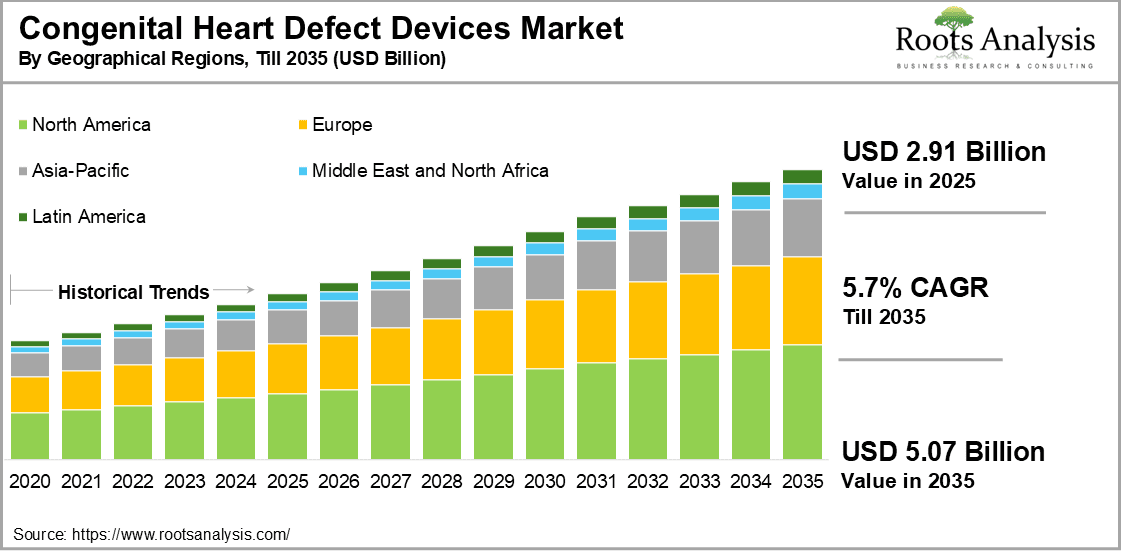
The global congenital heart defect devices market, valued at USD 2.72 billion in 2024, is projected to reach USD 2.91 billion in 2025 and USD 5.07 billion by 2035, representing a CAGR of 5.7% during the forecast period.
 |
The global market for congenital heart defect devices is witnessing an upward trajectory driven by the growing risk of chronic cardiovascular diseases. Congenital heart defect refers to the structural problems that result due to abnormal development of baby heart during pregnancy.
This heart defect can disrupt the blood flow and the problem ranges from mild to severe defects, if remain untreated. As per the data published by Centers for Disease Control and Prevention, every year around 40,000 babies are born with heart defect in the US. Ventricular septal defect is one of the most common congenital heart defect conditions. This defect generally requires surgical treatment or congenital heart defect devices to treat the condition and improve patients’ life.
Driven by the ongoing demand, several industry players are aiming to develop advanced congenital heart defect devices that aid in treating patients with congenital heart defect devices. For instance, in August 2024, Renata Medical announced that the USFDA approved a Minima Growth Stent, the first-of-its-kind device that helps to keep blood vessel open for use in infants, newborns and children who have narrow pulmonary artery and aorta. The coronary drug eluting stent can expand as they age, meaning these children do not require additional surgeries as they grow. Furthermore, in October 2024, six medical technology innovators who are presently focused on pediatric cardiology received grants of USD 50,000 each in the “Make Your Medical Device Pitch for Kids!TM competition in Toronto.
Bloom Standard, Compremium AG, Massachusetts Institute of Technology, OxiWear, PyrAmes and Sibel Health are the companies who have received the funds to accelerate their research and clinical care for patients born with single ventricle heart defects. Driven by the ongoing initiatives, we believe that the congenital heart defect devices market is expected to grow at a steady rate during the forecast period.
Congenital Heart Defect Devices Market Segmentation Insights
The market report provides comprehensive information on industrial players who are currently active across various segments of the industry as mentioned in the table below.
Congenital Heart Defect Devices Market: Report Attributes / Market Segmentation
| Key Report Attributes | Details | |
| Historical Trend | Since 2020 | |
| Forecast Period | Till 2035 | |
| Market Size 2025 | USD 2.91 Billion | |
| Market Size 2035 | USD 5.07 Billion | |
| CAGR till 2035 | 5.7% | |
| Type of Device |
|
|
| Type of Defect |
|
|
| Application Area |
|
|
| Type of Technology |
|
|
| Type of Patient Group |
|
|
| End User |
|
|
| Geographical Regions |
|
|
| Key Companies Profiled |
|
|
| PowerPoint Presentation (Complimentary) |
Available | |
| Customization Scope | 15% Free Customization | |
| Excel Data Packs (Complimentary) |
Available | |
One of the key objectives of the market report was to estimate the current congenital heart defect devices market size, opportunity, and the market growth potential, over the forecast period, till 2035. We have provided informed estimates on the likely evolution of the market for the forecast period.
The market analysis report also features the likely distribution of the current and forecasted opportunity within the market across various segments, such as type of device (catheters, pacemakers (single chamber pacemaker, dual chamber pacemaker, biventricular pacemaker and leadless pacemaker), implantable cardioverter defibrillators, biventricular devices, implanted cardiac loop recorders and others), type of defect (atrial septal defect, ventricular septal defect, atrioventricular septal defect, tricuspid atresia, truncus arteriosus and other defect types), application area (atrial septal defect (ASD), ventricular septal defect (VSD) and patency of ductus arteriosus (PDA)), type of technology (mechanical closure devices, biological closure devices and self-expanding closure devices), type of patient group (pediatric patients and adult patients), by end user (hospitals, cardiac catheterization labs and ambulatory surgical centers), geographical regions (North America, Europe, Asia-Pacific, Middle East and North Africa, and Latin America) and leading players.
In order to account for future uncertainties associated with some of the key parameters and to add robustness to our model, we have provided three global congenital heart defect devices market forecast scenarios, namely conservative, base, and optimistic scenarios, representing different tracks of industry’s evolution.
All actual figures have been sourced and analyzed from publicly available information forums and primary research discussions. The financial figures mentioned in this market report are in USD, unless otherwise specified.
Congenital Heart Defect Devices Market Share Insights
Market Share by Type of Device
Based on the type of device, the global market is segmented into catheters, pacemakers (single chamber pacemaker, dual chamber pacemaker, biventricular pacemaker and leadless pacemaker), implantable cardioverter defibrillators, biventricular devices, implanted cardiac loop recorders and others.
According to our congenital heart defect devices market report, presently catheters segment accounts for the highest share (nearly 30%) of the market. This can be attributed to the fact that cardiac catheter devices are widely adopted for the correction of congenital heart defects as they are minimally invasive options to open heart surgery. This catheter device helps doctors to repair heart defects through minor blood vessel punctures, leading to faster recovery. Driven by the ongoing adoption, this segment is likely to register a higher CAGR during the forecast period.
Market Share by Type of Defect
On the basis of defect type, the global market is bifurcated into atrial septal defect, ventricular septal defect, atrioventricular septal defect, tricuspid atresia, truncus arteriosus and other defect types. According to our congenital heart defect devices market analysis, the ventricular septal defect segment accounts for the largest share of the market. This can be attributed to the fact that ventricular septal defects are among the common congenital heart defects. Devices, such as catheters and congenital heart defect devices are widely used for closure for different types of ventricular septal defects. It is important to highlight here that this segment is likely to register a higher CAGR during the forecast period.
Market Share by Application Area
Based on the application area, the global market is further categorized into atrial septal defect (ASD), ventricular septal defect (VSD) and patency of ductus arteriosus (PDA). Presently, VSD segment occupies the highest share of the congenital heart defect devices report. This is potentially due to the increasing incidence of patients with ventricular septal defect that necessitated the demand for advanced heart defect devices to improve patient outcomes. It is worth mentioning that this segment will continue to maintain its dominance and is likely to grow at a steady CAGR during the forecast period.
Market Share by Type of Technology
This segment highlights the distribution of global market across different types of technology, such as mechanical closure devices, biological closure devices and self-expanding closure devices. According to our congenital heart defect devices market size, presently self-expanding closure devices segment accounts for the highest share of the market. This can be attributed to the fact that self-expanding closure device is a minimal invasive approach that involves inserting of catheter into blood vessels to treat heart opening. The device is specifically designed to anchor themselves inside the heart and close the abnormal opening itself.
Furthermore, the self-expanding closure device made with nitinol mesh is a shape-memory that allows expansion to desired shape with time. Driven by the growing demand for minimal invasive procedures, this segment will continue to grow at a higher CAGR during the forecast period.
Market Share by Type of Patient Group
The global market is further bifurcated across different type of patient group, such as pediatric patients and adult patients. Among these, pediatric patients’ segment is dominating the congenital heart defect devices market, and the trend is likely to remain unchanged during the forecast period. This can be attributed to the growing demand for early diagnosis and devices interventions for pediatric patients with complex congenital heart defects.
However, it is worth mentioning that the adults’ segment is expected to register a higher CAGR during the forecast period. This lucrative growth is likely to be the result of growing focus on treating adult patients with mild to severe congenital heart defects.
Market Share by End User
Based on the end user, the global market is segmented into hospitals, cardiac catheterization labs and ambulatory surgical centers. Currently, the hospitals segment holds the highest share of the market for congenital heart defect devices. This can be attributed to the rising patient pools in hospitals of congenital heart defects and patient’s preferences to receive treatment from specialized cardiologists available in healthcare settings. Furthermore, the availability of advanced healthcare infrastructure is likely to remain dominant and is projected to grow at a higher CAGR during the forecast period.
Market Share by Geographical Regions
Based on the geographical regions, the global market is distributed across North America, Europe, Asia-Pacific, Middle East and North Africa, and Latin America. According to our congenital heart defect devices market analysis, North America accounts for the highest share (nearly 40%) of the market. This can be attributed to the rising incidence of congenital heart defects and rising expenditure on advanced heart defect devices to treat patients.
However, in Asia-Pacific, the market for congenital heart defect devices is likely to register a higher CAGR during the forecast period. This is primarily due to the growing government initiatives to develop advanced treatment solutions for patients with congenital heart defects.
Congenital Heart Defect Devices Market Dynamic Insights
The “Congenital Heart Defect Devices Market: Industry Trends and Global Forecasts, till 2035” market report features an extensive study of the current market landscape, market size, market share, market growth, market trends, market value, market forecast, market outlook, statistics, and future opportunities for congenital heart defect devices developers and manufacturers. The market research report lays emphasis on the congenital heart defect products that are being developed. Key takeaways of the market report are briefly discussed below.
Congenital Heart Defect Devices Market Competitive Landscape
Currently, the global market for congenital heart defect devices is immensely competitive, featuring the presence of several well-established and new entrants. Majority of the market players, such as Abbott, Pfizer and Thermo Fisher Scientific, are undertaking strategic initiatives to drive the development of advanced congenital heart defect devices.
Additionally, companies have also launched some innovative products in the market. In May 2024, Japan based consortium of Teijin Limited, Fukui Tateami Co., Ltd., and Osaka Medical and Pharmaceutical University announced the approval of first-of-its-kind surgical patch SYNFOLIUM®. Made from knitted fabric consisting of both bio-absorbable and non-absorbable yarns, the patch is designed to be used in surgical treatment of patients with congenital heart disease.
Even academic institutes are actively working on the development of innovative products for congenital heart defects. In April 2025, Northwestern University announced the development of the world’s smallest light-activated pacemaker that is injected into the body with a tiny syringe. It is particularly helpful in pediatric patients who need temporary pacing post-surgery. Driven by the growing initiatives, the industry is likely to remain competitive during the forecast period.
Market Drivers: Increasing Prevalence of Minimally Invasive Congenital Heart Defect Treatment Devices and Demand for Minimal Invasive Procedures
The market for congenital heart defect devices is expected to be propelled by the increasing incidence of congenital heart defects and heightened demand for minimally invasive procedures.
Additionally, increasing awareness and research on congenital heart defects and effective treatment options are expected to drive the market during the forecast period. Furthermore, the bolstered demand for state-of-the-art medical devices is accelerating the industrial players’ initiative during the forecast period.
Congenital Heart Defect Devices Market Challenges: High Cost, Limited Treatment and Complex Regulatory Guidelines
Despite growing demand, several factors that may hinder market growth include high cost associated with congenital heart defect devices and limited treatment options. It is worth mentioning that the treatment of congenital heart defect devices is highly expensive, which may limit its adoption across patients in low to middle income countries. Additionally, the stringent guidelines associated with the approval and launch of congenital heart defect devices may create challenges for the market players.
Congenital Heart Defect Devices Market Trends: Technological Innovations and Focus on Congenital Heart Defect Devices for Pediatric Patients
Some of the notable trends that are driving the market growth include technological innovations and a focus on pediatric patient care. It is worth mentioning that currently the industrial players are focusing on minimal invasive surgeries and transcatheter interventions that offer significance, such as faster recovery and short hospital stays. Additionally, the industrial players are aiming to develop biodegradable devices specifically for pediatric patients to enhance the patient survival rate.
Congenital Heart Defect Devices Market Size Analysis
Presently, the global congenital heart defect devices industry is estimated to be valued at USD 2.91 billion in 2025 and is poised to reach USD 5.07 billion by 2035, representing a CAGR of 5.7% during the forecast period. The market is expected to be propelled by the rising partnerships and collaborations between industrial players to develop advanced congenital heart defect devices. For instance, in May 2024, SMT (Sahajanand Medical Technologies) and HeartX entered into the partnership to focus on the development of devices for patients with congenital heart defects. As more market players continue to focus on innovations in this field, we believe that this market will continue to grow at a steady pace over the forecasted period.
Leading Companies in Congenital Heart Defect Devices Market
Examples of key players engaged in this domain (which have also been captured in this report) include Abbott, ABIOMED, Boston Scientific, BD, Biotronik, Edwards Lifesciences, GE Healthcare, Gore Medical, OSYPKA MEDICAL and St.Jude Medical. This market report includes an easily searchable excel database of all the companies focusing on the development of congenital heart defect devices.
Congenital Heart Defect Devices Market Report Coverage
The market report presents an in-depth analysis, highlighting the capabilities of various device developers engaged in this domain across different segments. Amongst other elements, the market report includes:
- A preface providing an introduction to the full report, Congenital Heart Defect Devices Market, 2020-2024 (Historical Trends), and Future Forecast till 2035 (Forecasted Estimates).
- An outline of the systematic research methodology adopted to conduct the study on the congenital heart defect devices, providing insights on the various assumptions, methodologies, and quality control measures employed to ensure the accuracy and reliability of our findings.
- An overview of economic factors that impact the global congenital heart defect devices industry, including historical trends, currency fluctuation, foreign exchange impact, recession, and inflation measurement.
- An executive summary of the insights captured during our research. It offers a high-level view of the current state of the market for congenital heart defect devices and its evolution in the mid-and long-term.
- A detailed assessment of the congenital heart defect devices market landscape is based on several relevant parameters, including years of experience, company size, headquarters location, and ownership structure.
- Elaborated profiles of prominent players engaged in offering congenital heart defect devices, featuring information on their year of establishment, location of headquarters, company size, company mission, company footprint, management team, contact details, financial information, operating business segments, congenital heart defect devices product portfolio, recent developments, and an informed future outlook.
- A discussion on affiliated trends, key drivers, and challenges under a SWOT framework, which is likely to impact the industry's evolution, along with a Harvey ball analysis, highlighting the relative effect of each SWOT parameter on the overall congenital heart defect devices industry.
- A market impact analysis features a discussion on the factors that can impact the congenital heart defect devices market growth.
- A detailed estimate of the current market size and the future growth potential of the market for congenital heart defect devices over the next decade. Based on multiple parameters, we have provided an informed estimate of the market's evolution during the forecast period till 2035. The report also features the likely distribution of current and forecasted opportunities within the congenital heart defect devices industry. Further, in order to account for future uncertainties and to add robustness to our model, we have provided three forecast scenarios, namely conservative, base, and optimistic scenarios, representing different tracks of the industry’s growth.
- Detailed projections of the current and future congenital heart defect devices market across various types of devices, including catheters, pacemakers (single chamber pacemaker, dual chamber pacemaker, biventricular pacemaker and leadless pacemaker), implantable cardioverter defibrillators, biventricular devices, implanted cardiac loop recorders and others.
- Detailed projections of the current and future market opportunity for device developers working on congenital heart defect devices across various types of defects, including atrial septal defect, ventricular septal defect, atrioventricular septal defect, tricuspid atresia, truncus arteriosus and other defect types.
- Detailed projections of the current and future congenital heart defect devices market size across various application areas, including atrial septal defect (ASD), ventricular septal defect (VSD) and patency of ductus arteriosus (PDA).
- Detailed projections of the current and future market for congenital heart defect devices across various types of technology, including mechanical closure devices, biological closure devices and self-expanding closure devices.
- Detailed projections of the current and future congenital heart defect devices industry across various types of patient group, including pediatric patients and adult patients.
- Detailed projections of the current and future congenital heart defect devices market across various types of end user, including hospitals, cardiac catheterization labs and ambulatory surgical centers.
- Detailed projections of the current and future market for congenital heart defect devices across various key geographical regions, such as North America (US, Canada and Mexico), Europe (France, Germany, Italy, Spain, UK and Rest of Europe), Asia-Pacific (China, India, Japan, South Korea, and Rest of the Asia-Pacific), Middle East and North Africa (Egypt, Saudi Arabia and UAE), and Latin America (Argentina and Brazil).
Recent Developments in Congenital Heart Defect Devices Market
Several recent developments have taken place in the field of congenital heart defect devices. We have outlined some of these recent initiatives below.
- In January 2025, BrightHeart presented at the society for maternal-fetal medicine 2025 pregnancy meeting which was held in Aurora, Colorado. The aim of the presentation was to present the key studies (focused on congenital heart defects) of the company’s artificial intelligence software.
- In November 2024, Doctors of University Hospital Southampton carried out a dual-chamber pacemaker procedure to transform the lives of patients suffering from congenital heart defects, specifically irregular heart rhythms.
- In May 2024, Teijin and its consortium partners Fukui Tateami, Osaka Medical and Pharmaceutical University released Synfolium, a new cardiovascular surgical patch made with bio-absorbable and non-absorable yarns primarily coated with cross-linked gelatin to treat patients with congenital heart disease.
- In April 2024, Abbott announced the FDA clearance to the company’s first-of-its-kind TriClip transcatheter edge-to-edge repair system specifically designed to treat patients with tricuspid regurgitation or a leaky tricuspid valve.