
Lowest Price Guaranteed
Slides
237
Last Updated
July 2026
View Count
12812
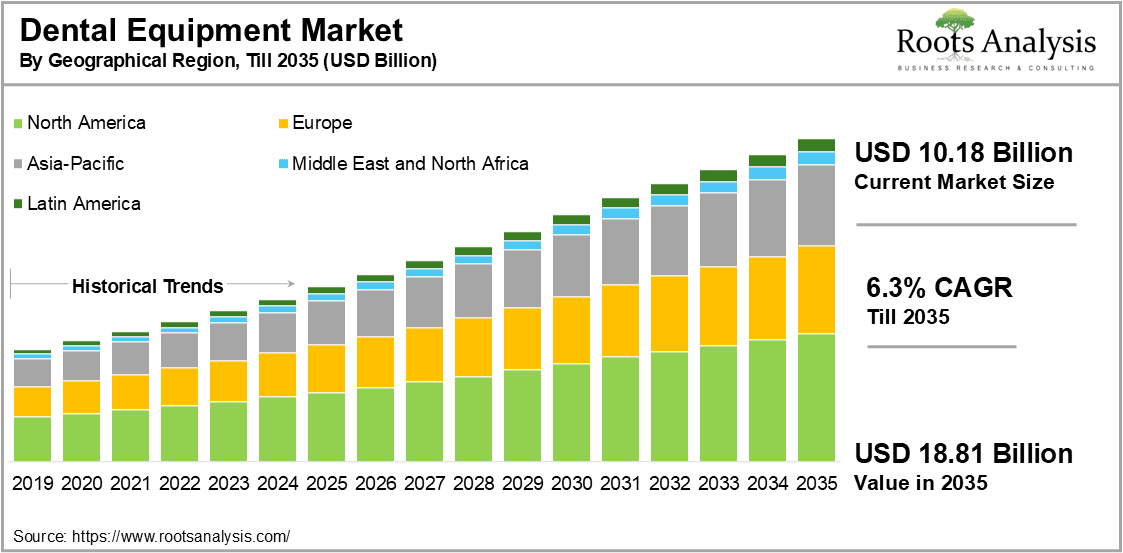
The global dental equipment market size, valued at USD 9.45 billion in 2024, is expected to reach USD 10.18 billion in 2025 and USD 18.81 billion by 2035, representing a CAGR of 6.3% during the forecast period.
 |
To learn more about this report, request a free sample copy
Dental equipment / instruments refer to the tools and technologies specifically designed to perform dental procedures. Some of the common dental equipment that are used to examine oral diseases and treatment include scalers, mirrors, electrosurgical equipment and computer-aided design and manufacturing (CAD / CAM). Currently, the dental equipment industry is experiencing a transformative shift driven by the rising prevalence of dental disorders such as malocclusion, tooth decay, and oral cancer.
According to the World Health Organization (WHO), nearly 3.5 billion people across the globe are suffering from dental conditions. Among these, nearly 2 billion people are suffering from dental caries in permanent teeth. Further, oro-dental trauma is estimated to affect around 1 billion people across the globe. Similar to other body parts, oral wellbeing is also important to achieve overall health. With growing concern about dental issues due to poor eating habits, misalignment and consistent use of carcinogenic substances, there is a surge in the demand for advanced dental equipment that aids in treating patients on time.
The demand for dental equipment has further been increased by the growing trend of cosmetic dentistry to achieve visibly brighter teeth. Notably, advanced dental equipment, such as CAD / CAM, dental lasers and dental systems are currently being adopted on a large scale for dental treatments and hygiene routine. In order to make treatment more sophisticated with a real-time approach, the key players of the market are focusing on bringing artificial intelligence and dental 3D printing technology.
These technologies help in designing dental implants and other vital 3D dental models to treat dental disorders such as malocclusion. In addition to dental equipment for treatment, the industrial players are focusing on using AI intelligence with dental imaging tools / technologies to enhance diagnostics accuracy and facilitating treatment remotely. Recently in December 2024, a team of researchers from the Faculty of Dentistry at HKU (University of Hong Kong) developed GUM AI (mobile dental health solution that combines artificial intelligence). This advanced tool helps in oral health screening of geriatric population and offers tailored oral care guidance.
The integration of AI enhances dental checkups, improved efficiency and reduces time to provide treatment. Moreover, technology also helps in facilitating early detection of oral health problems. In addition to technological innovations, the industrial players and organizations are aiming to make considerable investments in dental equipment to deliver high quality dental care to the patients and streamline dental treatment education. For instance, in August 2024, Case Western Reserve University School of Dental Medicine invested USD 2.6 million to upgrade its Simulation Clinic located in the Samson Pavilion. This investment will be utilized in state-of-the-art facility equipped with advanced A-dec dental simulation equipment that will enhance preclinical patient simulation curriculum in endodontics, digital dentistry, operative dentistry, prosthodontics, and implant dentistry to the highest possible level.
Owing to the growing innovations by both industry and non-industry players, and investments made, we believe that dental equipment market will continue to grow at a steady rate during the forecast period.
The market report provides comprehensive information on the key players of the dental equipment industry who are presently active across various segments as mentioned in the table below.
| Key Report Attributes | Details | |
| Historical Trend | Since 2019 | |
| Forecast Period | Till 2035 | |
| Current Market Size | USD 10.18 Billion | |
| Market Size 2035 | USD 18.81 Billion | |
| CAGR (Till 2035) | 6.3% | |
| Type of Product |
|
|
| Type of Treatment |
|
|
| End User |
|
|
| Geographical Regions |
|
|
| Key Companies Profiled |
|
|
| PowerPoint Presentation (Complimentary) |
Available | |
| Customization Scope | 15% Free Customization | |
| Excel Data Packs (Complimentary) |
Available | |
One of the key objectives of the dental equipment market report was to estimate the current size, opportunity and the market growth potential, over the forecast period, till 2035. We have provided informed estimates on the likely evolution of the market for the forecast period.
The global dental equipment market analysis report also features the likely distribution of the current and forecasted opportunity within the market across various segments, such as Type of Product (dental radiology equipment (intra-oral radiology equipment (digital X-ray units and digital sensors), extra-oral radiology equipment (digital units and analog units), dental lasers, diode lasers (quantum well lasers, distributed feedback lasers, vertical cavity surface emitting lasers, heterostructure lasers, quantum cascade lasers, separate confinement heterostructure lasers and vertical external cavity surface emitting lasers), carbon dioxide lasers and yttrium aluminum garnet lasers), dental system & parts (instrument delivery systems, vacuums & compressors, cone beam CT systems, cast machine, furnace and ovens, electrosurgical equipment, CAD / CAM, and other system and parts), laboratory machines (ceramic furnaces, hydraulic press, electronic waxer, suction unit and micro motor), hygiene maintenance devices (sterilizers, air purification & filters and hypodermic needle incinerator) and other equipment (chairs, hand piece, light cure and scaling unit), type of treatment (restorative, orthodontic, endodontic, periodontic and prosthodontic), end user (laboratories, dental hospitals and clinics and other end users), geographical region (North America, Europe, Asia-Pacific, Middle East and North Africa, and Latin America) and leading players.
In order to account for future uncertainties associated with some of the key parameters and to add robustness to our model, we have provided three market forecast scenarios, namely conservative, base, and optimistic scenarios, representing different tracks of industry’s evolution.
All actual figures have been sourced and analyzed from publicly available information forums and primary research discussions. The financial figures mentioned in this market report are in USD, unless otherwise specified.
Based on the type of product, the global dental equipment market size is segmented into dental radiology equipment (intra-oral radiology equipment (digital X-ray units and digital sensors), extra-oral radiology equipment (digital units and analog units), dental lasers, diode lasers (quantum well lasers, distributed feedback lasers, vertical cavity surface emitting lasers, heterostructure lasers, quantum cascade lasers, separate confinement heterostructure lasers and vertical external cavity surface emitting lasers), carbon dioxide lasers and yttrium aluminum garnet lasers)), dental system & parts (instrument delivery systems, vacuums & compressors, cone beam CT systems, cast machine, furnace and ovens, electrosurgical equipment, CAD / CAM, and other system and parts), laboratory machines (ceramic furnaces, hydraulic press, electronic waxer, suction unit and micro motor), hygiene maintenance devices (sterilizers, air purification & filters and hypodermic needle incinerator) and other equipment (chairs, hand piece, light cure and scaling unit).
According to our projection, currently, dental system & parts occupies the highest revenue share (nearly 40%) of the market. This can be attributed to the fact that dental system & parts such as cone beam CT systems, electrosurgical equipment, CAD / CAM are the crucial tools for performing dental procedures, which is anticipated to be a key reason for highest growth share.
However, in the long run, the dental laser segment is estimated to grow at a higher CAGR during the forecast period. This is likely to be the result of high demand for dental laser solutions such as diode lasers, quantum cascade lasers and vertical external cavity surface emitting lasers for removing damaged tissues near teeth and reshaping gym tissues with higher precision. Additionally, the rising geriatric population with dental issues has necessitated the demand for minimal invasive procedures like dental lasers to treat damage teeth.
This segment highlights the distribution of global dental equipment market size across different types of treatment, such as restorative, orthodontic, endodontic, periodontic and prosthodontic. According to our projection, orthodontic treatment is dominating the market by holding the highest share. Orthodontic (including invisible orthodontics) treatment includes preventative and corrective procedures to correct misaligned teeth. Owing to the growing incidence of malocclusion, orthodontic treatment is in high demand, which is expected to be the primitive reason for highest share.
However, in the long run, prosthodontic treatment is expected to grow at a faster CAGR during the forecast period. This is primarily due to the fact that prosthodontic dentistry requires advanced dental equipment and tools for dental repairs. Moreover, this segment is also gaining traction in the future driven by the rising shift towards cosmetic dentistry and dental prostheses for achieving aesthetic appearance.
Based on the end user, the global market is distributed into laboratories, dental hospitals and clinics and other end users. According to our market study, currently dental hospitals and clinics segment accounts for the largest dental equipment market share (60%). This can be attributed to the growing demand for advanced dental equipment in dental hospitals and clinics for orthodontics, prosthodontic and restorative treatment. Moreover, hospitals and clinicians witness a large pool of patients with dental issues and injuries.
Additionally, increasing requirements for advanced dental implants for medical aesthetic procedures have further increased the demand for dental equipment in hospitals and clinics. In addition, the availability of experienced orthodontists in hospitals and clinics has further supported the highest share of this segment. Driven by the growing adoption of dental equipment in hospitals and clinics, this segment will continue to grow at a higher CAGR during the forecast period.
The global market is distributed across different geographical regions, such as North America, Europe, Asia-Pacific, Middle East and North Africa, and Latin America. According to our projection, presently North America occupies the highest dental equipment market share (nearly 40%). This is likely to be the result of advanced healthcare infrastructure, increasing adoption of innovative technologies and rising population of dental disorders.
In Asia-Pacific, the market for dental equipment is estimated to grow at a higher CAGR during the forecast period. This is primarily due to the growing expenditure on advanced healthcare infrastructure and technologies to promote complete dental care. Moreover, rising dental tourism activities in Asian countries, such as India, Malaysia and Thailand has increased the demand for advanced dental treatment equipment.
The “Dental Equipment Market: Industry Trends and Global Forecasts, till 2035” research report features an extensive study of the focus on competitive landscape of strategic initiatives, emerging mega trends, big pharma initiatives, company profiles and key drivers and restraints. The market report highlights the efforts of several stakeholders engaged in this rapidly evolving segment of the medical device industry. Key takeaways of the market data analysis are briefly discussed below.
Currently, the market landscape is immensely competitive, witnessing the presence of a wide array of well-established and new entrants. The primary aim of the industrial players is to provide the next generation dental equipment for restorative and orthodontic equipment. In order to leverage competitive edge, several industrial players are forging strategic partnerships, collaborations, acquisition and latest product launch. For instance, in August 2024, UptimeHealth and Darby Dental Supply entered into a strategic partnership to enhance compliance management and operational efficiency for dental practices in US and introduce customers to Darby Dispatch.
Furthermore, in October 2024, Align Technology announced that its latest innovation (the Invisalign® Palatal Expander System) isavailable to the UAE doctors. Overall, the market seems highly competitive, featuring the presence of several small, mid-sized and large companies. As more market players continue to innovate dental equipment by leveraging cutting-edge technologies, we believe that the dental equipment market will remain competitive throughout the projected period.
The global market for dental equipment is continually witnessing an upward trajectory driven by the rising incidence of dental disorder across the globe. According to the Centers for Disease Control and Prevention, around 21% of the adult population (aged 20-64 years) had one or more untreated tooth decay. This rising prevalence of dental disorders has necessitated the demand for advanced dental equipment to treat patients.
In addition to the rising prevalence of dental disorders, demand for personalized dental treatment to achieve aesthetic appearance goals has further fueled the demand for cosmetic dentistry equipment. Moreover, the increasing technological advancements such as CAD / CAM systems, digital imaging and laser dentistry for improved patient outcomes has further contributed to the unprecedented dental equipment market growth.
Advanced dental equipment plays a significant role in improving oral health of global population. Despite rising demand, there are several challenges facing the dental equipment market that may hinder the adoption of advanced technologies for dental treatment. Some notable challenges are high equipment cost, installation cost and maintenance expenditures. Furthermore, dental equipment manufacturers are required to follow regulatory guidelines to ensure safety and efficacy of tools / technologies for dental procedures. In addition, lack of skilled personnel to operate advanced dental equipment may impede the adoption on a large scale.
Some of the latest trends that are anticipated to propel the market during the forecast period include telehealth, adoption of AI technology and 3D printing. It is worth noting that tele dentistry is amongst the popular trends that has increased the demand for digital imaging technology and CAD / CAM systems to deliver optimal care. In addition, industrial players are consistently adopting AI technology to enable real-time diagnosis and treatment.
Moreover, 3D printing medical device technology is increasingly adopted by the industrial players for the development of customized aligners to treat malocclusion. Furthermore, cosmetic dentistry is consistently gaining popularity to achieve aesthetic appearance, which is again estimated to drive the demand for advanced dental equipment.
Presently, the global market for dental equipment is expected to be valued at USD 10.18 billion and is poised to reach USD 18.81 billion by 2035. With rising demand for dental equipment for restorative and orthodontic procedures, the market is estimated to grow at a higher CAGR of 6.3% during the forecast period. In order to drive innovation in the industry, several market players are taking strategic initiatives followed by collaboration and partnerships. For instance, in October 2024, Philips announced a strategic partnership with Aspen Dental to bring Philips Sonicare to Aspen Dental’s national network of more than 1,100 locations. With this strategic partnership, Aspen Dental’s clinicians are able to provide Philips Sonicare solutions including Philips Sonicare ExpertClean (featuring built-in smart sensors) for brushing. Moreover, practitioners also utilize Philips Sonicare Cordless Power Flosser and Teeth Whitening kits solutions, the latest range of at-home teeth whitening.
Examples of key players engaged in this dental equipment industry (which have also been captured in this report) include 3M, A-Dec, Align Technologies, Biolase, Carestream Health, Danaher, Dentsply Sirona, GC, Pearl, Planmeca, Patterson Companies and Straumann. This market report includes an easily searchable excel database of all the companies focusing on dental equipment and solutions.
The market report presents an in-depth analysis, highlighting the capabilities of various companies engaged in this domain across different segments. Amongst other elements, the market report includes:
Several recent developments have taken place in the dental equipment field. We have outlined some of these recent initiatives below.