
Lowest Price Guaranteed
Slides
238
Last Updated
March 2025
View Count
14469
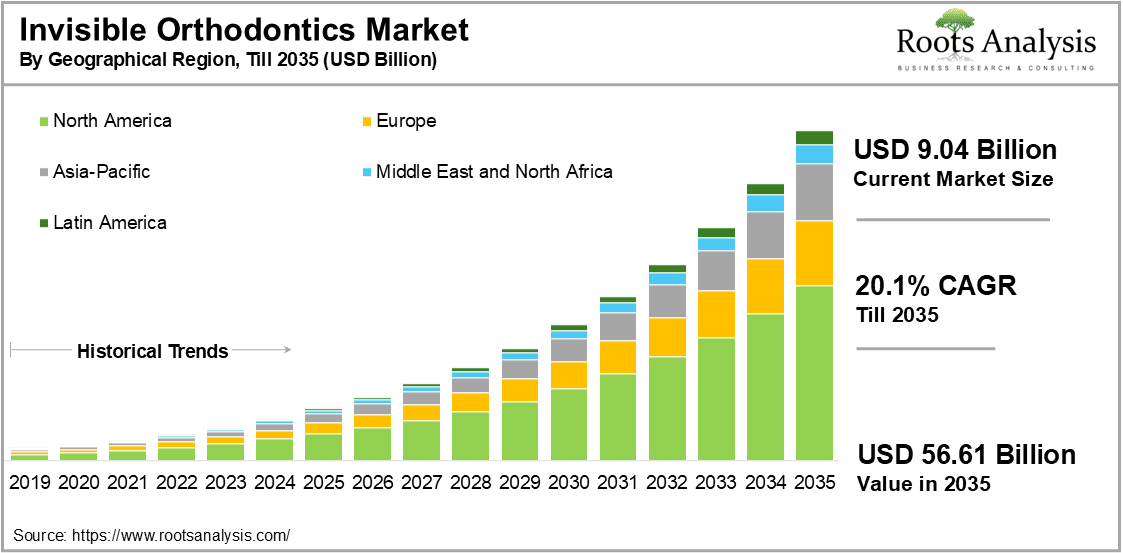
The global invisible orthodontics market is currently valued at USD 9.04 billion and is poised to reach at USD 56.61 billion by 2035, representing a CAGR of 20.1% during the forecast period.
 |
To learn more about this report, request a free sample copy
Invisible orthodontics refers to the form of dental treatment that involves Invisalign or clear aligners and braces to correct misaligned teeth. With growing incidence of malocclusion across the globe and rising concern of aesthetic appearance, there is a surge in the demand for invisible orthodontics. Unlike metallic braces, invisible orthodontics are visibly attractive, comfortable to wear and require short recovery time, which becomes a primitive reason for widespread adoption of invisible orthodontics by people.
According to a published report, the prevalence of malocclusion is around 39% to 93% among children and adolescents. Moreover, the World Health Organization has also considered malocclusion as amongst the crucial reasons of oral health problems. Invisible orthodontics treatment is custom designed to meet patient preferences and treat misaligned teeth.
Advanced technologies, such as 3D dental printing and computer aided design technology have made it possible to design aligners and braces with thermoplastic material which is transparent. Beyond the aesthetic appearance, malocclusion also impacts on the overall oral health, which further raises the demand for invisible orthodontics.
Owing to the rising demand, several industrial players are aiming to advance their efforts for the development of innovative invisible orthodontics. However, the primary focus will be on technological advancements that aid in designing tailored invisible aligners. For instance, in November 2024, Align Technology announced that its Invisalign® (a palatal expander system) received CE Mark in Europe under the Medical Device Regulation (MDR 2017 / 745). This palatal expander system is useful to direct 3D printed device during patient treatment. Moreover, the system has been designed for rapid expansion and holding of dental narrow maxilla / skeletal with primary, mixed and permanent dentition.
Earlier, in September 2024, OrthoFX™ announced the launch of NiTime™ clear aligners in India. This is first-of-its kind aligner system exceptionally designed for shorter wear times and received the USFDA clearance. As stated by Ren Menon, (Co-founder, OrthoFX),” NiTime Clear Aligners represent the most significant advancement in polymer science that the orthodontic industry has seen in decades. This innovation reflects our commitment to addressing real treatment challenges faced by providers and their patients. Unlike leading aligner manufacturers who use off-the-shelf materials such as Zendura A and Zendura FLX, OrthoFX is the only manufacturer utilizing this proprietary polymer material with AirShell™ technology. Our patented technology behind NiTime Aligners is designed to improve predictability and enhance patient compliance, helping to reduce unplanned refinements as only 22% require more than one refinement.”
The consistent penetration of industrial players in the market is making the industry immensely competitive and investible for a long term. Owing to the ongoing interest of industrial players in technological innovations, we believe invisible orthodontics market will continue to witness an upward trajectory during the forecast period.
The market report provides valuable details on the key players who are presently active across different segments of the invisible orthodontics industry as mentioned in the table below.
| Key Report Attributes | Details | |
| Historical Trend | 2019 | |
| Forecast Period | Till 2035 | |
| Market Size 2035 | USD 56.61 billion | |
| CAGR (Till 2035) | ~20.1% | |
| Type of Product |
|
|
| Type of Dentist |
|
|
| Type of Age Group |
|
|
| Type of Application |
|
|
| Type of Distribution Channel |
|
|
| End User |
|
|
| Key Geographical Region |
|
|
| Key Companies Profiled |
|
|
| PowerPoint Presentation (Complimentary) |
Available | |
| Customization Scope | 15% Free Customization | |
| Excel Data Packs (Complimentary) |
Available | |
One of the key objectives of the invisible orthodontics market report was to estimate the current market size, opportunity and the market growth potential, over the forecast period, till 2035. We have provided informed estimates on the likely evolution of the market for the forecast period.
Additionally, the market report features the likely distribution of the current and forecasted opportunity within the market distributed across various segments such as type of product (clear aligners, ceramic braces and lingual braces), type of dentist (general dentists and orthodontists), age group (teens and adults), application (excessive spacing, crowding, open bite, abnormal eruption, malocclusion and others applications), distribution channel (brick and mortar, and e-Commerce), end user (hospitals, standalone practices, group practices and other end users), geographical region (North America, Europe, Asia-Pacific, Middle East and North Africa, and Latin America), and leading players.
To account for the uncertainties associated with the development of invisible orthodontics industry and to add robustness to our model, we have provided three market forecast scenarios, portraying the conservative, base and optimistic tracks of the market’s evolution.
All actual figures have been sourced and analyzed from publicly available information forums and primary research discussions. Financial figures mentioned in this market research report are in USD, unless otherwise specified.
Based on the type of product, the global invisible orthodontics market is differentiated into clear aligners, ceramic braces and lingual braces. According to our study, clear aligners currently account for the largest share (more than 73%) of the overall market. Clear aligners are nearly invisible and customizable which increases their preference among orthodontics and patients for the treatment of misaligned teeth. Further, it is important to highlight here that clear aligners can easily align with tele-dentistry services, which offer a seamless pathway for virtual check-ins. Additionally, the high success rate of clear aligners for treating malocclusion has further fueled its demand, contributing to the highest share.
It is important to highlight here that the ceramic braces segment is likely to register the highest CAGR during the forecast period. This impressive growth rate is due to the high demand for custom-designed orthodontic solutions by adults and teenager patients. Ceramic braces are specifically designed with wires and brackets that resemble the color of teeth, offering a seamless solution for correcting misalignment without impacting natural appearance. Considering the increasing demand for clear aligners and ceramic braces, the market players are adopting innovative strategies to develop more solutions.
This segment highlights the distribution of global market based on type of dentist into general dentists and orthodontists. Among these, orthodontists hold the highest invisible orthodontics market share, and the trend is likely to remain dominant during the forecast period. This dominance is due to the patients’ preferences for orthodontists for invisible orthodontic therapy and treatment. Furthermore, the increasing adoption of smart technologies such as dental 3D printing, digital scanners and clear aligner therapy further enhance accuracy and efficiency of orthodontic treatment.
Notably, invisible orthodontics cosmetic restoration and therapies are also adopted by general dentists on a large scale. Driven by the rising adoption of these treatment modalities, general dentists segment is likely to register a higher CAGR during the forecast period.
The global invisible orthodontics market size is distributed by age group, such as teens and adults. According to our research, currently adult segment is dominating the market, accounting for 62% of the market share. This can be attributed to the high demand for invisible orthodontic solutions such as transparent aligners by adult patients. Moreover, adult patients are prioritizing clear aligners for treating misaligned teeth due to aesthetic appearance concerns. Additionally, adults are adopting invisible orthodontics as they require shorter treatment time and tailored design helps to meet specific treatment goals.
Based on invisible orthodontics market analysis, it is important to highlight here that teenager’s segment is likely to register highest CAGR during the forecast period. This is likely to be the result of growing preferences for treating misaligned teeth to improve aesthetic appearance. In addition, the growing awareness among teenagers of invisible orthodontics is likely to expand its adoption during the forecast period.
The global market is further split on the basis of type of application into excessive spacing, crowding, open bite, abnormal eruption, malocclusion and other applications. According to our projection, currently malocclusion accounts for the highest share of the market. This is primarily due to the growing incidence of malocclusion across the globe and increasing demand for invisible orthodontics for treating patients with malocclusion issues. However, it is important to highlight here that overcrowded teeth segment is likely to grow at a higher CAGR during the forecast period. This can be attributed to the fact that orthodontists are generally using invisible aligners for fixing overcrowded teeth. Moreover, treatment with invisible orthodontics has shown significant potential in fixing overcrowded teeth.
The global market is categorized based on the type of distribution channel into brick and mortar, and e-Commerce. According to our projection, brick and mortar accounts for the highest invisible orthodontics market share and is poised to capture (nearly 75%) of the market by 2035. This can be attributed to the growing patients preferences for visiting dental offices and physical clinics directly where they can get consultation and receive personalized treatment. Driven by the preferences, this segment will continue to grow at a higher CAGR during the forecast period.
Based on the end user, the global invisible orthodontics market size is segmented into hospitals, standalone practices, group practices and other end users. According to our projection, currently standalone practices accounts for the highest invisible orthodontics market of the market and is poised to capture (nearly 75%) of the overall revenue by 2035. Standalone practices such as orthodontics and dental clinics have been preferred by the patients for personalized services, which significantly raised the demand for invisible orthodontics. Moreover, orthodontists also prefer invisible orthodontics to treat misaligned or chipped teeth on their clinics.
However, hospital segment is anticipated to register substantial CAGR during the forecast period. Hospitals are focusing on offering patients customized orthodontic treatments and adopting state-of-the-art technology for offering invisible orthodontic treatment, which is estimated to be a key reason for its unprecedented growth.
The global invisible orthodontics market is distributed across key geographical regions, namely North America, Europe, Asia-Pacific, Middle East and North Africa, and Latin America. According to our projection, presently North America accounts for the largest share (nearly 55%) of the market. This is primarily due to the rising demand for invisible orthodontics to treat misaligned teeth without affecting aesthetic appearance. Additionally, growing disposable income and high expenditure on cosmetic dentistry has contributed to the highest share of the market.
It is worth mentioning that in Asia-Pacific, the invisible orthodontics market size is anticipated to grow at a higher CAGR during the forecast period. This lucrative growth is due to the rising incidence of malocclusion in Asian countries and rising preferences for aesthetic treatment has bolstered the demand for invisible orthodontics in this region.
The “Invisible Orthodontics Market: Industry Trends and Global Forecasts, till 2035” market report features an extensive study of the current market landscape, market size, market share, market growth, market trends, market value, market forecast, market outlook, statistics and future opportunities for invisible orthodontics industrial players. The market research report lays emphasis on the novel aligners and braces that are being developed for the treatment of misaligned teeth.
Currently, the global market landscape for invisible orthodontics is highly fragmented, witnessing the presence of new entrants and established players. The top players of industry such as Align Technology, Argan and Ormco are currently aiming to expand technological innovations to develop wide range of solutions to treat malocclusion. 3D Printing technology and software for custom-designed invisible aligners and treatment planning will remain the center of attraction in this growing invisible orthodontics industry.
For instance, in October 2024, Align Technology announced the launch of latest software Invisalign Smile Architect™ software that will allow doctors to visually compare treatment and modify orthodontic-restorative treatment plans to offer optimal solutions for patients. In addition to technological innovations, the key players of this industry are forging strategic initiatives followed by acquisitions, mergers, partnerships and investments.
Moreover, in November 2024, Impress (a specialized invisible aligners manufacturer) has successfully raised USD 110 million from a funding round led by the Trinity Capital, TA Ventures and LBO France. The funding will be utilized for expanding the orthodontic chain in European countries, in order to offer high-quality orthodontic care. Driven by the ongoing innovations and investments in the field, we believe that invisible orthodontics market will remain competitive and investible over the long term.
Some of the potential drivers that are expected to propel the market during the forecast period includes, rising incidence of malocclusion and high demand for customized orthodontic treatment. It is important to highlight here that malocclusion is among the major problems globally, affecting teenager and adults. Misaligned and crooked teeth impact speech and cause plaque buildup, thereby resulting in tooth decay. This growing concern of malocclusion has necessitated the demand for such advanced treatment, which is a key invisible orthodontics market growth factor. Furthermore, the growing preferences for custom-designed clear aligners to meet aesthetic appearance goals has further fueled the demand for invisible orthodontics therapy and treatment solutions.
The market for invisible orthodontics in witnessing serval challenges that hinder its industrial growth. One of the potential challenges includes the high cost of invisibility orthodontics and limited reimbursement policies. The average cost of invisible orthodontics may vary and is costly, without insurance. However, depending on the severity of malocclusion, the cost of treatment may cover additional costs. Additionally, the treatment cost, consultation fees and follow-up appointments may create a financial burden on the patients. Moreover, the limited reimbursement policies for orthodontic treatment can limit the adoption of treatment.
Some of the notable trends that are driving growth in this industry include rising demand for cosmetic dentistry treatment and shift towards digital technologies. The hype bolstered by social media and consumer preferences to achieve visibly brighter smile has increased the demand for invisible orthodontics. Additionally, the increasing adoption of digital solutions such as intraoral scanners, AI-driven software and Cone Beam Computer Tomography (CBCT) to improve patient outcomes are the key trends of the market that are shaping industry growth during the forecast period. Moreover, the increasing penetration of tele-dentistry has further supported the demand for invisible orthodontics treatment and therapies.
According to our market analysis, the global market for invisible orthodontics is expected to be valued at USD 9.04 billion in 2025 and is projected to reach USD 56.61 billion by 2035. Driven by the increasing preferences for cosmetic dentistry and invisible aligners, the market is expected to grow at a CAGR of 20.1% during the forecast period. It is important to highlight here that several industrial players are forging strategic partnerships to expand their services across the globe. For instance, in October 2024, Vitana Pediatric and Orthodontic enter into a partnership focusing on expanding its elite pediatric dental and orthodontic practices with complete operations in New York. Driven by the increasing partnerships, we believe that the market will continue to expand at a steady rate during the forecast period.
Examples of key players engaged in this domain (which have also been captured in this report) include 3M, Angel Aligner, Align Technology, Argen, ClearPath Healthcare Services, Dentsply Sirona, DB Orthodontics, G&H Orthodontics, Henry Schein, Institut Straumann, Ormco (Envista), SCHEU DENTAL, SmarTee, SmileDirectClub and TP Orthodontics. This market report includes an easily searchable excel database of all the companies focusing on the development of invisible orthodontics.
The market report presents an in-depth analysis, highlighting the capabilities of various companies engaged in this domain across different segments. Amongst other elements, the market report includes:
Several recent developments have taken place in the field of invisible orthodontics. We have outlined some of these recent initiatives below.