Global Dental Market
Global Dental Market: Distribution by Product Type (Dental Consumables and Dental Equipment), Treatment Type (Restorative Dentistry, Preventive Dentistry, Orthodontics, Endodontics, Periodontics, Prosthodontics, Cosmetic Dentistry and Other Treatments), Age Group, Practice Model, Technology, Distribution Channel, and Key Geographical Regions (North America, Europe, Asia-Pacific, Middle East and North Africa, and Latin America) – Trends and Forecast 2026-2035
-
Lowest Price Guaranteed
-
Pages
355 -
Last Updated
October 2026 -
View Count
3136 -
Market Outlook
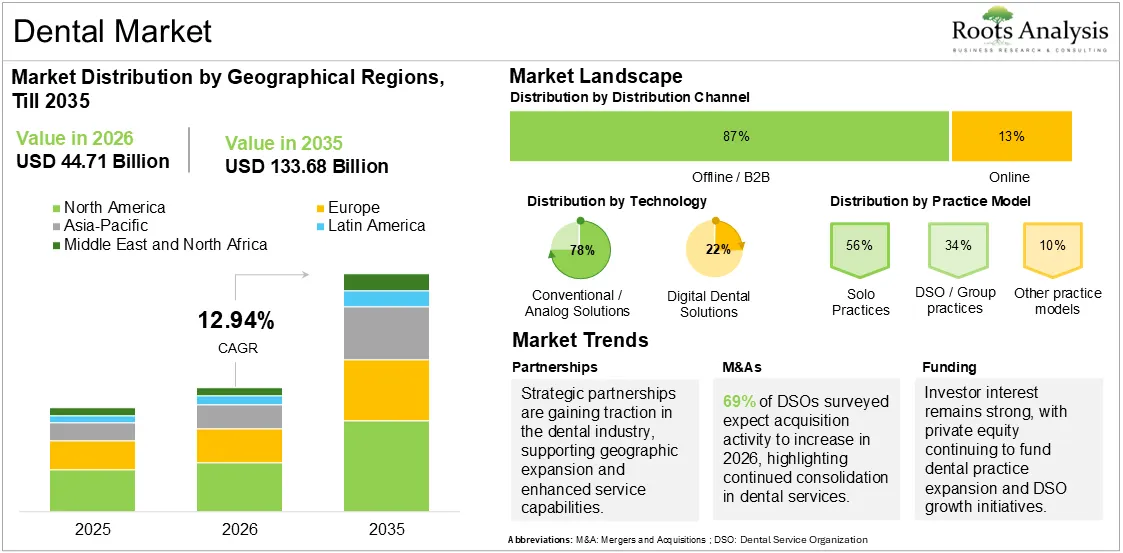
The dental market, valued at USD 41.03 billion in 2025, is projected to reach USD 44.71 billion in 2026 and USD 133.68 billion by 2035, representing a CAGR of 12.94% during the forecast period 2026 to 2035.
To learn more about this report, request a free sample copy
Market Report: Key Takeaways
Market Size & Trends
- Dental consumables account for the largest share of the dental market, driven by their extensive utilization across restorative, preventive, orthodontic, and endodontic procedures. The recurring demand for dental materials, coupled with the increasing volume of routine and specialized dental treatments, continues to support the segment's market dominance.
- Restorative dentistry holds the leading market share, supported by the high prevalence of dental caries, tooth damage, and tooth loss.
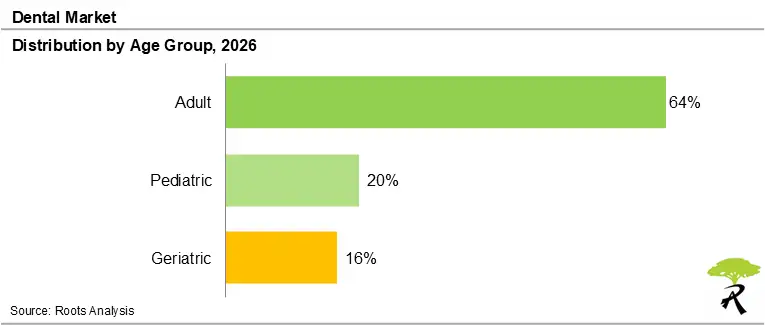
- Adults represent the largest segment of the dental market, owing to the substantial demand for preventive, restorative, and orthodontic treatments. However, the geriatric segment is projected to register the fastest growth, supported by the expanding aging population, increasing retention of natural teeth among older individuals, and growing demand for complex restorative, periodontal, and prosthodontic procedures.
- Solo dental practices currently dominate the market, supported by their established presence and widespread accessibility across dental care settings.
- Conventional / analog dental solutions continue to account for the largest market share, owing to their extensive installed base, established clinical familiarity, and comparatively lower initial investment requirements.
- Offline / B2B distribution channels dominate the market, primarily due to the importance of specialized product demonstrations, equipment installation, professional training, technical support, and established supplier relationships.
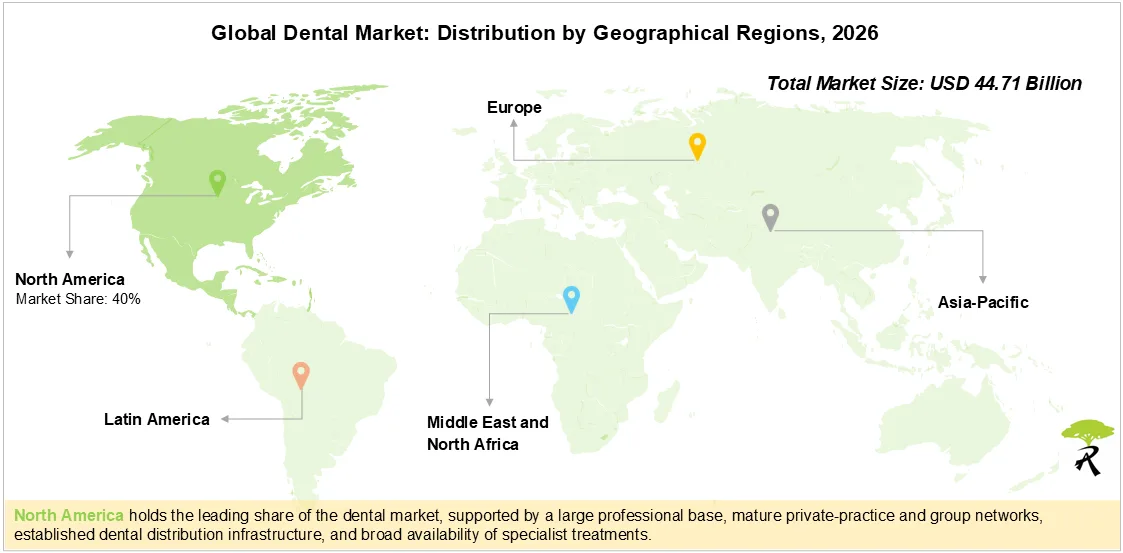
- North America holds the leading share of the global dental market, supported by its well-established dental healthcare infrastructure, extensive availability of advanced dental products, mature distribution networks, and relatively high adoption of digital dentistry solutions.
Key Market Statistics
- Market Size in 2026: $44.71 billion
- Estimated Market Size in 2035: $133.68 billion
- CAGR (2026-2035): 12.94%
- North America: Largest market in 2026
- Asia-Pacific: Fastest growing region
Market Introduction
The dental market is supported by the substantial global burden of oral diseases, an aging population retaining natural teeth for longer, increasing demand for restorative and aesthetic procedures, and continued development of dental-care infrastructure.
According to the World Health Organization, oral diseases affected nearly 3.7 billion people globally as of March 2025, with untreated caries in permanent teeth identified as the most prevalent condition in the Global Burden of Disease 2021. This persistent treatment burden, combined with rising dental visit volumes, is driving recurring demand for a wide range of dental products, including composites, adhesives, cements, impression materials, burs, endodontic files, prophylaxis products and infection-control supplies.
Technological advancement is also influencing the structure of the dental market. Digital dentistry solutions, including intraoral scanners, cone-beam computed tomography, computer-aided design and manufacturing, three-dimensional printing, practice-management software and artificial intelligence, are increasingly being integrated across diagnosis, treatment planning and production workflows.
These technologies can improve workflow efficiency, reduce remakes and shorten treatment turnaround times, creating new opportunities for equipment, software and consumables providers. However, adoption remains influenced by upfront investment requirements, software interoperability, clinician training, reimbursement conditions and the ability of smaller dental practices to achieve adequate utilization.
Market Segmentation
Based on the research, we have segmented the dental market into product type, treatment type, age group, practice model, technology, distribution channel, and geographical regions.
- By Product Type: Dental Consumables and Dental Equipment
- By Treatment Type: Restorative Dentistry, Preventive Dentistry, Orthodontics, Endodontics, Periodontics, Prosthodontics, Cosmetic Dentistry and Other Treatments
- By Age Group: Pediatric Dentistry, Adult Dentistry and Geriatric Dentistry
- By Practice Model: Solo Practices, DSO / Group Practice, and Other Practice Models
- By Technology: Conventional / Analog Dental Solutions and Digital Dental Solutions
- By Distribution Channel: Offline / B2B, and Online
- By Geographical Regions: North America, Europe, Asia-Pacific, Latin America, Middle East and North Africa
Dental Market Key Insights
What Are the Key Drivers of Growth in the Dental Market?
- Persistent Oral Disease and Tooth Loss Sustain Treatment Needs: A substantial burden of untreated disease creates continuing requirements for diagnosis, restoration and replacement of damaged or missing teeth. WHO estimates that severe periodontal diseases affect more than one billion people and that complete tooth loss affects approximately 23% of people aged 60 years or older globally. These needs provide a structural basis for demand across the dental market. The commercial opportunity depends on bringing patients into care and supporting treatment completion, rather than assuming that every affected individual becomes a purchaser. Suppliers can therefore strengthen demand conversion through affordable product options, reliable availability and training that enable clinicians to deliver suitable treatment efficiently.
- Public Dental Coverage Converts Deferred Care into Funded Demand: Expanded coverage can lower the financial threshold for seeking dental care and increase the number of patients able to proceed with treatment. In June 2026, Health Canada reported that more than 6.5 million Canadians were covered by the Canadian Dental Care Plan and more than 4.3 million had received care. This provides a concrete example of funded access translating into utilization. For suppliers, additional completed appointments can support replenishment of clinical materials and higher utilization of installed equipment. Sustained commercial benefits will depend on provider capacity and program participation, while procurement decisions should reflect the procedures actually delivered rather than enrollment alone.
- Digital Impressions Strengthen the Case for Workflow Investment: Digital impressions connect clinical data captured with the design and fabrication of dental restorations. A peer-reviewed review describes their integration with CAD/CAM (computer-aided design and computer-aided manufacturing), alongside reduced dependence on conventional impression materials and improved patient comfort. These capabilities create an investment rationale based on workflow efficiency and coordination with laboratories. The opportunity is reinforced by the ADA's late-2025 survey findings that approximately one-quarter of responding dentists intended to purchase major equipment in 2026. This intention is not a forecast of completed purchases, but it identifies a prospective customer base. Suppliers can improve conversion by demonstrating suitable applications, implementation support and realistic payback assumptions.
What are the Main Challenges for Market Growth?
- Patient Affordability and Practice Margin Pressure Limit Purchasing: High treatment costs can prevent underlying clinical need from translating into completed appointments. WHO identifies out-of-pocket spending as a major obstacle to oral health access. At the provider level, the ADA reported that US dental equipment and supply prices increased 5% during 2025, while reimbursement growth lagged inflation. Together, these pressures can constrain treatment acceptance and reduce funds available for modernization. Suppliers therefore face a commercial requirement to justify premium pricing and offer appropriate financing, dependable maintenance and transparent total ownership costs. Providers also need workable payment arrangements that support treatment completion without undermining practice viability.
- Staffing Constraints Restrict the Capacity to Deliver Care: Equipment availability alone cannot expand treatment capacity when practices lack supporting personnel. In its April 2026 analysis, the ADA reported that only 60% of US dentists had sufficient dental hygienists; among those actively or recently recruiting a hygienist, 91% described recruitment as very or extremely challenging. For the dental market, this creates a risk that additional patient demand will not generate a corresponding increase in completed procedures or product consumption. Practices need stronger retention, training and scheduling arrangements, while manufacturers should prioritize products that simplify clinical workflows. Efficiency gains must complement adequate staffing rather than assume that equipment can replace essential personnel.
- Disconnected Systems and Clinical Trust Slow Digital Adoption: Digital investment becomes harder to justify when equipment and software cannot exchange information efficiently. In March 2026, the ADA highlighted proprietary imaging formats, fragmented exchange pathways and inconsistent standards implementation as barriers to coordinated dental care. Its mid-2026 AI survey also found that fewer than 5% of responding dentists used AI for treatment recommendations, demonstrating the distinction between workflow assistance and clinical decision support. Suppliers must address both integration and confidence: open data exchange, clear compatibility specifications, transparent validation and effective training can reduce implementation friction. Without these measures, practices may postpone upgrades or restrict purchases to narrowly defined applications with clear operational value.
Recent Developments in the Dental Market
- In October 2026, SprintRay unveiled an expanded connected digital-dentistry platform at 3DNext 2026. The launch includes the Foundation wireless intraoral scanner and Nano Series chairside printing, washing and curing workflow, extending the company's digital process from scanning through post-processing.
- In August 2026, Formlabs entered a strategic distribution partnership with Nobel Biocare for the Form 4B and Form 4BL dental 3D printers, resins and accessories. The arrangement broadens access to digital workflows for implant-based restorations and prosthetics through Nobel Biocare's global network.
- In July 2026, Guardian Dentistry Partners entered a definitive agreement to acquire a majority interest in Select Dental Management. The transaction expands Guardian's Northeast footprint through 38 locations across eight states and Washington, D.C.
Industry Experts on Dental Market
Artificial intelligence is increasingly being integrated into dental workflows, supporting diagnostic assessment, treatment planning, and operational efficiency. In February 2026, DEXIS integrated Orca Dental AI's CephX technology into its DTX Studio platform, enabling AI-powered cephalometric analysis to support orthodontic treatment planning and reduce turnaround time.
Highlighting the growing role of AI in clinical workflows, Daniel Abraham, CEO and Founder of Orca Dental AI, stated, "This partnership allows us to deliver AI-driven diagnostics at scale, giving clinicians the clarity they need to focus on what matters most: their patients."
The market report includes third-party transcripts from executives and specialists across dental products and technology companies, dental care networks, dental laboratories, orthodontic technology companies, and dental distribution organizations, including the following roles:
- Chief Executive Officer, Leading Dental Products & Technology Company, US
- Chief Executive Officer, Leading Dental Technology Company, US
- President & Chief Executive Officer, Leading Dental Products Company, US
- Chief Executive Officer, Global Dental Distribution & Technology Company, US
- Chairman & Chief Executive Officer, Leading Dental Distribution Company, US
- Founder & Chief Executive Officer, European Dental Laboratory Group, Europe
- Chief Clinical Officer, Leading Dental Care Network, India
- Founder & Chief Executive Officer, Leading Dental Care Network, India
- President & Chief Executive Officer, Leading Orthodontic Technology Company, US
- Co-Chief Executive Officers, Dental Technology Company, Switzerland
Market Share Insights
Which Product Type Accounts for the Largest Share of the Dental Market?
Dental consumables currently hold the leading share of the global market and are expected to register the fastest growth during the forecast period, supported by their recurring use across restorative, preventive, endodontic, orthodontic, implant, and prosthetic procedures, combined with shorter replacement cycles than dental equipment, supports consistent demand as treatment volumes increase.
Which Treatment Type Represents the Biggest Opportunity in the Dental Market?
Restorative dentistry is expected to account for the largest share of the current market, and this trend is unlikely to change in the future. Dental caries, fractured teeth, failed restorations, and age-related tooth wear drive recurring use of composites, glass ionomers, bonding agents, cements, matrices, burs, and indirect restorative materials across general dental practices and diverse patient groups.
The cosmetic dentistry segment is expected to grow at a healthy CAGR during the forecast period due to the increasing awareness of dental aesthetics, adult orthodontics, tooth whitening, veneers, and digital smile planning. Greater social visibility and improved financing options are further supporting elective dental treatment, although growth remains influenced by disposable income and patient preference for aesthetic procedures.
Which Age Group Accounts for the Largest Share of the Dental Market?
Adult dentistry currently accounts for the highest market share (nearly 65%), and this trend is unlikely to change during the forecast period. Adults represent the largest treated population and use dental products across preventive, restorative, endodontic, periodontal, orthodontic, and prosthodontic procedures.
hat Makes Offline / B2B Distribution the Leading Choice in the Dental Market?
Offline / B2B distribution holds the leading share in the current year and is expected to remain widely adopted during the forecast period. This trend is due to the fact that dental equipment and specialized products often require demonstrations, installation, maintenance, regulatory documentation, and clinician training, while established distributors provide inventory management, financing, local logistics, and technical support.
Regional Analysis: Which Region Leads the Global Dental Market?
North America: Largest Regional Market
North America holds the leading share of the dental market, supported by a large professional base, mature private-practice and group networks, established dental distribution infrastructure, and broad availability of specialist treatments. High adoption of digital imaging, intraoral scanners, clear aligners, and implant workflows, along with equipment financing, laboratory infrastructure, and consumer-financing mechanisms, further supports regional demand.
Asia-Pacific to Register the Fastest Growth in the Dental Market by 2035
Asia-Pacific is expected to witness the fastest growth during the forecast period, driven by large patient populations, rising disposable incomes, expanding urban dental infrastructure, medical and dental tourism, professional training, and increasing access to implants, orthodontics, and digital dental technologies. Growth varies across Japan, Australia, China, India, South Korea, and Southeast Asia due to differences in coverage, pricing, workforce availability, and regulatory frameworks.
Key Players Profiled in Dental Market
The key players profiled in the dental market include Dentsply Sirona, Align Technology, Straumann Group, Envista Holdings Corporation, Henry Schein, Planmeca Group, and Solventum.
Report Deliverables and Customization
The report includes complimentary Excel data packs covering market landscape analysis, company competitiveness analysis, company profiles, partnerships and collaborations, funding and investments, and market sizing and forecast analysis. A complimentary PowerPoint presentation is available, and up to 15% customization can be requested subject to data availability.
Report Authorship
Author(s): Simriti Gupta and Pemba Lahmo. Both authors contribute to Roots Analysis's healthcare and life sciences research practice, covering dental, medical device, and healthcare market studies.
Independence and Non-Affiliation
This report is an independent work of market research and analysis published by Roots Analysis. It is not affiliated with, sponsored by, endorsed by, or reviewed by Dentsply Sirona, Align Technology, Straumann Group, Envista Holdings Corporation, or any other healthcare, dental, medical technology, or life sciences company, brand, or regulatory body referenced within it. No content in this report should be construed as medical advice. Roots Analysis maintains its own proprietary primary research process, and does not receive compensation from any company profiled within the report, in exchange for inclusion or favorable characterization