Digital Diabetes Management Market by Product / Solution Type (Continuous Glucose Monitoring Systems, Smart Blood Glucose Meters, Smart Insulin Pens, Insulin Pumps and Automated Insulin Delivery Systems, Diabetes Management Apps, Data Management Software and Analytics Platforms and Digital Diabetes Management Services), Device / Platform Modality, Diabetes Type, Application / Care Function, End User, Technology Layer, Geographical Regions, and Leading Players – Trends and Forecasts, 2026-2040
Market Size
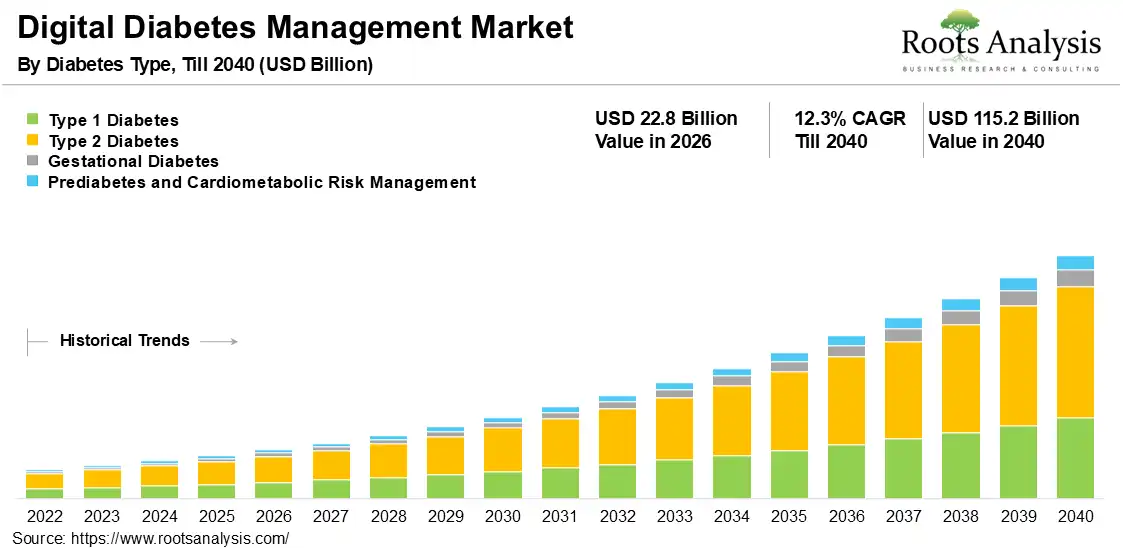
The global digital diabetes management market is expected to rise from USD 22.8 billion in 2026 to reach USD 115.2 billion by 2040, growing at a CAGR of 12.3% over the forecast period 2026 to 2040, driven by CGM penetration, automated insulin delivery, remote monitoring and cloud-connected diabetes workflows.
See What’s in the Full Report – Request Your Complimentary Insights!
Market Report: Key Takeaways
- Based on Product / Solution Type, continuous glucose monitoring systems capture 35.0% market share in 2026, whereas insulin pumps and automated insulin delivery systems register a 15.6% CAGR through 2040, driven by closed-loop therapy adoption.
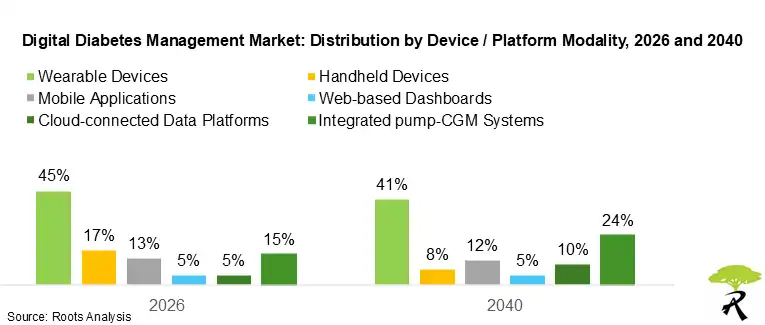
- Based on Device / Platform Modality, wearable devices capture 45.0% market share in 2026, whereas cloud-connected data platforms register an 18.0% CAGR through 2040, driven by device-data aggregation.
- Based on Diabetes Type, Type 2 diabetes captures 54.0% market share in 2026, whereas prediabetes and cardiometabolic risk management register a 16.4% CAGR through 2040, driven by prevention-oriented digital programs.
- Based on Application / Care Function, glucose monitoring and trend analysis captures 35.0% market share in 2026, whereas automated insulin delivery registers a 17.5% CAGR through 2040, driven by algorithmic insulin optimization.
- Based on Geography, North America captures 40.0% market share in 2026, whereas Asia-Pacific registers a 14.8% CAGR through 2040, driven by diabetes prevalence and device-access expansion.
Digital Diabetes Management Market Outlook
Continuous sensing, algorithmic insulin delivery and cloud workflows now define the digital diabetes management market. Earlier demand centered on episodic glucose meters, basic apps and patient self-logging. Current demand shifts toward continuous glucose monitoring systems, connected insulin devices and diabetes management software that clinicians can use between visits. Supply also moves from standalone hardware toward integrated pump-CGM systems, predictive analytics and remote patient monitoring for diabetes.
Current growth comes from broader CGM use, FDA-cleared software, payer interest in cardiometabolic programs and patient demand for connected care. Regulatory clearance remains a key commercialization gate because insulin dosing and automated delivery tools directly affect therapy safety. In May 2026, Glooko announced FDA 510(k) clearance for EndoTool IV Cloud, with commercial launch planned before the end of 2026. These pathways help buyers compare software maturity before adoption.
Through 2040, this high-growth market will shift toward closed-loop therapy, cloud-connected data platforms and AI-powered glucose analytics. Growth will increasingly favor vendors that combine device data, electronic health records integration, predictive alerts and workflow-ready dashboards. In January 2026, Diabeloop received FDA 510(k) clearance for DBLG2, an app-based automated insulin delivery algorithm. The outlook remains strong, with platform integration becoming the main competitive filter for commercialization across hospital and home settings.
Digital Diabetes Management Market Dynamics
Digital Diabetes Management Market Drivers
Continuous glucose monitoring systems drive adoption because they create daily glucose visibility, remote sharing and treatment feedback. Wearable devices held 45.0% share in 2026, while glucose monitoring and trend analysis held 35.0% share. FDA-cleared CGM upgrades, connected insulin pens and automated insulin delivery systems expand the addressable base across Type 1 and insulin-treated Type 2 diabetes. These shifts also increase clinician demand for integrated analytics.
Digital Diabetes Management Market Restraints
Regulatory clearance, reimbursement variation and device affordability slow commercialization because diabetes technology directly informs insulin decisions. Smart blood glucose meters lose share from 17.0% in 2026 to 9.0% in 2040 as continuous sensing expands. Hospitals and diabetes clinics also face integration costs when device data, CGM data management software and EHR workflows do not align cleanly. Smaller vendors face longer enterprise sales cycles.
Digital Diabetes Management Market Opportunities
Cloud-connected data platforms create a clear growth opportunity because clinicians need longitudinal device data inside care workflows. This modality grows at 18.0% CAGR through 2040, outpacing wearable devices and mobile applications. In May 2026, Glooko and mylife Diabetes Care expanded their diabetes data management partnership for mylife Loop users and care teams (https://www.businesswire.com/news/home/20260512745029/en/Glooko-and-mylife-Diabetes-Care-Expand-Diabetes-Data-Management-Partnership). That move strengthens platform stickiness and partnership leverage.
Digital Diabetes Management Market Challenges
Competitive differentiation becomes harder as CGM, app, pump and coaching vendors converge around similar connected-care claims. Patients and caregivers held 48.0% share in 2026, but homecare settings and payers gain share through 2040. Vendors must prove clinical value, data reliability and workflow fit while competing against established ecosystems from Abbott, Dexcom, Medtronic, Tandem, Insulet and Roche. Evidence quality now shapes procurement confidence.
Digital Diabetes Management Market Size Estimation Methodology
- As a starting point, the forecast anchored the digital diabetes management market to verified 2022 to 2026 revenue references. Multiple credible secondary sources informed the baseline. The baseline was normalized around CGM revenue, connected insulin delivery, diabetes management apps, software analytics platforms and digital care services. Scope was narrowed where sources appeared to include broader cardiometabolic programs or adjacent digital therapeutics.
- Moving forward, segment weights were built from product-level evidence across core diabetes technology categories. These categories included continuous glucose monitoring systems, smart blood glucose meters, smart insulin pens, insulin pumps and diabetes management software. Remote patient monitoring for diabetes was modeled separately where services or clinical workflows created distinct revenue. This preserved comparability across hardware, software and service categories.
- Building on this, adoption curves were cross-checked against regulatory submission counts, FDA 510(k) clearances, CE Mark examples and commercial launches. Recent approvals for Dexcom G7 15 Day, Control-IQ+, DBLG2, MiniMed Go Smart MDI and EndoTool IV Cloud validated therapy optimization. These events also supported faster growth for automated insulin delivery and cloud dosing software.
- Drawing upon these, regional forecasts reflected reimbursement maturity, specialist-care capacity, smartphone adoption, diabetes prevalence and device access. North America received the highest 2026 share because FDA pathways and early commercial launches remain concentrated there. Asia-Pacific received the fastest CAGR because India, Australia, China and Southeast Asia add device-access headroom. Regional shares were kept consistent with known launch sequencing. Launch evidence guided the regional adoption slope.
- The projected value was then extended annually to 2040 using segment-specific CAGRs rather than one blended growth rate. Automated insulin delivery, cloud-connected data platforms, AI and predictive analytics, payer and employer programs, and Asia-Pacific received faster growth assumptions. Smart blood glucose meters and handheld devices received slower growth because continuous sensing displaces episodic testing.
- Finally, each forecast line was reviewed for internal consistency between 2026 share, 2040 share, CAGR and the stated competitive narrative. The model checked whether dominant segments matched current adoption and whether faster-growing segments reflected clear technology or access change. Outputs were adjusted to avoid double counting across devices, platforms, services and diabetes prevention programs. This final review protected the forecast from inflated platform overlap.
Digital Diabetes Management Market Share Insights
Market Share by Product / Solution Type
According to our analysis, continuous glucose monitoring systems lead because they anchor daily glucose visibility, reimbursement pathways and connected-care workflows. In April 2025, Dexcom received FDA clearance for Dexcom G7 15 Day for adults with diabetes in the US.
Insulin pumps and automated insulin delivery systems will expand faster as CGM, pump and algorithm ecosystems converge. In February 2025, Tandem Diabetes Care received FDA clearance for Control-IQ+ automated insulin delivery technology for adults with Type 2 diabetes.
Market Share by Device / Platform Modality
Wearable devices lead because CGM sensors and patch-based insulin systems move monitoring into continuous daily use. In March 2025, Insulet expanded Omnipod 5 availability across Australia, Belgium, Canada and Switzerland with Dexcom and Libre integrations.
Cloud-connected data platforms will scale fastest as clinicians need longitudinal device data inside care workflows. In February 2025, Glooko joined Epic Showroom, enabling EHR-integrated access to diabetes device and sensor data.
Want Information on Specific Region / Segment?
Regional Analysis: North America Leads the Market and Asia-Pacific is Likely to Register Higher CAGR
Presently, North America holds a 40.0% share in 2026. North America leads because it combines early FDA-cleared device access, strong private payer coverage, specialist networks and digital-health investment depth. Large CGM, AID, RPM and EHR-integration vendors commercialize first in the US, then extend into Europe and Asia-Pacific. In April 2025, Dexcom received US FDA clearance for Dexcom G7 15 Day, the company’s longer-wear CGM system for adults with diabetes.
On the contrary, Asia-Pacific registers a 14.8% CAGR from 2026 to 2040. The growth will accelerate as diabetes prevalence rises, urban healthcare systems digitize, and device makers localize access through India, China, Australia and Southeast Asia. Sensor-based monitoring will expand beyond premium users as smartphone-linked CGM and remote-care platforms become more available. In August 2025, Abbott launched FreeStyle Libre 2 Plus in India with real-time glucose readings, optional alarms and caregiver data-sharing functions.
Market Ecosystem Analysis
The ecosystem concentrates around 11 Tier 1 leaders, supported by nine specialists and eight emerging entrants across CGM, AID, virtual care, dosing software and diabetes data platforms. The dominant consolidation dynamic is platform convergence, with pumps, CGMs, algorithms and EHR workflows moving into integrated diabetes operating systems. Ypsomed’s April 2025 diabetes-care carve-out to TecMed reflects this focus on sharper AID platform specialization. The primary commercial force is reimbursable cardiometabolic engagement, visible in Omada’s June 2025 IPO and DarioHealth’s April 2025 employer-focused GLP-1 support program. Competitive advantage is shifting toward algorithmic automation, CGM data liquidity and workflow integration because buyers now reward measurable therapy and cost outcomes.
- Dexcom received April 2025 FDA clearance for G7 15 Day, raising the adult CGM benchmark to 15.5 days with 8.0% MARD. Abbott launched FreeStyle Libre 2 Plus in India in August 2025 with minute-by-minute readings, optional alarms and 15-day wear. These moves pressure smart-BGM and app-only players by shifting glucose monitoring toward always-on wearable data in North America and Asia-Pacific.
- Ascensia signed a September 2025 MOU to transfer Eversense commercial operations to Senseonics. The move unifies R&D, manufacturing and distribution around Eversense, raising specialization barriers in implantable long-duration CGM. It strengthens continuous glucose monitoring for U.S. adults and pressures short-duration CGM vendors on longevity differentiation.
- Tandem received February 2025 FDA clearance for Control-IQ+ in adults with type 2 diabetes. The clearance moves AID beyond the core type 1 pump base and pressures MDI-first digital coaching providers. It strengthens insulin pump and AID systems, especially intensive insulin therapy optimization for type 2 diabetes.
- Medtronic received April 2025 FDA approval for Simplera Sync with MiniMed 780G, simplifying CGM insertion and 780G integration. Insulet rolled out June 2026 Omnipod 5 algorithm enhancements and U.S. FreeStyle Libre 3 Plus compatibility. Together, they raise competitive expectations for sensor flexibility, automated corrections and tubeless usability.
- Sequel Med Tech launched twiist in the U.S. in July 2025, adding a pharmacy-distributed AID option. CamDiab introduced CamAPS Liberty in March 2026, reducing meal-bolus burden through a fully closed-loop feature. These entrants pressure incumbents to reduce user decision load in integrated pump-CGM systems.
- Omada raised USD 150 million in a June 2025 IPO, validating virtual chronic-care demand across diabetes and hypertension. DarioHealth announced an April 2025 benefit administrator partnership for cardiometabolic and GLP-1 support across employers. These events pressure standalone apps to prove enrollment, persistence and cost-control value for payers and employers.
- Glooko launched June 2026 insulin pump settings EHR integration delivering pump configuration data into clinical flowsheets. Rimidi’s June 2025 Quest partnership reported connected BGM and CGM monitoring inside an athenahealth workflow. This raises the interoperability barrier for device makers that cannot normalize data inside clinical systems.
- Glooko received May 2026 FDA clearance for EndoTool IV Cloud, supporting cloud-based inpatient insulin dosing. Health2Sync and Novo Nordisk Pharma Korea launched July 2025 Mallya smart-cap integration into SugarGenie. These moves extend digital diabetes platforms from consumer tracking into hospital glycemic safety and dose-recording workflows.
Startup Companies and their Key Highlights
1. Signos
- Event type and funding amount: Funding round, USD 20 million
- Month and year: May 2026
- Lead investors or strategic partners: GV, Dexcom and Blue Cross Blue Shield of Alabama
- Stated purpose of the event: Accelerate growth and expand access to its FDA-cleared glucose monitoring system for weight management
- Market implication: This accelerates CGM-based cardiometabolic risk management because it extends glucose sensing into weight, nutrition and GLP-1 support use cases
2. Sequel Med Tech, LLC
- Event type: U.S. commercial launch of the twiist AID system
- Month and year: July 2025
- Stated purpose of the event: Launch a patient-centered AID system with pharmacy distribution and flexible access
- Market implication: This accelerates automated insulin delivery adoption because it adds a new access model outside traditional durable medical equipment cycles
3. CamDiab Ltd
- Event type: Product feature introduction for CamAPS Liberty
- Month and year: March 2026
- Stated purpose of the event: Reduce carbohydrate counting and meal-bolus burden through fully closed-loop insulin delivery
- Market implication: This strengthens therapeutic AI and AID algorithms because it moves insulin delivery closer to autonomous operation
4. Diabeloop SA
- Event type: Strategic partnership for AID algorithm integration
- Month and year: January 2026
- Lead investor or strategic partner name: Sequel Med Tech
- Stated purpose of the event: Integrate Diabeloop’s FDA-cleared DBLG2 algorithm into Sequel’s twiist AID system for the U.S. market
- Market implication: This accelerates interoperable AID because it separates algorithm differentiation from pump hardware ownership
Digital Diabetes Management Market Trends / Opportunities
CGM Longevity and Predictive Sensors Expanding Digital Diabetes Management Market Platform Control
Continuous glucose monitoring systems remain the largest product category because they anchor real-time visibility, alerts and data sharing. Dexcom received FDA clearance for G7 15 Day in April 2025, extending wearable duration for adults with diabetes. Longer-wear CGM strengthens retention and makes sensor ecosystems harder to displace.
Predictive CGM integration pushes app vendors toward therapy support rather than simple glucose logging. Roche received CE Mark in September 2025 for Accu-Chek SmartGuide CGM and mySugr app integration. The competitive implication is stronger bundling between sensors, apps and analytics.
Automated Insulin Delivery Broadening Digital Diabetes Management Market Competition Beyond Type 1 Users
Automated insulin delivery gains share because algorithms turn CGM data into therapy action. Tandem Diabetes Care received FDA clearance in February 2025 for Control-IQ+ for adults with Type 2 diabetes using intensive insulin therapy. This widens the commercial runway beyond traditional Type 1 diabetes pump users.
Interoperable algorithms create new competition between device makers and software-led therapy companies. Diabeloop received FDA 510(k) clearance in January 2026 for DBLG2 as a Class II interoperable automated glycemic controller. Software differentiation will increasingly matter as pump-CGM hardware ecosystems converge.
International pump-CGM expansion makes integration breadth a commercial advantage. Insulet expanded Omnipod 5 across Australia, Belgium, Canada and Switzerland in March 2025 with Dexcom and Libre integrations. Vendors with more sensor partnerships can scale faster across reimbursement systems.
Cloud Data Integration and Payer Programs Shifting Value Toward Software and Services
Cloud-connected data platforms grow fastest because care teams need device data inside clinical workflows. Glooko joined Epic Showroom in February 2025 to support EHR-integrated access to diabetes device and sensor data. Integration raises switching costs for clinics and strengthens enterprise software positioning.
Digital diabetes management services expand as payers connect diabetes, obesity and prevention into one pathway. Highmark and Noom announced an October 2025 collaboration covering weight management, diabetes prevention and diabetes journeys. This pushes vendors to prove outcomes across cardiometabolic risk, not diabetes alone.
Virtual care platforms move diabetes management closer to consumer access channels. HealthTap joined LillyDirect in October 2025 to offer virtual diabetes management services in the United States. Partnerships with branded access platforms can lower acquisition costs and improve patient conversion.
Your Business is Unique – Why Shouldn’t Your Report Be?
Market Access Considerations
FDA 510(k), CE Mark and Therapy-Safety Clearance
Regulatory clearance determines market access because CGM, dosing software and automated insulin delivery can directly affect therapy decisions. FDA 510(k) pathways and CE Mark approvals create credibility, but they also lengthen commercialization timelines and raise evidence requirements. Vendors with cleared algorithms, longer-wear sensors or hospital dosing software gain stronger positioning with clinicians, payers and channel partners. Clearance also helps procurement teams compare safety risk before rollout.
Device Interoperability and EHR Workflow Fit
Interoperability shapes scaling because clinics cannot manually reconcile data from CGMs, pumps, pens and meters. Glooko’s Epic Showroom activity shows that EHR-integrated device and sensor data access matters for provider adoption. Platforms that normalize multi-device data can sell into hospitals and diabetes clinics faster than vendors tied to isolated app dashboards. Workflow fit also reduces training burden for care teams. Poor integration can delay procurement despite strong product features.
Payer, Employer and Cardiometabolic Program Access
Payer and employer access increasingly depends on evidence across diabetes, obesity, hypertension and prevention. Teladoc Health’s cardiometabolic program and Highmark’s Noom collaboration show that buyers favor bundled risk-management pathways. This behavior enables broader contracts, but it pressures vendors to prove engagement, outcomes and cost impact beyond glucose tracking. Commercial teams must therefore package diabetes management inside wider cardiometabolic value cases. Single-condition tools face harder renewal discussions and channel expansion plans.
Regional Device Availability and Patient Affordability
Regional access depends on device launches, smartphone-linked workflows and affordability for large diabetes populations. Abbott’s India launch of FreeStyle Libre 2 Plus shows how phone-based readings, optional alarms and caregiver sharing can localize CGM demand. Vendors that adapt sensor pricing, distribution and support models can gain share in Asia-Pacific before premium-only competitors scale. Localized education also matters because caregiver workflows differ by market. Affordability shapes repeat sensor use.
How Stakeholders Benefit from the Key Focus Areas of Our Digital Diabetes Management Market Report
Digital diabetes management now matters because CGM, automated insulin delivery and cardiometabolic programs are converging into connected care pathways. The report supports decisions on segment focus, technology investment, partnership selection, regional entry and competitive positioning.
- Unmet Needs and Market Gaps in Digital Diabetes Management Market: The report identifies where episodic glucose testing, isolated app use and disconnected clinic workflows still limit care quality. Product teams can use this view to prioritize cloud-connected data platforms, EHR integration and automated insulin delivery. Commercial leaders can decide whether to target patients, homecare settings, clinics, payers or employers.
- Funding and Venture Investment Opportunities in Digital Diabetes Management Market: The report shows which categories combine fast growth with credible monetization signals, including AI and predictive analytics, payer programs and cardiometabolic management. Investment teams can benchmark platform models against Omada Health’s June 2025 Nasdaq debut and valuation signal (https://www.reuters.com/business/healthcare-pharmaceuticals/digital-health-company-omada-valued-13-billion-shares-jump-nasdaq-debut-2025-06-06/). This supports screening decisions across software, services and connected-device opportunities.
- Technology Innovation and Adoption Trends: The report tracks adoption across sensors, connected devices, mobile applications, cloud storage, EHR interoperability and AI-powered glucose analytics. Technology leaders can use these adoption curves to assess build, partner or acquire options. The analysis supports roadmap decisions where CGM data, predictive alerts and therapy algorithms increasingly converge.
- Digital Diabetes Management Market Competitive Landscape and Industry Analysis: The report compares Tier 1 leaders, specialists and emerging companies across CGM, pumps, smart pens, apps, analytics and virtual care. Strategy teams can identify where Abbott, Dexcom, Medtronic, Tandem, Insulet, Roche, Glooko and Teladoc hold defensible positions. This supports positioning, whitespace mapping and account prioritization.
- Mapping Strategic Partnerships and Ecosystem Synergies: The report maps partnerships that connect devices, diabetes data platforms, EHR workflows and virtual care channels. Business development teams can use Glooko’s May 2026 mylife Diabetes Care expansion to evaluate data-sharing partnership models. The analysis supports partner shortlisting and integration sequencing.
- Digital Diabetes Management Market CAGR and Growth Trends: The report explains why the overall market grows at 12.3% CAGR through 2040 while individual segments diverge. Finance and planning teams can compare faster growth in automated insulin delivery, cloud-connected platforms, AI analytics and Asia-Pacific. This supports budgeting, market-entry timing and portfolio allocation.
Digital Diabetes Management Market: Scope of the Report
| Key Report Attributes | Details | |
| Forecast Period | Till 2040 | |
| Market Size 2026 | USD 22.8 Billion | |
| Market Size 2040 | USD 115.2 Billion | |
| CAGR (Till 2040) | 12.3% | |
| Segments Covered |
|
|
| Geographical Regions Covered |
|
|
| Key Sections Covered |
|
|
Market Segmentation
The Digital Diabetes Management Market report presents an in-depth analysis, highlighting the capabilities of various stakeholders, based on different segments, such as product / solution type, device / platform modality, diabetes type, application / care function, end user, technology layer, geographical regions, and leading players.
By Product / Solution Type
- Continuous Glucose Monitoring Systems
- Smart Blood Glucose Meters
- Smart Insulin Pens
- Insulin Pumps and Automated Insulin Delivery Systems
- Diabetes Management Apps
- Data Management Software and Analytics Platforms
- Digital Diabetes Management Services
By Device / Platform Modality
- Wearable Devices
- Handheld Devices
- Mobile Applications
- Web-Based Dashboards
- Cloud-Connected Data Platforms
- Integrated Pump-CGM Systems
By Diabetes Type
- Type 1 Diabetes
- Type 2 Diabetes
- Gestational Diabetes
- Prediabetes and Cardiometabolic Risk Management
By Application / Care Function
- Glucose Monitoring and Trend Analysis
- Insulin Dose Tracking and Therapy Optimization
- Automated Insulin Delivery
- Lifestyle, Nutrition and Behavior Coaching
- Remote Patient Monitoring
- Clinical Data Integration and Workflow Management
- Diabetes Prevention and Cardiometabolic Management
By End User
- Patients and Caregivers
- Hospitals and Diabetes Clinics
- Homecare Settings
- Payers and Employers
- Ambulatory Care Providers
- Research and Academic Institutes
By Technology Layer
- Sensors and Connected Devices
- Mobile App Interfaces
- AI and Predictive Analytics
- Cloud Data Storage and Sharing
- EHR and Device Interoperability
- Coaching and Care-Management Services
By Geographical Regions
- North America
- US
- Canada
- Mexico
- Rest of North America
- Europe
- Austria
- Belgium
- Denmark
- France
- Germany
- Ireland
- Italy
- Netherlands
- Norway
- Russia
- Spain
- Sweden
- Switzerland
- UK
- Rest of Europe
- Asia-Pacific
- China
- India
- Japan
- Singapore
- South Korea
- Rest of Asia-Pacific
- Latin America
- Argentina
- Brazil
- Chile
- Colombia
- Venezuela
- Rest of Latin America
- Middle East and Africa (MEA)
- Egypt
- Iran
- Iraq
- Israel
- Kuwait
- Saudi Arabia
- UAE
- Rest of MEA
- Rest of the World


