Market Size
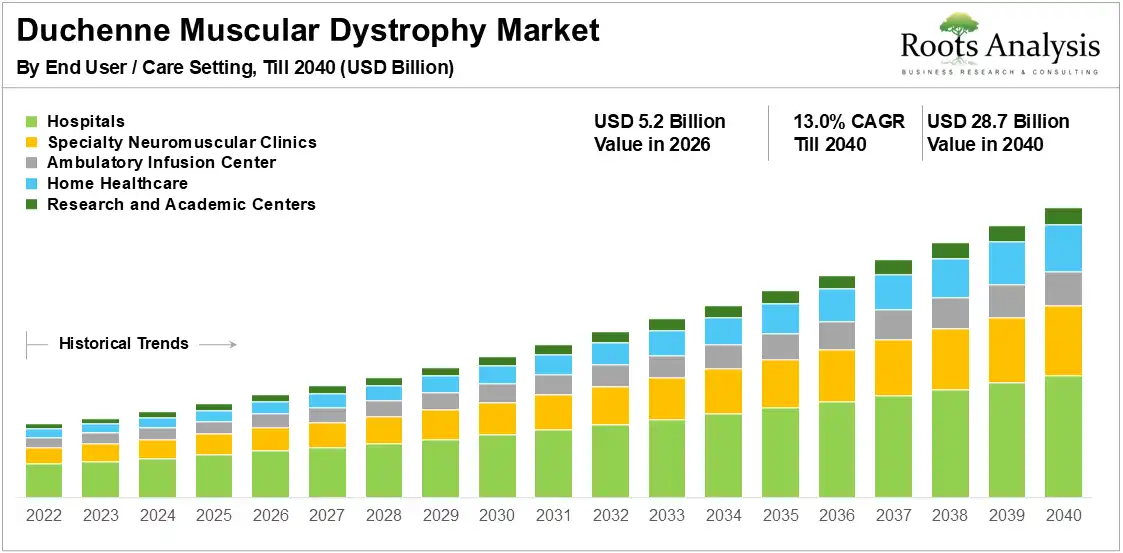
The global Duchenne muscular dystrophy market reached USD 5.2 billion in 2026 and is projected to reach USD 28.7 billion by 2040, growing at a CAGR of 13.0% over the forecast period 2026 to 2040, driven by mutation-targeted therapies, gene transfer adoption, and broader rare-disease reimbursement.
To learn more about this report, request a free sample copy
Market Report: Key Takeaways
- Based on therapy class, gene therapies capture 34.0% market share in 2026, whereas cell therapies register a 28.4% CAGR through 2040, driven by late-stage cardiac and skeletal-muscle programs.
- Based on genetic / mutation target, all genetic variants capture 58.0% market share in 2026, whereas exon 44 skipping-amenable DMD registers a 19.7% CAGR through 2040, driven by targeted oligonucleotide conjugates.
- Based on technology platforms, AAV micro-dystrophin gene transfer captures 34.0% market share in 2026, whereas in vivo gene editing platforms register a 29.8% CAGR through 2040, driven by durable dystrophin correction.
- Based on route of administration, intravenous infusion is both the dominant and fastest-growing category, holding 55.0% share in 2026 and expanding at 14.6% CAGR through 2040, driven by gene therapy and RNA therapy delivery.
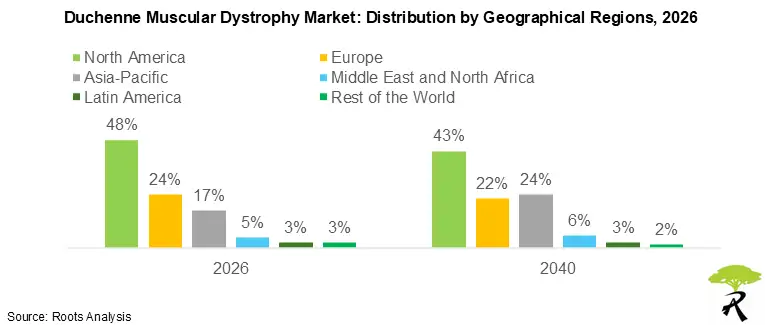
- Based on geography, North America captures 48.0% market share in 2026, whereas Asia-Pacific registers a 15.8% CAGR through 2040, driven by Japan and China rare-disease development momentum.
Duchenne Muscular Dystrophy Market Outlook
Mutation-targeted medicines are shifting Duchenne muscular dystrophy from steroid-led management toward genetically stratified treatment pathways. Earlier demand centered on corticosteroids, supportive care, and limited exon-skipping use. Current demand now tracks mutation eligibility, infusion-center capacity, and payer tolerance for premium gene therapy. Gene therapies hold the leading 2026 therapy-class share, while exon-skipping, HDAC inhibition, and cell therapies expand the competitive base across ambulatory, cardiac, and later-stage care settings.
Current growth comes from broader diagnosis, newborn-screening policy, and stronger clinical momentum across ambulatory and non-ambulatory populations. In December 2025, HHS added Duchenne muscular dystrophy to the Recommended Uniform Screening Panel, supporting earlier case identification and treatment planning. This policy shift should strengthen referral volumes for neuromuscular clinics, genetic testing providers, and specialty pharmacies before irreversible functional decline narrows treatment windows for eligible boys.
Through 2040, the Duchenne muscular dystrophy market remains high-growth as durable dystrophin restoration, antibody-oligonucleotide conjugates, and cell-derived therapies challenge older treatment mixes. In May 2026, Solid Biosciences dosed the first participant in Phase 3 IMPACT DUCHENNE for SGT-003, a next-generation AAV micro-dystrophin program. Competitive differentiation will depend on functional durability, safety management, mutation coverage, manufacturing reliability, access execution, and real-world evidence generation. The long-term outlook remains positive but evidence sensitive.
Duchenne Muscular Dystrophy Market Size Estimation Methodology
- As a starting point, we built the Duchenne muscular dystrophy market baseline from multiple credible secondary sources and verified treatment taxonomies. We normalized historical Duchenne muscular dystrophy drugs market estimates around corticosteroids, exon-skipping therapies, gene therapies, HDAC inhibitors, and supportive care. We excluded aggressive CAGR outliers that assumed unrealistic gene therapy and exon-skipping penetration. This created a conservative base for long-range scenario modeling.
- Moving forward, we mapped the clinical pipeline against mutation targets and technology platforms. Clinical trial databases, company pipeline pages, and drug approval timelines supported segmentation across exon 51, exon 53, exon 45, exon 44, nonsense mutation, and all-variant approaches. This step separated broad therapies from narrow mutation-targeted assets. It also highlighted where pipeline depth could support future share gains.
- Building on this, we modeled therapy-class adoption using route, care setting, and commercial logistics. Intravenous infusion received higher long-term weight because gene therapies, antisense oligonucleotide therapy, and cell therapies require supervised administration. Oral therapies retained meaningful share through vamorolone, givinostat, and muscle-protection programs. Distribution assumptions reflected hospital pharmacies, specialty pharmacies, and online pharmacy growth.
- Drawing upon these, we tested regional assumptions using regulatory submission counts, orphan designations, newborn-screening policy, and country-level trial activity. North America received a higher starting share because FDA pathways, rare-disease capital, and neuromuscular centers support early commercialization. Asia-Pacific received the fastest growth profile because Japan and China development activity is increasing. Europe remained important through conditional authorization and multinational access pathways.
- The projected value was then allocated across annual forecasts using segment-level CAGRs and share shifts. Gene therapies, AAV micro-dystrophin platforms, and hospital pharmacies received strong early weighting. Cell therapies, antibody-oligonucleotide conjugates, in vivo gene editing platforms, specialty pharmacies, and ambulatory infusion centers gained share after later clinical and access milestones. This allocation linked technology maturity to commercialization timing.
- Finally, we stress-tested the model against safety events, reimbursement friction, manufacturing constraints, and post-market evidence requirements. The Elevidys boxed warning, late-stage trial activity, and funding transactions informed the downside and upside ranges. This produced a consensus forecast that balances near-term approval risk with long-term dystrophin restoration innovation. Sensitivity checks focus on durability evidence, safety labeling, and mutation-specific adoption limits.
Duchenne Muscular Dystrophy Market Share Insights
Market Share by Therapy Class
According to our analysis, gene therapies lead because one-time dosing commands premium value and uses mature hospital infusion infrastructure. Notably, in July 2025, Sarepta Therapeutics said FDA recommended resuming ELEVIDYS shipments for ambulatory Duchenne patients.
Conversely, cell therapies grow fastest from a small base as cardiac and skeletal-muscle preservation programs advance. In June 2025, Capricor Therapeutics provided a regulatory update for deramiocel, its cell therapy candidate for DMD-associated cardiomyopathy.
Market Share by Genetic / Mutation Target
According to our analysis, all genetic variants dominate because corticosteroids, HDAC inhibition, supportive care, and AAV approaches address broader patient pools. In June 2025, the Commission granted EU conditional marketing authorization for givinostat in Duchenne muscular dystrophy.
On the other hand, exon 44 grows fast because antibody-oligonucleotide conjugates improve tissue delivery versus older exon-skipping chemistries. In September 2025, Avidity reported functional improvements for del-zota in exon 44 skipping-amenable DMD.
Regional Analysis: North America Leads the Market and Asia-Pacific is Likely to Register Higher CAGR
Presently, North America holds 48.0% share in 2026. It leads through deep neuromuscular centers, rare-disease capital access, and FDA accelerated-review infrastructure. In November 2025, the USFDA's ELEVIDYS safety update shows active post-market oversight of advanced DMD therapy.
Notably, Asia-Pacific registers a 15.8% CAGR from 2026 to 2040. The growth will strengthen as Japan, China, and regional trial hubs localize advanced DMD development. In September 2025, Japan's MHLW granted orphan drug designation to DYNE-251 for exon 51 skipping-amenable DMD.
Market Ecosystem Analysis
Approved DMD Therapy Leaders Repositioning Around Label Durability and Evidence Risk
Approved therapy leaders now compete around label durability, safety surveillance, and payer confidence, not only launch status.
- Sarepta's Elevidys label narrowed in November 2025 after FDA added a stronger warning and restricted treatment eligibility. This pressures high-cost AAV gene therapy, strengthens ambulatory-only positioning, and raises post-infusion monitoring barriers.
- PTC Therapeutics lost European commercial support for Translarna in March 2025 after the European Commission declined renewal. The decision weakens nonsense-mutation DMD coverage in Europe and shifts pressure toward remaining steroid, supportive, and non-EU channels.
- ITF Therapeutics reinforced DUVYZAT's all-variant HDAC position by presenting long-term givinostat data in March 2025. Santhera reported AGAMREE commercial rollout progress in April 2025, supporting steroid-analog competition against legacy corticosteroids. Together, these oral options gain relevance as gene therapy use becomes narrower and more closely monitored.
Specialists Advancing Exon-Specific Delivery Beyond Legacy PMO Benchmarks
Specialists now differentiate through exon coverage, tissue delivery chemistry, and stronger biomarker-to-function translation.
- NS Pharma reported 3.5-year brogidirsen data in October 2025 for DMD patients amenable to exon 44 skipping. Dyne reported December 2025 z-rostudirsen topline data showing increased dystrophin production at six months. These updates raise target-engagement expectations for exon 44 and exon 51 therapies.
- Edgewise's sevasemten platform moved toward broader rare-neurology commercialization after Servier agreed in June 2026 to buy its muscular dystrophy business. The transaction strengthens oral muscle-protection competition and pressures smaller small-molecule developers to prove functional differentiation.
Cardiac, Regeneration, and Diagnostic Players Expanding Beyond Dystrophin Replacement
The Competition increasingly follows earlier diagnosis and non-skeletal complications, rather than only dystrophin restoration.
- Capricor's deramiocel faced a higher evidence bar after FDA declined approval for DMD cardiomyopathy in July 2025. Cumberland strengthened the same cardiac-care opening with June 2025 ifetroban Phase 2 cardiac data. These activities keep cardiomyopathy treatment strategically important, but raise proof requirements for cell and oral cardiac therapies.
- Satellos filed September 2025 global regulatory submissions to advance pediatric Phase 2 SAT-3247 in ambulatory DMD children. Taiho reported in July 2025 that mutation-agnostic TAS-205 missed its Phase 3 primary endpoint in Japan. This split pushes oral small-molecule competition toward regeneration and away from weaker endpoint profiles.
Startup Companies and their Key Highlights
- SonoThera, Inc.
- Event type and funding amount: Series B financing, $125 million
- Month and year: June 2026
- Lead investor or strategic partner name: Vida Ventures
- Stated purpose of the event: Advance DMD and ADPKD programs into clinical development
- Market implication: Accelerates nonviral genetic medicine delivery for DMD and challenges AAV size and redosing constraints
- Entos Pharmaceuticals Inc.
- Event type and funding amount: Investment, $1 million
- Month and year: May 2025
- Lead investor or strategic partner name: CureDuchenne Ventures
- Stated purpose of the event: Develop a redosable full-length dystrophin gene therapy for DMD
- Market implication: Accelerates nonviral full-length dystrophin delivery for patients constrained by micro-dystrophin and AAV limitations
- Precision BioSciences
- Event type: FDA Orphan Drug Designation for PBGENE-DMD
- Month and year: July 2025
- Stated purpose of the event: Support development of PBGENE-DMD for Duchenne muscular dystrophy
- Market implication: Advances ARCUS in vivo gene editing as a differentiated alternative to AAV micro-dystrophin transfer
- Entrada Therapeutics
- Event type: U.K. authorization to initiate the ELEVATE-44-201 Phase 1/2 study
- Month and year: February 2025
- Stated purpose of the event: Evaluate ENTR-601-44 in DMD patients amenable to exon 44 skipping
- Market implication: Accelerates endosomal escape vehicle delivery in DMD44 and pressures conventional exon-skipping chemistry
- Satellos Bioscience
- Event type: IND submission and global regulatory filings for pediatric Phase 2 SAT-3247
- Month and year: September 2025
- Stated purpose of the event: Advance SAT-3247 into a pediatric ambulatory DMD Phase 2 clinical trial
- Market implication: Accelerates mutation-agnostic oral muscle-regeneration therapy, broadening competition beyond dystrophin-restoration platforms
Duchenne Muscular Dystrophy Market Trends / Opportunities
AAV Safety Reassessment Reshaping Duchenne Muscular Dystrophy Market Gene Therapy Competition
Post-market safety scrutiny is changing how gene therapy developers compete for physician confidence. FDA approved a boxed warning and revised Elevidys use in November 2025 after fatal liver injury reports. This makes liver monitoring, patient selection, and durability evidence central to premium reimbursement.
Next-generation AAV programs are still advancing despite tighter oversight. Solid Biosciences dosed the first participant in Phase 3 IMPACT DUCHENNE in May 2026 for SGT-003. Developers that prove differentiated safety and functional durability can still win share from incumbent micro-dystrophin platforms.
Antibody-Oligonucleotide Conjugates Expanding Duchenne Muscular Dystrophy Market
Improved tissue delivery is raising the competitive ceiling for exon skipping therapies. Dyne Therapeutics received FDA Breakthrough Therapy designation in August 2025 for DYNE-251 in exon 51 skipping-amenable DMD. This validates investor and regulatory interest in targeted oligonucleotide platforms with stronger muscle exposure.
Exon 44 programs are becoming a distinct commercial growth lane. Avidity reported September 2025 del-zota results showing functional improvements in DMD44 patients. This supports the forecast that exon 44 skipping-amenable DMD will grow faster than mature exon-skipping categories.
Newborn Screening and Diagnostic Workflows Moving DMD Treatment Earlier
Newborn-screening policy is shifting commercial strategy toward earlier diagnosis and faster referral. HHS added Duchenne muscular dystrophy to the Recommended Uniform Screening Panel in December 2025. Earlier diagnosis improves the commercial relevance of Revvity and Labcorp testing workflows.
Earlier genetic confirmation also strengthens specialty pharmacy and neuromuscular clinic coordination. The all-genetic-variant segment holds 58.0% share in 2026, reflecting the value of broad therapies. Companies with testing, referral, and access-support infrastructure can capture patients before mutation-specific treatment windows narrow.
Cell Therapy and Muscle Protection Assets Broadening Competitive Positioning
Cell therapies are moving from experimental visibility toward late-stage commercial relevance. Capricor reported positive HOPE-3 results in December 2025 for deramiocel across skeletal and cardiac function outcomes. This supports the 28.4% CAGR outlook for cell therapies from a small base.
Muscle protection strategies are attracting acquisition capital because they can serve broader patient pools. Servier agreed in June 2026 to acquire Edgewise Therapeutics' muscular dystrophy business for up to USD 2.65 billion. Broad mutation relevance gives small molecules a partnering advantage over narrow exon-specific assets.
Market Access Considerations
Safety Labeling and Post-Market Gene Therapy Controls
Safety labeling now determines how quickly AAV micro-dystrophin gene therapy can scale. FDA approved a boxed warning and revised Elevidys use in November 2025 after fatal liver injury reports. Hospitals must manage liver monitoring, emergency readiness, and patient selection. Developers with clearer risk protocols can defend access against competing gene therapies and repeat-dose alternatives. Safety evidence now affects both prescribing confidence and payer contracting. It also shapes patient consent and center readiness.
Mutation Eligibility and Genetic Testing Pathways
Mutation confirmation gates access to exon 51, exon 53, exon 45, exon 44, exon 50, and nonsense-mutation treatments. HHS added Duchenne muscular dystrophy to the Recommended Uniform Screening Panel in December 2025, supporting earlier diagnosis and referral. This benefits genetic testing workflows from Revvity and Labcorp. Companies without clear testing and referral pathways will lose eligible patients before treatment decisions occur. Earlier identification also raises demand for counseling and payer documentation.
Infusion Infrastructure and Specialty Pharmacy Coordination
Intravenous infusion controls access because gene therapies, antisense oligonucleotides, and cell therapies require supervised administration. The route holds 55.0% share in 2026 and reaches 67.0% by 2040. Hospital pharmacies lead near-term procurement, while specialty pharmacies grow faster through reimbursement support and patient services. Sponsors must build site-of-care scheduling, benefits verification, and adverse-event workflows before commercial launches. These capabilities influence launch speed more than physician awareness alone. They also affect adherence for repeat RNA therapies.
Regulatory Designations and Late-Stage Evidence Thresholds
Regulatory designations can speed development, but payers still require functional and safety evidence. Precision BioSciences received FDA Fast Track designation in March 2026 for PBGENE-DMD. Dyne initiated the Phase 3 FORZETTO trial in May 2026 for z-rostudirsen and DYNE-251. Programs with late-stage outcomes, mutation clarity, and scalable manufacturing will hold stronger access positions. Weak evidence packages will delay reimbursement even after regulatory progress. Evidence strength now determines sequencing against approved alternatives.
How Stakeholders Benefit from the Key Focus Areas of Our Duchenne Muscular Dystrophy Market Report
Earlier diagnosis, regulatory scrutiny, and mutation-targeted drug development make Duchenne muscular dystrophy commercially urgent now. The report supports portfolio, access, clinical, and technology decisions across therapies, delivery routes, care settings, and regions.
- Unmet Needs and Market Gaps in Duchenne Muscular Dystrophy Market: The report identifies where current therapies still leave functional, cardiac, and mutation-specific needs unresolved. Product teams can prioritize assets for non-ambulatory patients, DMD cardiomyopathy, and under-served exon targets. This supports indication selection, trial design, and evidence planning before expensive late-stage investment.
- Funding and Venture Investment Opportunities in Duchenne Muscular Dystrophy Market: The report maps funding signals across nonviral genetic medicine, cell therapy, small-molecule protection, and oligonucleotide delivery. Deal teams can assess SonoThera's June 2026 Series B financing. They can compare it with Servier's June 2026 Edgewise transaction. This supports decisions on platform partnering, asset acquisition, and risk-adjusted entry timing.
- Technology Innovation and Adoption Trends: The analysis compares AAV micro-dystrophin gene transfer, antibody-oligonucleotide conjugates, in vivo gene editing, HDAC inhibition, and cell-derived platforms. R&D teams can see which technologies gain share and which face safety or delivery constraints. This supports platform prioritization, manufacturing investment, and clinical differentiation.
- Duchenne Muscular Dystrophy Market Competitive Landscape and Industry Analysi: The report profiles approved leaders, specialist developers, and emerging platforms across gene therapy, exon skipping, HDAC inhibition, diagnostics, and cell therapy. Commercial teams can benchmark Sarepta, PTC Therapeutics, NS Pharma, ITF Therapeutics, Santhera, Capricor, Dyne, Avidity, and Solid Biosciences. This supports positioning, launch sequencing, and competitor-response planning.
- Mapping Strategic Partnerships and Ecosystem Synergies: The report shows where drug developers, diagnostics providers, specialty pharmacies, and infusion sites connect across the care pathway. Business development teams can identify partnerships that shorten patient identification, reimbursement approval, and site activation. This supports alliance decisions involving genetic testing, access support, and regional commercialization.
- Duchenne Muscular Dystrophy Market CAGR and Growth Trends: The report explains the 13.0% CAGR outlook through segment-level share shifts and adoption timing. Planning teams can compare cell therapies at 28.4% CAGR, in vivo gene editing at 29.8%, and Asia-Pacific at 15.8%. This supports revenue planning, regional prioritization, and capital allocation.
Duchenne Muscular Dystrophy Market: Scope of the Report
| Key Report Attributes |
Details |
| Forecast Period |
Till 2040 |
| Market Size 2026 |
USD 5.2 Billion |
| Market Size 2040 |
USD 28.7 Billion |
| CAGR (Till 2040) |
13.0% |
| Segments Covered |
- Therapy Class
- Genetic / Mutation Target
- Technology Platform
- Route of Administration
- Distribution Channel
- End User / Care Setting
- Geographical Regions
|
| Geographical Regions Covered |
- North America, Europe, Asia-Pacific, Latin America, Middle East and Africa, and rest of the world
|
| Key Sections Covered |
- Global Duchenne Muscular Dystrophy Market Forecast
- Duchenne Muscular Dystrophy Market Landscape
- Startup Ecosystem Analysis
- Company Competitiveness Analysis
- Funding and Investment Analysis
- SWOT Analysis
- PORTER's Five Forces Analysis
- Unmet Needs Analysis
- Recent Developments
- Company Profiles
|
Market Segmentation
The Duchenne muscular dystrophy market report presents an in-depth analysis, highlighting the capabilities of various stakeholders, based on different segments such as, therapy class, genetic / mutation target, technology platform, route of administration, distribution channel, end user / care setting, geographical regions, and leading players.
By Therapy Class
- Corticosteroids And Steroid Analogs
- Exon-Skipping / Antisense Oligonucleotide Therapies
- Gene Therapies
- HDAC Inhibitors
- Cell Therapies
- Small-Molecule Muscle Protection Therapies
- Supportive And Symptomatic Therapies
By Genetic / Mutation Target
- Exon 51 skipping-amenable DMD
- Exon 53 skipping-amenable DMD
- Exon 45 skipping-amenable DMD
- Exon 44 skipping-amenable DMD
- Exon 50 skipping-amenable DMD
- Nonsense mutation DMD
- All genetic variants
By Technology Platform
- AAV Micro-Dystrophin Gene Transfer
- RNA / Antisense Exon-Skipping Platforms
- Antibody-Oligonucleotide Conjugates
- In Vivo Gene Editing Platforms
- Nonviral Genetic Medicine Delivery
- HDAC Inhibition
- Cell-Derived Therapy Platforms
- Muscle Regeneration Small Molecules
By Route of Administration
- Oral
- Intravenous infusion
- Other Injectable / Parenteral Administration
By Distribution Channel
- Hospital Pharmacies
- Retail Pharmacies
- Specialty Pharmacies
- Online Pharmacies
By End User / Care Setting
- Hospitals
- Specialty Neuromuscular Clinics
- Ambulatory Infusion Center
- Home Healthcare
- Research and Academic Centers
By Geographical Regions
- North America
- US
- Canada
- Mexico
- Rest of North America
- Europe
- Austria
- Belgium
- Denmark
- France
- Germany
- Ireland
- Italy
- Netherlands
- Norway
- Russia
- Spain
- Sweden
- Switzerland
- UK
- Rest of Europe
- Asia-Pacific
- Australia
- China
- India
- Japan
- New-Zealand
- Singapore
- South Korea
- Rest of Asia-Pacific
- Latin America
- Argentina
- Brazil
- Chile
- Colombia
- Venezuela
- Rest of Latin America
- Middle East and Africa (MEA)
- Egypt
- Iran
- Iraq
- Israel
- Kuwait
- Saudi Arabia
- UAE
- Rest of MEA
- Rest of the World
Frequently Asked Questions
What is the Duchenne muscular dystrophy market size?
The market is estimated at USD 5.2 billion in 2026 and is forecast to reach USD 28.7 billion by 2040.How fast is the Duchenne muscular dystrophy treatment market growing?
The market is projected to grow at a 13.0% CAGR from 2026 to 2040.Which therapy class dominates DMD market share?
Gene therapies dominate therapy class share at 34.0% in 2026.Who are the leading Duchenne muscular dystrophy market companies?
Tier 1 leaders include Sarepta Therapeutics, PTC Therapeutics, NS Pharma, and ITF Therapeutics. Specialists and emerging competitors include Santhera, Capricor, Dyne, Avidity, Solid Biosciences, Precision BioSciences, SonoThera, and Satellos.Where is Duchenne muscular dystrophy therapeutics market share highest?
North America holds the highest regional share at 48.0% in 2026.When will newborn screening affect Duchenne muscular dystrophy diagnosis rates?
HHS added Duchenne muscular dystrophy to the Recommended Uniform Screening Panel in December 2025, supporting earlier diagnosis, referral, and treatment planning.Is regulatory risk changing the Duchenne muscular dystrophy gene therapy market?
Yes. FDA approved a boxed warning and revised Elevidys use in November 2025 after fatal liver injury reports.What funding activity is reshaping Duchenne muscular dystrophy gene therapy?
SonoThera closed a USD 125 million Series B in June 2026 for ultrasound-mediated nonviral genetic medicines, including DMD programs. Which Duchenne muscular dystrophy technology segment is growing fastest?
In vivo gene editing platforms grow fastest at a 29.8% CAGR from 2026 to 2040.How is exon skipping driving DMD industry analysis?
Exon-skipping / Antisense oligonucleotide therapies hold 20.0% share in 2026 and rise to 23.0% by 2040 at a 14.1% CAGR.