


 Download Free Sample
 Buy Now
Market Size
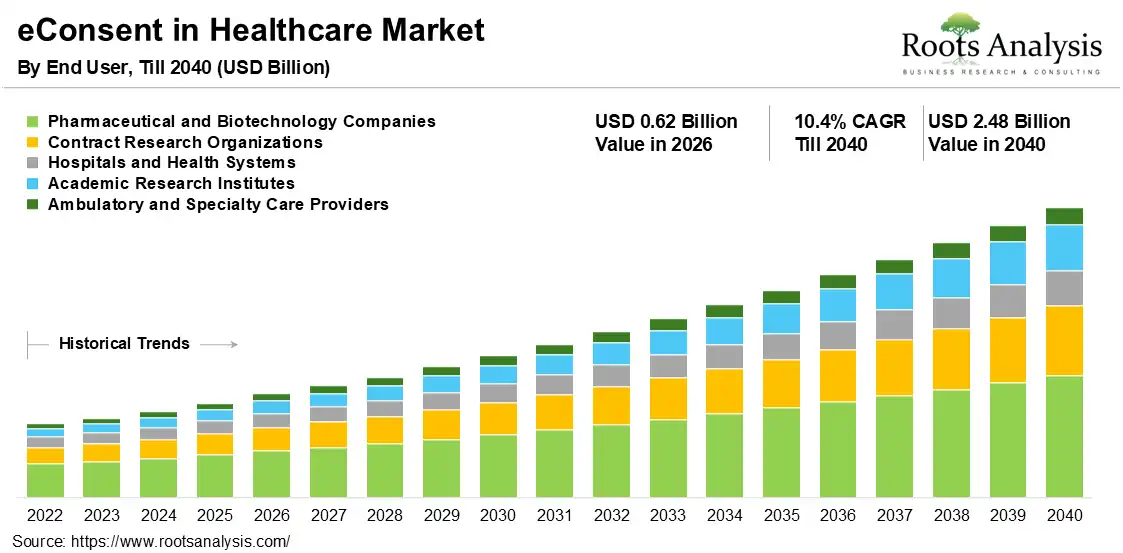
The global eConsent in healthcare market is expected to rise from USD 0.62 billion in 2026 and is projected to reach USD 2.48 billion by 2040, growing at a CAGR of 10.4% over the forecast period 2026 to 2040, driven by clinical-trial digitalization, remote consent workflows, and regulated patient-data sharing.
See What’s in the Full Report – Request Your Complimentary Insights!
Market Report: Key Takeaways
- Based on platform / deployment model, cloud-based platforms capture 70.0% market share in 2026, whereas hybrid deployments register an 18.8% CAGR through 2040, driven by mixed site-and-remote consent models.
- Based on enrollment model, on-site consent capture 46.0% market share in 2026, whereas hybrid consent and re-consent register a 14.5% CAGR through 2040, driven by remote follow-up and protocol amendments.
- Based on application / use case, clinical trial informed consent capture 50.0% market share in 2026, whereas registry, biobank, and longitudinal health-record consent register a 14.3% CAGR through 2040, driven by durable data-sharing permissions.
- Based on end user, pharmaceutical and biotechnology companies capture 44.0% market share in 2026, whereas hospitals and health systems register a 12.8% CAGR through 2040, driven by EHR-linked consent workflows.
- Based on geography, North America captures 42.0% market share in 2026, whereas Asia-Pacific register a 12.7% CAGR through 2040, driven by digital-health infrastructure and consent-based data exchange.
eConsent in Healthcare Market Outlook
Electronic informed consent has moved from a trial documentation tool into a broader patient workflow layer. It now spans research, care delivery, and data exchange. The eConsent healthcare market now reflects demand for remote consent, audit-ready eSignature records, multimedia education, and re-consent controls. Cloud-based platforms still carry 70.0% share in 2026. Hybrid deployments show the fastest 18.8% CAGR as sponsors blend site, home, and follow-up consent workflows through 2040.
Regulatory pressure now centers on participant understanding, data-sharing permission, and inspection-ready evidence rather than paper replacement alone. FDA issued final ICH E6(R3) Good Clinical Practice guidance in September 2025, supporting technology-enabled trial conduct while keeping participant protection central. Kayentis launched an AI-enabled interactive eConsent module in June 2026, turning complex consent forms into guided multimedia experiences. This combination makes comprehension, audit trails, and workflow integration purchase criteria.
Growth will remain high through 2040 as consent expands from initial signatures to continuous patient permission management. Remote consent reaches 46.0% share by 2040, while hybrid consent and re-consent grows at 14.5% CAGR. Medidata unveiled next-generation Patient Consent innovations in October 2025, including AI-assisted setup, platform integration, and future remote-consent enhancements. The long-term outlook favors integrated platforms with measurable participant understanding and re-consent depth.
eConsent in Healthcare Market Dynamics
eConsent in Healthcare Market Drivers
Clinical-trial digitalization drives the eConsent healthcare market because sponsors need auditable, remote-ready workflows across study start-up, enrollment, and protocol amendments. Clinical trial informed consent holds 50.0% share in 2026, showing where budgets remain concentrated across sponsors and CROs globally. FDA’s September 2025 E6(R3) guidance supports flexible, technology-enabled conduct while keeping participant protection and data reliability central.
eConsent in Healthcare Market Restraints
Compliance complexity restrains adoption because eConsent platforms must manage HIPAA, GDPR, 21 CFR Part 11, audit trails, version control, and identity-sensitive workflows. On-premise deployments retain 6.0% share in 2026 because some providers and research sites still prefer local control for regulated records. Hospitals and academic institutes also face integration costs when consent data must connect with electronic health records, EDC, IRT, and eClinical systems.
eConsent in Healthcare Market Opportunities
Hybrid consent creates the strongest commercial opening because remote education and site confirmation now need one governed workflow. Hybrid deployments grow at 18.8% CAGR through 2040, while hybrid consent and re-consent grows at 14.5%. Suvoda and Greenphire completed an April 2025 merger combining consent, outcomes data, payments, and patient-support tools into a broader trial platform. This favors vendors with integrated patient-support capabilities.
eConsent in Healthcare Market Challenges
Participant comprehension remains the hardest operating challenge because valid consent increasingly depends on understanding, not signature capture alone. Comprehension checks and knowledge assessment grow at 13.7% CAGR through 2040, outpacing electronic signatures and audit trails. HHS/OHRP issued February 2025 guidance on key information and facilitating understanding. It raises the bar for content design, readability, and consent presentation across study-specific informed consent workflows.
eConsent in Healthcare Market Size Estimation Methodology
- As a starting point, the 2026 baseline for the eConsent healthcare market was triangulated from multiple credible secondary sources and industry data. The review prioritized public market-size ranges, accepted CAGR bands, and vendor evidence. It focused on electronic informed consent software, clinical trial eConsent platforms, and patient digital consent workflows. Narrow clinical-trial-only outliers and inconsistent scale estimates were excluded before building the consensus curve. The process also separated clinical-trial consent from hospital treatment consent to avoid scope inflation.
- Moving forward, annual growth from 2022 through 2040 was modeled from a smoothed adoption curve rather than a single-source forecast. The curve used a 10.4% long-term CAGR, then checked year-by-year progression against 2025 to 2030 industry estimates. This avoided over-weighting short-term spikes from decentralized trial activity, regulatory updates, or one-time product launches.
- Building on this, segment shares were assigned using recurring evidence from platform, enrollment, application, end-user, form-type, technology, and geography taxonomies. Product validation pages from Medidata, Veeva Systems, Signant Health, Suvoda, Medable, Florence Healthcare, and other listed companies confirmed capability clustering. These pages supported shares for cloud-based platforms, remote consent, multimedia education, audit trails, and eClinical integration.
- Drawing upon these, growth differentials were applied to each sub-segment using adoption constraints and commercial readiness. Hybrid deployments received the highest platform CAGR because site-led consent, remote education, and re-consent workflows increasingly run together. Comprehension checks and knowledge assessment received faster growth because HHS/OHRP and sponsor requirements place more emphasis on participant understanding.
- The projected value was then cross-checked against practical demand indicators. Inputs included clinical trial databases, regulatory guidance counts, product launch activity, and platform consolidation. Recent examples included Medidata Patient Consent, Kayentis interactive eConsent, and Suvoda-Greenphire platform integration. These examples helped test whether forecast acceleration matched observable vendor investment. Region-level assumptions also reflected policy-backed health-data exchange, including ABDM consent-based interoperability.
- Finally, the forecast was stress-tested for adoption risk across healthcare systems, CROs, sponsors, and research sites. The model checked whether HIPAA, GDPR, 21 CFR Part 11, localization, audit trail, and EHR integration requirements would slow commercialization. Final outputs were balanced so the forecast reflects both technology pull from decentralized trials and operational friction from regulated consent workflows.
eConsent in Healthcare Market Share Insights
Market Share by Platform / Deployment Model
According to our analysis, cloud-based platforms lead because sponsors, CROs, and sites prefer scalable deployment, lower IT burden, and compliance-ready access. Veeva’s April 2025 SiteVault CTMS announcement integrated CTMS with eISF and eConsent for research sites.
Hybrid deployments will grow fastest as trials mix site-led consent, remote participant education, and re-consent workflows. Medidata’s October 2025 Consent update expanded app-based consent with future remote capabilities and personalized educational content.
Market Share by Enrollment Model
On-site consent remains largest in 2026 because investigator oversight, identity confirmation, and site workflows still anchor many studies. FDA’s September 2025 E6(R3) guidance supports innovation while keeping participant protection and trial reliability central.
Hybrid consent and re-consent will scale fastest as protocols require mid-study updates, remote education, and site confirmation. Suvoda and Greenphire completed an April 2025 merger covering consent, outcomes data, payments, and patient-support tools.

Want Information on Specific Region / Segment?
Regional Analysis: North America Leads the Market and Asia-Pacific is Likely to Register Higher CAGR
Presently, North America holds 42.0% share in 2026. The region leads through mature clinical-trial infrastructure, FDA-aligned compliance processes, and deep vendor penetration across sponsors and CROs. FDA’s September 2025 final E6(R3) guidance embraced trial-design and technology innovation.
On the contrary, Asia-Pacific registers a 12.7% CAGR from 2026 to 2040. The growth will come from digital-health infrastructure, clinical-trial globalization, and policy-backed health-data exchange. India’s August 2025 ABDM update confirmed patient-consent-based health-data exchange and HIECM-enabled interoperability.
Market Ecosystem Analysis
The supplied ecosystem clusters commercial weight around six Tier 1 platforms, followed by twelve specialists and seven emerging entrants. Platform convergence, reinforced by merger activity, is the dominant consolidation dynamic in healthcare eConsent. Hybrid trial execution and consent-governance risk now reshape buying behavior across sponsors, sites, and hospitals. Competitive advantage is shifting toward connected consent workflows, because buyers want enrollment, comprehension, auditability, and downstream data integration in one environment.
- Medidata advanced Medidata Consent in October 2025 with AI-assisted setup and native Rave EDC integration. This raises the barrier for standalone eSignature vendors, especially where sponsors need audit-ready consent and direct data flow. It strengthens clinical trial informed consent, electronic signatures, audit trails, and eClinical integration segments.
- Veeva announced SiteVault CTMS in April 2025, integrated with SiteVault eISF and SiteVault eConsent. The company also said SiteVault would be free for over 90% of research sites. This lowers site adoption friction and pressures site workflow vendors without sponsor connectivity.
- Florence Healthcare announced AI-assisted workflows in September 2025 across site identification, feasibility, startup, document exchange, and monitoring. The announcement links eConsent to a broader site enablement stack trusted by over 37,000 research sites. This strengthens sponsor-CRO-site workflow integration and raises the scale barrier for smaller eConsent tools.
- Suvoda completed its merger with Greenphire in April 2025, combining consent, RTSM, eCOA, payments, budgeting, and travel tools. This consolidates patient-journey control around one operating platform for complex studies. It strengthens hybrid consent, re-consent, sponsor workflows, CRO workflows, and complex clinical trial execution.
- Signant Health published its SmartSignals eConsent platform overview in May 2025. The platform supports remote re-consent, translation management, comprehension testing, video, audio, and audit trails. This pressures PDF-led consent tools and strengthens global remote trial, localization, and multimedia education segments.
- Clinical ink launched TrialLens in April 2025 as an AI-powered operations dashboard for eCOA and connected-device trials. Its broader patient-engagement stack includes eConsent, televisits, eRetention, eCOA, and connected device workflows. This pushes eConsent vendors toward real-time operational analytics across decentralized and hybrid studies.
- Concentric Health was profiled in January 2025 for digital treatment-consent adoption across UK healthcare providers. The source states adoption by over 40 NHS Trusts and more than 750,000 annual patients. This strengthens procedural consent, EHR-integrated workflows, shared decision-making, and hospital end-user segments.
- Radar Healthcare positioned Digital Consent in June 2026 as part of wider quality, risk, governance, and learning workflows. The article cites nearly GBP 460 million in informed-consent-related claims between 2019 and 2025. This pressures hospital consent vendors to evidence governance value beyond digital form capture.
- Castor highlighted its May 2025 eConsent update through a June 2025 announcement. The update made OTP login default and created a direct landing-page-to-screener-to-eConsent flow. This reduces remote participation friction and strengthens direct-to-patient, DCT, and hybrid enrollment models.
Startup Companies and their Key Highlights
- Wemedoo AG
- Event type: Strategic infrastructure selection
- Month and year: February 2025
- Strategic partner name: Across Global Alliance
- Stated purpose of the event: Across Global selected oomnia as centralized digital infrastructure for alliance members across over 90 countries.
- Market implication: This accelerates unified cloud eClinical infrastructure for CRO-led global trials, including EDC, CTMS, RTSM, eTMF, and eConsent.
- Wemedoo AG
- Event type: Industry award recognition
- Month and year: October 2025
- Stated purpose of the event: SCDM recognized Wemedoo’s oomnia unified system for reducing clinical trial fragmentation.
- Market implication: This validates emerging demand for one-system eConsent, EDC, RTSM, eTMF, CTMS, eSource, and ePRO/eCOA workflows.
- Curebase
- Event type: AI-powered platform expansion and Sitebase launch
- Month and year: January 2026
- Stated purpose of the event: Curebase expanded its AI-powered eClinical platform to accelerate trials and improve data quality.
- Market implication: This lowers site technology barriers and strengthens eConsent, EDC, ePRO, participant engagement, and recruitment workflows.
- Clinion
- Event type: ISCR 2025 platform showcase
- Month and year: January 2025
- Stated purpose of the event: Clinion demonstrated its AI-enabled eClinical platform at ISCR 2025 in Navi Mumbai.
- Market implication: This supports India-focused adoption of integrated EDC, eConsent, ePRO, eSource, CTMS, and AI automation workflows.
eConsent in Healthcare Market Trends / Opportunities
AI-Guided Multimedia eConsent Healthcare Market Workflows Raising Differentiation in Patient Understanding
AI-guided multimedia consent is shifting competition from document digitization to patient education quality. Kayentis launched an AI-enabled interactive eConsent module in June 2026. It converts complex consent forms into guided multimedia experiences, strengthening differentiation around comprehension and retention. Vendors that prove measurable understanding can defend premium positioning with sponsors and regulators.
Interactive setup and personalized education are becoming competitive features because study teams need faster configuration and clearer participant journeys. Medidata unveiled next-generation Patient Consent innovations in October 2025, including AI-assisted setup, platform integration, and future remote-consent enhancements. These capabilities raise switching pressure on basic eSignature-only tools.
Hybrid Trial Consent Models Shifting eConsent Healthcare Market Competition Toward Integrated Platforms
Hybrid consent models are turning eConsent into a connected patient-trial workflow rather than a standalone signature module. Suvoda and Greenphire completed an April 2025 merger combining consent, outcomes data, payments, travel, scheduling, and patient-support tools. The combined scope increases cross-sell potential for vendors already embedded in trial operations.
Site workflow integration is becoming decisive because research sites need consent records connected with clinical-trial management systems and eISF workflows. Veeva’s April 2025 SiteVault CTMS announcement integrated CTMS with eISF and eConsent for research sites. This makes platform adjacency a stronger buying factor than consent functionality alone.
Consent-Based Health Data Exchange Expanding Healthcare eConsent Demand Beyond Clinical Trials
Consent-based interoperability is expanding demand into longitudinal health-record sharing, registries, and biobank permissions. India’s August 2025 ABDM update confirmed health-data exchange only after patient consent through HIECM infrastructure. This policy-backed model supports faster Asia-Pacific growth and creates openings for consent management tied to national digital-health rails.
EHR-linked consent workflows are pushing hospital adoption as care delivery and research operations use the same patient permission layer. Interlace Health’s October 2025 clinical-trial consent page highlighted EHR and clinical-trial software integration for health-system consent workflows. Hospitals that standardize consent across research and care can reduce workflow fragmentation and improve vendor stickiness.
Platform Consolidation Creating Broader eClinical Bundles and Higher Switching Costs
Platform consolidation is concentrating buyer attention on vendors that connect consent with adjacent trial functions. Suvoda and Greenphire completed brand integration in September 2025 under Suvoda, presenting eConsent alongside eCOA, payments, travel, scheduling, and clinical finance tools. Broader bundles can raise account retention when sponsors standardize patient-facing operations.
Regional expansion through acquisition is reshaping competition for mid-tier eClinical providers. CRScube acquired Mednet in November 2025 to expand its North American eClinical technology presence. The transaction signals continued demand for consent modules inside larger EDC, eClinical, and site-support platforms.
Your Business is Unique – Why Shouldn’t Your Report Be?
Market Access Considerations
Inspection-Ready Compliance Controls
Inspection-ready compliance controls determine which vendors can serve regulated trials at scale. Buyers expect electronic signatures, audit trails, role-based access, version control, and records that support HIPAA, GDPR, and 21 CFR Part 11 expectations. FDA’s E6(R3) Good Clinical Practice guidance reinforces technology use only when participant protection and trial reliability remain intact. Vendors without validation evidence face longer procurement cycles, deeper security reviews, weaker sponsor confidence, and tougher vendor scorecards during global protocol amendments.
EHR and eClinical Integration Depth
Integration depth shapes access because consent records must move between EHR, EDC, IRT, eISF, CTMS, and patient-engagement systems. Cloud-based platforms lead with 70.0% share in 2026 because they lower site IT burden and support multi-country studies. Veeva’s SiteVault CTMS example connects CTMS, eISF, and eConsent for research sites. Integration-ready vendors scale faster because they reduce duplicate documentation, site training costs, manual reconciliation, and inspection preparation work. These benefits matter across sponsors, CROs, and sites during audits.
Participant Understanding and Localization Requirements
Participant understanding has become a market-access requirement because consent validity depends on clear content, not only signature capture. HHS/OHRP’s key information guidance raises expectations for focused presentation and comprehension-friendly workflows. Multimedia education, comprehension checks, and localization management help sponsors manage different languages, literacy levels, and protocol updates globally. Vendors that cannot support understanding evidence lose ground in decentralized, pediatric, rare-disease, and multinational trial settings. Comprehension risks can delay enrollment and re-consent.
How Stakeholders Benefit from the Key Focus Areas of Our eConsent in Healthcare Market Report
eConsent now matters because decentralized trials, patient-data exchange, and digital-care workflows require auditable permission management. This report helps teams prioritize platform investment, partnership outreach, product integration, and geographic expansion. It keeps the focus on a regulated eConsent in healthcare market. It also separates durable demand from temporary digital-trial experimentation and regulated procurement.
- Unmet Needs and Market Gaps in eConsent in Healthcare Market: The report identifies unmet needs around comprehension checks, re-consent workflows, localization, and integration with EHR, EDC, IRT, and CTMS systems. Product leaders can use these gaps to define feature roadmaps beyond eSignature capture. Commercial teams can prioritize accounts where paper consent, fragmented re-consent, or weak participant education still create operational risk.
- Funding and Venture Investment Opportunities in eConsent in Healthcare Market: The report tracks investment signals from platform consolidation, including Suvoda-Greenphire and CRScube-Mednet activity. Corporate development teams can assess whether eConsent has become a standalone asset, a patient-engagement module, or an eClinical platform feature. Investors can use this evidence to screen targets with integration depth, sponsor reach, and recurring trial workflows.
- Technology Innovation and Adoption Trends: The report evaluates adoption across AI-assisted setup, multimedia education, comprehension checks, version control, and remote-consent workflows. Technology teams can compare fast-growing capabilities against baseline requirements such as audit trails and electronic signatures. This helps buyers avoid underpowered tools that digitize forms but fail to prove participant understanding or inspection readiness.
- eConsent in Healthcare Market Competitive Landscape and Industry Analysis: The report maps Medidata, Veeva Systems, Signant Health, Suvoda, Medable, Florence Healthcare, and specialist providers by role and tier. Strategy teams can compare platform breadth, clinical-trial focus, hospital workflow access, and regional growth exposure. Sales teams can use this structure to position against integrated platforms and niche workflow specialists.
- Mapping Strategic Partnerships and Ecosystem Synergies: The report shows how eConsent connects with eCOA, EDC, patient payments, travel, CTMS, eISF, and EHR workflows. Business development teams can identify partnership logic around sponsor operations, site enablement, patient support, and hospital integration. This supports decisions on ecosystem alliances, reseller targets, integration priorities, and acquisition screening.
- eConsent in Healthcare Market CAGR and Growth Trends: The report explains why the market grows at 10.4% CAGR through 2040 and where faster expansion occurs. Planning teams can benchmark hybrid deployments, hybrid re-consent, hospitals, Asia-Pacific, and comprehension checks against slower legacy segments. This supports budget allocation, product sequencing, and regional prioritization using segment-level growth evidence rather than broad digital-health assumptions.
eConsent in Healthcare Market: Scope of the Report
| Key Report Attributes | Details | |
| Forecast Period | Till 2040 | |
| Market Size 2026 | USD 0.62 Billion | |
| Market Size 2040 | USD 2.48 Billion | |
| CAGR (Till 2040) | 10.4% | |
| Segments Covered |
|
|
| Geographical Regions Covered |
|
|
| Key Sections Covered |
|
|
Market Segmentation
The eConsent in Healthcare Market report presents an in-depth analysis, highlighting the capabilities of various stakeholders, based on different segments, such as platform / deployment model, enrollment model, application / use case, end user, consent / form type, technology / capability, geographical regions, and leading players.
By Platform / Deployment Model
- Cloud-Based Platforms
- Web-Based Platforms
- On-Premise Deployments
- Hybrid Deployments
By Enrollment Model
- On-Site Consent
- Remote Consent
- Hybrid Consent and Re-Consent
By Application / Use Case
- Clinical Trial Informed Consent
- Patient Treatment and Procedural Consent
- Telemedicine and Remote-Care Consent
- Data Privacy, GDPR, and HIPAA Consent
- Registry, Biobank, and Longitudinal Health-Record Consent
By End User
- Pharmaceutical and Biotechnology Companies
- Contract Research Organizations
- Hospitals and Health Systems
- Academic Research Institutes
- Ambulatory and Specialty Care Providers
By Consent / Form Type
- General Consent
- General Consent with Specific Denials
- General Denial with Specific Consents
- General Denial
- Study-Specific Informed Consent and Re-Consent
By Technology / Capability
- Electronic Signatures and Audit Trails
- Multimedia Patient Education
- Comprehension Checks and Knowledge Assessment
- Version Control and Re-Consent Workflow
- Localization and Translation Management
- EHR, EDC, IRT, and eClinical System Integration
By Geographical Regions
- North America
- US
- Canada
- Mexico
- Rest of North America
- Europe
- Austria
- Belgium
- Denmark
- France
- Germany
- Ireland
- Italy
- Netherlands
- Norway
- Russia
- Spain
- Sweden
- Switzerland
- UK
- Rest of Europe
- Asia-Pacific
- China
- India
- Japan
- Singapore
- South Korea
- Rest of Asia-Pacific
- Latin America
- Argentina
- Brazil
- Chile
- Colombia
- Venezuela
- Rest of Latin America
- Middle East and Africa (MEA)
- Egypt
- Iran
- Iraq
- Israel
- Kuwait
- Saudi Arabia
- UAE
- Rest of MEA
- Rest of the World


