
Lowest Price Guaranteed
Slides
222
Last Updated
September 2026
View Count
14023
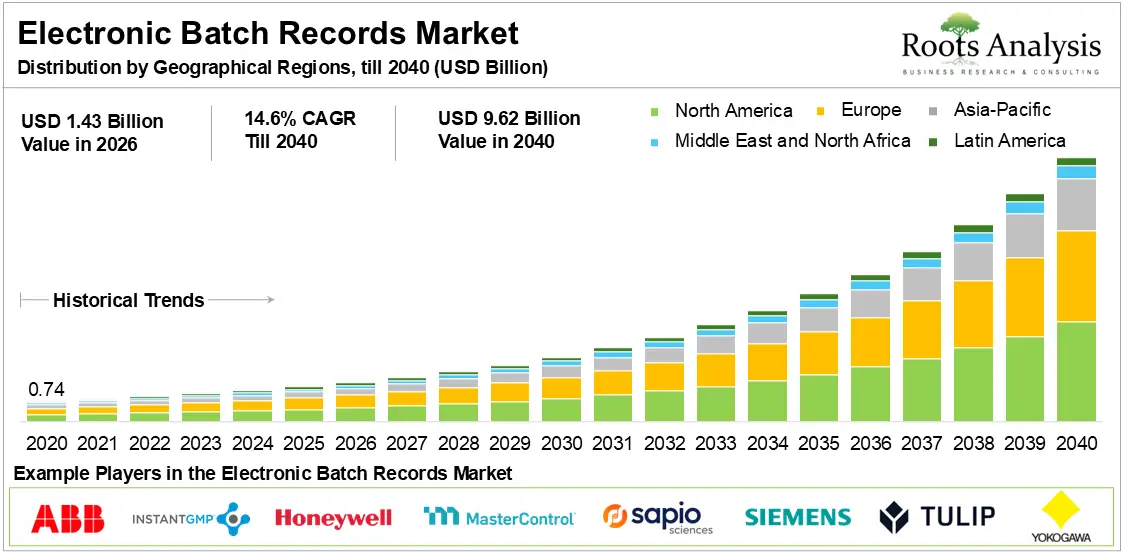
The electronic batch records market is estimated to grow from USD 1.28 billion in 2025 to reach USD 1.43 billion in 2026 and USD 9.62 billion by 2040, representing a higher CAGR of 14.6% during the forecast period 2026 to 2040.
 |
To learn more about this report, request a free sample copy
Electronic batch record (EBR) is a digital system designed to track, streamline and automate manufacturing production processes. It captures, monitors, and stores production data for all batches in a production line, ensuring transparency and compliance with quality standards throughout the manufacturing process. Presently, electronic batch record system is employed in various fields, such as drug manufacturing, healthcare, biotechnology, and food and beverage industries where regulatory compliance and quality assurance are crucial.
Manual batch records present several challenges that can significantly impact manufacturing processes since they are more susceptible to human errors, leading to potential regulatory standard violations. Hence, various manufacturers employ electronic batch records to obtain high-quality products with reduced operating and manufacturing cost. In 1990, the United States Food and Drug Administration (USFDA) issued compliance standards under 21 CFR Part 11 to promote Good Manufacturing Practices (GMPs) which paved the way for batch manufacturing solutions highlighting the need for adoption of electronic batch records.
 |
 |
 |
Safety concerns, stringent regulatory guidelines and the requirement for scientific validations have spurred the need for advanced electronic batch records. Further, the increased focus on quality and multi-product strategies, the necessity to incorporate advanced technologies and rise of artificial intelligence integration in electronic batch record solutions are likely to drive the electronic batch records market growth.
| Key Report Attributes | Details | |
| Historical Trend | Since 2020 | |
| Forecast Period | Till 2040 | |
| Market Size 2026 | $1.43 Billion | |
| Market Size 2040 | $9.62 Billion | |
| CAGR (Till 2040) | 14.6% | |
The electronic batch records market analysis also features the likely distribution of the current and forecasted opportunity within the domain across various segments, such as type of electronic batch record system, deployment mode, purpose of electronic batch record, geographical regions and leading players.
 |
 |
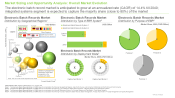 |
We have created three market forecast scenarios, conservative, base and optimistic, to account for future uncertainties in key parameters and enhance the robustness of our model. These scenarios represent different tracks of the industry's evolution.
Prevailing safety concerns, stringent regulatory guidelines and the requirement for industrial automation have spurred the need for electronic batch records in order to uphold product quality, consumer safety, manufacturing efficiency and trust. Advancements in systems, such as quality management systems (QMS), laboratory informatics management systems (LIMS) and manufacturing execution systems (MES electronic batch record) have significantly improved the industrial as well as research efficiency with automated data tracking in batch processes.
 |
 |
 |
Several recent developments in the field of electronic batch records have occurred, and we outline some of these below. These developments, even if they arose after our market report’s release, support the overall electronic batch records market trends detailed in our analysis.
The market research report presents an in-depth analysis of the various electronic batch record companies, across different segments, as defined in the table below:
| Market Segmentations | Details | |
| Type of Electronic Batch Record System |
|
|
| Deployment Mode |
|
|
| Purpose of Electronic Batch Record |
|
|
| Geographical Regions |
|
|
| Market in North America |
|
|
| Market in Europe |
|
|
| Market in Asia-Pacific |
|
|
| Market in Middle East and North Africa |
|
|
| Market in Latin America |
|
|
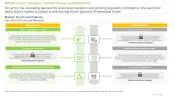
As the demand to improve efficiency, accuracy, and compliance in manufacturing processes increases, the global market for electronic batch records is expected to rise. Additionally, the need for improved data integrity, traceability, and reduced operational manufacturing costs will augment the demand for electronic batch record solutions.
Electronic batch records will mark a turning point in the near future. Gunter Baumgartner, (Global Head of Engineering, Takeda), states, “By transitioning from manual to automated processes in many of our manufacturing operations, we’re improving efficiency and quality and allowing our employees to focus on other value-add tasks. We aim to be 80% paperless in our manufacturing organization by the end of fiscal year 2026”.
| Report Deliverables | Details | |
| Excel Data Packs (Complimentary) |
|
|
| Key Electronic Batch Record Companies Profiled |
|
|
| PowerPoint Presentation (Complimentary) |
Available | |
| Customization Scope | 15% Free Customization | |
The “Electronic Batch Records Market: Industry Trends and Global Forecasts, till 2040” market report features an extensive study of the current market landscape, company competitiveness analysis, partnership and collaboration analysis, recent initiative and market size and future opportunities within the electronic batch record industry, during the forecast period.
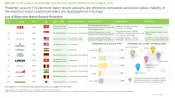
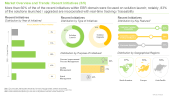
The current market landscape features more than 110 electronic batch record solution providers including very large, large, mid-sized and small companies. These solution providers have the required expertise to provide electronic batch record solutions, across different key geographical regions.
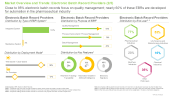
It is worth highlighting that majority (98%) of electronic batch record solution providers are offering web-based / cloud-based electronic batch record solutions, followed by on-premises (17%) electronic batch record solutions. In additiron, majority (86%) of the electronic batch record solution providers offer solutions providing real-time tracking / traceability.
The global electronic batch records market size is likely to be worth $ 1.43 billion in 2026 and will reach $ 9.62 billion by 2040. In terms of the type of electronic batch record systems, the integrated systems segment holds the largest share of the market, as per electronic batch records market forecast, due to rising demand for these systems with wide range compatibility. This trend is likely to remain the same during the forecast period.
The increase in the need for batch production quality and automation of batch record management are the primary drivers of this market. Further, the rising interest in health consciousness coupled with industrial digitalization is likely to significantly drive the growth of this market.
North American companies will likely dominate the global electronic batch records domain in 2040. The majority (close to 35%) of electronic batch record solution companies are headquartered in Europe. This is due to the rising adoption of these solutions and the ongoing innovation in electronic batch records domain across this region.
The market in Asia-Pacific is likely to grow at a relatively high CAGR (15.4%), during the forecast period till 2040. This is due to several factors, including rising urbanization and increased demand for automated solutions.
A major role of artificial intelligence in electronic batch records management is observed over the years. Such metaverse in healthcare (AI) technologies, such as optical character recognition (OCR), intelligent character recognition (ICR), and handwriting recognition (HWR) have the capability to transform batch records by automating batch production process and reducing the risk of human errors.
One of the key drivers of electronic batch records industry is the rising technological advancements which have made EBR solutions more efficient. The rising need for pharmaceutical products and the increasing complexity of manufacturing processes has driven the need for sophisticated solutions, such as pharmaceutical electronic batch records.
These solutions enable seamless integration with existing systems and further enhance data management. These advancements in the domain have resulted in the development of advanced electronic batch manufacturing records solutions. It is important to note that the pharmaceutical companies are adopting Pharma 4.0 technologies, including the integration of EBRs in achieving paperless manufacturing.
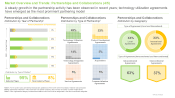
Electronic batch record solution providers have forged several partnerships with other stakeholders in order to enhance their solution portfolio. It is worth highlighting that in the last three years, companies based in North America and Europe have inked several partnerships to strengthen their electronic batch record capabilities.
Notably, majority of the deals signed in this domain are instances of technology utilization agreements, followed by product development agreements. This is due to the persistent efforts of electronic batch record solution providers to further advance their solution offerings in order to meet the requirements of their clients.
Electronic batch record providers have also introduced new features to their pre-existing EBR solutions in order to expand their electronic batch record solutions portfolio. Since 2021, more than 60% of recent initiatives focused on the launch of new electronic batch record solutions. Such initiatives undertaken in this domain indicate that the providers are upgrading their capabilities and infrastructure to accommodate the current and anticipated demands, driven by the need for streamlined manufacturing processes while ensuring compliance with regulatory bodies.
The market report presents an in-depth analysis, highlighting the capabilities of various stakeholders in the electronic batch records domain, across different geographies. Amongst other elements, the market report includes:
The electronic batch records market offers a huge opportunity to the industries adopting digitization. There is a rising shift of manufacturers towards digitalized manufacturing with an aim to ensure streamlined manufacturing processes, eliminate paper-based documentation and comply with strict regulatory standards. Therefore, with the ongoing technological advancements, we anticipate a steady growth in the electronic batch record market.
Lead Author: Aanchal Chaudhary
Lead Reviewer: Nancy Kapila
Chief Editor: Rupanshi Sharma