
Lowest Price Guaranteed
Pages
190
Last Updated
May 2025
View Count
11055
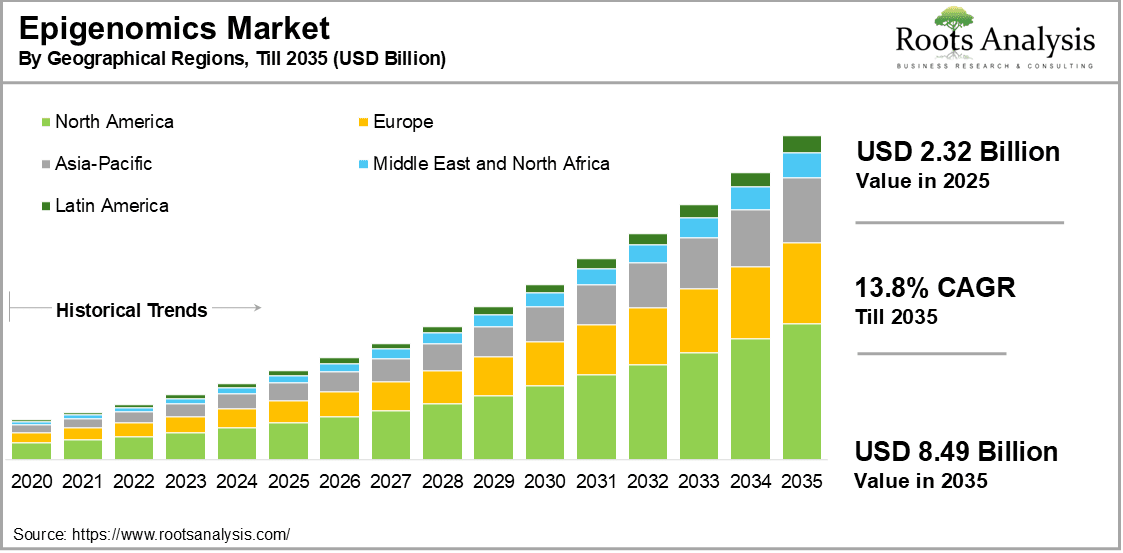
The global epigenomics market, valued at USD 1.98 billion in 2024, is projected to reach USD 2.32 billion in 2025 and USD 8.49 billion by 2035, representing a CAGR of 13.8% during the forecast period.
 |
Epigenomics refers to the study of whole set of epigenetic modifications / epigenomes across genetic material of a cell. The study of epigenomes is crucial in the healthcare sector as it helps to analyze lifestyle and environmental factors that can influence gene function and cause diseases, such as cancer, diabetes, and neurodegenerative disorders.
Notably, the rising incidence of chronic conditions specifically diabetes and cancer has shifted the healthcare industry towards epigenomics to gain better insight of diseases underlying causes, progression, and therapeutic interventions to improve patient treatment outcomes, such as RNA therapeutics, cancer therapeutics and peptide therapeutics. Beyond understanding the root cause of diseases, epigenomics also play a significant role in the development of personalized medicine to target a wide range of diseases, which further increases its adoption across pharmaceutical and healthcare sectors.
With growing usage across healthcare industry, various industrial players are focusing on the development of advanced products, instruments, and services. For instance, in November 2024, PacBio announce the launch of Vega™ system (company’s first benchtop long-read sequencing platform). This newly launched benchtop long-read sequencing platform offers high throughput and accuracy with HiFi technology and faster turnaround time, making it a valuable tool for whole genome sequencing and RNA sequencing.
Furthermore, several researchers are focusing on understanding the non-genetic disease hierarchy by initiating epigenetic programming. For instance, in March 2025, a USD 2.7 million grant from the John Templeton Foundation has been awarded to UTSA researchers to propel the research on how environmentally induced diseases originate through the disruption of epigenomic / epigenetic programming. Driven by the ongoing initiatives, we believe that the epigenomics market is expected to grow at a steady pace during the forecast period.
The market report provides comprehensive information on industrial players who are currently active across various segments of the industry as mentioned in the table below.
| Key Report Attributes | Details | |
| Historical Trend | Since 2020 | |
| Forecast Period | Till 2035 | |
| Market Size 2025 | USD 2.32 Billion | |
| Market Size 2035 | USD 8.49 Billion | |
| CAGR till 2035 | 13.8% | |
| Type of Product |
|
|
| Type of Component |
|
|
| Type of Technology |
|
|
| Application Area |
|
|
| End-Users |
|
|
| Geographical Regions |
|
|
| Key Companies Profiled |
|
|
| PowerPoint Presentation (Complimentary) |
Available | |
| Customization Scope | 15% Free Customization | |
| Excel Data Packs (Complimentary) |
Available | |
One of the key objectives of the epigenomics market report was to estimate the current size, opportunity, and the market growth potential, over the forecast period, till 2035. We have provided informed estimates on the likely evolution of the market for the forecast period.
The global market analysis report also features the likely distribution of the current and forecasted opportunity within the market across various segments, such type of product (reagents, kits (ChIP sequencing kit, whole genomic amplification kit, bisulfite conversion kit, RNA sequencing kit and others), instruments, enzymes and services), type of component (methylation, acetylation, phosphorylation, ubiquitylation, and sumoylation), type of technology (DNA methylation, histone methylation, histone acetylation, large non-coding RNA, microrna modification and chromatin structures), type of disease (cancer, neurological disorders, inflammatory & autoimmune disease, cardiovascular disease and others), application area (oncology (solid tumors and liquid tumors), and non-oncology (inflammatory diseases, metabolic diseases, infectious diseases, cardiovascular diseases and others)), end user (academic research, clinical research, hospitals & clinics, pharmaceutical & biotechnology companies and other end users), geographical regions (North America, Europe, Asia-Pacific, Middle East and North Africa, and Latin America) and leading players.
In order to account for future uncertainties associated with some of the key parameters and to add robustness to our model, we have provided three epigenomics market forecast scenarios, namely conservative, base, and optimistic scenarios, representing different tracks of industry’s evolution.
All actual figures have been sourced and analyzed from publicly available information forums and primary research discussions. The financial figures mentioned in this market report are in USD, unless otherwise specified.
Based on the type of product, the global market is segmented into reagents, kits (ChIP sequencing kit, whole genomic amplification kit, bisulfite conversion kit, RNA sequencing kit and others), instruments, enzymes, and services. According to our epigenomics market report, the reagents segment holds the largest share of the market. This can be attributed to the widespread usage of reagents for the study of epigenomes.
However, it is worth mentioning that the kits segment is likely to show lucrative growth potential and is poised to expand at a higher CAGR over the forecasted period. This is likely to be the result of high adoption of kits, such as whole genome amplification kit, RNA sequencing kit and ChIP sequencing kit for gene analysis, drug analysis and disease diagnosis.
Based on the type of component. The global market is segmented into methylation, acetylation, phosphorylation, ubiquitylation, and sumoylation. Presently, methylation accounts for the highest share of the epigenomics market. This can be attributed to the fact that methylation is important in epigenomics as it acts as a primary epigenetic mechanism that regulates the gene expression by adding a methyl group at the side chain of DNA, thereby influencing which genes are switched on / off without altering the basic sequence of DNA. It is important to highlight here that this segment will continue to grow at a higher CAGR during the forecast period.
This segment highlights the distribution of global market across different types of technology, such as DNA methylation, histone methylation, histone acetylation, large non-coding RNA, microrna modification and chromatin structures. Among these, presently, DNA methylation segment occupies the highest epigenomics market share. This dominance is due to the increasing research on genetics, diseases, and biological processes. Furthermore, the increasing technological innovations, such as high throughput sequencing systems and methylation specific PCR for the detailed analysis of DNA methylation has further contributed to the highest share of this segment.
It is worth mentioning that histone acetylation segment is likely to grow at a substantial CAGR during the forecast period. Notably, histone acetylation has several significances in healing disorders, such as leukemia, inflammation, viral infection, and others which underscore the demand for histone acetylation in the future.
This segment highlights the distribution of global market across different types of diseases, such as cancer, neurological disorders, inflammatory & autoimmune disease, cardiovascular disease, and others. Among these, the cancer segment accounts for the largest share of the epigenomics market. This can be attributed to the growing incidence of cancer and expanding usage of epigenomics in oncology studies and treatment.
However, in the long run, neurological disorders segment is likely to register a higher CAGR during the forecast period. This is primarily due to the expanding usage of epigenomics for studying neurological disease progression, such as Alzheimer’s disease.
The global market is further categorized based on application area into oncology and non-oncology. According to our epigenomics market report, currently oncology segment accounts for the largest share of the market. This can be attributed to the rising incidence of cancer across the globe and growing usage of epigenomics to understand the relation between cancer and gene alteration.
However, in the long run, non-oncology segment is expected to register a higher CAGR during the forecast period. This lucrative growth is driven by the increasing application of epigenomics across different health conditions, such as neurological disorders, cardiovascular disorders, and rare diseases.
Based on the end user, the global market is segmented into academic and research institutes, pharmaceutical companies, biotechnology companies, and contract research organizations. It is worth mentioning that academic and research institutes account for the highest share of the market for epigenomics. This dominance is due to the expanding usage of epigenomics for the identification of biomarkers and finding drug targets and understanding the disease mechanism and their correlation with epigenetics.
However, in the long run, pharmaceutical companies’ segment is likely to grow at a higher CAGR during the forecast period. Notably, pharmaceutical companies are aiming to leverage epigenomics to understand molecular aspects of cancer. Additionally, pharmaceutical industries are focusing on understanding the microorganism-derived drug resistance and tailored drug development.
The global market is distributed across different geographical regions, such as North America, Europe, Asia-Pacific, Middle East and North Africa, and Latin America. According to our global epigenomics market analysis, currently North America accounts for the highest share of the market. This can be attributed to the growing incidence of cancer and chronic conditions in this region.
Furthermore, several research organizations and pharmaceutical companies are adopting epigenomics to understand the underlying mechanism of diseases and development of tailored drugs, which further contributed to the largest share of the market.
However, in Asia-Pacific, the market for epigenomics is likely to register a higher CAGR during the forecast period. This lucrative growth is likely to be the result of increasing focus on leveraging epigenomics technologies, such as PCR-based diagnostics kits and NGS for understanding gene defects.
The “Epigenomics Market: Industry Trends and Global Forecasts, till 2035” market report features an extensive study of the current market landscape, market size, market share, market growth, market trends, market value, market forecast, market outlook, statistics, and future opportunities. The market research report lays emphasis on the epigenomics solutions that are being developed. Key takeaways of the market report are briefly discussed below.
Currently, the market landscape of companies active in the epigenomics industry includes the presence of several well-established and new entrants. It is worth noting that the industrial players presently focus on technological innovations and launching new products. In order to leverage competitive edge, various industrial players are undertaking strategic initiatives, such as collaborations and partnerships.
For instance, in December 2024, UK Biobank, Oxford Nanopore Technologies, Genomics England and NHS England entered into the partnership to understand the root cause of diseases, such as cancer, heart disease and dementia.
Furthermore, the partnership aims to offer comprehensive epigenetic dataset insight into how lifestyle choices and environmental factors can impact disease progression. Overall, the market seems consolidated with the presence of several small, mid-sized and large industrial players who are accelerating their efforts to develop innovative products and services.
The epigenomics market has experienced an upward trajectory driven by the increasing incidence of chronic conditions and heightened demand for personalized medicine. It is worth mentioning that the study of epigenomes helps to understand the root cause of diseases and role of lifestyle choices in disease progression. The information of epigenomic data helps to develop tailored therapeutic drugs that helps to treat patients effectively.
Furthermore, the increasing focus on understanding epigenomic biomarkers to identify disease indication and targeted molecules has further fueled the market growth during the forecast period.
Several challenges that are impeding market growth include the high cost of epigenomics instruments and stringent guidelines. Notably, the high initial investment for instruments may hinder the adoption of epigenomics specifically in low to middle income countries.
Additionally, the stringent guidelines associated with the epigenomics usage and technologies may create challenges for the market players. In addition, lack of skilled personnel may further limit the adoption of epigenomics.
Despite challenges, the market for epigenomics is growing exponentially owing to the growing technological advancements, expanding research and collaboration. Notably, the industrial players are focusing on the development of technologies, such as next-generation sequencing, CRISPR-based epigenomics technologies that help to offer higher precision in manipulating gene expression. Additionally, the growing research on epigenomics to understand the role of lifestyle and environment factors in disease progression has further offered enormous opportunities to industrial players for driving innovation.
Furthermore, the market players are focusing on collaborations and partnerships to expand research on epigenetics and develop new products. For instance, in November 2024, PharmaKure entered into a partnership with Sheffield Hallam University to emphasize on epigenetic markers for determining the risk scores for Alzheimer’s disease using AlZmetrix™, Pharmakure’s blood-based biomarker.
Currently, the global market for epigenomics is estimated to be valued at USD 2.32 billion in 2025 and is poised to reach USD 8.49 billion by 2035, representing a CAGR of 13.8% during the forecast period. The market for epigenomics is consistently gaining momentum driven by the growing awareness about environmental factors and gene expression in diseases.
Contrastingly, the market players are focusing on the development of epigenomic biomarkers, medicine, and technologies. For instance, in November 2024, Omega Therapeutics announced the completion of MyCHELANGELO™ (epigenomic controller) Phase I clinical trial and strategic prioritization of its clinical pipeline to focus resources on programs in which Omega Therapeutics believe that epigenomic controllers offer therapeutic significances to address the unmet requirements.
Examples of key players engaged in this domain (which have also been captured in this report) include Abcam, Active Motif, Bio-Rad Laboratories, Diagenode, Illumina, Merck, New England Biolabs, PacBio, Promega, PerkinElmer, Roche, Qiagen, Thermo Fisher Scientific and Zymo Research. This market report includes an easily searchable excel database of all the companies focusing on the development of epigenomics products.
The market report presents an in-depth analysis, highlighting the capabilities of various companies engaged in this domain across different segments. Amongst other elements, the market report includes:
Several recent developments have taken place in the field of epigenomics. We have outlined some of these recent initiatives below.