Europe Antibody Drug Conjugates Market
Europe Antibody Drug Conjugates Market by Target Indication (Breast Cancer, Non-Small Cell Lung Cancer, Ovarian Cancer, Multiple Myeloma, B-Cell Lymphoma and Other Specified Indications), Therapeutic Area (Solid Tumor and Hematological Cancer), Type of Antibody (Humanized, Human and Chimeric), Target Antigen, Linker, Payload / Cytotoxin / Warhead, Type of Payload, Countries - Trends and Forecast 2026-2035
-
Lowest Price Guaranteed
-
Pages
247 -
Last Updated
September 2026 -
View Count
5651 -
Market Outlook
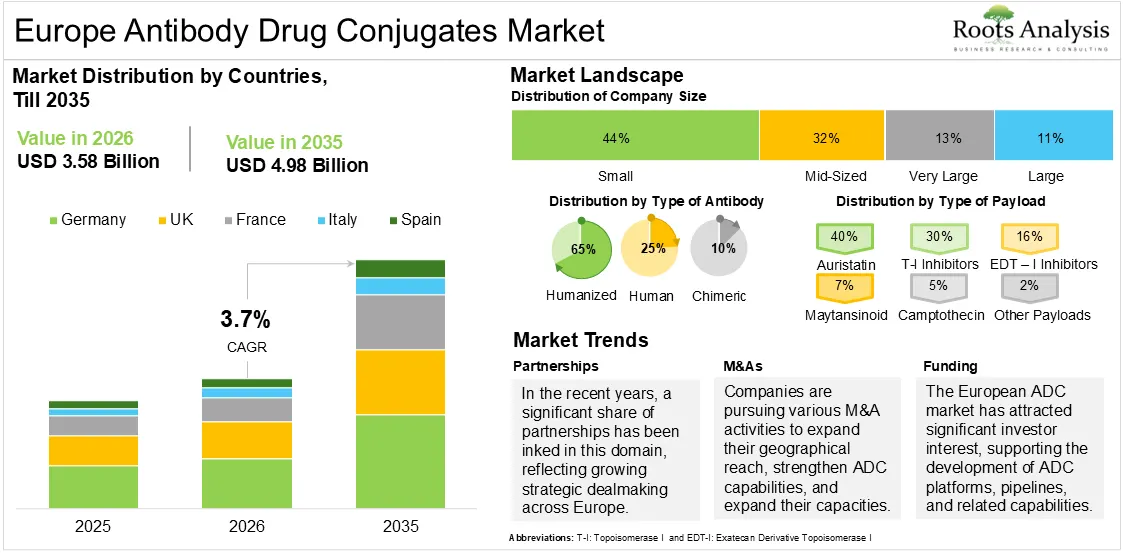
The Europe antibody drug conjugates market, valued at USD 3.26 billion in 2025, is projected to reach USD 3.58 billion in 2026 and USD 4.98 billion by 2035, representing a CAGR of 3.7% during the forecast period 2026 to 2035.
To learn more about this report, request a free sample copy
Market Report: Key Takeaways
Market Size & Trends
- Breast cancer represents the dominant segment, contributing over 45% of the overall market at present. However, head and neck cancer is poised to experience the most rapid expansion over the forecast period.
- Solid tumors account for the majority of the market currently and are projected to maintain their leading position while recording the strongest growth throughout the forecast period.
- HER2 (ERBB2) is the predominant target in the current market and is expected to remain the leading target over the forecast period, while investigational targets such as B7-H4 (VTCN1) are attracting increasing development interest.
- Humanized antibodies represent the leading and fastest-growing antibody category.
- Auristatin leads by type of payload, while Topoisomerase I Inhibitors represent the fastest-growing category.
- Germany is the leading country market and is projected to register the fastest CAGR during 2026-2035.
Key Market Statistics
- Market Size in 2026: $3.58 Billion
- Estimated Market Size in 2035: $4.98 Billion
- CAGR (2026-2035): 3.7%
- Germany: Largest market in 2026
Market Introduction
Antibody-drug conjugates (ADCs) combine the targeting specificity of a monoclonal antibody with potent cytotoxic payloads through specialized linkers, enabling selective delivery of anticancer agents to antigen-expressing tumor cells. For market sizing, the Europe scope in this report comprises Germany, France, the UK, Italy and Spain. The current market-size estimate reflects revenues from commercially available ADC therapeutics in these covered markets, while the broader market landscape also evaluates relevant investigational programs across solid tumors and hematological malignancies.
Across Europe, ADC adoption is increasingly shaped not only by regulatory approvals, but also by biomarker-testing infrastructure, health technology assessment and country-specific reimbursement decisions. Expansion into earlier treatment lines and biomarker-defined populations, including HER2-low and HER2-ultralow disease, is broadening the eligible patient pool while increasing the importance of accurate pathology testing and treatment-specific patient selection.
Market growth is being supported by advances in linker technologies, payload selection, drug-to-antibody ratios, bystander effects, and antibody engineering. Innovations such as Daiichi Sankyo's DXd platform highlight ongoing efforts to improve ADC potency, stability, tumor penetration, and therapeutic windows. Artificial intelligence and computational modeling are also being applied to target prioritization, antibody engineering and the screening of linker-payload combinations, helping developers evaluate a wider range of ADC constructs before experimental and clinical development.
Despite strong development activity, challenges related to payload toxicity, target heterogeneity, biomarker selection, manufacturing complexity and high-potency handling remain. Commercial scale-up requires reproducible conjugation, tight control of drug-to-antibody ratio, specialized payload handling and reliable technology transfer. Consequently, CMOs and CDMOs with integrated linker, HPAPI and bioconjugation capabilities are becoming increasingly important to developers seeking to scale ADC programs across Europe.
Future market growth will depend on improving therapeutic windows, identifying predictive biomarkers and navigating Europe's regulatory, HTA and reimbursement environment effectively.
Market Segmentation
Based on the research, the Europe antibody drug conjugates market has been segmented by target indication, therapeutic area, type of antibody, target antigen, linker, payload / cytotoxin / warhead, type of payload and country.
- By Target Indication: Breast Cancer, Non-Small Cell Lung Cancer, Ovarian Cancer, Multiple Myeloma, B-Cell Lymphoma, Renal Cancer, Gastric Cancer, Head and Neck Cancer, Hodgkin's Lymphoma, T-Cell Lymphoma, and Other Target Indications
- By Therapeutic Area: Solid Tumor and Hematological Cancer
- By Type of Antibody: Humanized, Human, and Chimeric
- By Target Antigen: HER-2 (ERBB2), FOLR1 (Folate receptor alpha), TROP-2, CD79b, BCMA (TNFRSF17 / BCM), Nectin 4, c-MET, PD-L1, CD30, and Other Antigens
- By Linker: Valine-citrulline, Tetrapeptide-based Linker, Maleimidocaproyl, Succinimidyl-4-(N-maleimidomethyl) cyclohexane-1-carboxylate, Dipeptide Linker, Peptide Linker, Valine-alanine, N-Succinimidyl 4-(2-pyridyldithio)-2-sulfobutanoate (Sulfo-SPDB), Maleimide, and Other Linkers
- By Payload / Cytotoxin / Warhead: Monomethyl auristatin E (MMAE), Camptothecin, Exatecan, Monomethyl auristatin F (MMAF), DM1, DM4, SN-38 / Irinotecan and Other Payloads / Cytotoxins
- By Type of Payload: Auristatin, Topoisomerase I Inhibitors, Exatecan Derivative Topoisomerase I Inhibitor, Maytansinoid, Camptothecin, and Other Types of Payloads
- By Countries: UK, Germany, Spain, Italy, and France
Europe Antibody Drug Conjugates Market Key Insights
What Are the Key Drivers of Growth in the Europe Antibody Drug Conjugates Market?
- Broader biomarker-defined indications are extending use beyond established patient groups. Enhertu's EU indications include selected HER2-low and HER2-ultralow breast cancers, demonstrating that eligibility for some ADCs extends beyond conventional HER2-positive disease. This increases the importance of accurate pathology classification and treatment-specific interpretation of biomarker results.
- Combination regimens are supporting renewed opportunities in hematological cancer. In July 2025, the European Commission approved Blenrep combinations for eligible adults with relapsed or refractory multiple myeloma. These regimens broaden the commercial context for BCMA-directed ADC treatment, although practical uptake remains dependent on safety management and access.
What are the Main Challenges for Market Growth?
- Product-specific toxicities can restrict treatment suitability and continuity. ADC targeting does not eliminate adverse effects. Enhertu requires attention to interstitial lung disease and pneumonitis, while Blenrep has important ocular safety considerations. Monitoring requirements, treatment interruptions and dose modifications affect both clinical delivery and the duration of commercial treatment.
- Biomarker-based eligibility requirements can create additional implementation challenges. Pathology services must accurately identify eligible patients based on the biomarker criteria specified for each therapy. For Elahere, treatment eligibility depends on the presence of folate receptor-alpha (FRα) expression. Limited access to appropriate testing or variability in biomarker interpretation may delay or restrict access to treatment for otherwise eligible patients.
Recent Developments in the Europe Antibody Drug Conjugates Market
- AstraZeneca and Daiichi Sankyo: In September 2026, the companies received European Commission approval for Enhertu in combination with pertuzumab as first-line treatment for adults with unresectable or metastatic HER2-positive breast cancer. The approval was based on the Phase III DESTINY-Breast09 trial.
- Heidelberg Pharma and Huadong Medicine: In August 2026, Germany-based Heidelberg Pharma and China-based Huadong Medicine expanded their ADC collaboration to jointly research and develop candidates against up to six targets. The collaboration combines Heidelberg Pharma's ATAC technology and other novel payloads with Huadong Medicine's research and development capabilities, including potential bispecific, multispecific and dual-payload ADCs.
- Novartis acquired Myricx Bio: In August 2026, Myricx Bio became an indirect, wholly owned subsidiary of Novartis following completion of the transaction announced in July 2026. The transaction included USD 1.1 billion upfront and up to USD 400 million in potential milestone payments, adding Myricx's two lead ADC candidates and N-myristoyltransferase inhibitor (NMTi) payload platform to Novartis' oncology pipeline.
Methodology and Industry Expert Interviews
Driven by continued advances in ADC technologies and the emergence of newer generations of targeted therapies, the Europe antibody-drug conjugates market is expanding toward broader clinical applications and improved treatment options.
Highlighting the evolving potential of ADCs in oncology, Prof. Fabrice André, Director of Research at Gustave Roussy Cancer Campus, France, stated, "The evolution of ADCs in recent years is quite incredible. It is offering our patients better chances." He further noted that newer generations of ADCs are providing clinical options for patients who were resistant to earlier conjugated antibodies.
The findings presented in this report were developed through a combination of secondary research, company and regulatory disclosures, clinical-development information, proprietary databases and primary discussions with stakeholders across the ADC value chain. Findings were triangulated across market sizing, technology trends, clinical development, manufacturing, reimbursement and country-level adoption before finalization.
Discussions with multiple stakeholders in this domain influenced the opinions and insights presented in this study. The market report includes transcripts from the executives and specialists spanning biotechnology and pharmaceutical companies, CMOs/CDMOs, business development, chemistry, regulatory affairs, R&D and commercial functions, including the following roles:
- Founder and Chief Executive Officer, Mid-sized Company, UK
- Founder and Chief Executive Officer, Small Company, US
- Founder and Chief Executive Officer, Small Company, US
- Co-Founder and Chief Executive Officer, Small Company, France
- President and Chief Executive Officer, Large Company, Italy
- Chief Executive Officer, Leading CMO
- Former Chief Executive Officer, Large Company, US
- President and Executive Director, Very Large Company, Japan
- Executive Director and Chief Scientific Officer, Very Large Company, Japan
- Chief Business Officer and Head of Strategy, Mid-sized Company, US
- Chief Commercial Officer, Mid-sized Company, Switzerland
- Chief Business Officer, Small Company, South Korea
- Former Chief Business Officer, Mid-sized Company, Switzerland
- Vice President, Business Development, Small Company, Netherlands
- Former Vice President and Head of Chemistry, Mid-sized Company, US
- Director, Business Development, Leading CMO
- General Manager, Large Company, Japan
- Former Director of CDMO, Very Large Company, France
- Former Director, Very Large Company, US
- Former Group Product Manager, Very Large Company, US
- Former Head of Bioconjugates Commercial Development, Very Large Company, Switzerland
- Former Site Head, Large Company, US
- Professor, School of Medicine, Very Large Company, UK
In addition, the antibody drug conjugates market report (9th edition) includes transcripts of the following other third-party discussions:
- President and Chief Executive Officer, Small Organization, US
- Chief Executive Officer and Co-Founder, Mid-sized Organization, US
- Chief Executive Officer and Co-Founder, Mid-sized Organization, US
- Founder and Chief Technology Officer, Mid-sized Organization, Belgium
- Chief Executive Officer, Mid-sized Organization, Japan
- Chief Executive Officer, Small Organization, US
- President and Co-Founder, Small Organization, US
- Vice President of Cell Technology, Mid-sized Organization, Belgium
- Associate Director, Regulatory Affairs, Mid-sized Organization, US
- Team Leader, Research and Development, Mid-sized Organization, Germany
Market Share Insights
Which Target Indication Accounts for the Largest Share of the Europe Antibody Drug Conjugates Market?
- The breast cancer segment currently holds the largest share. Its position is consistent with the availability of multiple ADC treatment approaches and established biomarker-based treatment pathways. The introduction of Datroway adds a TROP-2-directed option within eligible hormone receptor-positive, HER2-negative disease.
- Head and neck cancer is projected to be the fastest-growing indication, supported by ongoing ADC development in previously treated advanced disease, including a Phase II study of enfortumab vedotin. Market growth will ultimately depend on regulatory approvals and evidence across endpoints such as objective response rate, duration of response, progression-free survival and overall survival, together with reimbursement and clinical implementation.
Which Payload is Gaining the Most Ground in the Europe ADC Market?
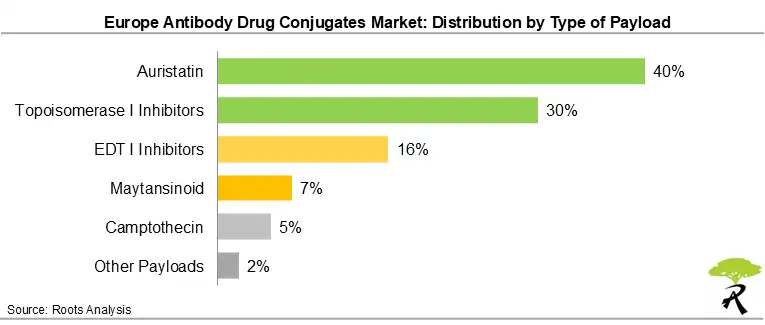
- Auristatin currently holds the largest market share (40%), supported by the established use of auristatin-based ADCs across solid tumors and hematological malignancies, including MMAE- and MMAF-based therapies.
- Topoisomerase I inhibitors are expected to witness the fastest growth, driven by the increasing adoption and development of ADCs utilizing this payload mechanism, such as Datroway.
Which Target Antigen Leads the Europe ADC Market?
- HER-2 (ERBB2) is expected to maintain its leading position, accounting for the highest market share and registering the fastest CAGR during the forecast period.
- This strong market position is supported by the established HER2-directed ADC franchise, growing use in earlier lines of breast cancer treatment, and continued expansion into additional HER2-positive solid tumor indications.
Which Country Represents the Leading Antibody Drug Conjugates Market in Europe?
- Germany's established oncology assessment framework supports the evaluation and adoption of new ADC indications, as demonstrated by the G-BA's assessment of trastuzumab deruxtecan in HER2-low and HER2-ultralow breast cancer. Germany also has a growing ADC development ecosystem, with companies such as BioNTech and Heidelberg Pharma contributing to domestic research and development.
- The UK represents a significant market for ADC therapies in Europe, supported by an established regulatory and health technology assessment framework. NICE's indication-specific recommendations play an important role in determining access and funded use of ADCs. The recent recommendation for mirvetuximab soravtansine in eligible ovarian cancer patients highlights the country's growing ADC adoption.
Key Players Profiled in Europe Antibody Drug Conjugates Market
The Europe ADC market includes pharmaceutical companies, biotechnology firms, and ADC-focused developers involved in antibody-drug conjugate research, development, and commercialization, including, AbbVie, ADC Therapeutics, Astellas Pharma, AstraZeneca, BioNTech, Daiichi Sankyo, Eli Lilly and Company, Genmab, Gilead Sciences, GSK, Merck & Co., Pfizer, Roche / Genentech, and Zymeworks.
Report Deliverables and Customization
The report includes complimentary Excel data packs covering market landscape analysis, clinical trials, partnerships and collaborations, funding and investment analysis, patent analysis, grants analysis, market sizing and forecast analysis. A complimentary PowerPoint presentation is available, and up to 15% customization can be requested subject to data availability.
Report Authorship
Author(s): Simriti Gupta and Pemba Lahmo. Both authors contribute to Roots Analysis's healthcare and pharma research practice, covering biologics discovery, development, and manufacturing market studies.
Independence and Non-Affiliation
This report is an independent work of market research and analysis published by Roots Analysis. It is not affiliated with, sponsored by, endorsed by, or reviewed by Novo Nordisk, AstraZeneca, Sanofi, or any other pharmaceutical company, drug brand, or regulatory body referenced within it. No content in this report should be construed as medical advice. Roots Analysis maintains its own proprietary primary research process, and does not receive compensation from any company profiled within the report, in exchange for inclusion or favorable characterization.