Global Non-Small Cell Lung Cancer Market Size
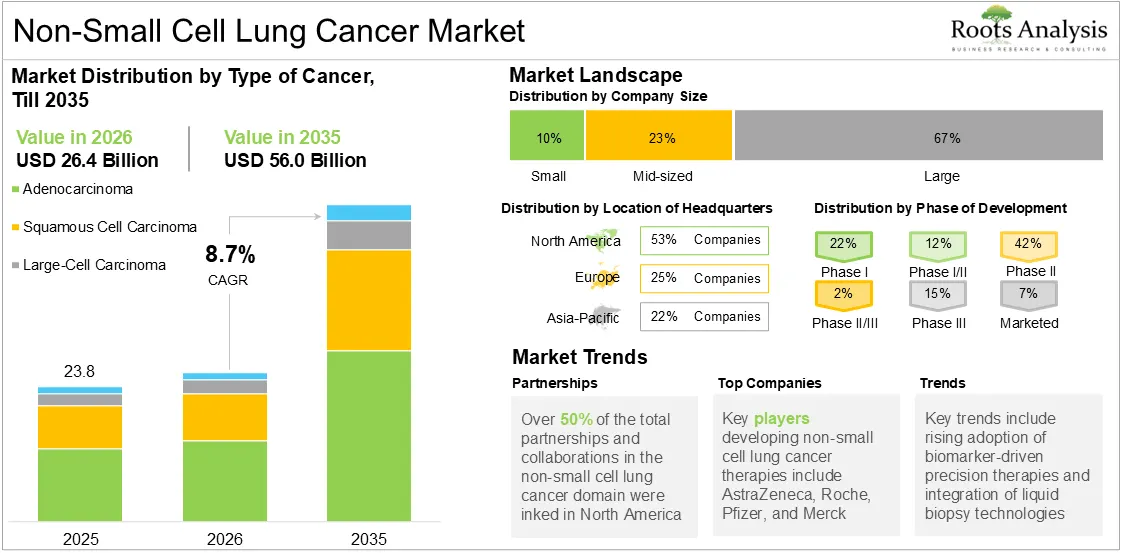
The global non-small cell lung cancer market size is estimated to grow from USD 23.8 billion in 2025 to USD 26.4 billion in 2026 and USD 56.0 billion by 2035, representing a CAGR of 8.7% during the forecast period.
To learn more about this report, request a free sample copy
In non-small cell lung cancer, malignant cancerous cells form inside the lungs. With unhealthy lifestyles, rising air pollution and high consumption of tobacco, there has been a significant increase in the number of non-small cell lung cancer patients. According to the Centers for Disease Control and Prevention, lung cancer remains the one of the most commonly diagnosed cancers in the US.
It is worth highlighting that among all the forms of non-small cell lung cancer, squamous cell carcinoma is one of the most common types and it may develop due to prolonged use of tobacco. In fact, the World Health Organization report shows that smoking is the main cause of lung cancer, accountable for nearly 85% of all cases. Thus, the increasing burden of non-small cell lung cancer across the globe has underscored the requirement of advanced cancer therapeutics which experts anticipate will contribute towards non-small cell lung cancer market growth.
Considering the necessity for effective treatment options, various pharmaceutical companies are conducting research on the non-small cell lung cancer treatments and receiving the US Food and Drug Administration (FDA) approval for their therapeutics. It is important to highlight that in August 2024, Janssen Biotech’s combination (RYBREVANT® and LAZCLUZE™) received the US Food and Drug Administration (FDA) approval for the first-line NSCLC treatment in patients with epidermal growth factor receptor (EGFR) exon 19 deletions or exon 21 L858R substitution mutations.
Non-Small Cell Lung Cancer Market: Report Attributes
| Key Report Attributes |
Details |
| Historical Trend |
Since 2019 |
| Forecast Period |
Till 2035 |
| Market Size 2026 |
$26.4 Billion |
| Market Size 2035 |
$56.0 Billion |
| CAGR |
8.7% |
The non-small cell lung cancer market analysis also features the likely distribution of the current and forecasted opportunity within the non-small cell lung cancer domain across various segments, such as type of cancer, type of molecule, type of drug class, type of therapy, type of treatment, route of administration, end user, distribution channel, geographical regions, and leading players.
We have created three market forecast scenarios, conservative, base and optimistic, to account for future uncertainties in key parameters and enhance the robustness of our model. These scenarios represent different tracks of the industry's evolution.
Prevailing safety concerns, stringent regulatory guidelines and the requirement for scientific validations have spurred the need for development and approval of novel and safe non-small cell lung cancer therapeutics. With the rise in the approval of therapeutic modalities for the non-small cell lung cancer treatment, the global NSCLC market growth is expected to be at a healthy CAGR during the forecast period.
Recent Developments in Non-Small Cell Lung Cancer Market
Several recent developments have taken place in the field of non-small cell lung cancer treatment, and we outline some of these below. These developments, even if they arose after our market report’s release, support the overall non-small cell lung cancer market trends detailed in our analysis.
- In June 2026, GSK announced a USD 10.6 billion acquisition of Nuvalent to strengthen its oncology pipeline, which includes two late-stage non-small cell lung cancer drugs, zidesamtinib and neladalkib, currently under FDA review.
- In May 2026, Merck announced that the FDA granted Breakthrough Therapy designation to calderasib (MK-1084), a KRAS G12C inhibitor, combined with pembrolizumab for first-line treatment of advanced or metastatic NSCLC. The designation is based on Phase 1 KANDLELIT-001 trial data and aims to accelerate development for patients with KRAS G12C mutations and PD-L1 expression.
- In May 2026, Nuvation Bio announced the FDA acceptance of a supplemental New Drug Application for taletrectinib in advanced ROS1-positive NSCLC.
- In February 2026, FDA granted accelerated approval to zongertinib (Hernexeos) for adults with unresectable or metastatic non-squamous NSCLC harboring HER2 mutations. Based on the Beamion LUNG-1 trial involving 72 patients, the approval expands treatment options, including first-line use, under an expedited review program addressing critical oncology needs.
- In January 2026, Summit Therapeutics announced the FDA acceptance of its Biologics License Application for ivonescimab combined with chemotherapy in EGFR-mutated NSCLC patients post-TKI therapy.
Non-Small Cell Lung Cancer Market Segmentation Insights
The market research report presents an in-depth analysis of the various companies developing drugs for non-small cell lung cancer, across different segments, as defined in the table below:
Non-Small Cell Lung Cancer Market: Market Segmentations
| Market Segmentations |
Details |
| Type of Cancer |
- Squamous Cell Carcinoma
- Adenocarcinoma
- Large Cell Neuroendocrine Tumors
- Large-Cell Carcinoma
|
| Type of Molecule |
- Small Molecules
- Biologics
|
| Type of Drug Class |
- Alkylating Agents
- Antimetabolites
- EGFR Inhibitors
- Mitotic Inhibitors
- Multi-kinase Inhibitors
- Others
|
| Type of Therapy |
- Monotherapies
- Combination Therapies
|
| Type of Treatment |
- Chemotherapy
- Radiation Therapy
- Targeted Therapy
- Immunotherapy
- Other Treatments
|
| Route of Administration |
- Parenteral
- Oral
- Other Routes of Administration
|
| End User |
- Hospitals
- Homecare
- Specialty Clinics
- Other End Users
|
| Distribution Channel |
- Hospital Pharmacies
- Drugs and Retail Pharmacies
- Online Pharmacies
|
| Geographical Regions |
- North America
- Europe
- Asia-Pacific
- Middle East and North Africa
- Latin America
|
As the prevalence of non-small cell lung cancer continues to rise, along with a growing understanding of the disease and advancements in treatment options, the global market for non-small cell lung cancer is also expected to increase.
Non-small Cell Lung Cancer Market Share Insights
Market Share by Type of Cancer: Adenocarcinoma Industry Holds the Largest Share
- The non-small cell lung cancer market forecast is categorized into various sub-segments based on the type of cancer, such as squamous cell carcinoma, adenocarcinoma, large cell neuroendocrine tumors, and large-cell carcinoma. In 2026, the adenocarcinoma (~55%) sub-segment is expected to dominate the market.
- The increasing research on combination therapies and immunotherapies (including immune checkpoint inhibitors) for targeting adenocarcinoma has contributed to the high market share.
- Our in-house experts anticipate the squamous cell carcinoma market to grow at a higher CAGR during the forecast period, owing to the presence of thin, flat squamous cells lining the airways of the lungs. The high exposure to ultraviolet radiation can result in mutations and cause squamous non-small cell lung cancer.
Market Share by Type of Molecule: Small Molecules Hold the Largest NSCLC Market Share
- There are various sub-segments of non-small cell lung cancer market analysis based on the type of molecules, such as small molecules and biologics. Currently, small molecules account for the highest share of the market, due to the growing shift towards combination therapies wherein researchers develop targeted therapies using small molecules and chemotherapy.
- In the long run, biologics will grow at a significant CAGR driven by the growing trend of oncology precision medicines for the treatment of patients with lung carcinoma.
Market Share by Drug Class: Drugs with Epidermal Growth Factor Receptor (EGFR) Inhibitors Hold the Largest Share within Non-small Cell Lung Cancer Market
- Within the market for non-small cell lung cancer therapeutics, drug classes, such as alkylating agents, antimetabolites, EGFR inhibitors, mitotic inhibitors, multi-kinase inhibitors and other drug classes, define various sub-segments. EGFR inhibitors currently account for the highest non-small cell lung cancer market share, and this trend is unlikely to change in the coming years.
- EGFR inhibitors have shown significant potential to target the epidermal growth factor receptor pathway, which slows cancerous cell proliferation. The growing demand for personalized treatment based on biomarker status and development of next-generation inhibitors has contributed to the highest share of EGFR inhibitors.
Market Share by Therapy: Immunotherapy Drugs for Non-Small Cell Lung Cancer Market Trends
- Global market is further categorized into monotherapies and combination therapies, based on the type of therapy. According to our NSCLC market report, at present combination therapies account for the highest share. This largest share is due to the fact that combination therapy, particularly immunotherapy and targeted therapies have shown higher efficacy in the treatment of patients with non-small cell lung cancer.
- It is important to highlight that combination therapy will continue to grow at a higher CAGR during the forecast period because industry stakeholders are increasingly developing innovative combination-based therapies for the treatment of non-small cell lung cancer.
Market Share by Type of Treatment: Targeted Therapy is the Most Used Treatment for Non-small Cell Lung Cancer Treatment
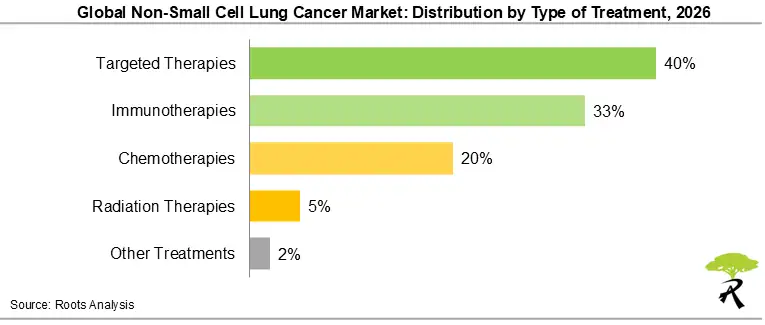
- There are various sub-segments of non-small cell lung cancer treatment market based on treatment, such as chemotherapy, radiation therapy, targeted therapy, immunotherapy and other treatments. According to our projection, targeted therapy accounts for the highest non-small cell lung cancer market share (~40%). The factors for highest share include high demands for tailored drugs with target specificity and low side effects during treatment.
- Driven by the increasing shift towards therapeutic modalities, such as immunocytokines and immune checkpoint inhibitors, the immunotherapy segment continues to grow at a higher CAGR during the forecast period.
Market Share by Route of Administration: Parenteral Route is the Preferred Route
- The global non-small cell lung cancer market is segmented based on route of administration into parenteral, oral and other routes of administration. Among these, currently the parenteral route of administration occupies the highest share of the market, as it surpasses the gastrointestinal lining and offers direct delivery of the market at targeted sites.
- In the long run, oral route is expected to grow at a higher CAGR during the forecast period, attributed to the ease of administration and preferences by the geriatric population.
Market Share by End User: Non-Small Cell Lung Cancer Drugs are Mostly Used in Hospitals
- Based on the end user, the global non-small cell lung cancer market is segmented into hospitals, homecare, specialty clinics and other end users. According to our projection, currently hospitals account for the highest share (~50%) of the overall market.
- In the long run, specialty clinics and homecare will show lucrative growth potential, growing at a higher CAGR during the forecast period, owing to the growing preferences for specialized and convenient treatment environment among patients.
Market Share by Distribution Channel: Hospital Pharmacies Dominate NSCLC Market
- This segment highlights the distribution of the global NSCLC market based on distribution channel into hospital pharmacies, drug and retail pharmacies, and online pharmacies. Among these distribution channels, hospital pharmacies currently dominate (>65%) the market, as hospital pharmacies are the primary distributors of therapies for non-small cell lung cancer.
- The drugstores and retail pharmacies will show lucrative growth potential and are expected to grow at a higher CAGR during the forecast period. This highest growth rate is primarily due to the increasing availability of the FDA approval drugs for patients with non-small cell lung cancer in drugstores and retail pharmacies.
Market Share by Geographical Regions: Asia-Pacific to Prosper in the NSCLC Sector in the Coming Years
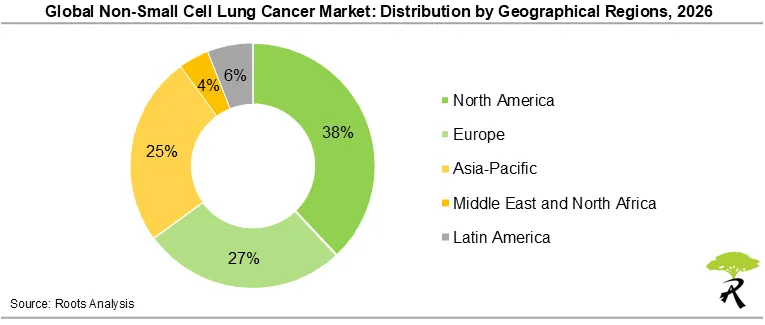
- This segment highlights the distribution of market for non-small cell lung cancer therapeutics across various geographies, such as North America, Europe, Asia-Pacific, Middle East and North Africa, and Latin America. According to our projections, North America is likely to capture the majority (~40%) of the non-small cell lung cancer market share in 2026, and this trend is unlikely to change in the future.
- It is worth highlighting that the market in Asia-Pacific is likely to grow at a relatively higher CAGR, during the forecast period. This lucrative growth potential is due to the growing smoking addiction among the population, which is the primary reason for non-small cell lung cancer, in this region. Notably, as per the World Health Organization, in Southeast Asia, lung carcinoma is the most common form of cancer mortality and the third commonly diagnosed carcinoma.
Non-Small Cell Lung Cancer Market: Report Deliverables
| Report Deliverables |
Details |
Excel Data Packs
(Complimentary) |
- Market Landscape
- Product Portfolio Competitiveness
- Key Market Insights
- Market Forecast and Opportunity Analysis
|
| Key Non-Small Cell Lung Cancer Drugs Profiled |
- Afatinib
- Atezolizumab
- AZD4547
- Cadi 05
- Camrelizumab
- Canakinumab
- Cemiplimab
- Ipilimumab
- KN046
- Necitumumab
- Niraparib
- Nivolumab
- Palbociclib
- Pembrolizumab
- Penpulimab
- Retifanlimab
- SCT-I10A
- Serplulimab
- Sintilimab
- Tislelizumab
- Toripalimab
- Zimberelimab
|
PowerPoint Presentation
(Complimentary) |
|
| Customization Scope |
|
Non-Small Cell Lung Cancer Market Major Takeaways
The “Non-Small Cell Lung Cancer Market: Industry Trends and Global Forecasts, till 2035” market report features an extensive study of the current market landscape, product portfolio competitiveness, key market insights related to clinical trials, partnerships and collaborations and KOL analysis, and market size and future opportunities within the non-small cell lung cancer industry, during the forecast period.
Competitive Landscape of Non-Small Cell Lung Cancer Drug Developers
Presently, several well-established players and new entrants possess the technical expertise to develop advanced therapeutics in the market landscape. In order to maintain a competitive edge, the active stakeholders are forging strategic collaborations, partnerships and acquisition agreements to enhance product portfolio, accelerating research on non-small cell lung cancer.
Companies, such as AstraZeneca, Roche, Pfizer Inc and Merck are among the top pharmaceutical companies who have made robust presence in developing therapeutic drugs for the patients with non-small cell lung cancer. BioNTech, the mRNA leader, also recently started phase I clinical trials for BNT116, its mRNA cancer vaccine targeting NSCLC. Overall, the non-small cell lung cancer market will continue to remain competitive, offering enormous opportunities for industry leaders to make significant investments.
Market Size Analysis: What is the Opportunity for the Non-Small Cell Lung Cancer Drugs?
The global non-small cell lung cancer market size is likely to be worth $26.4 billion in 2026 and will reach $ 56.0 billion by 2035. Amongst the different types of cancers, adenocarcinoma holds the largest share of the non-small cell lung cancer market, as the number of patients with adenocarcinoma is increasing and the availability of targeted therapies for the treatment of patients is limited. Notably, the risk factors associated with adenocarcinoma include genetic causes, hexavalent chromium, lung scarring and prolonged exposure to radiation. The market size for squamous cell carcinoma is likely to grow at a relatively higher CAGR during the forecast period.
Key Segment Analysis: Where Does the Opportunity Lie for Drug Developers?
Amongst all the forms of NSCLC cancer, squamous cell carcinoma is one of the common forms that may develop due to prolonged use of tobacco. The growing government initiatives to raise awareness about the risk factors of squamous cell carcinoma (including prolonged UV exposure) and extensive research and development (R&D) of therapeutic drugs for its treatment will contribute to the higher growth rate of this market segment during the forecast period.
Regional Analysis: Which Region Holds the Largest Share of the Non-Small Cell Lung Cancer Market?
North America is Leading the Market
North America will likely dominate the global NSCLC market in 2035, with nearly 55% of players based in the region. This necessitates a robust healthcare infrastructure with innovative diagnostic tools and treatment alternatives to address the high disease burden.
Asia-Pacific: An Emerging Growth Spot
Our in-house experts anticipate the market in Asia-Pacific to grow at a relatively high CAGR, during the forecast period till 2035. This is due to several factors, including increasing smoking addiction among the population, which is the primary reason for non-small cell lung cancer, in this region.
As per World Cancer Research Fund, China has the highest incidence of lung cancer across the globe, with more than 1 million people diagnosed each year. As the treatment landscape for NSCLC improves in the region, the market will witness significant growth. In April 2025, Akeso Bio announced National Medical Products Administration (NMPA) approval for ivonescimab as monotherapy for the first-line treatment of PD-L1-positive non-small cell lung cancer (NSCLC) in patients who are negative for epidermal growth factor receptor (EGFR) gene mutations and anaplastic lymphoma kinase (ALK) gene mutations.
What are the Key Drivers of Non-Small Cell Lung Cancer Market?
Currently, the rising incidence of cancer is a significant driver for the global non-small cell lung cancer market. This can primarily be because of the changing lifestyles and environmental factors, thus increasing the demand for early diagnosis and effective treatment monitoring.
It is worth mentioning that developers of non-small cell lung cancer drugs are employing various approaches to create more precise and effective treatments. These include targeted therapies, such as EGFR and ALK inhibitors, as well as advanced immunotherapies like immune checkpoint inhibitors. Together, these strategies are driving the development of highly targeted and effective medications for NSCLC.
The pipeline for NSCLC is rich with a number of anticipated approvals during the period 2025-2026. For instance, in February 2026, FDA granted accelerated approval to zongertinib (Hernexeos) by Boehringer Ingelheim for adults with unresectable or metastatic non-squamous non-small cell lung cancer harboring HER2 mutations. In addition to this, Boehringer Ingelheim’s Zongertinib, a novel HER2-selective tyrosine kinase inhibitor, received priority review from the FDA in February 2025 for the treatment of HER2 (ERBB2)-mutant advanced non-small cell lung cancer. Another drug, Dizal Pharmaceuticals’ Sunvozertinib was granted priority review by the FDA in January 2025 for treatment of patients with locally advanced or metastatic non–small cell lung cancer (NSCLC) who also have EGFR exon 20 insertion mutations (exon20ins) and whose disease has progressed on or after platinum-based chemotherapy.
Furthermore, advancements in cell therapies and immunotherapies for the treatment of non-small cell lung cancer are the key driver for the market. US-based Kiromic BioPharma is evaluating KB-GDT-01 (Deltacel), a T-cell therapy, in phase I/II clinical trials. The drug is an allogeneic cell therapy. It is important to highlight here that several government organizations have initiated funding and investments for cancer research.
Key Market Trends: Rising Focus on Combination Therapies and Advancements in Liquid Biopsy Technologies
Early diagnosis and advanced therapeutic treatments are the two factors that aid healthcare professionals to provide the desired treatment for lung carcinoma. In this context, various stakeholders have begun focusing on the advancements in liquid biopsy for early diagnosis and real-time monitoring of disease progression. Furthermore, the market leaders are emphasizing combination therapies with improved efficacy and minimal off-target effects, which has further fueled the non-small cell lung cancer market growth during the forecast period. Increasing partnerships and collaborations between industrial leaders for cancer research and drug development are the primary growth factors of the market.
Frequently Asked Questions
What is non-small cell lung cancer (NSCLC)?
NSCLC is a condition in which the normal cells of the lungs begin to grow out of control. It is the second most common type of lung cancer.How big is the NSCLC market?
The market size is expected to be USD 26.4 billion in 2026.What is the projected market size for non-small cell lung cancer treatment by 2035?
The NSCLC market size is expected to reach USD 56.0 billion by 2035.What is the CAGR of NSCLC market?
The global market for non-small cell lung cancer is likely to grow at a CAGR of 8.7% till 2035.Which region holds the largest non-small cell lung cancer treatment market share?
North America holds ~40% share of the market in 2026.What is the target for non-small cell lung cancer?
The primary targets for non-small cell lung cancer are specific genetic mutations and proteins that drive tumor growth and spread, including EGFR, ALK, ROS1, and KRAS.How prevalent is non-small cell lung cancer?
Most lung cancer statistics include both non-small cell lung cancer (NSCLC) and small cell lung cancer (SCLC). Overall, >85% of lung cancers are NSCLC, while about 15% are SCLC.Who are the leading players in NSCLC market?
Aurobindo Pharma, Bayer, CLOVIS ONCOLOGY, GSK, Johnson & Johnson, Eli Lilly, Lupin, Mylan, Merck, Novartis, Pfizer Inc, Roche, Sanofi, Sun Pharmaceutical and Teva Pharmaceutical.