Europe Aseptic Fill Finish Manufacturing Market
Europe Aseptic Fill Finish Manufacturing Market by Type of Molecule (Biologics and Small Molecules), Type of Biologic Manufactured (Antibodies, Cell Therapies, Gene Therapies, Oligonucleotides, Recombinant Proteins, Vaccines, and Other Biologics), Type of Packaging Container (Ampoules, Bags, Cartridges, Syringes, and Vials), Scale of Operation (Commercial and Preclinical / Clinical), Company Size, Type of Product, Therapeutic Area, and Country – Trends and Forecast 2026-2035
-
Lowest Price Guaranteed
-
Pages
256 -
Last Updated
November 2026 -
View Count
3132 -
Market Outlook
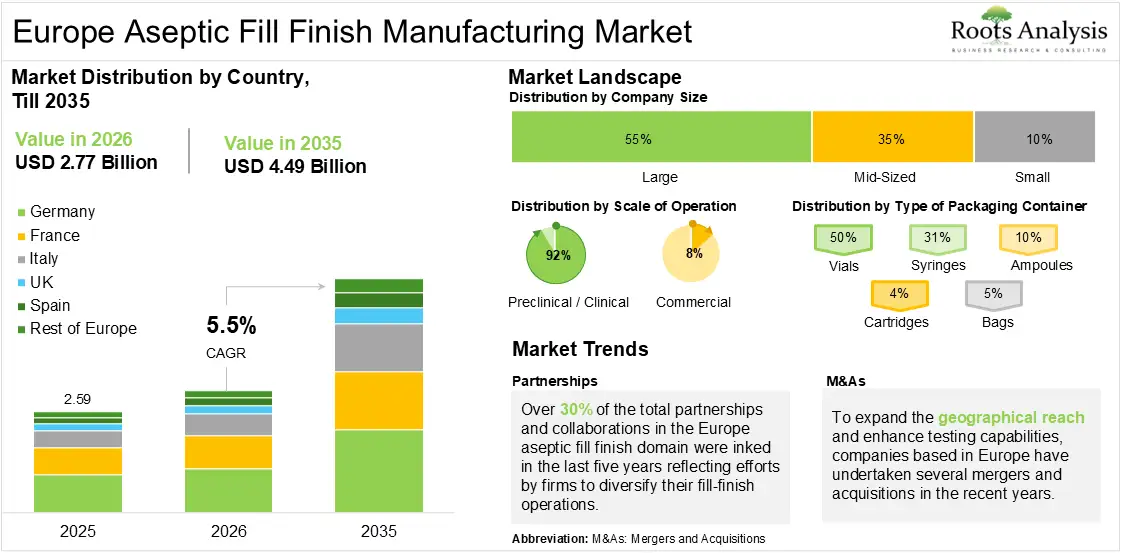
The Europe aseptic fill finish manufacturing market, valued at USD 2.59 billion in 2025, is projected to reach USD 2.77 billion in 2026 and USD 4.49 billion by 2035, representing a CAGR of 5.5% during the forecast period 2026 to 2035.
To learn more about this report, request a free sample copy
Market Report: Key Takeaways
Market Size & Trends
- The biologics segment is expected to hold the largest share of the Europe aseptic fill finish manufacturing market by molecule type.
- The antibodies segment represents both the leading and fastest-growing category among types of biologics manufactured.
- Vials account for the dominant share by packaging container type, owing to their versatility for both liquid and lyophilized drug products.
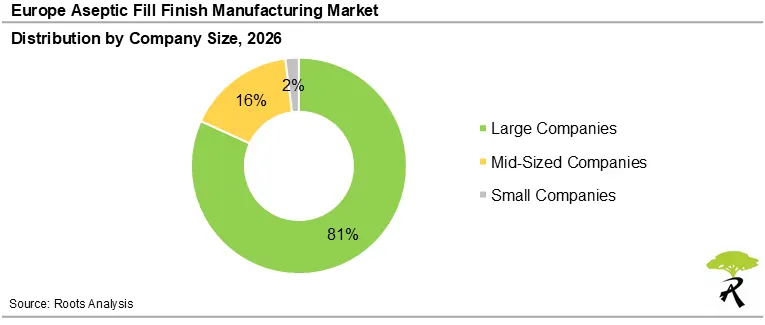
- Large companies account for the leading share in the current market, reflecting the capital investment and quality-system requirements associated with sterile manufacturing.
- Commercial operations hold the leading share and are expected to register the fastest growth during the forecast period, driven by recurring manufacturing requirements for approved products.
- Branded products hold the largest share of the current market and are expected to witness the fastest growth within the approved product classification during the forecast period.
- Oncological disorders represent the leading therapeutic area, supported by the growing demand for injectable therapies and specialized handling requirements.
- Germany represents the leading market and is also expected to register the fastest CAGR, supported by its strong pharmaceutical manufacturing base, established CDMO ecosystem, and concentration of sterile manufacturing capabilities.
Key Market Statistics
- Market Size in 2026: $2.77 Billion
- Estimated Market Size in 2035: $4.49 Billion
- CAGR (2026-2035): 5.5%
- Germany: Largest market in 2026
Market Introduction
Aseptic fill finish manufacturing covers the final drug-product operations used to place sterile medicines into containers such as vials, prefilled syringes, cartridges, ampoules and bags while maintaining sterility through filling and closure. Activities can include formulation, sterile filtration, aseptic filling, lyophilization, inspection and packaging.
The market growth is supported by the increasing need to convert sensitive drug substances into sterile, patient-ready presentations. Monoclonal antibodies, recombinant proteins, vaccines, and selected advanced therapies require product-specific filling processes, stringent contamination controls, analytical testing, and suitable primary packaging. As development programs progress toward commercial supply, they can generate recurring manufacturing campaigns, while lifecycle initiatives, such as introducing new syringe or cartridge presentations, may create additional formulation, filling, assembly, and validation requirements.
Investment in European manufacturing capacity is also being driven by rising contamination-control expectations and the need to strengthen regional supply resilience. FUJIFILM Biotechnologies is expanding integrated drug-substance, drug-product, and finished-goods capabilities in Hillerød, Denmark. These investments indicate future regional capacity; however, announced or under-construction facilities should not be interpreted as current commercial manufacturing output.
Market Segmentation
Based on the research, we have segmented the Europe aseptic fill finish manufacturing market into type of molecule, type of biologic manufactured, type of packaging container, scale of operation, company size, type of product, therapeutic area, and countries.
- By Type of Molecule: Biologics and Small Molecules
- By Type of Biologic Manufactured: Antibodies, Cell Therapies, Gene Therapies, Oligonucleotides, Recombinant Proteins, Vaccines, and Other Biologics
- By Type of Packaging Container: Ampoules, Bags, Cartridges, Syringes, and Vials
- By Scale of Operation: Commercial and Preclinical / Clinical
- By Company Size: Large, Mid-sized, and Small
- By Type of Product: Branded Products and Generic Products
- By Therapeutic Area: Autoimmune Disorders, Cardiovascular Disorders, Genetic Disorders, Infectious Diseases, Metabolic Disorders, Neurological Disorders, Oncological Disorders, and Other Disorders
- By Geography: France, Germany, Italy, UK, Spain, and Rest of Europe
Europe Aseptic Fill Finish Manufacturing Market: Key Insights
What Are the Key Growth Drivers of the Europe Aseptic Fill Finish Manufacturing Market?
- Expanding Biologics and Complex Injectable Pipelines are Raising Sterile Manufacturing Requirements: European drug pipelines increasingly include antibodies, biosimilars, advanced therapies and complex injectable products that require careful formulation, filtration, filling, inspection and cold-chain management. EMA recommended 104 medicines for marketing authorisation in 2025, including 38 with new active substances and 41 biosimilar recommendations, illustrating continued pharmaceutical development activity across Europe. IDT Biologika provides aseptic filling for vaccines and biologics, while Lonza is expanding commercial drug-product capacity specifically for ADCs in Switzerland. These modalities create demand not only for filling capacity but also for specialized development, containment, lyophilization and technology-transfer expertise, increasing the commercial value of each outsourced manufacturing program.
- Annex 1 Compliance is Accelerating Investment in Isolators and Reduced-Intervention Manufacturing: The revised EU GMP Annex 1 is fully applicable and places heightened emphasis on contamination-control strategy and sterile manufacturing design. The regulatory environment is encouraging investment in isolators, barrier systems, automation and modern facility layouts. Upperton received MHRA authorization in September 2026 for its Annex 1-aligned Nottingham sterile facility, which uses Grade A isolator environments and vaporized hydrogen peroxide bio-decontamination. Simtra's expanded German site likewise incorporates isolator-based PFS and vial lines. These investments create replacement and outsourcing demand because sponsors increasingly need manufacturing partners with facilities already designed around current sterility-assurance expectations rather than retrofitted legacy workflows.
- Commercial Capacity Expansion is Strengthening Europe's Role in Global Injectable Supply: European CDMOs continue to commit substantial capital to commercial-scale sterile capacity. Vetter plans ten additional filling lines by 2032, including additional aseptic lines at existing sites and its new Saarlouis facility. CordenPharma announced an EUR 80 million expansion in Caponago designed to increase overall sterile injectable capacity toward 500 million units annually. Delpharm is also increasing vial capacity across its sterile network. These investments allow pharmaceutical companies to outsource larger late-stage and commercial programs without necessarily constructing dedicated facilities. Greater format flexibility and regional redundancy can also support second-source strategies, creating additional demand for manufacturers that combine technical depth with validated high-volume capacity.
What are the Main Challenges for Growth in Europe Aseptic Fill Finish Manufacturing Market?
- Annex 1 Compliance Raises the Technical and Operating Threshold for Sterile Facilities: EU GMP Annex 1 establishes stringent expectations for sterile-product manufacturing, increasing the importance of contamination-control strategies, facility design and validated aseptic processes. Compliance can require significant upgrades to barrier technology, environmental monitoring, process simulation, operator controls and documentation. Annex 1 states that the use of RABS or isolators should be considered within the contamination-control strategy and alternative approaches justified. These requirements improve sterility assurance but increase capital spending, validation workload and specialist staffing needs. Manufacturers must continually upgrade facilities and quality systems while avoiding extended shutdowns or capacity losses during implementation.
- Complex Molecules Increase Technology-Transfer and Manufacturing Risk: Drug-product manufacturing becomes more difficult as portfolios expand into high-concentration antibodies, ADCs, viral-vector products and other sensitive modalities. These products can require specialized containment, cold handling, lyophilization or narrow filling conditions. Symbiosis emphasizes that rapid, smooth technology transfer and access to appropriate drug-product manufacturing slots have become important requirements for pharmaceutical and biotechnology companies. BSP Pharmaceuticals operates dedicated manufacturing systems for ADC conjugation and sterile fill finish, illustrating how specialized processes differ from conventional injectable production. CDMOs must therefore develop experienced technical-transfer teams, adaptable equipment and formulation knowledge that can move programs between clinical and commercial scale without introducing unnecessary process changes.
- New Aseptic Capacity Requires High Capital Spending and Long Lead Times: Capacity expansion is expensive because sterile facilities require specialized cleanrooms, utilities, filling equipment, barrier technologies and extensive qualification before routine production can begin. CordenPharma's Italian expansion exceeds EUR 80 million, while Simtra invested approximately USD 100 million in additional German PFS and vial manufacturing capacity. Vetter's phased program extends through 2032, illustrating how capacity development can span multiple years. These timelines create a mismatch between rapidly changing sponsor pipelines and slower infrastructure deployment. Manufacturers must therefore forecast demand carefully, preserve adaptable capacity and secure sufficient utilization to justify investments without creating new bottlenecks in high-demand formats.
Recent Developments in Europe Aseptic Fill Finish Manufacturing Market
- In September 2026, CordenPharma announced an €80 million multi-year expansion of its Caponago, Italy, sterile injectable facility. The investment includes new manufacturing space and additional aseptic fill finish lines, with site capacity expected to reach up to 500 million injectable units annually.
- In August 2026, Delpharm announced a new aseptic filling line at its Saint-Rémy facility in France, alongside investments in sterile liquid and powder vial manufacturing. The company stated that the Saint-Rémy expansion, together with modernization of its Boucherville site in Canada, would increase the group's sterile-vial capacity to up to 100 million vials annually.
- In August 2026, Siegfried reported continued progress on its fill finish expansion at the Hameln, Germany, facility. The investment is focused on targeted technology upgrades to expand manufacturing capabilities in response to growing customer demand.
Industry Experts on Europe Aseptic Fill Finish Manufacturing Market
The European aseptic fill finish market is witnessing continued investment in sterile injectable capacity, particularly for complex modalities and high-volume commercial manufacturing.
Commenting on the €80 million investment to expand its Caponago, Italy facility, adding new aseptic fill finish lines and increasing total injectable capacity to up to 500 million units annually, Dr. Michael Quirmbach, President & CEO of CordenPharma Group, stated "This strategic investment strengthens our leadership in the manufacture of drug products using complex modalities and enhances our end-to-end supply capabilities to meet rising global demand for injectable outsourcing, ultimately enabling partners to bring vital drug products in key therapeutic areas to patients more efficiently."
Detailed transcripts were prepared from discussions with senior stakeholders across the aseptic fill-finish manufacturing value chain, including chief executives and business, commercial, formulation-development and technology leaders.
- Ex-Chief Commercial Officer, Large Company, Germany
- Ex-Vice President Business Development & Marketing, Mid-sized Company, US
- Vice President and Head of Formulation Development, Very Large Company, India
- Head of Business Development, Mid-sized Company, Czech Republic
- Ex-Technology Watch Manager, Mid-sized Company, France
- International Business Developer, Mid-sized Company, Netherlands
Market Share Insights
Which Type of Packaging Container Accounts for the Largest Share of the Europe Aseptic Fill Finish Manufacturing Market?
Vials account for the leading share of the Europe aseptic fill finish manufacturing market, supported by their suitability for liquid and lyophilized formulations across a broad range of fill volumes. Their versatility enables use across clinical and commercial production.
Which Company Size is Leading the Europe Aseptic Fill Finish Manufacturing Market?
Large companies are expected to account for the largest share and fastest CAGR in the Europe aseptic fill finish manufacturing market, supported by their ability to invest in capital-intensive sterile facilities, quality systems, and specialized personnel. Their established customer base and financing capacity also support capacity expansion and integrated manufacturing services.
Which Type of Product Leads the Market?
Branded products are expected to account for the largest share and fastest CAGR in the Europe aseptic fill finish manufacturing market, supported by the manufacturing complexity of originator injectable therapies and their formulation, stability, and validation requirements. The segment growth is further supported by new therapies and additional presentations entering commercial production.
Which Scale of Operation Leads the Europe Aseptic Fill Finish Manufacturing Market?
Commercial operations are expected to account for the largest share and fastest CAGR, supported by recurring manufacturing requirements for marketed products, including scheduled production, consistent quality specifications, and reliable supply replenishment. Growth is further driven by the transition of products from development to commercialization and the expansion and qualification of additional manufacturing capacity.
Country Analysis: Europe's Leading Aseptic Fill Finish Manufacturing Markets
Germany Is Expected to Lead the Market by 2035
Germany is expected to account for the largest share and register the fastest CAGR in the Europe aseptic fill finish manufacturing market, supported by its strong pharmaceutical and biotechnology manufacturing base, established CDMO ecosystem, and concentration of sterile manufacturing capabilities. Continued investments in fill finish facilities are expected to further support growth.
Key Players Profiled in Europe Aseptic Fill Finish Manufacturing Market
The key players that have been profiled in the Europe aseptic fill finish manufacturing market includes Vetter Pharma, Lonza, Delpharm, Boehringer Ingelheim BioXcellence, Fresenius Kabi, and Aenova.
Report Deliverables and Customization
The report includes complimentary Excel data packs covering market landscape analysis, company competitiveness, partnerships and collaborations, recent expansions, capacity analysis, demand analysis, market impact analysis, value chain analysis, and market sizing and forecast analysis. A complimentary PowerPoint presentation is available, and up to 15% customization can be requested subject to data availability.
Report Authorship
Author(s): Simriti Gupta and Pemba Lahmo. Both authors contribute to Roots Analysis's healthcare and pharma research practice, covering biologics discovery, development, and manufacturing market studies.
Independence and Non-Affiliation
This report is an independent work of market research and analysis published by Roots Analysis. It is not affiliated with, sponsored by, endorsed by, or reviewed by Novo Nordisk, AstraZeneca, Sanofi, Merck KGaA, or any other pharmaceutical company, drug brand, or regulatory body referenced within it. No content in this report should be construed as medical advice. Roots Analysis maintains its own proprietary primary research process, and does not receive compensation from any company profiled within the report, in exchange for inclusion or favorable characterization.